 Skip to content

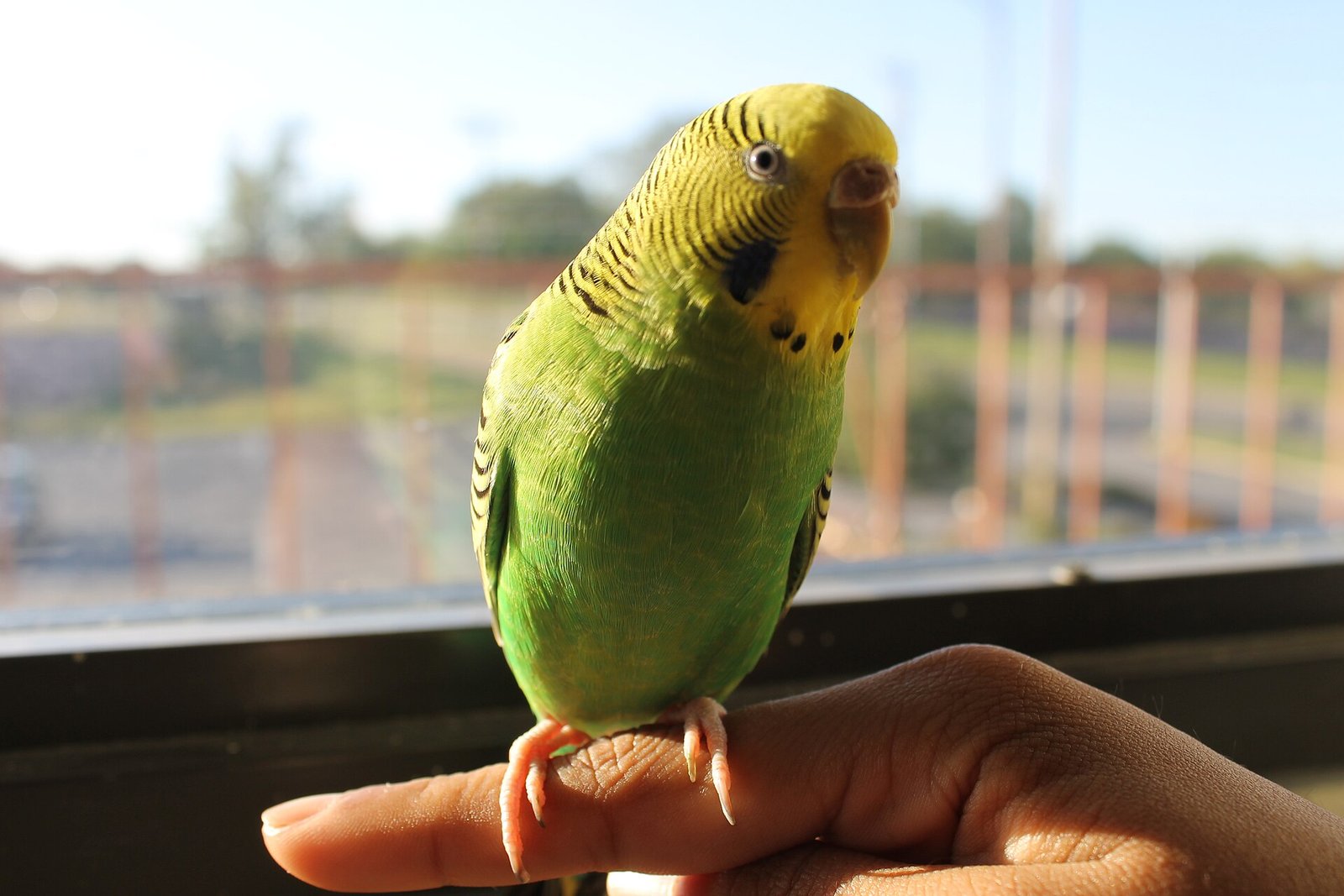
The short answer: if you want to know how to tame a budgie, let it settle 3 to 5 days, sit near the cage 15 to 20 minutes daily, rest a still hand inside the cage, offer millet spray as a training reward, and teach step-up. Keep sessions to 5 to 10 minutes, 2 to 3 times daily, and let the bird set the pace.
So you just brought home a budgie, and you want to know how to tame a budgie the right way. Good news: budgies are among the friendliest small parrots you can keep, and most will learn to perch on your finger, take treats from your hand, and even follow you around the room. The less convenient news is that none of this happens on day one.
Taming a budgie is a gradual trust process, not a single event. Your new bird sees your hand the way you would see a giant stranger reaching into your bedroom. Every step in this guide is designed to change that perception slowly, from “that hand is scary” to “that hand brings millet and good things.” Follow the steps in order, keep sessions short and positive, and you will be amazed how far patience takes you. If this is your first pet bird, read our step-by-step bird care tips for first-time bird owners alongside this guide.

How to Tame a Budgie: What “Taming” Really Means
To tame a budgie means teaching it that people, and especially your hands, are safe. A tame budgie steps onto a finger without panic, accepts treats from your palm, and stays calm when you move slowly around it. It does not mean the bird obeys commands like a dog, and it does not mean the bird will never get startled. Taming is trust, and trust is built in small daily deposits, never in one big gesture. Learning how to tame a budgie starts with seeing the process through your bird’s eyes.
Budgies are flock animals. In the wild, budgerigars live in large Australian flocks where safety comes from the group. Your goal is to become part of your budgie’s flock. That is why rushing, grabbing, or forcing contact backfires: a predator grabs, a flock mate never does. Understanding this flock instinct is the foundation of how to tame a budgie: you want to become flock, not predator.
Setting Up for Budgie Trust Building
Budgie trust building starts before your hand ever enters the cage. A calm environment and the right supplies make every later step easier. A calm, well-planned setup makes learning how to tame a budgie much easier.
Give your budgie a safe, calm home
Place the cage in a lived-in room where the bird can watch daily life, but away from loud speakers, kitchens with nonstick cookware fumes, and high-traffic doorways. Keep a consistent daily routine for feeding and cleaning, because predictability is the foundation of trust. Cover part of the cage at night so the bird gets 10 to 12 hours of quiet, dark sleep. A well-rested budgie learns faster and bites less.
Gather your training supplies
You need very little to start taming a budgie. Keep these ready:
Millet spray: the gold-standard motivator for budgie hand training. Buy plain spray millet with no added flavoring. Small treat cup or clip: for offering millet through the cage bars in the early stages. A quiet chair: so you can sit at cage level during passive bonding sessions. Patience: the most important supply, and the one beginners run out of first. For everyday nutrition beyond training treats, see this budgie food and care guide.
How to Tame a Budgie: Taming a Budgie Step by Step
This is the heart of learning how to tame a budgie. Work through the steps in order, and do not move on until your bird is relaxed at the current step. Some budgies progress in days, others need weeks. Let the bird set the pace.
Step 1: Let Your New Budgie Settle (Days 1 to 5)
For the first 3 to 5 days, do not try to handle your budgie at all. Change food and water on a calm, predictable schedule, clean the cage gently, and speak softly when you are near. Many new budgies sit frozen on a perch, puffed up and silent. That is normal. They are mapping their new territory and deciding whether anything here is dangerous. Your job in this phase is simple: be the calm, predictable person who brings food and never grabs.
Step 2: Be Present Without Pressuring
Once your budgie is eating, drinking, and chirping normally, begin passive bonding. Spend 15 to 20 minutes a day sitting near the cage. Read aloud, work quietly on a laptop, or hum. The point is to pair your voice and presence with safety. Budgies are drawn to gentle, rhythmic sound, and many will start chirping along or grinding their beaks, a soft clicking that signals contentment. Do this for several days. You are teaching the bird that you are background, not a threat.
Step 3: Introduce Your Hand With the Stationary Hand Method
Hands are the scary part, so introduce yours in stages over several days:
Hand beside the cage: rest your hand on a table next to the cage for a few minutes while you sit nearby. Hand on the cage: place your hand flat against the outside of the bars. Hand inside the cage: open the door and rest your hand just inside, palm up, perfectly still.
At each stage, wait until the bird returns to normal behavior, eating, preening, chirping, before advancing. Never reach toward the bird or wiggle your fingers. Let curiosity do the work. A budgie that hops over to inspect your hand on its own has taken the biggest step in the whole process.
Step 4: Budgie Hand Training With Treats
Now turn your hand into the source of the best food in the bird’s life. Hold a piece of millet spray through the cage bars so the budgie can nibble the far end while your hand stays outside. After a day or two of this, hold the millet from your open palm inside the cage, and gradually shorten the piece so the bird must step closer to your fingers to reach it.
One rule makes all the difference here: reserve millet as a training-only reward. If millet hangs in the cage all day, it becomes boring background food. If it appears only when your hand appears, your hand becomes the most interesting thing in the bird’s world.
Step 5: Teach the Step-Up
Step-up is the foundation skill of all budgie hand training. With the bird perched and calm, offer your index finger horizontally and gently press it against the lower belly, just above the feet, while saying “step up” or “up” in a warm, consistent tone. The light pressure unbalances the bird slightly, and stepping onto your finger becomes the natural way to regain balance. The instant both feet land on your finger, reward with a nibble of millet and soft praise.
Practice in short sessions of 5 to 10 minutes, 2 to 3 times a day, and always end on a success, even if that success is just one calm step-up. If the bird flies off or nips, do not chase or scold. Simply try again later. Positive reinforcement only: no grabbing, no punishment, no yelling, ever.
Step 6: First Out-of-Cage Time
Only open the door to the wider world once step-up is reliable inside the cage. Choose a small, bird-safe room: windows and mirrors covered so the bird does not fly into them, ceiling fans off, doors and windows closed, other pets out of the room. Let the budgie come out on its own rather than pulling it out. Keep the first outings short, stay seated and calm, and use step-up plus millet to guide the bird back. Returning to the cage should always feel like a good decision, so reward it.

How to Bond With a Parakeet Beyond the Hand
Hand training gets your budgie onto your finger, but real bonding is what keeps it there happily. Once step-up is solid, deepen the relationship with shared routines. Talk to your budgie throughout the day using the same cheerful phrases, and you will notice it starting to mimic your tone and rhythm. Many tame budgies love riding on a shoulder while you walk around the house, preening while you read, or playing with simple toys like bells and shreddable paper while you watch.
Budgies also bond through gentle play. Offer a finger for beak wrestling (light, playful nibbling, not hard biting), let the bird explore a safe play gym near you, and whistle short tunes it can learn. If speech interests you, a trusting budgie is the best student: our realistic guide to teaching a parakeet to talk explains what to expect. The theme stays the same: your presence should predict good things, every single day.
Reading Your Budgie’s Body Language
Your budgie is always telling you how it feels. Learning to read these signals is what separates patient taming from accidental bullying. If you see fear signals, back off to the previous step. If you see comfort signals, you are on the right track.
| Signal | Comfort: keep going | Fear or stress: back off |
|---|---|---|
| Posture | Relaxed, feathers smooth, standing on one foot | Feathers flattened tight, crouching low on the perch |
| Movement | Preening, stretching a wing, hopping toward you | Frantic fluttering, pressing into the cage corner, rapid breathing |
| Eyes and beak | Slow blinking, relaxed beak | Eyes pinning (pupils rapidly dilating), open-beak lunging |
| Around your hand | Steps closer, nibbles treats calmly | Freezes, then bolts; hard bites when cornered |
| Sounds | Soft chirping, chattering, beak grinding | Sharp alarm calls, hissing, sudden total silence |
A light exploratory nibble is normal curiosity, especially in young birds. A hard bite that breaks skin is communication: “I am scared, give me space.” Never punish a bite. Punishment teaches the bird that hands bring pain, which is the exact opposite of your goal. Learning to read these cues is a key skill in how to tame a budgie gently.
Your Budgie Bonding Guide to Mistakes Worth Avoiding
Most taming failures come from a short list of avoidable errors. Check yourself against these:
Chasing the bird around the cage: every chase teaches your budgie that you are a predator. If it flies off your hand, wait and invite it back with millet. Skipping the settle-in period: handling on day one almost guarantees a fearful first impression that takes weeks to undo. Training when the bird is tired or hungry: train between meals, not at bedtime, and keep the room calm. Moving too fast between steps: if the bird is not relaxed at the current step, you are not ready for the next one. Inconsistent sessions: ten minutes daily beats one long session on weekends. Trust is built by routine. Forcing out-of-cage time: a bird that will not step up inside the cage is not ready for the living room. Letting others rush the bird: ask family members to follow the same slow steps, especially children.
How Long Does It Take to Tame a Budgie?
Most hand-fed baby budgies become finger-tame within 1 to 3 weeks of consistent daily sessions. Pet store budgies with little human contact often take 4 to 8 weeks, and some shy or older birds need several months. These are ranges, not promises. Progress depends on the bird’s age, history, personality, and how consistently you train. A budgie that takes two months to trust you is not failing: it is learning at its own speed, and the bond you build slowly is usually the strongest one. Every owner learning how to tame a budgie moves at their bird’s pace.
Track progress by milestones, not days: first takes millet through the bars, first steps onto the palm, first step-up, first out-of-cage return. Celebrate each one, because each one is proof the method is working.

Frequently Asked Questions
How do I tame a budgie that is scared of hands?
Go back to the stationary hand method and stay there longer. Rest your hand near the cage during passive bonding sessions, then on the cage, then just inside the door, advancing only when the bird stays relaxed. Pair every hand appearance with millet. Fear of hands usually comes from being grabbed in the past, and the only cure is many repetitions of hands doing nothing scary.
Can you tame an adult budgie, or only babies?
You can tame a budgie at any age. Babies tame faster because they have fewer bad experiences, but adult budgies bond deeply too. Older birds simply need more patience at each step, especially hand introduction. Never assume an adult bird is “too old to tame.” The steps for how to tame a budgie stay the same whatever their age.
My budgie bites when I offer my hand. What should I do?
First, check whether it is a curious nibble or a fear bite. Nibbles are gentle and exploratory: stay still and let the bird investigate. Hard bites mean you moved too fast: return to an earlier step and rebuild. Do not pull away sharply, yell, or flick the beak, since sudden reactions confirm that hands are unpredictable. Calm, boring consistency wins.
Should I get one budgie or two if I want a tame bird?
One budgie usually bonds with its owner faster, because you become its flock. Two budgies often bond more strongly with each other and may show less interest in people. That said, a pair can still be tamed with individual training sessions. If companionship for the bird matters most to you, two is kinder; if a close human bond is the priority, start with one.
Is it okay to wear gloves when handling my budgie?
Avoid gloves. Budgies find them frightening, and a bird tamed to a glove is not tame to your hand. If you are nervous about bites, remember that a relaxed budgie rarely bites hard. Work at the bird’s pace and the fear, on both sides, fades.
Can a tame budgie learn to talk?
Yes. Male budgies in particular can learn dozens of words, and taming comes first because a frightened bird will not mimic speech. Once your budgie is hand-tame and chatters around you, short daily speech sessions work well. Still deciding on the right species for your home? Our conure vs parakeet comparison can help you choose.
The Bottom Line
Taming a budgie is one of the most rewarding projects a bird owner can take on. Give your bird a few quiet days to settle, show up daily with a calm voice and a still hand, let millet spray do the persuading, and teach step-up one short session at a time. Read the body language, respect the fear signals, and never rush. Do that consistently, and the day your budgie flies to your shoulder on its own, you will know exactly what all that patience bought. Stick with it, and you’ll soon know exactly how to tame a budgie the gentle way.





