

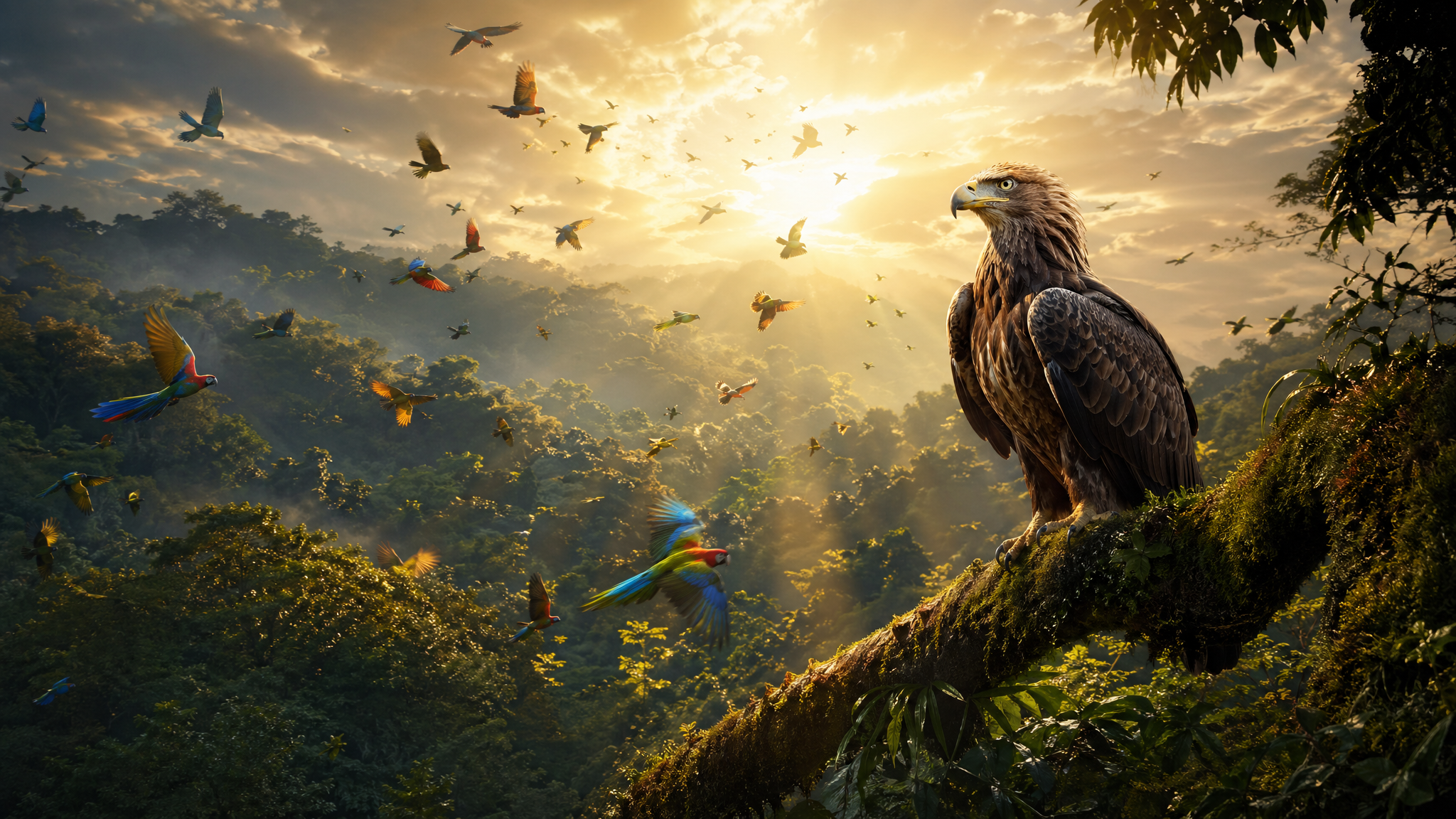
The morning chorus is fading. Across meadows, forests, and wetlands, the skies that once hummed with birdsong are growing quieter, and that silence should alarm every one of us.
Bird conservation matters not as an abstract cause reserved for naturalists and birdwatchers, but as one of the most urgent environmental imperatives of our time.
Birds are vanishing at a pace that would have seemed unthinkable just a few decades ago, and their disappearance is dragging entire ecosystems toward collapse.
Understanding why birds are important, and why we are losing them so rapidly, is the first step toward turning this crisis around.
Table of Contents
The Alarming Numbers Behind the Silence

Let’s begin with a number that should stop you cold: 3 billion.
That is how many birds North America has lost since 1970. Not 3 million. Not 30 million. Three billion individual birds, sparrows, warblers, swallows, thrushes, simply gone from the skies in a single human lifetime. Globally, the picture is equally grim:
- Nearly half of all bird species are experiencing decreasing populations
- Roughly 13% are now threatened with extinction
- Grassland birds like the bobolink and eastern meadowlark have lost over 70% of their populations
- Seabird colonies around the world are collapsing due to overfishing and ocean pollution
These are not statistics about distant, exotic creatures. The birds disappearing include common backyard visitors, such as the house sparrow, the meadowlark, and the chimney swift.
So familiar we stopped noticing them until they were gone. Bird conservation matters precisely because this loss is happening everywhere, silently and rapidly, right outside our windows.
Birds as Nature’s Early Warning System

Long before scientists had satellites and air quality monitors, miners carried canaries into coal mines. If the canary stopped singing, the miners knew toxic gas was present, and they evacuated.
Birds have always been nature’s most sensitive instruments, exquisitely tuned to environmental conditions that human senses cannot detect.
Today, birds serve the same function on a planetary scale. They are among the most reliable environmental early warning systems we have.
A decline in bird populations almost always signals something deeply wrong with the ecosystem, habitat loss, pesticide contamination, water pollution, or climate disruption, often long before those problems register in human health data.
- When insect-eating birds vanish from agricultural landscapes, it warns us that insecticide use has reached toxic levels
- When seabirds begin laying thin-shelled eggs or failing to reproduce, it alerts researchers to chemical contamination in marine food chains
- When migratory birds arrive weeks earlier or later than historical records, they are broadcasting the reality of climate change with a precision no political speech can match
This is one of the most compelling reasons why bird conservation matters: protecting birds means protecting the entire environmental monitoring network that nature has built over millions of years of evolution.
What Do Birds Do? The Ecological Services We Cannot Replace?

Ask most people what do birds do, and they will mention singing, flying, and looking beautiful. The honest ecological answer is far more staggering.
Natural Pest Control
Birds consume an estimated 400 to 500 million metric tons of insects annually worldwide. For farmers, this represents an incalculable economic benefit:
- A single barn swallow can consume more than 800 insects per day
- Colonies of purple martins and cliff swallows suppress mosquito and agricultural pest populations across entire regions
- Insectivorous birds protect crops from locusts, aphids, caterpillars, and beetles without a single drop of chemical spray
This is why birds are important to humans in the most direct economic sense. They provide a free, self-sustaining pest-control service that agriculture depends on. Replacing them with pesticides, even partially, would cost billions of dollars annually and create toxic side effects far worse than the problem they solve.
Seed Dispersal and Forest Regeneration
Birds are the world’s most prolific gardeners. Frugivorous birds, those that eat fruit, disperse seeds across vast distances, often depositing them in nutrient-rich droppings far from parent plants:
- Jays alone bury tens of thousands of acorns each autumn, forgetting many and effectively planting entire oak forests
- Toucans, hornbills, and pigeons in tropical regions disperse the seeds of trees that form the backbone of rainforest ecosystems
- Some tree species are so dependent on birds for reproduction that their populations cannot regenerate without them
When we ask why birds are important to the ecosystem, seed dispersal ranks near the top of the list of reasons. Lose the birds, and you lose the forests. Lose the forests, and you lose everything they provide, clean air, clean water, climate regulation, and habitat for countless other species.
Pollination
While bees rightly receive most of the credit for pollination, birds, particularly hummingbirds, sunbirds, and honeyeaters, pollinate thousands of plant species worldwide.
Many tropical flowering plants have co-evolved specifically with bird pollinators, developing tubular flowers perfectly shaped for long, curved beaks. Remove the birds, and these plants cannot reproduce.
Scavenging and Disease Control
Vultures and other scavengers perform a service that is easy to overlook yet impossible to overvalue: they dispose of carcasses, helping prevent the spread of diseases such as anthrax, botulism, and rabies. I
n regions of South Asia where vulture populations collapsed due to veterinary drug contamination, feral dog populations exploded to fill the niche, bringing a surge in rabies and other zoonotic diseases.
The cost, measured in human lives and healthcare spending, was catastrophic. It was a brutal lesson in how do birds help the environment, and what happens when they cannot.
The Threats Accelerating the Crisis

Understanding the importance of birds is only half the story. The other half is understanding why they are disappearing so fast and why the pace is accelerating.
Habitat Loss
Urban expansion, industrial agriculture, and deforestation are eliminating the nesting grounds, feeding areas, and migration stopover points that birds depend on. Key drivers include:
- Conversion of native grasslands to monoculture farms and housing developments
- Draining of wetlands that serve as critical refueling stops for migratory species
- Logging of old-growth forests that provide irreplaceable nesting cavities
- Coastal development destroying shorebird breeding beaches and tidal feeding flats
Climate Change
Climate change is reshuffling the timing of seasons faster than many bird species can adapt:
- Migratory birds arrive on their ancient schedules to find that insect hatches have already peaked
- Breeding birds experience mismatches between egg hatching and food availability
- Arctic and alpine species are running out of cold habitat as temperatures rise
For many species, climate change is not a future threat. It is already pushing them toward the edge.
Domestic Cats
This is the statistic most people find shocking: domestic and feral cats kill an estimated 2 billion birds annually in the United States alone.
Cats are among the single greatest human-linked causes of bird mortality, surpassing even window strikes and vehicle collisions.
It is an uncomfortable truth for cat lovers, but addressing it through responsible pet ownership and feral cat management is among the most direct actions ordinary people can take to protect bird populations.
Pesticides and Pollution
- Neonicotinoid pesticides impair bird navigation, reduce body mass in migratory species, and cause reproductive failure
- Light pollution confuses night-migrating birds, drawing them toward cities where they collide with buildings
- Plastic pollution entangles seabirds and fills their stomachs with indigestible material
- Oil spills coat the feathers of diving birds, stripping them of insulation and buoyancy
Why Birds Matter to Human Well-Being
The question why do we need birds has a psychological answer as well as an ecological one.
Decades of research have established that exposure to birdsong and the presence of birds in urban and suburban environments provides measurable mental health benefits:
- People living in neighborhoods with more birds report lower levels of depression, anxiety, and stress
- The effect is comparable in magnitude to those seen with meaningful increases in income
- Birdwatching improves attention, reduces cortisol levels, and promotes mindfulness
- Hospital patients with views of trees and birds recover faster than those without
Birdwatching has emerged as one of the fastest-growing recreational activities globally, with millions of people reporting that it grounds them, sharpens their attention, and connects them to something larger than their daily routines.
In an era of escalating mental health crises, the importance of birds to human psychological health is not a soft benefit. It is a public health consideration.
The Economic Case for Bird Conservation
Bird conservation matters economically in ways that often surprise people:
- Birders in the United States alone spend over $41 billion annually on equipment, travel, and related expenses
- Wildlife tourism anchored by bird species supports hundreds of thousands of jobs in hospitality, guiding, and retail
- The pest control services provided by birds to agriculture are valued at tens of billions of dollars annually
- Pollination and seed dispersal services add further economic value that, because it is provided freely by nature, rarely appears on any balance sheet until it disappears
What Bird Conservation Looks Like in Practice
Knowing that bird conservation matters is one thing. Understanding what effective conservation looks like is another.
Habitat protection and restoration remain the foundation. Preserving old-growth forests, restoring native grasslands, protecting wetlands, and creating urban green corridors all provide the habitat birds need to feed, breed, and migrate safely.
Reducing pesticide use, particularly neonicotinoids, and transitioning to bird-friendly agricultural practices protects both birds and the insects they depend on.
Making homes and buildings bird-safe through the use of patterned glass, reduced nighttime lighting, and responsible cat ownership helps address some of the most preventable sources of bird mortality.
Supporting citizen science through programs such as the Audubon Christmas Bird Count, eBird, and local breeding bird surveys provides scientists with the data they need to track population trends and direct conservation resources effectively.
Advocating for strong environmental policy, protecting the Migratory Bird Treaty Act, funding wildlife corridors, and integrating bird-friendly standards into land-use planning ensures that individual actions are backed by systemic change.
A World Worth Saving
There is a moment familiar to almost anyone who has paused long enough to notice. A flash of red at the feeder on a grey winter morning, the liquid pour of a wood thrush’s song through evening forest. The improbable sight of thousands of sandpipers turning in unison above a coastal mudflat. I
n those moments, the question what the purpose of birds is dissolves. They don’t exist to serve a purpose. They exist, as we do, as expressions of life’s extraordinary complexity.
But they are also, undeniably, essential. They hold ecosystems together. They warn us when something is wrong. They feed our crops, plant our forests, clean our landscapes, and steady our minds. They are woven into the fabric of life on Earth so completely that to lose them is to unravel something we cannot put back together.
Bird conservation matters more than ever because we are losing them faster than ever, and because everything we love about the living world, clean air, clean water, abundant food, wild beauty, depends on them more than most people realize.
The morning chorus is fading. But it does not have to fall silent. The science is clear, the solutions are known, and the choice is ours.
Every bird saved is a thread held in place. Every habitat protected is a story that continues. Start where you are, with a window, a feeder, a neighbor’s cat, a vote, a donation, and add your voice to the chorus before it is too late.