 Skip to content

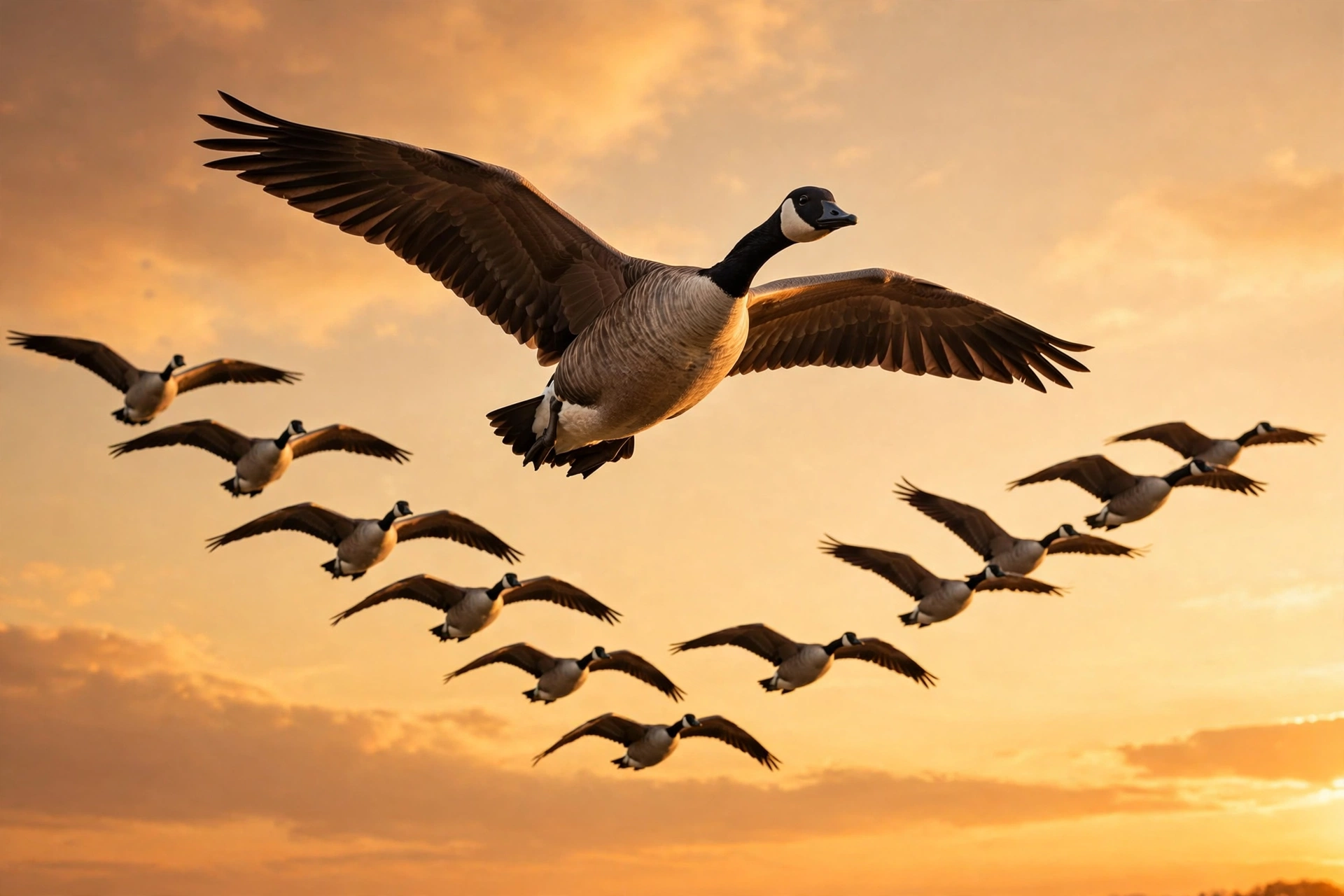
Step outside on an October evening and listen. That chorus of honks drifting down from the sky is the sound of migration in motion. Across North America, Canada geese are on the move right now, and the sight of a perfect V of geese gliding overhead never gets old. It is one of nature’s most familiar shapes, and it raises the same question every fall: why do geese fly in a V formation?
The short version is aerodynamics. Each goose in the V is surfing on invisible currents of air stirred up by the wings of the bird ahead, and that free lift saves real energy over a long journey. But the full story is richer than the slogan, and messier than the feel-good version you may have seen forwarded in an email. This article separates the verified science from the myths, from wingtip vortices to the famous “71 percent” claim.
The Short Answer: Energy Savings
Geese fly in a V formation to spend less energy. That is the core answer, and researchers are confident about it.
Every bird that flaps its wings pushes air around. The air disturbed behind a flying bird is not random turbulence; it has structure. A goose that positions itself just behind and slightly to the side of another goose catches a pocket of rising air and avoids the sinking air directly behind it. The result is free lift, and less work for every bird except the one at the point.
How much energy does it save? Dr. Lina Rifai, an associate professor of vertebrate biology at Indiana University-Kokomo, puts the figure at 20 to 30 percent less energy than flying alone, a number she shared with Birds and Blooms alongside the research behind it. Over a migration of thousands of miles, that difference is enormous. Fewer calories burned per mile means fewer refueling stops and a safer journey overall.
Vortex Surfing: How the Airlift Works
To understand the V, you have to understand what wings do to the air. A goose wing does not just slice through the sky. As it flaps, it shoves air downward behind it, and that air curls off the wingtips in tight spirals called vortices.
The spinning air behaves differently depending on where you are relative to the wingtip. Directly behind the bird, the air is moving downward. That is downwash, and it is bad news for anyone flying there. Off to the sides of each wingtip, though, the air rolls upward. That is upwash, and it is the good stuff.
Upwash: The Free Lift at Each Wingtip
Upwash is a narrow column of rising air created where the wing of the bird ahead ends. A goose that flies in that column gets a small but steady push upward, almost like standing on a slow elevator.
This is why the V shape appears. Every bird lines up so that its wingtip sits in the upwash zone of the bird just ahead and to the side. Do this across the whole flock and the classic V emerges naturally. The V is not a design the geese chose for beauty; it is the shape that falls out of every bird chasing the best air.

Why Spacing Matters So Much
The sweet spot is small. Fly too close and a bird blunders into the downwash. Fly too far back and the helpful upwash has faded away.
A review of the formation-flight research noted that ibises in a landmark study held positions of about one meter behind and one meter to the side of the bird ahead, almost exactly where aerodynamic theory said the upwash would be strongest. Geese are bigger birds with slower wingbeats, so their ideal spacing differs, but the principle is identical: close, precise, and slightly offset.
This precision is one reason young geese learn the formation from experienced birds rather than inventing it. Holding the right slot in a V takes practice, and migration flocks often pair the young with the veterans who know the geometry by heart.
What the Research Actually Found
For decades, scientists suspected that formation flight saved energy, but nobody had measured what free-flying birds actually do in a V. That changed with a remarkable study published in 2014.
The 2014 Ibis Study
Steven Portugal of the Royal Veterinary College in London led a team that worked with 14 hand-reared northern bald ibises in a conservation program. The young birds had been taught to follow a powered hang-glider as if it were the leading bird of their flock, following it along a migration route between Austria and Italy.
Each ibis carried a lightweight package: a GPS locator to record position within about 30 centimeters, and an accelerometer that logged the timing and effort of every wing flap. Over a 43-minute stretch of flight, the loggers captured around 180,000 wingbeats.
The results, published in the journal Nature (Portugal et al., 2014, DOI: 10.1038/nature12939), were the first hard evidence of the mechanism. The ibises positioned themselves in the aerodynamically optimal spots, avoiding the downwash behind the bird ahead and placing their wingtips in the upwash zones. Theoretical models had predicted exactly this, but the birds were doing it in real air, in real time.
Timing Their Wingbeats to the Wake
The most astonishing finding was about rhythm. The birds did not just park in the right spot. They adjusted the timing of their flaps to match the swirling wake left by the wings ahead.
When a bird flew roughly one full wingbeat wavelength behind its leader, its own wings matched the leader’s position: both tips up at the same moment, both down together. When it flew half a wavelength behind, it flapped in the exact inverse pattern. Either way, the trailing bird’s wingtips traced the same undulating path through the air as the wingtips of the bird ahead, a technique called wingbeat phase matching.
Portugal called it “a remarkable awareness and ability of birds” to respond to their flock-mates. The birds seemed to sense or predict the wake and adjust on the fly. This was the first experimental proof that birds actively exploit the wake, not just tolerate it.
One honest caveat: the study did not measure exactly how much total energy the birds saved. As Portugal himself noted at the time, it remained unclear precisely how much energy the formation saves, even though the mechanism was now proven.
Why the Leader Works Hardest
Every bird in the V gets free lift except one: the bird at the point. The leader flies in clean, undisturbed air. It generates the upwash everyone else rides, but it rides nobody’s.
That means the lead goose burns the most fuel and fights the most wind resistance. It is the hardest job in the flock, and it is also the most important one. The leader sets the course, and the entire V follows its heading adjustments almost instantly, since each bird can see the bird directly ahead of it.
This is where one of the great questions about V formation comes in: how does the leader not burn out completely? The answer lies in rotation, which is where we go next.

Do Geese Really Take Turns? What We Know
Yes, the lead goose does not hold the point forever. When it tires, it drops back into the formation and another bird takes the lead. This rotation is widely reported by ornithologists and wildlife experts.
Dr. Rifai notes that the most experienced birds lead during migration, because they know the route. Younger geese line up further back, where the flying is easier, and they learn the journey from the veterans. When the leader tires, it falls back and a rested bird moves up to the point.
There is also intriguing evidence that this swapping is cooperative, not just practical. A follow-up study on the same ibis population, published in the Proceedings of the National Academy of Sciences in 2015 by Bernhard Voelkl and colleagues, found that birds generally matched the time they spent leading and following, switching positions frequently. The researchers found signs of direct reciprocity: a bird that had ridden in another’s wake seemed more likely to let that bird ride in its wake later.
That study was on ibises, not geese, so we should be careful about claiming geese keep a precise ledger. But it matches what observers report from goose flocks: leadership is shared, and the sharing is frequent.
Why Honk? Communication in the Flock
The V formation is a visual experience, but the soundtrack matters too. Geese honk constantly in flight, and that racket is part of how the formation holds together.
The most widely accepted explanation is coordination. Honking helps birds keep track of each other, maintain their pace, and stay in position, especially during night flights or poor visibility when visual cues fade. Dr. Rifai has pointed out that the V lets birds both see each other and communicate across long distances, keeping the flock cohesive over a journey of thousands of miles.
The idea that geese honk “to encourage the leader,” as the viral story puts it, is charming but unproven. What we can say with confidence is that the calls are social: they keep the group together, and a flock that stays together stays safe.
The Viral “Teamwork Lessons” Story: True or Myth?
Almost everyone has seen the forwarded message. It goes by names like “Lessons from Geese” or “The Goose Story,” and it lists life lessons drawn from V formation flight: share a common direction, take turns doing hard jobs, honk encouragement from behind, and stay with a fallen companion until it flies again or dies.
It is a lovely piece of writing. Some of it is grounded in real biology. Some of it is not. Here is the honest breakdown.
The 71 Percent Claim
The story’s most famous statistic is this: by flying in V formation, the whole flock adds at least 71 percent greater flying range than if each bird flew on its own.
This number does not come from measuring geese. It traces back to a 1970 theoretical paper by Lissaman and Shollenberger that modeled the aerodynamics of formation flight. It was a mathematical prediction, made with simplifying assumptions, and it was never a field measurement of migrating geese.
Modern evidence points to real but smaller savings. The 20 to 30 percent energy figure cited by Dr. Rifai is grounded in the research literature, and the 2014 Nature study proved the mechanism without claiming a specific total. The honest version of the lesson is: formation flight genuinely saves energy, but the “71 percent” number is a decades-old theoretical estimate, not a measured fact about geese.
Geese and a Fallen Companion
The story claims that when a goose gets sick or wounded and drops out of formation, two other geese follow it down and stay with it until it can fly again or dies.
Geese are genuinely devoted to their families and mates. Canada geese pair for life, and mates have been observed lingering near an injured partner. But there is no scientific study documenting the tidy rule of “two geese always descend and stay until recovery or death.” That part of the story reads like embellishment added as the email was forwarded from inbox to inbox.
The kind interpretation is this: the chain email captured a real grain of truth, that geese are social, loyal birds, and polished it into a parable. Enjoy the parable. Just don’t cite it as ornithology.
Which Birds Fly in V Formation
Geese are the poster birds for the V, but they are far from the only ones. The formation shows up wherever large birds migrate long distances and flap their way there.
Regular V fliers include:
- Geese: Canada geese, snow geese, and their relatives are the classic example, and the ones you are most likely to see overhead this month.
- Swans: tundra swans and trumpeter swans migrate in V formation on the same flyways as geese.
- Cranes: sandhill cranes and whooping cranes fly in V or in loose diagonal lines.
- Pelicans: white pelicans and brown pelicans use V formation, often in long, ragged lines.
- Ibises: northern bald ibises, the stars of the 2014 study, migrate in V formation.
- Cormorants and ducks: both use V or line formations on migration.
Many birds never use the V at all. Small songbirds migrate mostly at night in loose, scattered flocks, and the aerodynamic payoff of tight formation flight seems to vanish below a certain body size. Portugal himself suggested the cutoff may sit around the size of a gull. Raptors like hawks and eagles soar on thermals instead of flapping in formation, and hummingbirds migrate solo.
The pattern makes sense: the V is a tool for heavy, flapping migrants. If your migration strategy is gliding, soaring, or traveling alone under cover of darkness, the V has nothing to offer.

FAQs About Geese and V Formation
Do all geese fly in V formation?
No. Geese use the V mainly on longer migratory flights, when the energy savings matter most. On short local flights, moving between a field and a pond, geese often fly in loose groups or ragged lines. Very large flocks, like the enormous snow goose gatherings on the prairies, may break into several smaller V formations or long diagonal lines rather than one giant V.
Why is one side of the V longer than the other?
You have probably noticed that real flocks are rarely symmetrical. One arm of the V is often longer, or the whole thing bends into a shape closer to a J.
There is no single proven explanation. Wind is a likely factor: birds may favor the sheltered side. Simple arithmetic matters too, since a flock with an odd number of birds, or birds joining and leaving the arms as the flight goes on, will naturally produce lopsided arms. It is also possible that some birds just prefer one side; the ibis study found that individual birds favored the left, the right, or the center, with frequent position swaps. The asymmetry is normal, not a sign that something is wrong.
Do geese fly at night?
Yes, geese often migrate at night. Night air tends to be calmer, with fewer thermals and less turbulence, which makes steady flapping flight easier. Cooler night temperatures also help large, heavily feathered birds avoid overheating during sustained flight. That constant honking you hear after dark in October is very likely a migrating flock talking its way through the night sky.
How fast and how far do geese fly?
Canada geese are strong, fast fliers. They typically cruise at 30 to 40 miles per hour, and with a good tailwind they can go faster. Their migrations cover enormous distances: many populations travel 2,000 to 3,000 miles between breeding and wintering grounds, a journey broken into stages with stopovers to rest and refuel. To learn more about the timing of these journeys, see our guide to fall migration season and where geese go for the winter.
Conclusion
The next time a V of geese crosses the October sky above you, picture what is really happening. Each bird holds a precise slot, offset from the bird ahead, riding a curl of rising air off its wingtip. Each one times its wingbeats to the invisible wake rolling backward through the flock. And at the point of the V, one tired bird does the hardest work of all, waiting for its turn to drop back and rest.
That is the real science of the V formation: not a teamwork poster, but something better. Millions of years of evolution produced a flight strategy so precise that it took GPS backpacks and 180,000 measured wingbeats to finally prove how it works. The viral stories got the spirit right even when they fudged the numbers. So listen for the honks this month, look up, and enjoy the show. Migration is happening right now. If you want to understand how they find their way across continents, read our explainer on how birds navigate during migration.






[…] The lead bird works the hardest because it flies into undisturbed air with no upwash to ride. No single goose can hold that position forever, so the flock regularly rotates the lead. When it is time to switch, the honking changes noticeably: the new leader calls out, trailing birds answer, and the whole formation reshuffles without losing speed or shape. For a deeper look at the aerodynamics, read our full guide on why geese fly in a V-formation. […]