Skip to content

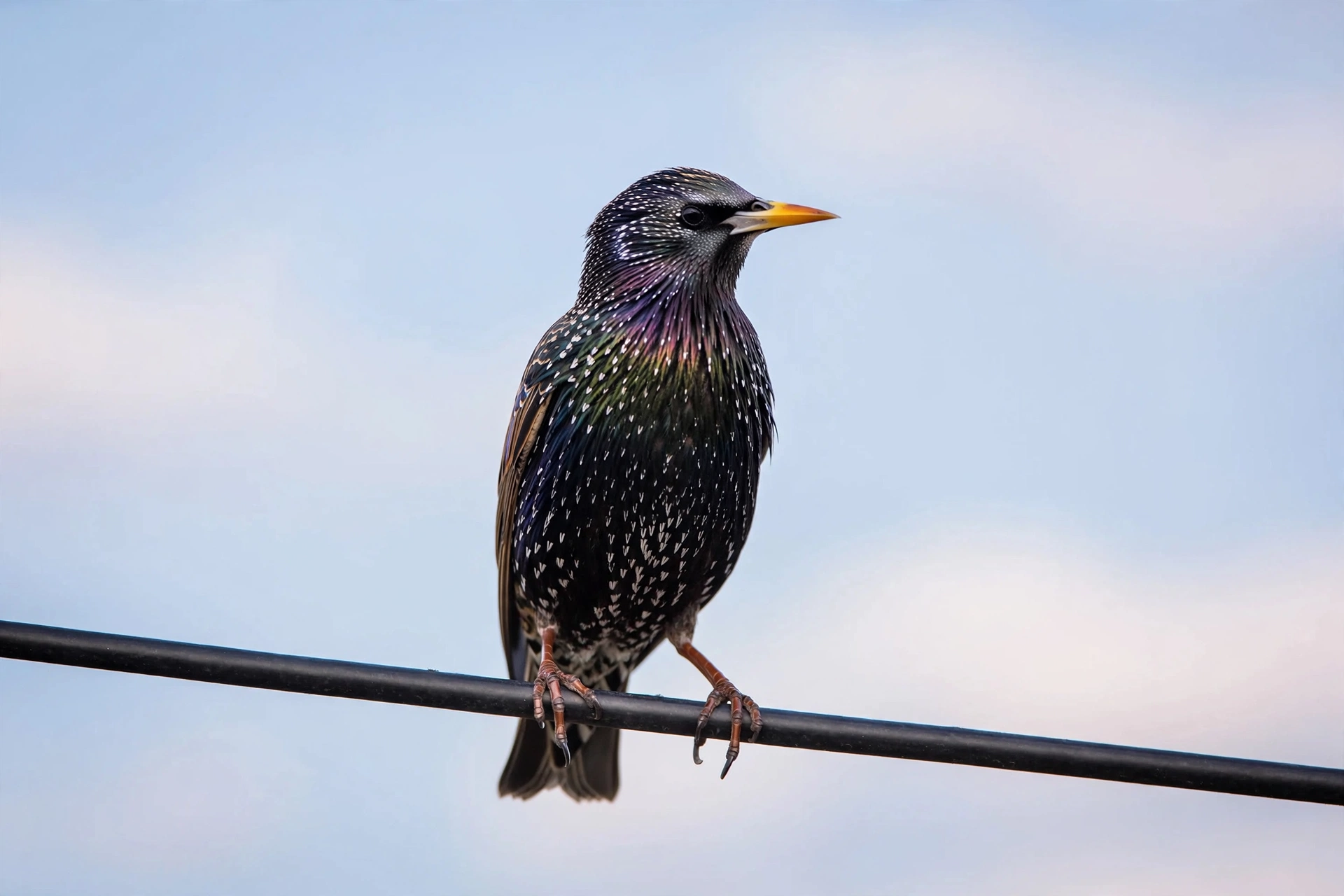
You have seen the picture a hundred times. A row of starlings sits on a power line at sunset, chattering away in the evening light, utterly relaxed on a wire carrying thousands of volts. It looks like it should be impossible.
Touch a downed power line and the results are catastrophic, yet birds treat the same wires like park benches. So why don’t birds get electrocuted on power lines?
The answer is one of the most satisfying in all of backyard science, because it is pure physics and it applies to you too. Birds are not immune to electricity. They have no special insulation, no secret resistance, no magic feathers. They survive for a beautifully simple reason: electricity needs a path, and a bird sitting on a single wire does not give it one.
Once you understand the rule, you will also understand exactly when the rule breaks, which is when birds do die, and why power companies spend real money keeping large birds away from their poles. They chatter in the evening, but if you want the real concert, read our guide to why birds chirp in the morning and the dawn chorus.
Why Don’t Birds Get Electrocuted on Power Lines? The Simple Physics
Electricity is lazy. It always takes the easiest available path from high electrical pressure to low electrical pressure, and it only moves when such a path exists. Voltage is the pressure. Current is the actual flow.
What harms a living body is current passing through it, and current only flows when a difference in voltage across the body pushes it along.
Now look at the bird. Both of its feet grip the same wire. That means both feet sit at the same electrical potential, the same voltage. There is no meaningful difference between the two contact points, so nothing pushes current up one leg, through the body, and down the other.
The bird’s body is not part of a circuit. It is just a bump on the wire.
A useful image: voltage is like height on a hill. Water does not flow across flat ground, no matter how high above sea level that ground sits. A wire carrying 35,000 volts is like a plateau at 35,000 feet. Everything standing on the plateau is at the same height, so nothing flows.
As BBC Science Focus puts it, it is not voltages that kill but voltage differences. Touch a second wire at a different voltage, and you have just built a slope.
It Is the Current That Kills, Not the Voltage
This distinction trips up almost everyone. Power lines carry enormous voltages, from a few thousand volts on neighborhood distribution lines up to 400,000 volts or more on big transmission towers. Those numbers sound lethal because we associate high voltage with danger. But voltage by itself is only potential, a difference waiting to happen.
Current, measured in amperes, is the actual movement of charge, and it is current through the body that injures and kills. A bird on a single wire experiences essentially no voltage difference across its body, so essentially no current flows through it. The wire beneath its feet, made of aluminum or copper, offers a vastly easier path, so the current keeps moving along the metal and ignores the bird entirely.
There is even a subtle footnote worth knowing. Power lines carry alternating current, which means the voltage swings back and forth dozens of times per second. A bird sitting on the wire gets charged and discharged slightly with each swing.
But birds are small, so they store very little charge, and the resulting current through the body is on the order of microamps, far below anything a living creature can feel. The bird never notices.
When Birds Do Get Electrocuted
Here is the part most short explainers skip. Birds do get electrocuted, and it happens in specific, well-understood ways. Every one of them follows the same rule: the bird accidentally completes a circuit between two points at different voltages.
Touching two wires at once
If a bird touches two wires carrying different voltages at the same time, its body becomes the bridge between them, and current flows through it. Small songbirds almost never manage this because the wires are spaced farther apart than a sparrow is wide. But a large bird spreading its wings to land or take off can span the gap.
Eagles, hawks, cranes, and ravens are the usual victims. As wildlife biologist Will Babb of the Ohio Department of Natural Resources explained to IFLScience, birds that touch two wires simultaneously allow electricity to flow, with fatal results.
Touching a wire and a grounded pole
The more common killer is the utility pole itself. Wires are held away from the wooden or metal pole by insulators, chunks of glass, ceramic, or polymer that current cannot easily cross. But if a bird perched on a wire leans over and touches the grounded pole, the crossarm, a guy wire, or a transformer case at the same time, it connects the energized wire to the ground through its body. That is exactly the dangerous situation a person faces touching a live wire while standing on the earth.
Washington State University’s Ask Dr. Universe explains it plainly: insulators cut off the path so electrons stay in the wire, but if a bird touches the pole and the power line at the same time, electrons flow through the bird’s body. That flow is electrocution.
Wet feathers and bad luck
Water makes everything worse. Wet feathers conduct better than dry ones, and rain can create conductive paths across insulators that are safe when dry. Most electrocutions happen on distribution poles, the shorter wooden poles in neighborhoods, rather than giant transmission towers, because the wires sit closer together and closer to grounded hardware. A big wet bird landing awkwardly on a rainy-day pole is playing the worst odds in the bird world.

Safe vs Dangerous: A Quick Comparison
Use this table to keep the rule straight. Every safe scenario has one thing in common: the bird touches only one electrical potential. Every dangerous one bridges two.
| Situation | What the bird touches | Result |
|---|---|---|
| Both feet on one wire | Same voltage at both feet | Safe: no circuit through the body |
| Perched on one wire, wings clear | A single contact point | Safe |
| Two wires at different voltages | Voltage difference across the body | Electrocution |
| Wire plus grounded pole or hardware | Wire to ground through the body | Electrocution |
| Wire plus wet, contaminated insulator | Leakage path toward ground | Dangerous |
Why Big Birds Face More Danger
Size is the main risk factor, and it explains a pattern you may have noticed: the birds lined up safely on wires are almost always small. Starlings, sparrows, blackbirds, and swallows fit comfortably between wires with room to spare. A bald eagle with a six-foot wingspan lives in a different geometric world.
Large raptors also prefer the most dangerous real estate. Hawks and eagles love to perch on crossarms and pole tops because the height gives them a hunting vantage. That puts their wingtips within reach of energized wires on both sides. Researchers studying power-line deaths have found that raptors, ravens, and other big birds make up most electrocution victims, which is why utilities focus their bird-safety work on poles in raptor country.
There is a twist worth knowing. A study published in the journal iScience found that along surveyed power lines in the American West, most dead birds found with a determinable cause had actually been illegally shot, not electrocuted. Electrocution remains a real and serious threat, especially to eagles and other raptors, but as Phys.org reported, the finding was a reminder that power-line deaths have more than one cause.

What About Squirrels?
Squirrels get asked about almost as often as birds, and the physics is identical. A squirrel scampering along a single wire is at one voltage all over, so it is perfectly safe. Squirrels run into trouble for a different reason: curiosity.
They climb transformers, chew on insulation, and bridge the gap between an energized wire and the grounded metal case of a transformer. That is when the lights go out in the neighborhood.
Utility crews know this pattern well, which is why you will see plastic guards and insulated covers on transformers and pole hardware in squirrel-heavy areas. The squirrel is not being punished for bad physics. It is being protected from its own adventurous climbing.
How Power Companies Keep Birds Safe
Utilities take bird electrocution seriously, partly for the birds and partly because outages are expensive. The Avian Power Line Interaction Committee, a group of utilities and wildlife agencies, publishes detailed guidance on building bird-safe power lines, and many companies now follow it.
The fixes are straightforward engineering. Wires get more spacing so big wings cannot bridge them. Exposed energized parts get insulated covers. Perch guards discourage birds from landing on the most dangerous spots, while utilities install safe, attractive perching and nesting platforms nearby to give birds a better option.
Some companies even build dedicated nesting platforms for ospreys and eagles, keeping the birds and the equipment apart.
It works. Retrofitting dangerous poles with covers and spacing has reduced raptor electrocutions in many areas, though older poles remain a hazard and the work is ongoing. If you ever find a dead raptor beneath a power pole, wildlife agencies want to know. Your report can flag a pole that needs fixing.
Could You Do What the Bird Does?
Yes, with enormous caveats. If you hung from a single power line like a gymnast, touching nothing else, you would be as safe as the sparrow. Your whole body would sit at one voltage, with no path for current. Live-line utility crews work on this exact principle, bonding themselves to energized conductors so their entire body rides at the wire’s potential while they make repairs.
Do not try it, obviously. The bird’s safety margin is inches wide, and yours would be too. One brush of a fingertip against a second wire, a pole, or a tree branch, and the physics turns lethal instantly.
The birds make it look easy because they never touch anything but the wire. That discipline is the entire trick.

FAQs
Why don’t birds get electrocuted on power lines?
Because both feet touch the same wire at the same voltage. With no voltage difference across the body, no current flows through it. The bird is not insulated against electricity. It simply is not part of a circuit.
Can a bird sit on a power line in the rain?
A small bird sitting on one wire in the rain is still touching only one voltage, so the basic rule holds. The added risk comes when wet, dirty insulators allow current to leak toward grounded hardware, or when a large wet bird bridges two conductors with its wings. Rain raises the stakes, but it does not change the physics.
Do birds ever die from power lines?
Yes. Birds die from electrocution when they touch two wires at once or a wire plus grounded equipment, which happens most often to large birds like eagles, hawks, and ravens on distribution poles. Birds also die from colliding with wires in flight, which is a separate problem from electrocution.
Why don’t birds’ feet get burned on the wire?
A wire at one voltage drives no current through the bird, so there is no heating. As for cold, bird feet are mostly tendon and scale with very little blood flow, which is why they can grip a wire in January without freezing. We covered that trick in detail in our guide to why birds’ feet don’t freeze in winter.
Bird bodies are full of surprises like that. Their waste system, for instance, works nothing like ours, as we explored in our look at how bird waste actually works.
Can birds sit on high-voltage transmission lines?
Yes. The physics does not change with voltage. A bird on a 400,000-volt transmission line is exactly as safe as one on a neighborhood distribution line, as long as it touches only that one conductor. Higher voltage only matters more when something goes wrong, because the resulting current is more destructive.
What should I do if I find a dead bird under a power line?
Do not touch any downed wires, and keep pets away. If the bird is a raptor, eagle, or other protected species, report it to your state wildlife agency or the local utility. Your report can help identify a dangerous pole.
And never touch a downed power line yourself, even if birds are sitting on nearby wires. You are grounded. They are not.
Conclusion
The next time you see starlings lined up on a wire at sunset, you will know the secret they are keeping. They are not immune to electricity. They are not wearing invisible insulation. They are simply obeying the one rule that governs every electric shock: current needs a voltage difference and a path.
Sitting on a single wire, they offer neither.
It is a rule worth respecting. The same physics that lets a sparrow doze on a live wire is what makes downed power lines so dangerous to people and pets on the ground. And spare a thought for the eagles, whose wide wings sometimes break the rule by accident.
The bird on the wire is safe because it touches one world at a time. Everything else, the second wire, the pole, the ground, is another world, and touching two worlds at once is where the danger lives.