 Skip to content

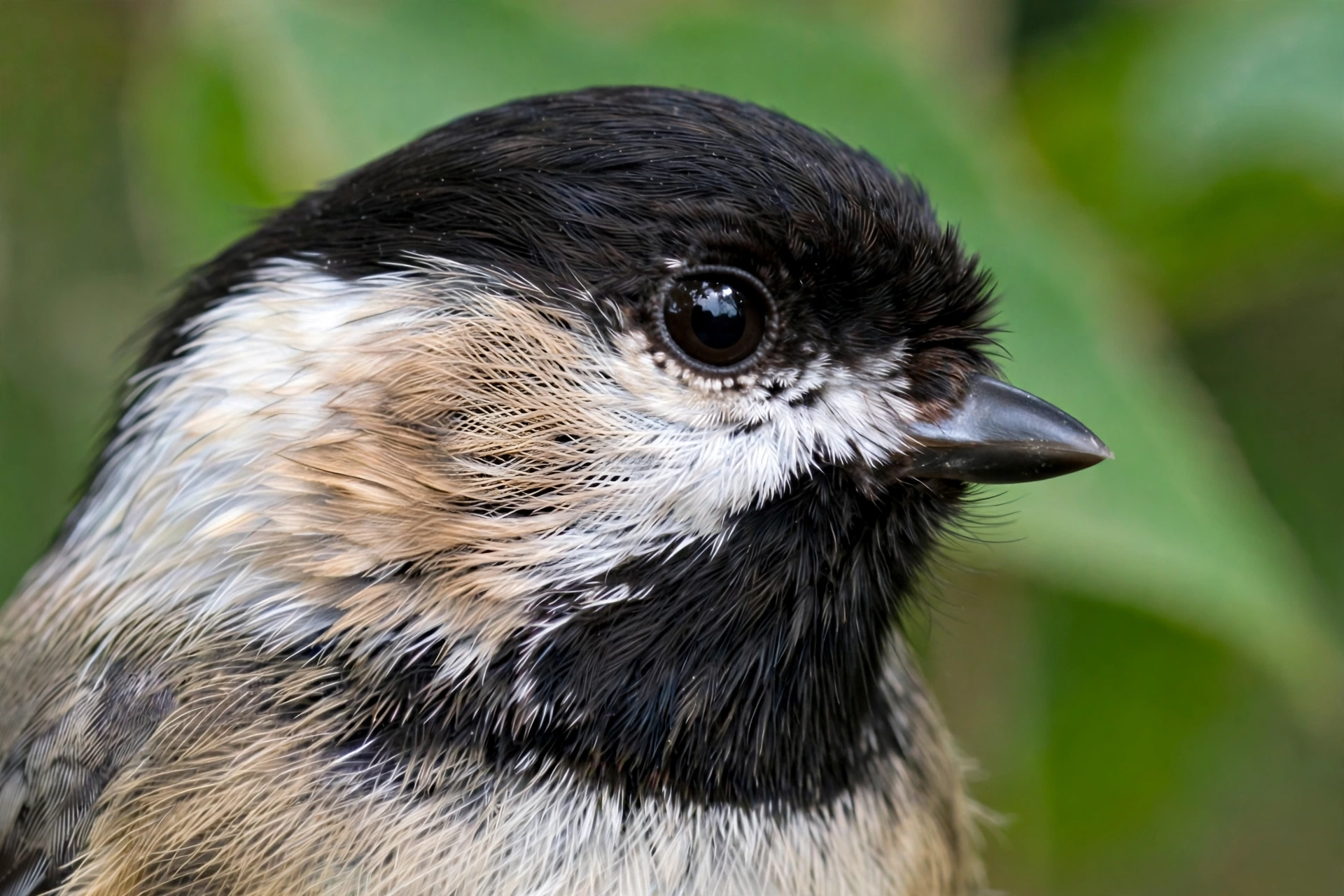
Look closely at any bird and you will notice something missing. No ears. No flaps, no openings, nothing resembling the ears on the sides of our heads. It is natural to wonder: do birds have ears at all, or do they navigate the world of sound in some completely different way?
The answer is yes, birds absolutely have ears. They are simply hidden.
Beneath the feathers on the sides of a bird’s head sit real ear openings, a middle ear with a single tiny bone, and an inner ear every bit as sophisticated as our own. Birds hear beautifully.
Some of them, like owls, hear better than almost any animal on Earth. And unlike us, birds can regrow the delicate hearing cells that loud noise destroys.
Do Birds Have Ears? The Short Answer
Yes. Birds have ears, but they do not have external ears. There are no flaps or pinnae sticking out from the head the way ours do. Instead, each side of a bird’s head carries a funnel-shaped ear opening, called the external acoustic meatus, tucked slightly behind and below the eye and covered by special soft feathers known as ear coverts or auriculars.
These coverts do more than hide the opening. They shield it from debris and moisture, keep the head streamlined for flight, and may even help direct sound into the ear. As IFLScience explains, beneath those coverts sit funnel-shaped openings leading to a full outer, middle, and inner ear, much like ours minus the flaps. If you ever gently part the feathers behind a pet bird’s eye, you will find the opening waiting underneath, because every bird has them, from hummingbirds to eagles.
Where Exactly Are a Bird’s Ears?
Picture a clock face on the side of a bird’s head with the eye at the center. The ear opening sits at roughly four or five o’clock: behind and slightly below the eye. The exact position varies a little between species, but the behind-and-below pattern holds across nearly all birds.
Finding the openings by sight alone is nearly impossible, because the auricular feathers blend seamlessly with the surrounding plumage. In most birds the ear region looks like ordinary head feathers. The giveaway is texture. Ear coverts are often a touch softer and lie slightly differently from neighboring feathers, forming a subtle patch you can learn to spot with practice.
Owls hide their ears even more thoroughly. Their ear openings sit at the sides of the head behind the eyes, buried under the feathers of the facial disc. In many owl species the openings are strikingly asymmetrical, with one set higher than the other, an arrangement that turns out to be a hunting superpower.
How a Bird’s Ear Works: Outer, Middle, and Inner
A bird’s ear has the same three-part architecture as yours: outer, middle, and inner. The details differ in fascinating ways.
Outer Ear: In birds this is simply the funnel-shaped opening and the short ear canal leading inward. There is no pinna to swivel or cup. The job of collecting sound falls to the shape of the head itself and, in owls, the facial disc.
Middle Ear: Here lies the biggest difference. Mammals have three tiny ossicle bones, the malleus, incus, and stapes, linked in a chain. Birds make do with one: the columella.
This single slender bone stretches from the eardrum to the oval window of the inner ear, carrying vibrations across the middle-ear cavity. In birds the columella ends in a Y-shaped, trifurcated footplate that spreads across the eardrum, an arrangement thought to lower the hearing threshold and sharpen the detection of faint airborne sounds.
Inner Ear: The avian inner ear contains a cochlea, but it is shorter and less coiled than the mammalian spiral. Inside sit the hair cells that convert mechanical vibrations into electrical signals for the brain. Birds hear with the same basic cellular machinery we use, which makes their power of recovery, covered below, all the more remarkable.
Birds also carry small middle-ear muscles that can dampen sudden loud sounds, giving the inner ear a degree of protection against acoustic shock. It is a built-in volume limiter, though it has its limits. Bird anatomy is full of quiet surprises like this. If you enjoy them, read our explainer on how birds pee, which tackles another bodily function birds handle completely differently from us.

Bird Hearing vs Human Hearing
How does avian hearing stack up against ours? The honest answer is that the ranges overlap more than most people expect, with birds holding a few surprising advantages, as summarized in Wikipedia’s hearing-range overview.
| Feature | Birds | Humans |
|---|---|---|
| Most sensitive range | 1 to 4 kHz | 2 to 5 kHz |
| Upper limit | Around 10 to 12 kHz in most species | Around 20 kHz, declining with age |
| Lower limit | Below 50 Hz in many species; pigeons hear down to 0.5 Hz | Around 20 Hz |
| Ultrasound response | No species observed reacting above 20 kHz | Not heard either |
| External ears | None; openings hidden under feathers | Pinnae on the sides of the head |
| Middle-ear bones | One: the columella | Three: malleus, incus, stapes |
| Sound localization | Excellent; head shape supplies elevation cues | Excellent; pinnae supply elevation cues |
| Hair-cell regeneration | Yes, hearing recovers after damage | No, damage is permanent |
The headline is that birds hear roughly the same slice of the sound world we do, centered on the frequencies of speech and song. They are especially sensitive to pitch, tone, and rhythm changes, which lets them recognize individual birds by voice even in a noisy flock. That sensitivity underlies everything from the dawn chorus to a chickadee’s whispered alarm calls.
Where birds pull ahead is at the bottom of the scale. Several species hear deep into infrasound, below the 20 Hz floor of human hearing. Pigeons are the champions, detecting sounds as low as 0.5 Hz, which may let them sense distant storms, earthquakes, and even volcanoes, and use those deep rumbles as navigational landmarks.
The Owl Exception: Nature’s Hearing Champions
If birds are good listeners, owls are in a league of their own. Owls have probably the most acute hearing of any bird, able to detect sounds ten times fainter than a human can perceive, as Australian Geographic describes. Nearly every part of the owl is tuned for sound.
The facial disc is the star of the show. Its stiff, densely packed ruff feathers form a parabolic dish around the face, collecting sound and reflecting it toward the ear openings the way a satellite dish gathers signals. The owl can even adjust the disc’s shape with special facial muscles, effectively tuning its focus. Deep, soft feathers around the extra-large ear openings funnel sound further inward.
Then there is the asymmetry. In strictly nocturnal owl species, one ear opening sits higher than the other.
A sound from above arrives slightly louder in the higher ear, while a sound from below favors the lower one. Combined with the left-right timing difference between the ears, this gives the owl true three-dimensional hearing. Barn owls can detect a left-right time difference of about 30 millionths of a second, enough to strike a mouse rustling under snow in total darkness.
All of this would be useless if the owl were a noisy flyer. The rustle of its own wings would drown out the faint sounds of prey, and the prey would hear it coming. So night-hunting owls evolved fringed, downy flight feathers that cut flight noise almost to nothing. Silent wings plus radar-dish ears make one of the most formidable hunters in the animal kingdom.
One persistent myth needs clearing up. The “ear tufts” on great horned owls and their relatives are not ears at all. They are simply display feathers, thought to aid camouflage or communication. The real ears are the hidden openings at the sides of the head, the same as in every other bird.

How Birds Pinpoint Sound Without Ear Flaps
Mammals use their external ears to judge whether a sound comes from above or below. Without pinnae, how do birds manage it?
A 2014 study found an elegant answer. The shape of the bird’s head itself alters incoming sound, creating subtle spectral cues that reveal a sound’s elevation. In effect, the head is the pinna.
Left-right localization is simpler, and birds share it with us. Sound reaches the nearer ear a fraction of a second before the farther one, and the brain reads that tiny delay as direction. An owl turns its head until the sound arrives at both ears simultaneously, and then it knows the prey is dead ahead.
This directional hearing is not a luxury. It is how a songbird finds a singing rival through dense foliage, how a mother bird locates a begging chick, and how prey species hear a hawk’s approach in time to dive for cover. Cardinals take individual recognition further: both sexes sing, and learning to tell a male vs female cardinal apart starts with listening closely to who is singing and how. Hearing is a bird’s early-warning system, and it runs constantly.
Can Birds Hear Things We Can’t?
For the most part, birds and humans hear the same world. But birds own a few exclusive channels.
Infrasound is the big one. Pigeons, chickens, and guinea fowl all show sensitivity to frequencies below 20 Hz, with pigeons reaching down to 0.5 Hz. These deep rumbles travel enormous distances, so a pigeon may literally hear a storm front or a shifting mountainside long before any visual cue arrives.
At the other end, some birds push toward the top of their range in ways that surprise researchers. Andean hillstar hummingbirds sing with fundamental frequencies above 13 kHz, among the highest known in any bird, with harmonics reaching near 28 kHz. Whether the birds fully hear those harmonics remains an open question, since no bird has been observed reacting to sounds above 20 kHz.
Then there are the oilbirds. These cave-dwelling birds of South America navigate pitch-black caverns using echolocation, emitting rapid clicks and listening for the echoes, just as bats do. It is the only known case of true echolocation in birds, and a reminder that avian hearing still holds surprises.
Can Loud Noises Damage a Bird’s Hearing?
Yes. Birds are not immune to acoustic trauma. Prolonged exposure to very loud sound destroys hair cells in the avian inner ear just as it does in ours.
In laboratory studies, tones around 115 to 120 decibels sustained for 48 hours produced clear lesions in chickens’ cochleas. Fireworks, construction blasting, and low-flying aircraft are real-world sources of damaging noise, and wildlife biologists take the effects seriously, especially near nesting colonies.
Here is where the story takes its astonishing turn. Unlike mammals, birds can regrow what noise destroys.
The Remarkable Comeback: How Birds Regrow Hearing
In the late 1980s, researchers Jeffrey Corwin and Douglas Cotanche exposed young chickens to loud noise for 48 hours, wiping out patches of inner-ear hair cells. Within ten days, the damaged areas were rebuilding. New hair cells were appearing, grown from neighboring supporting cells, and the birds’ hearing was recovering. A parallel report found the same regeneration in adult quail.
Modern research has mapped the process in detail. When a chicken’s auditory hair cells are destroyed, supporting cells divide and differentiate into fresh hair cells, which then reconnect to auditory neurons. Hearing thresholds recover within four to five weeks, according to research published in Cell Reports. The regenerated wiring even preserves the ear’s frequency map, so the bird hears the right pitches in the right places.
This matters far beyond ornithology. In humans and other mammals, hair-cell loss is permanent, which is why age-related and noise-induced hearing loss cannot be reversed. Bird ears are now one of the most important model systems in hearing-restoration research, with teams using single-cell gene sequencing to decode exactly which signals trigger regeneration. The hope is that what a chicken’s ear does naturally might one day be coaxed from our own.
It also reframes how we think about birds and noise. A bird deafened by a loud event is not necessarily deaf for life. Given quiet and time, its ears can rebuild themselves, a superpower hidden behind those unassuming feathered faces.

FAQs
Where are a bird’s ears located?
A bird’s ear openings sit on the sides of the head, slightly behind and below the eyes. They are funnel-shaped holes covered by soft feathers called ear coverts or auriculars, which is why you cannot see them. In owls the openings hide beneath the facial disc feathers.
Do birds have eardrums?
Yes. Birds have a tympanic membrane, or eardrum, at the inner end of the short ear canal. Vibrations of the eardrum are carried to the inner ear by the columella, the single middle-ear bone. Small middle-ear muscles can dampen sudden loud sounds to protect the inner ear.
Do birds have an outer ear?
Not the way mammals do. Birds have no pinna, the external flap. Their outer ear is just the feather-covered opening and canal. Sound-funneling duties are handled by the shape of the head and, in owls, the facial disc.
Can birds hear better than humans?
In overall range, bird and human hearing are roughly similar, both centered on 1 to 5 kHz. Birds excel at detecting pitch and rhythm changes to recognize individuals, and some species hear deep into infrasound that humans cannot detect. Owls can hear sounds ten times fainter than humans can.
Do owls hear better than other birds?
Yes, owls have the most acute hearing of any bird group. Their asymmetrical ear openings, parabolic facial discs, and silent flight feathers let them pinpoint prey by sound alone in complete darkness, detecting time differences of about 30 millionths of a second between their ears.
Can loud noises damage a bird’s hearing?
Yes, very loud or prolonged noise destroys the hair cells of a bird’s inner ear, just as in humans. The remarkable difference is that birds regenerate those hair cells and recover their hearing within weeks, while mammalian hearing loss is permanent.
Why can’t I see a bird’s ears?
Because there is nothing to see from the outside. The ear opening is a hole hidden beneath the auricular feathers, with no protruding structure. This keeps the head streamlined for flight while still allowing excellent hearing.
Conclusion
So do birds have ears? They do, and they are marvels of compact engineering: hidden openings behind the eyes, a single Y-shaped bone doing the work of three, and an inner ear that hears the world in rich detail. From the pigeon listening to storms hundreds of miles away to the barn owl triangulating a mouse under snow, birds prove that you do not need visible ears to be a superb listener.
The deepest lesson may be the one about recovery. Every loud noise that permanently dims a human’s hearing is an injury a bird can undo, regrowing the very cells we cannot replace. Scientists are studying that trick intensely, hoping to borrow it. The next time a bird tilts its head at you, consider the possibility that it is hearing you perfectly well, and that its ears are doing something yours never could.






[…] Do Birds Have Ears? Where They Are and How They Hear […]