


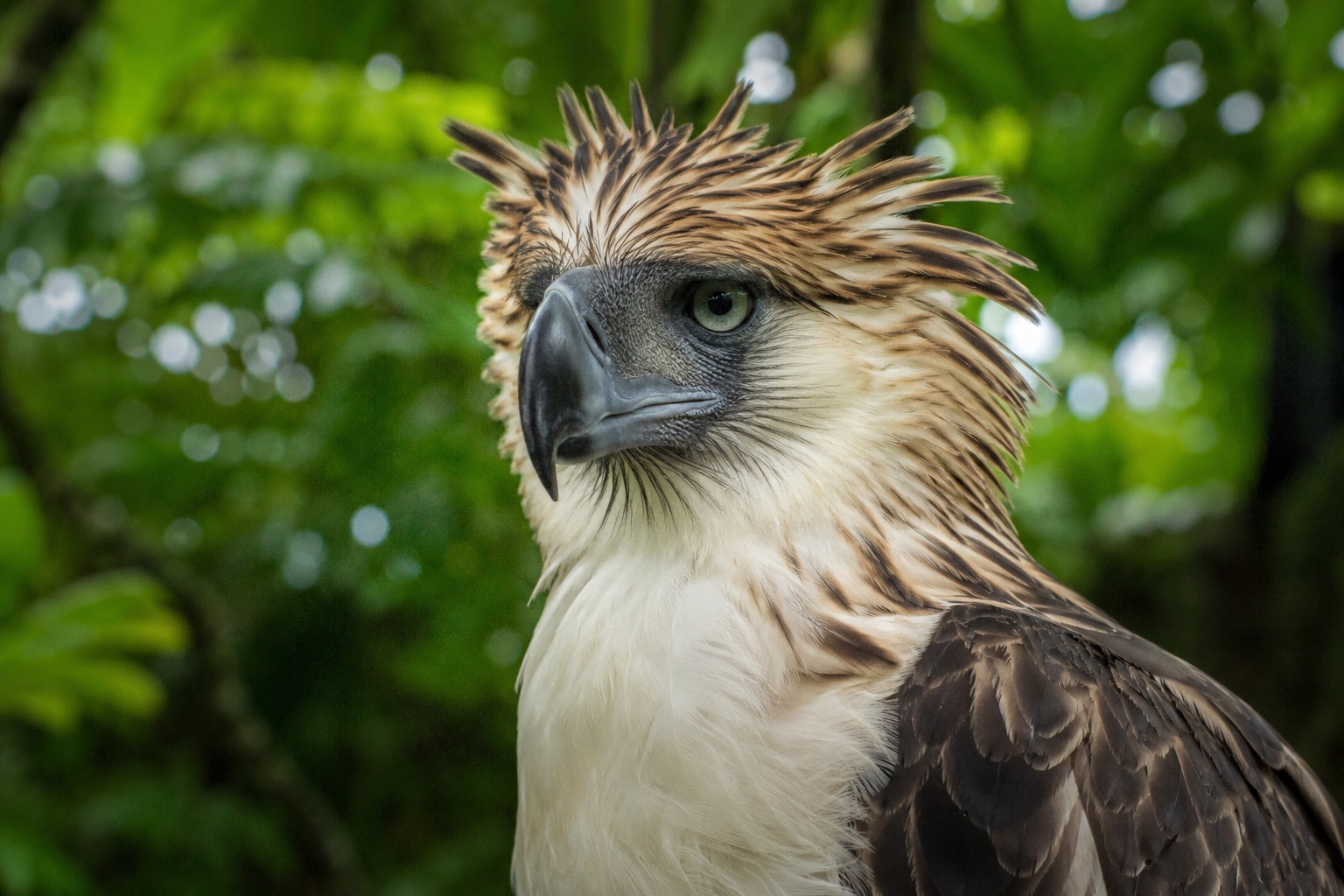
The Philippine eagle species is a critically endangered bird of prey, endemic to the forests of the Philippines, and classified under the family Accipitridae, one of nature’s most formidable predators.
The Philippine eagle stands as one of the largest, most powerful forest raptors on Earth, and its story is as extraordinary as its appearance.
Scientific identity begins with the species’ formal name, Pithecophaga jefferyi, assigned by British naturalist John Whitehead in 1896 after he discovered the bird in Paranas, Samar, as noted by the National Museum of the Philippines. The genus name Pithecophaga translates roughly to “monkey-eater,” a label that shaped the bird’s earliest common name: the Monkey-eating Eagle.
However, scientific observation eventually revealed that the species feeds on a much broader range of prey flying lemurs, large bats, monitor lizards, and snakes among them. The name was changed to Philippine eagle both to reflect that dietary reality and to honor the nation to which this bird is entirely native.
Cultural weight surrounds this species in ways few animals can claim. Declared the Philippine National Bird in 1995, it carries the local title Haring Ibon, King of Birds, a name that speaks to the deep reverence Filipinos hold for it.
The Philippine Eagle Foundation documents several regional names including Aguila, Manaol, Banog, Mamboogook, and Garuda, each reflecting distinct linguistic traditions across the archipelago. These names are not mere labels; they signal how deeply interwoven this eagle is with Filipino identity and heritage.
Understanding where this bird lives and why that habitat is disappearing is essential context for everything that follows.
Table of Contents
Where the Philippine Eagle Lives?

Pithecophaga jefferyi is a species defined entirely by its geography a bird so deeply bound to one archipelago that its survival rises or falls with the fate of Philippine forests.
The Philippine eagle is strictly endemic to the Philippines, meaning it exists nowhere else on Earth in the wild. Its range spans four major islands: Mindanao, Leyte, Samar, and Luzon. Of these, Mindanao holds the largest and most stable population, making it the species’ primary stronghold. Sightings on the other islands are far less frequent, and populations there face sharper habitat pressures.
Habitat preference is a defining trait. These eagles are old-growth forest specialists, requiring large tracts of intact, lowland to montane dipterocarp forests to survive and breed. A single breeding pair needs an estimated 25 to 50 square miles of contiguous forest territory, which speaks directly to why deforestation is so devastating for them. Ancient nesting sites are considered irreplaceable, and conservation scientists argue they must remain entirely off-limits to development.
And the threats are relentless. Logging, agricultural encroachment, and mining have fragmented the forests these eagles depend on, isolating populations and shrinking the prey base they need. A recent DENR monitoring in Cotabato observed one bird preening along forest edges a reminder that even in surviving patches of habitat, conditions are far from ideal.
Understanding where this eagle lives helps you appreciate something else: the sheer physical scale required to rule these forests. That scale the size, the wingspan, the raw presence is what the next section examines in full.
Size and Wingspan: Visualizing the World’s Largest Forest Raptor
The Philippine eagle is not merely large it is built on a scale that redefines what a forest raptor can be, and its dimensions alone explain why this species holds the title of Philippine National Bird with such commanding authority.
Standing up to 3 feet (1 meter) tall, the Philippine eagle ranks as the largest forest-dwelling eagle on the planet, according to The Peregrine Fund. For context, the Harpy Eagle, its closest rival in the size debate, is heavier on average but shorter in overall height. The Philippine eagle wins on sheer vertical presence, a distinction that carries real ecological weight inside dense, layered tropical forest where height advantage translates directly to dominance.
The wingspan is where the numbers become genuinely staggering. Discovery Channel Southeast Asia confirms a wingspan reaching up to 7 feet (2 meters), one of the broadest recorded among all forest raptors worldwide. And DENR Region 5 notes that this span is specifically adapted for navigating dense canopy, allowing the bird to bank and accelerate through tight forest corridors where other large raptors would struggle.
Up close, the physical details are equally striking. The eagle’s shaggy brown-and-white crest fans outward around its face to form a lion-like mane, a feature so distinctive it gave rise to one of its early common names, the monkey-eating eagle.
Its fierce, pale yellow eyes can resolve detail roughly eight times more sharply than the human eye, giving it a predator’s lock-on precision across forest distances. These are not ornamental features; every physical trait serves a functional role in pursuit and capture.
Grip strength and talon capability complete the physical profile. The talons are massive, curved, and built to cut cleanly through prey on impact. In practice, this grip strength means the bird can secure prey significantly larger than itself, a critical advantage for a predator that targets animals deep inside the forest canopy. That hunting capability, and the surprisingly varied menu of prey it supports, is worth examining more closely in the next section.
Diet and Hunting: The Myth of the Monkey-Eater
The Philippine eagle earned its original common name, “monkey-eating eagle,” from early colonial-era observations but that label tells only a fraction of the story and has misled casual readers for over a century.
The Philippine eagle is a generalist apex predator whose diet spans flying lemurs, palm civets, large snakes, and even other birds not a specialist locked onto a single prey item. Flying lemurs, also called colugos, are widely regarded as the dietary staple, but the Oriental Bird Club confirms the species takes palm civets and large serpents with equal opportunism.
Given the Philippine eagle’s size a bird standing over a meter tall with talons built to pierce and lock it has the physical architecture to handle prey that would overwhelm almost any other forest raptor in Southeast Asia.
Pair hunting is where this species becomes genuinely extraordinary. According to DENR, bonded pairs coordinate a two-stage ambush: one eagle moves into the prey’s line of sight, holding its attention while the partner sweeps in silently from behind.
This level of cooperative predation is rare among raptors and reflects a cognitive sophistication that goes well beyond instinct. It is a behavioral adaptation that demands a large, intact forest one with enough space and prey density to support both birds of a breeding pair simultaneously.
Contrast that with the Philippine hawk-eagle, a smaller forest raptor that hunts alone, relying on stealth within the canopy to take snakes, small birds, and mammals. The hawk-eagle stays hidden and strikes opportunistically; the Philippine eagle orchestrates. One is a solitary ambush predator. The other is a cooperative hunter that functions, in ecological terms, more like a wolf pair than a conventional bird of prey.
That apex status carries real weight in the rainforest food web. Without a top predator regulating populations of flying lemurs and civets, prey species can overcrowd their own ecological niches, destabilizing the balance of the forest floor and mid-canopy.
The eagle does not merely sit at the top of the food chain it actively maintains it. And because it requires such a vast, undisturbed territory to hunt effectively, the condition of the bird is a direct indicator of the condition of the forest itself, a point that becomes even clearer when you examine exactly where these eagles can and cannot survive.
Habitat and Distribution: Why You Won’t Find Them in Your Backyard
The Philippine eagle’s staggering Philippine eagle’s wingspan is only one reason it cannot exist outside its wild home — the bird’s survival is inseparably tied to vast, unbroken forest systems that no human enclosure could ever replicate.
Endemic status is the first and most fundamental barrier. According to the Philippine Eagle Foundation, this species exists exclusively on four islands in the Philippines:
- Mindanao — the primary stronghold, home to the largest remaining population
- Luzon — where ancient nesting sites in areas like Apayao have been recently documented
- Samar — the island where British naturalist John Whitehead first recorded the species in 1896
- Leyte — a smaller but ecologically significant range, currently targeted for reintroduction efforts
Territory requirements explain why even the most spacious private land cannot support this bird. A single breeding pair demands approximately 4,000 to 11,000 hectares of contiguous forest — that figure, cited by EDGE of Existence / ZSL, represents a range roughly equivalent to tens of thousands of American football fields. Compress that down to any enclosure, and the bird does not simply struggle. It deteriorates.
Forest dependency runs deeper than raw space. Philippine eagles are intimately connected to what local communities call the “Spirit Forest” old-growth canopy systems that provide the thermal updrafts, prey density, and nesting structures the species requires. These forests are not interchangeable with secondary growth or plantation land. Remove the old-growth component, and the ecological relationships the eagle depends on collapse entirely.
Domestic adaptation is biologically impossible. Unlike opportunistic raptors that adjust their behavior to fragmented landscapes, the Philippine eagle is a habitat specialist. Its hunting strategy, its pair-bonding rituals, and its breeding cycles are all calibrated to the rhythms of primary tropical forest.
A small enclosure does not provide an impoverished version of that environment it provides none of it. And that distinction matters enormously when considering why conservation centers, not private owners, are the only legitimate setting for eagles that cannot return to the wild.
That reality brings the conversation directly to what responsible captivity actually looks like and the careful, science-driven work happening right now to give some of these birds a second chance.
The Reality of Captivity and Conservation Efforts
Captivity can save a species from the brink, but it can never replace the wild and no bird makes that truth clearer than the haring ibon, the Philippine eagle.
The Philippine Eagle Center in Davao City stands as the most important facility in the world for this species. Operated by the Philippine Eagle Foundation, the center serves a dual purpose: rehabilitating injured or confiscated birds and running a carefully managed captive breeding program.
It is not a zoo in any conventional sense. Every protocol feeding schedules, human contact limits, enclosure design is shaped around one goal: preparing eagles to function as wild animals. Staff deliberately minimize behavioral imprinting to give each bird the best possible chance of surviving outside human care.
Lakpue’s story is the clearest proof that these efforts can work. After spending 20 years under the care of the Philippine Eagle Foundation, Lakpue was reintroduced to the forests of Leyte, representing new hope for restoring the species to an island where it had effectively disappeared.
His return was not a symbolic gesture it was the product of decades of behavioral conditioning, health monitoring, and habitat assessment. And it demonstrates what responsible conservation looks like in practice.
The scale of the problem, however, remains daunting. The IUCN Red List estimates only 400 pairs remain in the wild. At that population size, losing even a single breeding pair carries measurable consequences for the species’ genetic diversity.
Inbreeding becomes a compounding risk, weakening immune systems and reducing adaptability across generations. Each pair is not just two birds it represents an irreplaceable genetic thread holding the population together.
Private ownership makes this crisis worse, not better. Philippine law classifies the eagle as a strictly protected species, and keeping one, whether captured from the wild or obtained through other means, is a criminal offense. But beyond legality, the ecological damage is direct: a bird removed from the wild is a bird removed from the breeding pool.
There is no conservation benefit to captivity outside accredited programs with reintroduction goals. A Philippine eagle in a private enclosure is not being saved. It is being removed from the only system that can actually sustain its species.
These realities make clear why the path to recovery is so fragile and why the birds that do survive to breed carry enormous weight. Understanding just how slowly that recovery unfolds requires looking closely at how Philippine eagles actually reproduce.
Reproduction: The Slow Path to Recovery
The Philippine eagle’s reproductive biology is one of the most significant biological constraints standing between this species and recovery and it is remarkably unforgiving.
Lifelong pair bonding is one of the eagle’s most striking traits. According to a DENR official statement, Philippine eagles are believed to stay with the same mate for their entire lives.
Lose one bird to a snare or a chainsaw, and you do not simply lose an individual you effectively remove a bonded pair from the breeding population. For a species already down to as few as 400 pairs in the wild, that loss compounds fast.
The breeding cycle itself compounds the problem further. A mated pair raises only a single egg per clutch, and if that chick survives to fledge, the parents will not breed again for another two years. Compare that to species that produce multiple eggs annually, and the math becomes sobering. Even under ideal conditions, population growth for this bird — sometimes still called the monkey-eating eagle after its historical prey associations — is extraordinarily slow.
Nesting sites are not interchangeable either. Pairs return to the same ancient nest trees across generations, making those specific locations irreplaceable. As Dr. Jayson Ibañez of the Philippine Eagle Foundation has stated:
“Ancient nesting sites of Philippine eagles should be excluded from any form of development or use.”
He argues these sites should actively guide forest conservation planning not be treated as incidental habitat to be weighed against economic interests.
Low reproductive output means every single chick matters enormously. There is no biological buffer, no surplus breeding capacity to absorb ongoing losses. That biological reality makes the threats this species faces and what is driving them all the more urgent to understand.
Threats to Survival: Deforestation and Human Conflict
The Philippine eagle faces a relentless convergence of threats — and understanding them is essential to grasping why this species teeters so close to the edge.
Deforestation remains the single greatest driver of Philippine eagle decline. Each pair requires roughly 11,000 hectares of intact forest to survive, hunt, and raise a chick. As logging both legal and illegal strips the islands of old-growth canopy, that territory shrinks. What remains is often fragmented, forcing eagles into smaller, isolated patches where prey is scarce and human encounters become inevitable.
Agricultural encroachment compounds the problem in ways that are harder to reverse. Small-scale farming operations push steadily into forest margins, converting buffer zones into cropland. For a bird whose home range spans entire mountain systems, even modest agricultural expansion can sever critical movement corridors between nesting and foraging grounds. The result is a slow, quiet erosion of habitat that does not make headlines but steadily tightens the noose.
The threat does not stop at habitat loss. The Biodiversity Management Bureau has highlighted that degraded forests also increase the risk of emerging infectious diseases spreading through wildlife populations a warning that takes on new weight in a world still processing the lessons of recent global health crises. Healthy, contiguous forest is not only the eagle’s home; it is a frontline defense for broader ecological stability.
Then there is the most direct human threat: shooting. The case of “Uswag” is a sobering illustration of this reality. According to Inquirer.net, the eagle was shot by a human, ending a life that conservation teams had invested years in protecting. Uswag’s death was not an isolated incident.
It reflects a persistent pattern of conflict between eagles and communities who see the birds as threats to livestock or simply as targets. And because each eagle represents an irreplaceable piece of a population numbering only around 400 pairs in the wild, every single loss carries outsized consequence.
These threats deforestation, agricultural pressure, disease risk, and direct human conflict do not operate in isolation. They reinforce one another, creating compounding pressures on a species already slowed by one of the most challenging reproductive timelines in the avian world. Before you can fully appreciate the conservation stakes, it helps to bring the essential facts about this bird into sharp focus which is exactly where this discussion leads next.
Key Takeaways: What You Need to Know
The Philippine Eagle is irreplaceable — a singular apex predator found nowhere else on Earth, standing at the absolute edge of extinction.
Everything covered in this article leads back to one unavoidable conclusion: this bird cannot be owned, cannot be replicated in captivity as a wild equivalent, and cannot survive without sweeping, sustained human action. Before looking at how you can make a difference, these are the essential facts worth carrying forward.
- The Philippine Eagle (Pithecophaga jefferyi) is the world’s largest forest raptor by length and wing surface area. As the only member of its genus, it occupies a biological category entirely its own — a product of millions of years of island evolution that cannot be recreated.
- Critically endangered status is not an abstraction. According to the Philippine Eagle Foundation, as few as 400 breeding pairs remain in the wild as of 2023. Every individual lost to habitat destruction or human conflict carries enormous ecological weight.
- Private ownership is not a gray area. Philippine law prohibits keeping this species under any circumstances, with penalties severe enough to constitute a criminal offense. Conservation depends on protecting the vast 11,000-hectare forest territories each breeding pair requires — territory no private enclosure could ever replace.
- Endemic identity matters. Known locally as the Haring Ibon — the King of Birds — this eagle exists solely within the Philippine archipelago. Its survival is inseparable from the health of Philippine forests and the communities that depend on them.
Understanding these pillars is what separates passive admiration from meaningful advocacy. And meaningful advocacy, it turns out, is something anyone with a genuine love of birds can practice — starting with knowing where to direct that energy.
How Bird Lovers Can Help Save the Haring Ibon
The Philippine Eagle’s survival does not rest solely with scientists and government agencies — every bird lover who chooses advocacy over acquisition makes a measurable difference.
The single most impactful shift any enthusiast can make is redirecting the impulse to “own” wildlife into the drive to protect it. That transition from pet-seeker to wildlife advocate is not abstract. It is practical, accessible, and urgent given that as few as 400 pairs remain in the wild according to the Philippine Eagle Foundation.
Supporting the Philippine Eagle Foundation is one of the most direct channels for action. The Foundation runs adoption programs that allow individuals and organizations to sponsor eagles financially, funding veterinary care, captive breeding, and reintroduction efforts. These programs transform passive admiration into tangible conservation outcomes.
Philippine Eagle Week, observed every June 4 to 10 by Presidential Proclamation, offers a structured annual opportunity to spread awareness through social media, school programs, and community events. The Philippine Eagle Foundation designates this week specifically to build public knowledge around the eagle and its forest habitat. Sharing verified facts during this period — rather than sensationalized content — amplifies conservation messaging where it reaches the most people.
Ethical birding tours that respect established nesting sites represent another powerful avenue. Ancient nesting sites should remain intact and undisturbed, guiding any responsible wildlife tourism operation. Choosing tour operators who enforce distance protocols and avoid nesting zone intrusions ensures that the act of appreciating the Haring Ibon does not inadvertently harm it.
The Philippine Eagle does not need admirers who want it caged. It needs advocates who understand that the greatest privilege is witnessing it free — and fighting to keep it that way. Explore responsible birding resources at Birdsbuzz to take your next step.