
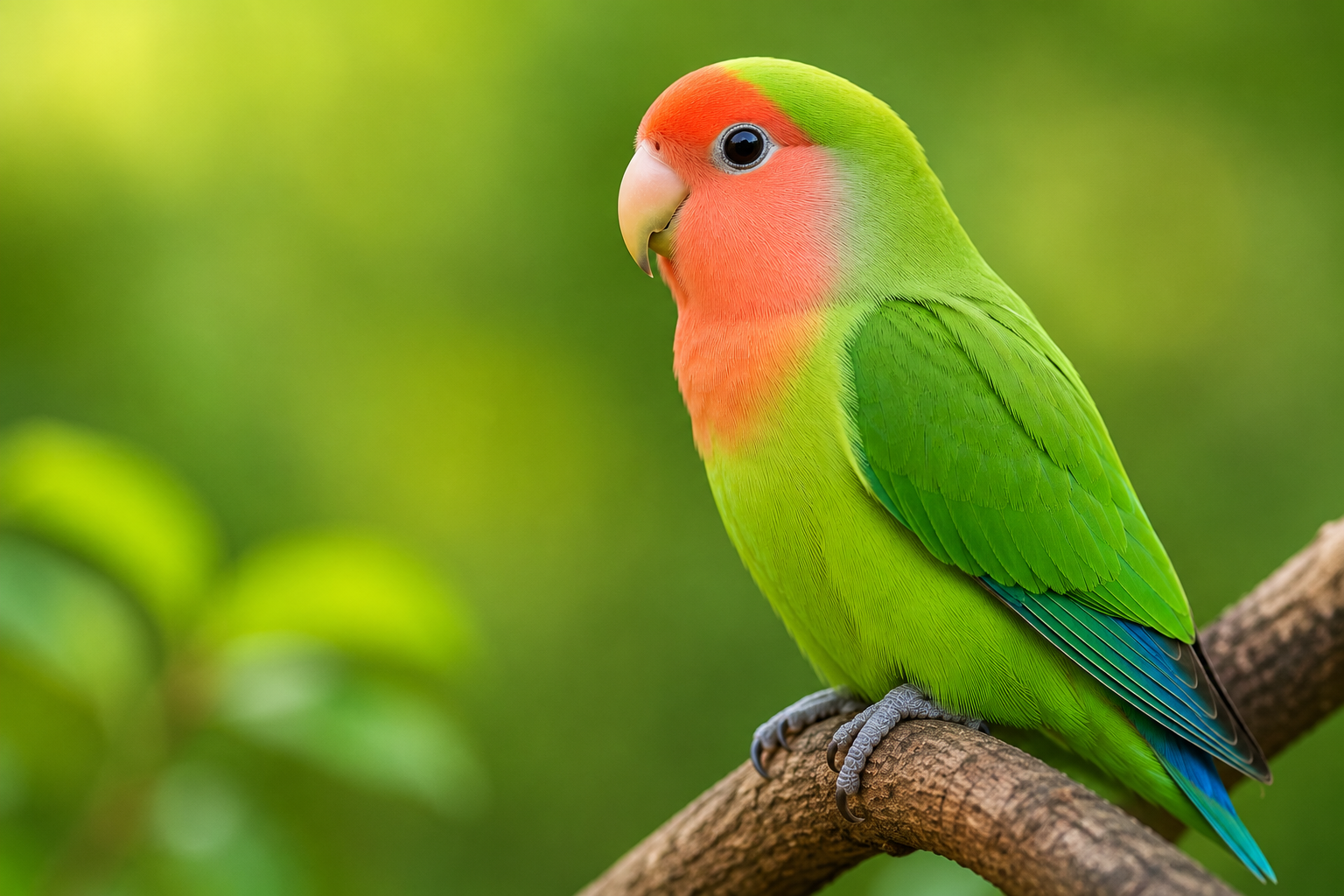
Lovebirds are amongst the most vibrant and affectionate small parrot species out there – and it’s no wonder they’ve earned a spot in the hearts (and homes) of many a bird enthusiast around the world. If you’re curious about all the different breeds of lovebirds.
Then this guide is the place for you because we cover everything you need to know about these wonderful little birds. Lovebirds are part of the genus Agapornis – a group of nine pretty well known lovebird species that originally hail from Africa and Madagascar.
People started calling them “lovebirds” because of how strongly these little birds bond and the affectionate way they often treat each other. While there are nine species of lovebird out there, only a handful of them are commonly kept as pets – like the super popular peach-faced lovebird, the unmissable masked lovebird, and Fischer’s lovebird. Each one of these species has its own one-off colours, markings, personality – and lets be honest, care requirements that can be quite unique.
If you’re either just starting out as an owner or a seasoned bird enthusiast, getting to know the various types of lovebirds – from the cheerful little peach-faces to the rarer breeds – will make it loads easier to pick the perfect companion and will give you a whole new appreciation for these utterly fascinating birds.
Quick answer: There are 9 types of lovebirds, all in the genus Agapornis and native to Africa and Madagascar. The three commonly kept as pets are the Peach-faced, Fischer’s and Masked lovebirds. The other six are Lilian’s, Black-cheeked, Abyssinian, Red-faced, Grey-headed and Black-collared lovebirds, which are rare in captivity.
How Many Different Breeds of Lovebirds Are There?
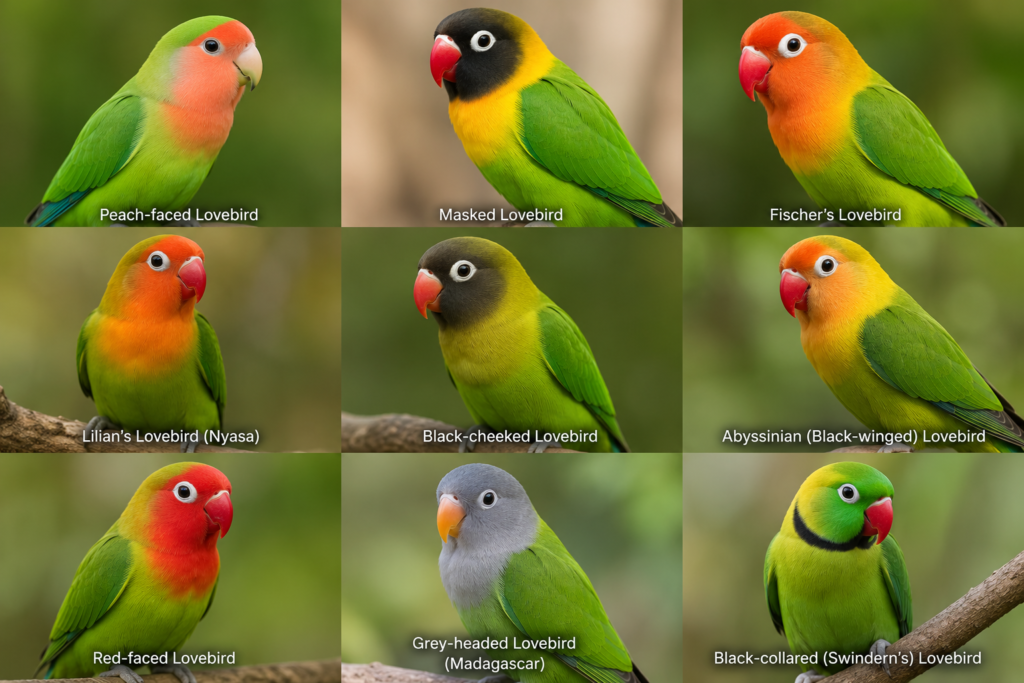
There are 9 different breeds of lovebirds, all classified in the genus Agapornis. These tiny, beautiful parrots hail from Africa, & it just so happens that one of the species – the Madagascar lovebird – is exclusive to Madagascar. We all know that lovebirds get a bad rep for being a bit one-sided in their love lives, but that’s actually not the case.
They’re actually really into affection & forming strong pair bonds, which is probably where they get their name from. Each of the lovebird species has its own little quirks when it comes to things like plumage, beak colour, size & personality, & whether theyve got that super distinctive white eye ring or not.
Take Agapornis fischeri for example – that one’s a real showstopper when it comes to colors & looks, while Agapornis nigrigenis is easily picked out by its dark cheek patches. Then there’s the Nyasa lovebird, which is easily identified by its soft – almost orange-red – head.
Some lovebirds even sport yellow collars, while others have more understated markings. The one thing you will notice is that the males & females can sometimes look pretty similar, but sadly most lovebird species just aren’t commonly bred or kept as pets in captivity.
Quick Comparison of All Different Breeds of Lovebirds
| Lovebird Species | Scientific Name | Eye Ring | Size | Common as Pet | Difficulty |
|---|---|---|---|---|---|
| Peach-faced | Agapornis roseicollis | No | Small | ★★★★★ | Easy |
| Fischer’s | Agapornis fischeri | Yes | Small | ★★★★★ | Easy |
| Masked | Agapornis personatus | Yes | Small | ★★★★★ | Moderate |
| Lilian’s | Agapornis lilianae | Yes | Small | Rare | Moderate |
| Black-cheeked | Agapornis nigrigenis | Yes | Small | Rare | Moderate |
| Abyssinian | Agapornis taranta | No | Largest | Rare | Moderate |
| Red-faced | Agapornis pullarius | No | Medium | Very Rare | Difficult |
| Grey-headed | Agapornis canus | No | Small | Very Rare | Difficult |
| Black-collared | Agapornis swindernianus | No | Medium | Almost Never | Expert |
The 9 Different Breeds of Lovebirds Explained
1. Peach-faced Lovebird (Agapornis roseicollis)
The Peach-faced Lovebird is the most popular companion among lovebird species thanks to its gentle personality and adaptability. Its colourful appearance and playful behaviour make it an excellent choice for first-time bird owners.
- One of the most common different types of lovebirds kept as pets.
- Features a bright pink face and throat with mostly green or bright green feathers.
- Has a distinctive blue rump, while some colour mutations show blue or purple shades.
- Unlike eye-ring species, it has no white ring around the eyes.
- Adults grow about 15–17 cm long with a sturdy red beak.
- Friendly, curious, and known for its affectionate nature and strong pair bonding.
- Lifespan averages 15–20 years with proper care.
- Native to southern Africa and widely bred for the pet trade.
- A perfect beginner-friendly member of the 9 species of lovebirds.
2. Masked Lovebird (Agapornis personatus)
The Masked Lovebird is admired for its striking facial markings and energetic personality. It is one of the most colourful different species of lovebirds commonly found in aviculture.
- Recognised by its black face and head with a golden yellow or bright yellow collar.
- Displays green bodies with a vivid red beak.
- Has a bright white ring around each eye.
- Sometimes referred to as the yellow-collared lovebird because of its distinctive neck colouring.
- Highly curious, intelligent, and active throughout the day.
- Enjoys daily interaction and toys for mental stimulation.
- Thrives in pairs because of its strong pair bonding behaviour.
- Requires a spacious cage, fresh food, and regular exercise.
- Native to East Africa and one of the most popular different lovebird choices for experienced owners.
3. Fischer’s Lovebird (Agapornis fischeri)
Fischer’s Lovebird is famous for its cheerful personality and stunning vibrant colors. It is one of the friendliest members of the nine species and remains a favourite companion bird worldwide.
- Scientifically known as Agapornis fischeri.
- Bright orange-yellow face and head with green plumage.
- Features a clear white eye ring around each eye.
- Has a bright red beak and compact body.
- Fischer’s lovebird is extremely playful and enjoys social interaction.
- Fischer’s Lovebird forms close bonds with its owner and other birds.
- Average lifespan ranges from 12–20 years with proper care.
- Native to Tanzania and commonly bred for the pet trade.
- One of the most recognisable different species of lovebirds due to its colourful appearance.
4. Lilian’s Lovebird (Nyasa Lovebird)
Lilian’s Lovebird, also known as the Nyasa Lovebird, is a beautiful but less common species. It closely resembles Fischer’s lovebird but has several unique characteristics.
- Scientifically known as Agapornis lilianae.
- Displays an orange-red face and throat with bright green bodies.
- Surrounded by a distinct white eye ring around the eyes.
- Lilian’s lovebird is considered the smallest of the lovebird species.
- Native to southeastern Africa near Lake Malawi.
- Often confused with Fischer’s because of similar colouring.
- Wild populations face habitat loss, making conservation important.
- Lilian’s lovebirds are less common in captivity than other pet species.
- Appreciated for their gentle temperament and beautiful green plumage.
5. Black-cheeked Lovebird (Agapornis nigrigenis)
The Black-cheeked Lovebird is one of the rarest different types of lovebirds in the wild. Its unique facial markings make it easy to distinguish from other species.
- Scientifically known as Agapornis nigrigenis.
- Features dark brown to black cheeks with a white eye ring around the eyes.
- Body is mostly green in color with a bright red beak.
- Native to Zambia, where wild populations remain relatively small.
- Naturally inhabits woodland and open forest habitats.
- Calm, social, and highly intelligent.
- Less frequently seen in the pet trade compared to Fischer’s or Peach-faced Lovebirds.
- Conservation efforts continue to protect declining populations.
- One of the most fascinating different species of lovebirds.
6. Abyssinian (Black-winged) Lovebird (Agapornis taranta)
The Black-winged Lovebird is the largest member among the 9 species of lovebirds. Its calm personality and striking markings make it unique.
- Also known as the black-winged lovebird.
- Adult males display a bright red forehead around the eyes.
- Wings contain distinctive black flight feathers.
- Body is mostly green with a sturdy red beak.
- Native to Ethiopia and native to the African continent.
- Known for its gentle and calm temperament.
- Less commonly available as a pet than other species.
- Strong flyer that enjoys spacious aviaries.
- A favourite among experienced keepers looking for a different lovebird.
7. Red-faced Lovebird (Agapornis pullarius)
The Red-faced Lovebird is one of the most striking but least common lovebird species. Its specialised breeding habits make it difficult to keep in captivity.
- Also called the red-faced lovebird or red-headed lovebird.
- Features a bright red or orange-red face and throat.
- Has green bodies with darker wings and a red beak.
- Native to tropical forests across West and Central Africa.
- Naturally nests inside termite mounds instead of tree cavities.
- Rarely breeds successfully in captivity.
- Less common in the international pet trade.
- Displays excellent pair bonding behaviour in the wild.
- One of the most unusual different species of lovebirds.
8. Grey-headed Lovebird (Agapornis canus)
The Grey-headed Lovebird is the only lovebird native to Madagascar. It differs from most other species because males and females have noticeably different colours.
- Also called the Madagascar Lovebird or grey-headed lovebird.
- Males have a grey face and head, while females remain entirely green.
- Body shows soft green plumage with a pale rump.
- Found across the island of Madagascar.
- Excellent example of sexual dimorphism among parrots.
- Quiet and less aggressive than many other lovebirds.
- Rarely available outside specialist breeders.
- Considered one of the least common pet species.
- An important member of the different species of lovebirds.
9. Black-collared (Swindern’s) Lovebird (Agapornis swindernianus)
Swindern’s Lovebird is one of the rarest parrots kept by humans. Its specialised diet and habitat requirements make it extremely challenging to maintain in captivity.
- Also known as Swindern’s Lovebird.
- Recognised by the distinctive black collar across the back of the neck.
- Body is mostly green with a bright red beak.
- Lives in dense rainforests native to Africa.
- Feeds heavily on native fig species and other forest fruits.
- Difficult to adapt to captive diets.
- Almost never seen in the commercial pet trade.
- Best suited to life in its natural forest habitat.
- Considered one of the rarest members of the nine species of lovebirds.
Which Lovebird Breed Makes the Best Pet?
Choosing the best pet from the different breeds of lovebirds depends on your experience, lifestyle, and the amount of daily interaction you can provide. While each species has its own personality, a few stand out for their friendliness, intelligence, and ease of care.
- Peach-faced Lovebird – Best Overall: Friendly, affectionate, easy to tame, and highly recommended for beginners. Moderate noise level, quick to learn simple tricks, and relatively easy to care for.
- Fischer’s Lovebird – Best for Playfulness: Extremely playful, social, and energetic. Enjoys interactive toys and bonding with its owner. Moderate noise level and suitable for owners who can provide daily attention.
- Masked Lovebird – Best for Intelligence: Curious, active, and intelligent. Learns routines quickly and benefits from regular mental stimulation. Slightly more vocal than Peach-faced Lovebirds.
- Abyssinian Lovebird – Best for Experienced Owners: Calmer than many species but less common and more challenging to find. Best suited for experienced keepers familiar with their care needs.
- Talking Ability: Lovebirds are not strong talkers, though some can imitate a few words or sounds with consistent training.
- Affection and Bonding: All lovebirds form close bonds with their owners when properly socialised, making them wonderful companion parrots.
How to Identify Different Breeds of Lovebirds?
Identifying the different breeds of lovebirds is easier when you focus on a few key physical features instead of colour alone. Comparing multiple characteristics will help you accurately recognise each species.
- Face Color: Peach-faced Lovebirds have pink faces, Fischer’s have orange-yellow faces, Masked Lovebirds have black faces, and Red-faced Lovebirds display bright red faces.
- Eye Ring: Fischer’s, Masked, Lilian’s, and Black-cheeked Lovebirds have a distinct white eye ring, while Peach-faced and several others do not.
- Beak Color: Most species have bright red or orange-red beaks.
- Wing Markings: The Abyssinian Lovebird stands out with black wing feathers.
- Body Size: Lilian’s is the smallest, while the Abyssinian is the largest species.
- Tail Shape: Most have short tails, but Peach-faced Lovebirds have slightly longer, pointed tails.
- Native Origin: Most species are native to Africa, while the Grey-headed Lovebird is native to Madagascar.
Frequently Asked Questions
How many different breeds of lovebirds are there?
There are nine recognized different breeds of lovebirds, all belonging to the genus Agapornis. These small parrots are native to Africa and Madagascar and vary in colour, markings, size, and temperament. While all nine species exist in the wild, only a few, such as Peach-faced, Fischer’s, and Masked Lovebirds, are commonly kept as companion pets.
Which lovebird breed is the friendliest?
The Peach-faced Lovebird is widely considered the friendliest species. It is affectionate, easy to tame, and enjoys interacting with people when socialised from a young age. Fischer’s Lovebirds are also friendly and playful, while Masked Lovebirds tend to be slightly more independent but still develop strong bonds with their owners.
What is the rarest lovebird species?
The Black-collared Lovebird (Agapornis swindernianus) is considered the rarest of the different breeds of lovebirds in captivity. It has specialised dietary needs, prefers dense rainforest habitats, and adapts poorly to captive environments. As a result, it is rarely seen in the pet trade and is primarily found in its natural habitat in Africa.
Which lovebird is best for beginners?
The Peach-faced Lovebird is the best choice for beginners because of its gentle temperament, adaptability, and ease of care. It is generally easier to tame than many other species and thrives with regular interaction. New bird owners often find this species more forgiving and easier to train than rarer lovebirds.
What is the difference between Fischer’s and Masked lovebirds?
Fischer’s Lovebirds have bright orange-yellow faces and green bodies, while Masked Lovebirds feature a black head with a yellow collar. Both have white eye rings, but Masked Lovebirds are generally more active and vocal. Fischer’s Lovebirds are often considered slightly more playful and outgoing with their owners.
Are Peach-faced lovebirds better pets than Fischer’s?
Both species make excellent pets, but Peach-faced Lovebirds are usually better for first-time owners because they are easier to tame and adapt well to handling. Fischer’s Lovebirds are highly social and energetic, making them ideal for owners who can provide plenty of attention, enrichment, and daily interaction.
Can different lovebird species mate?
Yes, some lovebird species can mate and produce hybrid offspring, especially closely related species kept together in captivity. However, responsible breeders generally avoid hybrid breeding to preserve pure bloodlines. Keeping compatible pairs of the same species is recommended for maintaining healthy and genetically distinct lovebird populations.
Which lovebird species talks the most?
Lovebirds are not known for strong talking abilities compared to larger parrots. However, Peach-faced and Fischer’s Lovebirds may learn a few words or sounds with patient training and regular repetition. Most owners value these birds more for their playful personalities, intelligence, and affectionate behaviour than their speech.
Do all lovebirds have white eye rings?
No, not all lovebirds have white eye rings. Only four species Fischer’s, Masked, Lilian’s, and Black-cheeked Lovebirds display this distinctive feature. Peach-faced, Abyssinian, Red-faced, Grey-headed, and Black-collared Lovebirds do not have white eye rings, making this one of the easiest identification characteristics.
Which lovebird species lives the longest?
The Peach-faced Lovebird generally has one of the longest lifespans among the different breeds of lovebirds, often living 15 to 20 years with proper care. A healthy diet, spacious cage, mental stimulation, regular exercise, and routine veterinary care all contribute to a longer, healthier life for companion lovebirds.
Conclusion
The nine recognized lovebird species each offer unique colors, markings, personalities, and care needs. From the striking Black-collared Lovebird to the calm Abyssinian and colourful Lilian’s Lovebird, every species has characteristics that appeal to different bird enthusiasts.
However, the Peach-faced Lovebird, Fischer’s Lovebird, and Masked Lovebird remain the most popular companion birds because they are friendly, social, and relatively easy to care for.
When choosing a lovebird, focus on its temperament, activity level, care requirements, and availability instead of appearance alone. Matching a bird’s needs with your lifestyle will create a stronger bond and a more rewarding ownership experience.
By understanding the different breeds of lovebirds, you can provide the proper diet, housing, enrichment, and attention each species requires, helping your feathered companion live a healthier, happier, and longer life.
Matching a Lovebird to Your Lifestyle
Looks are only part of the story. Each of the 9 lovebird species has its own personality, energy level, and care needs, so the best bird for you is the one that fits your daily life. A good match means a happier bird and a stronger bond.
First-time owners do best with the Peach-faced Lovebird. It is gentle, forgiving, and easy to tame, and it adapts well to home life. Families with children also do well with Peach-faced and Fischer’s Lovebirds, as long as children handle the birds under adult supervision.
In an apartment, choose a quieter bird and keep a steady routine. The Peach-faced Lovebird has a moderate noise level and settles well indoors. If you want the most playful companion, pick a Fischer’s or Masked Lovebird and provide puzzle toys, climbing ropes, and supervised out-of-cage flight time every day.
Lovebird Diet and Nutrition: The 70/20/10 Rule
A seed-only diet is one of the most common mistakes in lovebird care. Many experienced keepers follow a simple 70/20/10 rule: about 70 percent high-quality pellets, 20 percent fresh vegetables, and 10 percent fruits, healthy seeds, and treats.
Offer dark leafy greens, carrots, broccoli, and bell peppers daily, plus small amounts of fruit a few times a week. Foraging toys that hide food keep your bird mentally sharp and mimic natural feeding behaviour.
Some everyday foods are toxic to lovebirds and must be avoided completely: avocado, chocolate, caffeine, onion, garlic, alcohol, and the pits of stone fruits. When in doubt, leave it out of the cage.
Housing Your Lovebird: Cage Size, Enrichment, and Safety
Lovebirds are small but very active, so cage size matters more than many owners expect. A single lovebird needs a cage at least 24 inches wide with bar spacing no wider than half an inch. Bigger is always better.
Fill the cage with natural wood perches of different diameters, climbing ropes, and a rotating mix of chew, shred, and foraging toys. Daily supervised flight time outside the cage keeps muscles strong and minds busy.
Keep the cage away from kitchens, where fumes from overheated nonstick cookware can be fatal, and avoid cages or toys made with zinc or lead. A calm, well-lit room away from constant draughts makes the best home base.
Understanding the Lovebird Social Bond
Lovebirds earned their name honestly. In the wild they form deep, lasting pair bonds, and pet lovebirds bring that same devotion into the home, either with a feathered partner or with you.
A single lovebird will usually bond closely with its owner and needs daily talking, training, and play to stay happy. A bonded pair will focus more on each other. Whichever you choose, plan on daily interaction, because lonely lovebirds can develop feather plucking or constant calling.