Skip to content

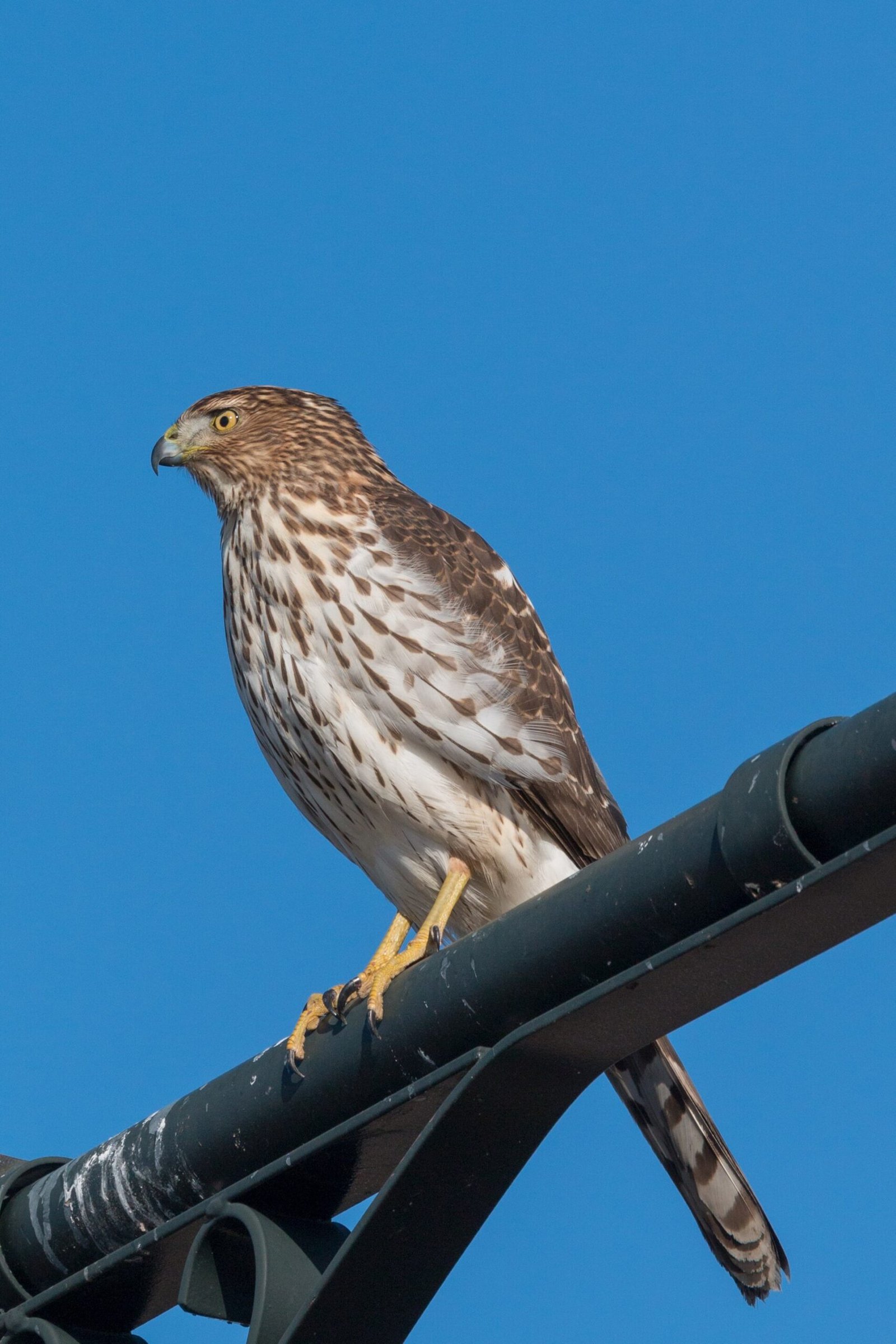
Quick answer: In the cooper’s hawk vs sharp-shinned hawk matchup, size is the first clue: Cooper’s Hawks are crow-sized with a large blocky head, rounded tail tip, and slow steady wingbeats, while Sharp-shinned Hawks are jay-sized with a small round head, squared tail tip, and quick snappy wingbeats. Confirm with two or three field marks.
The cooper’s hawk vs sharp-shinned hawk puzzle usually starts the same way: a streaky brown hawk explodes through your backyard, scatters the sparrows, and vanishes behind the fence. Was it a Cooper’s Hawk or a Sharp-shinned Hawk? If you have asked yourself this question, you are in good company. It is one of the most famous identification challenges in North American birding.
Both birds are accipiters, the genus of short-winged, long-tailed hawks built for chasing other birds hrough trees. They share the same blue-gray adult plumage, the same brown-streaked juvenile plumage, and the same backyard hunting habits. But once you know which field marks to check, you can separate them with confidence.

Why Are Cooper’s and Sharp-Shinned Hawks So Hard to Tell Apart?
The cooper’s hawk vs sharp-shinned hawk confusion is completely understandable, and it has three main causes.
First, they are close relatives with nearly identical plumage — the root of the cooper’s hawk vs sharp-shinned hawk confusion. Adults of both species are slate gray above with warm orange barring below and red eyes. Juveniles of both are brown above with dark vertical streaking below.
Second, their size ranges overlap where the sexes meet. Females of both species are roughly one-third larger than males, so a large female Sharp-shinned Hawk can approach the size of a small male Cooper’s Hawk. If you judge by size alone, you will sometimes be wrong.
Cooper’s Hawk vs Sharp-Shinned Hawk: Side-by-Side Comparison Table
This cooper’s hawk vs sharp-shinned hawk comparison table puts every major field mark in one place.
| Field Mark | Cooper’s Hawk | Sharp-Shinned Hawk |
|---|---|---|
| Length | 14 to 20 inches, roughly crow-sized | 9 to 13 inches, roughly jay-sized |
| Wingspan | 24 to 35 inches | 17 to 21 inches |
| Head | Large, blocky, angular, with a visible neck | Small, round, barely past the wings, looks neckless |
| Tail tip | Rounded, outer feathers shorter | Squared or slightly notched |
| Adult crown | Dark cap contrasting with a paler nape | Hooded look, dark crown blends into the nape |
| Legs | Thick and robust | Pencil-thin and delicate |
| Body shape | Barrel-chested, widest at mid-body | Widest at the shoulders, narrowing toward the hips |
| Flight | Slow steady wingbeats, longer glides | Quick snappy wingbeats, shorter glides |
| Call | Slower, lower “cak-cak-cak” | Higher, rapid “kik-kik-kik” |
For range maps, photos, and sounds that support this cooper’s hawk vs sharp-shinned hawk comparison, the Cornell Lab of Ornithology’s All About Birds species accounts cover the Cooper’s Hawk and the Sharp-shinned Hawk in detail.
Cooper’s Hawk vs Sharp-Shinned Hawk: 7 Field Marks That Actually Work
Think of this section as your personal cooper’s hawk vs sharp-shinned hawk identification guide. Work through the marks in order, and stack at least two or three before you commit to an ID.
1. Size: Cooper’s Hawk Size vs Sharp-Shinned Hawk
Size is the fastest first impression, and it is right most of the time. A Cooper’s Hawk is about the size of an American Crow, 14 to 20 inches long with a 24 to 35 inch wingspan. A Sharp-shinned Hawk is about the size of a Blue Jay, 9 to 13 inches long with a 17 to 21 inch wingspan.
But remember the overlap trap. Females run about one-third larger than males in both species, so a big female sharp-shin and a small male Cooper’s can look nearly identical in size. Treat size as a strong hint, then confirm with the structural marks below.
2. Head Shape and Neck Projection
Head shape is one of the most reliable marks, and it works on perched and flying birds. A Cooper’s Hawk has a large, blocky, angular head that looks almost too big for its body. In flight, that big head projects well past the leading edge of the wings, and you can see a distinct neck.
A Sharp-shinned Hawk has a small, round head that barely sticks out past the wings in flight. On a perched bird it often looks like the head sits directly on the shoulders with no neck at all. Big blocky head with a neck means Cooper’s. Small round head with no neck means sharp-shin.
3. Tail Shape: The Hawk Tail Shape Identification Test
Hawk tail shape identification is the classic cooper’s hawk vs sharp-shinned hawk field mark. Look at the very tip of the tail. On a Cooper’s Hawk, the outer tail feathers are noticeably shorter than the central ones, which rounds off the tip. On a Sharp-shinned Hawk, all the tail feathers are close to the same length, so the tip looks squared off, sometimes with a small notch in the center.
Two cautions. First, worn or molting feathers can fake a rounded or squared tip, so check this mark when the tail looks fresh and even. Second, judge it on a perched bird with the tail folded or on a flying bird gliding straight at you. A fanned tail in a banking turn can mislead.

4. Cap vs Hood: The Adult Crown Clue
This mark only works on adults, but when it works it is close to decisive. An adult Cooper’s Hawk wears a dark cap: the crown is dark gray and contrasts clearly with the paler gray nape. An adult Sharp-shinned Hawk looks hooded instead: the dark crown color continues down the nape with little contrast.
Check this on a perched adult in good light. Juveniles of both species have streaky brown heads with no cap or hood, so skip this mark entirely on young birds and lean on head shape, tail shape, and size instead.
5. Legs, Feet, and Body Shape
The names are honest here. A Sharp-shinned Hawk has famously thin, delicate, pencil-like legs and small feet, built for snatching small songbirds. A Cooper’s Hawk has thicker, more robust legs and larger feet, built for grappling bigger prey like doves and jays.
Body shape backs this up. A Cooper’s Hawk is barrel-chested, widest around the middle of its body. A Sharp-shinned Hawk is widest at the shoulders and tapers down toward narrow hips, giving it a top-heavy silhouette.
6. Flight Style
When the bird is moving, watch how it flies rather than what it looks like — flight style is one of the most underused tools in cooper’s hawk vs sharp-shinned hawk identification. A Cooper’s Hawk flies with slow, steady, powerful wingbeats and then stretches out into long smooth glides. A Sharp-shinned Hawk flies with quick, snappy, almost nervous wingbeats and takes only short glides between bursts.
Both species use the classic accipiter pattern of flap-flap-glide through wooded areas, so focus on the tempo. Slow and smooth points to Cooper’s. Fast and flicky points to sharp-shin.
7. Calls
You will hear these hawks far less often than you see them, since both are usually silent around feeders, but calls can clinch a cooper’s hawk vs sharp-shinned hawk ID near a nest. A Cooper’s Hawk gives a slower, lower-pitched “cak-cak-cak,” while a Sharp-shinned Hawk gives a higher, faster “kik-kik-kik.”
What If Size Lies? Females, Juveniles, and the Overlap Problem
Here is the honest truth about cooper’s hawk vs sharp-shinned hawk identification when size refuses to cooperate. In both species, females are roughly one-third larger than males, which is one of the biggest size gaps between sexes of any North American hawk. A large female Sharp-shinned Hawk can stand nearly as tall as a small male Cooper’s Hawk, and a lone bird with no reference object can fool anyone.
When size is ambiguous in cooper’s hawk vs sharp-shinned hawk identification, demote it and promote structure. Head shape, tail tip shape, leg thickness, and body silhouette do not change with sex. A bird with a huge blocky head, thick legs, and a rounded tail tip is a Cooper’s Hawk even if it looks small.
Juveniles add one more wrinkle: both wear brown streaky plumage in their first year, so ignore the cap-versus-hood mark on young birds and lean on head shape, tail shape, and leg thickness instead.
How to Identify a Cooper’s Hawk: 3 Mistakes Beginners Make
Knowing what not to do is half the cooper’s hawk vs sharp-shinned hawk identification skill. These are the traps that catch almost everyone at first.
- Trusting size alone: A female sharp-shin can match a male Cooper’s in size, so back up every size guess with head or tail shape.
- Judging the tail when it is worn or fanned: Molt, wear, and banking turns distort the tail tip. Check it on a folded or straight gliding tail, and treat ragged tails as unreadable.
- Forgetting that all juveniles look streaky: Brown streaked underparts do not identify either species. On young birds, skip plumage and read structure: head, legs, tail, and body shape.
If your mystery bird turns out to be small, brown, and streaky but lacks the long tail and hooked bill of a hawk, it may not be a raptor at all. Our quick ID guide to small brown yard birds can help you sort the songbirds from the raptors.
Sharp-Shinned Hawk vs Cooper’s Hawk Identification: Your 10-Second Field Checklist
When a hawk flashes past and you have seconds, run this cooper’s hawk vs sharp-shinned hawk checklist in order and go with the majority vote.
- Size: Crow-sized leans Cooper’s, jay-sized leans sharp-shin.
- Head: Large and blocky with a visible neck leans Cooper’s, small and round with no neck leans sharp-shin.
- Tail tip: Rounded leans Cooper’s, squared or notched leans sharp-shin.
- Legs: Thick and strong leans Cooper’s, pencil-thin leans sharp-shin.
- Flight: Slow steady beats with long glides leans Cooper’s, quick snappy beats with short glides leans sharp-shin.
Three or more marks pointing the same way is a confident cooper’s hawk vs sharp-shinned hawk ID. Two against two means you say “accipiter species” and enjoy the bird anyway. There is no shame in that; caution is part of good birding.
Want a second opinion from your phone on a tricky cooper’s hawk vs sharp-shinned hawk ID? A clear photo run through a modern ID tool can confirm what your eyes told you.

Frequently Asked Questions
Which is bigger, a Cooper’s Hawk or a Sharp-Shinned Hawk?
The Cooper’s Hawk is the larger bird: 14 to 20 inches long with a 24 to 35 inch wingspan, roughly crow-sized. The Sharp-shinned Hawk is 9 to 13 inches long with a 17 to 21 inch wingspan, roughly jay-sized. Females of both are about one-third larger than males, so the biggest sharp-shins and smallest Cooper’s can overlap.
What is the easiest field mark for telling them apart?
For the classic cooper’s hawk vs sharp-shinned hawk question, the tail tip is the easiest single mark for most beginners. A Cooper’s Hawk shows a rounded tail tip because its outer tail feathers are shorter, while a Sharp-shinned Hawk shows a squared or slightly notched tip because its feathers are nearly equal in length.
Can a Sharp-Shinned Hawk be as big as a Cooper’s Hawk?
Almost. A large female Sharp-shinned Hawk can approach the size of a small male Cooper’s Hawk, because females run about one-third larger than males in both species. This overlap is exactly why experienced birders never rely on size alone and always check head shape, tail shape, and legs.
Do both hawks hunt at backyard bird feeders?
Yes. Both are bird-hunting accipiters, and feeders concentrate their prey. Sharp-shinned Hawks specialize in small songbirds like sparrows and finches, often ambushing them right at the feeder. Cooper’s Hawks also visit feeders but can take larger prey such as doves and jays.
How can you tell a juvenile Cooper’s Hawk from a juvenile Sharp-Shinned Hawk?
In the cooper’s hawk vs sharp-shinned hawk juvenile puzzle, ignore plumage color, since both juveniles are brown above and streaked below. Use structure instead: the juvenile Cooper’s has a larger blocky head, thicker legs, a barrel-shaped body, and a rounded tail tip, while the juvenile sharp-shin has a smaller rounder head, pencil-thin legs, a shoulder-heavy body, and a squared tail tip.
What do their calls sound like?
For the cooper’s hawk vs sharp-shinned hawk sound check: a Cooper’s Hawk gives a slower, lower-pitched “cak-cak-cak,” while a Sharp-shinned Hawk gives a higher-pitched, faster “kik-kik-kik.” Both are usually silent while hunting, so you are most likely to hear them near nesting areas in spring and summer.
Which one am I more likely to see at my feeder in winter?
It depends on where you live, since both species migrate and winter across much of North America. In the cooper’s hawk vs sharp-shinned hawk winter matchup, Sharp-shinned Hawks are frequent winter visitors to backyard feeders in many regions because they specialize in the small songbirds feeders attract. Cooper’s Hawks visit feeders year-round wherever they are resident.
Keep Practicing and Trust the Checklist
Separating Cooper’s Hawks from Sharp-shinned Hawks is a skill, not a talent, and every confusing flyby makes the next one easier. Start with size, confirm with head shape and tail tip, and let flight style break the ties. Stack two or three marks and compare your notes against the cooper’s hawk vs sharp-shinned hawk comparison table above. Within a season of feeder watching, this famous ID puzzle starts to feel routine.
And once these two accipiters feel easy, keep stretching your skills. Our hawk versus falcon identification guide tackles the next classic confusion pair, and our small brown bird ID guide helps with everything else visiting your yard. Happy hawk watching.