 Skip to content

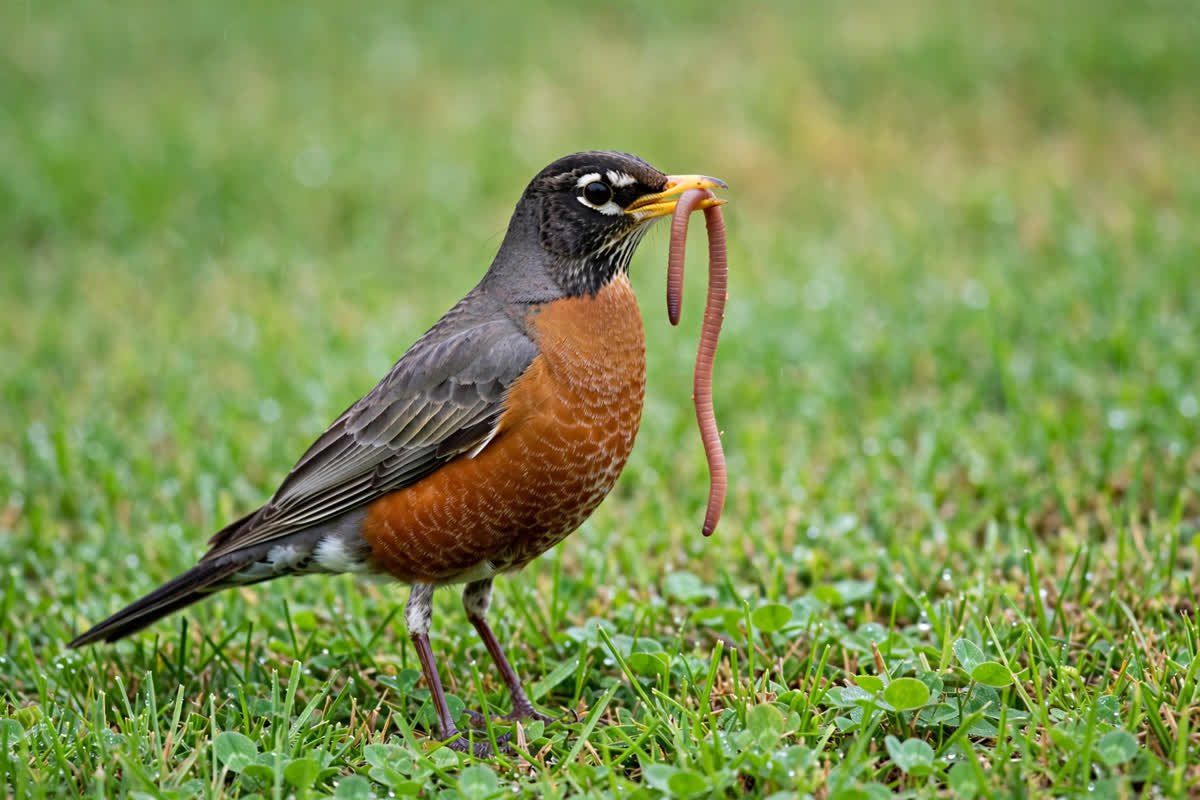
How do robins find worms? Mostly by sight. The famous head tilt that looks exactly like listening is really the robin aiming one sharp eye at the ground, scanning for the tiny soil movements that betray a worm near the surface. Hearing may play a small supporting role, but the experiments point to vision as the lead sense.
The answer surprises many people. For more than a century, naturalists assumed robins cocked their heads to listen for worms moving underground. That idea felt so right that it lived on in books, articles, and backyard wisdom for generations. Scientists have since tested it directly, using hidden worms, cardboard barriers, and white noise, and the results tell a more interesting story.
This guide walks through what researchers have learned about how robins locate earthworms, why the head tilt matters, what hearing actually contributes, why rainy days turn lawns into worm buffets, and the full run, pause, tilt, and strike sequence you can watch on any lawn. You will also learn what else robins eat and how their diet shifts with the seasons.

The Short Answer: Mostly by Sight
Robins find worms mainly with their eyes. The Audubon field guide puts it plainly: the American robin apparently locates earthworms by sight, not by hearing them move underground. That is the current scientific consensus, and it comes from decades of observation and controlled experiments.
What the robin is actually looking for is subtle. A worm working near the surface disturbs the soil, shifts a blade of grass, or pokes the pink tip of its body out of a burrow opening. Robins also key in on worm castings and the tiny holes where worms have been active. From a few feet away, those cues are invisible to us, but they are well within a robin’s visual range.
Robin eyesight is built for this kind of work. Their eyes sit on the sides of their heads, giving them a wide field of view for scanning the lawn, and their color vision helps them separate the earthy tones of a worm or disturbed soil from the surrounding grass. Most of their hunting happens in daylight, especially during the early morning hours when worms are near the surface, which is one reason dawn is the best time of day to see birds in action.
The Head Tilt Is Not Listening
The listening myth has deep roots. Naturalists writing as far back as the 1800s watched robins hop along, stop, and cock their heads, and they concluded the birds were listening for worms. The pose looks so convincingly like a person straining to hear that the explanation stuck, repeated in popular articles and field guides for well over a century.
The tilt is actually about vision, not sound. Like many birds, robins use monocular vision when they aim at something close: each eye works independently. Tilting the head brings one eye close to the ground for a detailed look at a promising spot. The other eye stays pointed up and outward, still watching for hawks, cats, and other predators. It is a clever division of labor that lets the robin hunt and stay alert at the same time.
You can see this for yourself on any lawn. When a robin pauses and tilts, watch which way the lowered eye is aimed. It is pointed straight at the patch of ground the bird is about to strike, locking on like a sight on a target. The bird is not cocking an ear toward the soil. It is aiming an eye.
What the Experiments Show About How Robins Find Worms
The first serious test came from ornithologist Frank Heppner, who published a report in May 1965 titled “Sensory Mechanisms and Environmental Clues used by the American Robin in locating earthworms.” He designed experiments around each of the five senses to find out which one the birds were really using.
In one set of trials, Heppner drilled holes in the ground that looked exactly like worm holes. The robins ignored the fake holes unless a real worm was inside and within visual range. It did not matter whether the worm was alive, dead, or coated with a bad-smelling substance. The birds found it by seeing it. By systematically ruling out hearing, smell, taste, and touch, he concluded that sight was the key sense robins use to find earthworms.
Later experiments dug deeper. In aviary trials described by Indiana University’s Moment of Science, researchers buried mealworms in trays of dirt and tested each sense in turn. Robins found live worms more often than dead ones, which argued against smell, and birds have a poor sense of smell in general.
Hanging the trays so the birds could not feel vibrations through their feet made no difference, ruling out touch. When cardboard blocked the birds’ view of the soil, they could still find the worms, which meant another sense was at work. When white noise blocked their hearing, the hunting got noticeably harder. The researchers concluded that robins could use visual or auditory cues alone to find worms, but probably use both together.
Taken as a whole, the evidence points the same direction: vision leads, and hearing can back it up when sight is limited. That balance matters, because it keeps the popular story from being completely wrong while correcting where it goes too far.

Can Robins Hear Worms Too?
The honest answer is that hearing probably helps, but as a secondary sense rather than the main one. The aviary experiments show robins can locate buried worms when they cannot see them, as long as they can hear. That is a real ability, demonstrated under controlled conditions, and it deserves more credit than the old “it’s all vision” story sometimes gives it.
Researcher Bob Montgomerie of Queen’s University in Canada even recorded the sounds worms make underground, using a high-sensitivity directional microphone in a soundproof chamber. The sounds were extremely faint, just soil particles shifting as the worms moved, but they were real sounds a sensitive ear could pick up. In related captive experiments, robins had the hardest time finding worms when their hearing was compromised, which suggests the ears matter more than the early vision-only experiments implied.
There is an important catch. Finding a worm in a quiet lab tray is not the same as finding one on a noisy suburban lawn with traffic, wind, and other birds calling. In the wild, especially in daylight on open grass, vision almost certainly does most of the work. Hearing looks like a backup system the robin can fall back on when visual cues are poor, such as in dim light, deep leaf litter, or dense cover.
So the fair summary is this: robins are primarily visual hunters that can also listen. The head tilt is visual aiming, not eavesdropping, but a robin’s ears are not idle while it hunts.
Why Robins Find More Worms After Rain
Anyone who watches robins knows the best hunting follows a rainstorm. Lawns fill with robins after a downpour, and there is a good reason. Rain brings worms up, which puts more prey within a robin’s reach. Robins also gather in numbers where sprinklers are running or lawns have just been mowed, because both situations expose or attract prey near the surface.
Worms surface in wet weather for practical reasons. Earthworms breathe through their skin, which must stay moist for oxygen to pass through, so a wet lawn is comfortable territory for them. Researchers also believe worms use rainy spells to travel: they can move much farther across a wet surface than by burrowing through soil, which helps them find mates and new ground. The old idea that worms come up to avoid drowning is mostly a myth, since earthworms can survive submerged in water for days as long as oxygen is present.
Vibrations add another layer to the story. Raindrops drumming on the soil create vibrations that worms can feel, and some birds exploit this with a behavior called foot trembling, rapidly stamping their feet to mimic the vibrations of rain and coax worms upward. Gulls and wood turtles are known to do this, and the folk tradition of “worm charming,” vibrating a stake in the ground to drive worms up for fishing bait, works on the same principle. Charles Darwin himself noted that beating the ground could send worms fleeing as if from a burrowing mole. If you are curious about avian behavior in wet weather, read our piece on where birds go when it rains.
It is worth being precise here. There is no solid evidence that American robins perform an elaborate rain dance of their own. Their advantage after rain is simpler: the rain does the work of bringing worms up, and the robins show up to collect them. The hunting gets easier because the prey gets closer.
The Robin’s Hunting Sequence, Step by Step
Once you know what to look for, a robin’s hunt follows a predictable rhythm. Watch for this sequence on your lawn:
- Run: The robin makes a short burst across the grass, covering ground quickly between hunting spots.
- Pause: It stops abruptly and stands tall and still, scanning the area. This stop-and-scan pattern is a signature robin behavior.
- Tilt: The head cocks to one side, aiming one eye at a promising patch of soil while the other eye keeps watch for danger.
- Approach: The robin hops or walks closer and crouches slightly, lining up its bill with the exact spot.
- Strike: The bill darts into the soil and seizes the worm. Then comes the famous tug-of-war as the robin pulls backward, sometimes bracing its feet, while the worm grips the burrow.
- Swallow or carry: The robin either gulps the worm down on the spot or flies off with a beak full of worms for hungry nestlings.
The whole sequence can take just seconds, and a skilled robin repeats it dozens of times in a morning. Studies have found robins capturing upwards of 20 earthworms an hour, and one often-cited estimate holds that a single robin can eat up to fourteen feet of earthworms in a day.
What Else Robins Eat Besides Worms
Worms get the fame, but they are only part of the robin’s menu. During the breeding season, robins eat large numbers of insects and other invertebrates: beetles, grasshoppers, ants, caterpillars, spiders, and snails. Nestlings are fed primarily on soft-bodied prey like earthworms and insects, since those are easy to digest and packed with protein for fast growth.
Fruit is the other half of the story, and it grows more important as the year turns. The Cornell Lab of Ornithology notes that robins eat an enormous variety of fruits, including chokecherries, hawthorn, dogwood, sumac, and juniper berries. As insects disappear in fall and winter, robins shift heavily to berries, which may make up around 60 percent of their year-round diet according to Audubon. If you want to support them through the cold months, see our guide on what to feed birds in winter.
Backyard robins will also visit feeders for the right offerings. Mealworms, berries, and suet all appeal to them, especially in winter when the ground is frozen and worms are out of reach. For a full rundown of this familiar backyard bird, from identification to nesting, see our complete guide to American robins.

Frequently Asked Questions
Do robins listen for worms or see them?
Primarily they see them. Experiments going back to the 1960s show that vision is the main sense robins use to locate earthworms, and field guides describe the robin as locating worms by sight. Hearing appears to work as a backup sense that helps when visual cues are blocked, such as in dim light or under leaf litter, but the head tilt itself is visual aiming.
Why do robins tilt their heads sideways?
The tilt lines up one eye with the ground for a close, detailed look at a spot where a worm may be near the surface. Because robin eyes work independently, the other eye can keep scanning the sky for predators at the same time. It looks like listening, but it is really a one-eyed targeting system.
Why do robins find more worms after it rains?
Rain brings earthworms closer to the surface. Wet ground lets worms travel and breathe comfortably through their moist skin, so more of them end up within striking range. Robins respond by gathering on wet lawns, and they show up in similar numbers where sprinklers run or grass has just been mowed.
How many worms does a robin eat in a day?
One often-repeated estimate, cited from a published study by a naturalist columnist, puts the figure at up to fourteen feet of earthworms per day for a single robin. Robins have also been observed catching more than 20 earthworms per hour while hunting. The exact number varies with the season, the bird, and how available worms are.
Do robins hunt worms at night?
Very rarely. Robins are daytime hunters, and they do their most serious foraging in the early morning when worms are near the surface and the light favors their sharp vision. At night they roost. Their eyes are adapted for daylight hunting, not night vision.
Why do robins hop and stop across lawns instead of walking steadily?
The run-and-pause pattern is their hunting method. Each burst of movement covers new ground, and each sudden stop gives the robin a still platform for scanning the soil with that tilted head. Constant walking would make it harder to spot the tiny movements that give worms away, so the pauses are where the actual detecting happens.
Conclusion
So how do robins find worms? The evidence says mostly by sight, with hearing in a supporting role. The head tilt that fooled naturalists for a century is a visual targeting move, one eye locked on the ground while the other watches for danger. Experiments with hidden worms, cardboard barriers, and white noise have confirmed that robins can use either sense, but on a sunny lawn it is the eyes doing the real work.
Rain tilts the odds further in the robin’s favor by drawing worms toward the surface, which is why the day after a storm looks like a worm-hunting festival. The next time you watch a robin run, pause, tilt, and strike, you will know exactly what is happening: a precision visual hunter working a sequence it has perfected over millions of years, pulling dinner out of the ground one careful aim at a time.




