 Skip to content

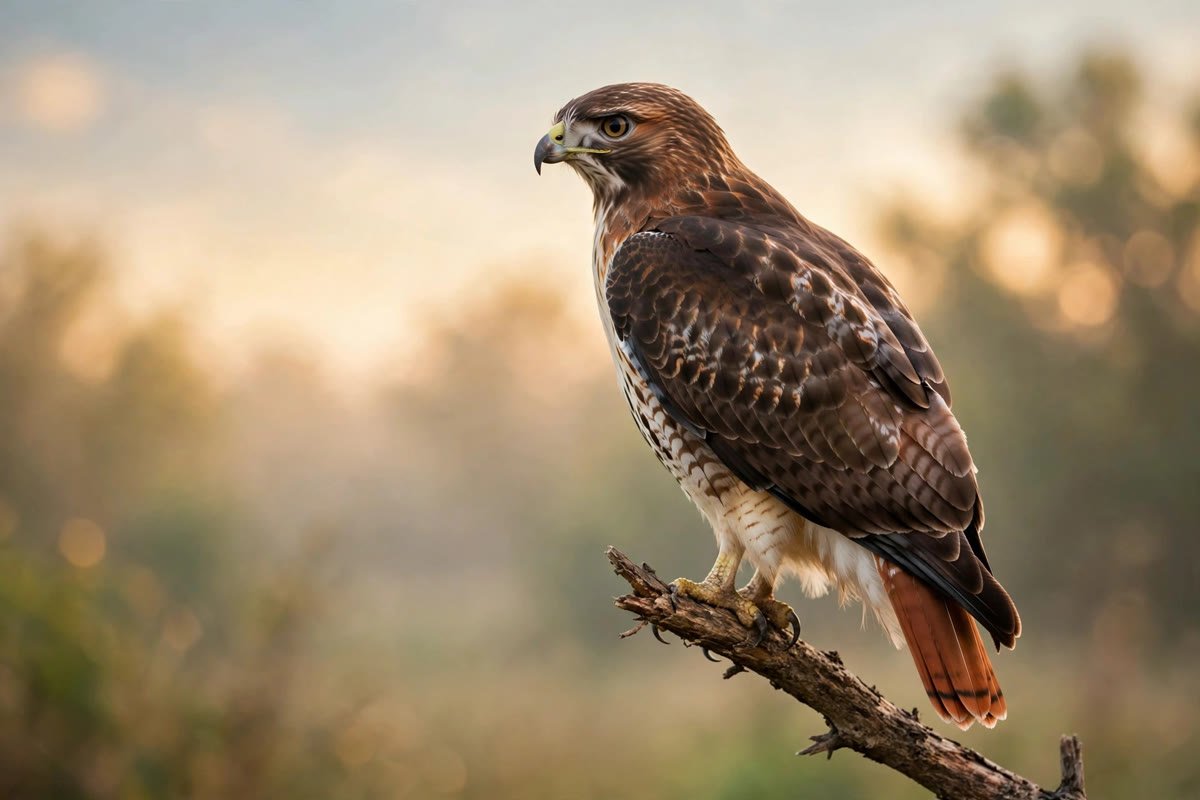
A hawk just glided over your yard, or landed on your fence, and you are asking yourself what does it mean when you see a hawk. The short, honest answer is that the hawk is almost certainly going about ordinary business: hunting, guarding territory, or riding the wind south for the fall. There is nothing random or broken about it; raptors are a daily part of North American skies.
At the same time, people have been reading meaning into hawk sightings for thousands of years. Across many traditions, the hawk is seen as a symbol of sharp vision, focus, and messages arriving from beyond the everyday. Both answers can be true at once: the ecological explanation tells you what the bird is doing, and the cultural one tells you what the sighting has meant to people who came before you. This guide covers both, carefully separating verified facts from beliefs so you can decide what your encounter means to you.

The Short Answer: What Does It Mean When You See a Hawk Near Your Home
If you keep seeing a hawk around your home, the most likely explanation is also the simplest: a hawk has made your neighborhood part of its routine. Red-tailed hawks, the most common hawk in North America, hold hunting territories that can overlap suburbs, parks, farms, and road corridors. Seeing one perched on a light pole or circling over the same field day after day usually means it has found reliable prey there.
Another common reason is the calendar. Fall is hawk migration season, and October is one of the busiest months of the year for raptor movement across the continent. If your recent sightings feel like a sudden uptick, migration is a strong suspect. During these weeks, hawks that never visit your area in summer may pass overhead in groups or pause to hunt along their route south.
The third usual explanation is that your yard itself is attracting them. Backyard bird feeders concentrate songbirds, and concentrated songbirds attract accipiters like Cooper’s hawks and sharp-shinned hawks. If the bird you saw is small, fast, and darting through trees rather than soaring high, a feeder raid is the likely story. Either way, the message is reassuring: the hawk is doing normal hawk things in a place that suits it.
What People Believe It Means: Hawk Symbolism Across Cultures
Before going further, one rule keeps this section honest: everything below is belief, not biology. These are ideas held by cultures and communities about what hawks represent. They are presented with respect and without any claim that they are scientifically true. Take what resonates, and enjoy the rest as folklore.
Native American traditions
Many Native American nations regard the hawk as a messenger carrying communication between the physical and spiritual worlds. Its famous eyesight is often interpreted as a symbol of prophetic insight and clarity of purpose: the ability to see the full picture when something is unclear in life. In some Plains traditions the hawk also stands for courage, strength, and protection.
Specific beliefs vary widely from nation to nation. The Cheyenne associate hawks with protection from enemies, and some hold that dreaming of a hawk can be a warning that danger lies ahead. In Ojibwe tradition, the hawk is considered a sacred animal believed to carry prayers to the spirits and to watch over people. The key point is that there is no single “Native American meaning”; meanings differ between tribes and families, and anyone claiming one universal interpretation is oversimplifying.
Celtic traditions
In Celtic belief, hawks are often described as messengers of the gods, bridging the human and divine worlds. The hawk’s keen eyesight is interpreted as a symbol of clarity and vision, both literal and spiritual, and Celtic practitioners took the bird as a reminder to look beyond surface appearances. Some modern retellings connect the hawk to the goddess Brighid, framing it as a sacred guide in rituals and divination, though precise ancient details are sparse.
A striking piece of Celtic lore holds that a hawk circling overhead was a sign of death and victory, warning people to stay alert. Another strand of folk astrology associates the hawk with those born between late March and mid-April, characterizing them as observant, intuitive, and quick to act. As with any ancient tradition, separate the documented from the embellished.
Ancient Egypt and other traditions
Ancient Egyptians held the hawk in high regard, most famously associating it with the sky god Horus, who was often depicted with a hawk’s head. The connection linked hawks with divine power, kingship, and protection. The ba, or soul, was sometimes represented as a human-headed hawk, symbolizing the soul’s ability to move between the world of the living and the afterlife.
Other traditions add their own threads. In Greek mythology the hawk was sacred to Apollo and linked to light and prophecy. In Hindu imagery, the hawk appears in the broader raptor symbolism surrounding divine mounts. In Japanese art and culture, hawks are associated with strength, bravery, and the protection of the home. Christianity’s folk readings have used the hawk as an emblem of watchfulness and divine protection.
Modern spiritual interpretations
Contemporary spiritualist writers tend to converge on a few themes: the hawk as a messenger, a call to focus, and a reminder to take the wider view of a situation. People often describe hawk sightings as nudges to pay attention, trust intuition, or stop circling their own problems. Whether or not you subscribe to these views, the underlying advice is sound: the hawk became a symbol of clarity because of the real qualities described in the next section, including its extraordinary eyesight and patience. For the bird-meaning companion to this article, see our guide to what it means when you see a cardinal.

What It Usually Means in Real Life
Hawks seen in everyday settings are almost always doing one of a small set of activities. Once you know the list, most sightings decode themselves. Here is what the bird in your view was probably up to.
- Still-hunting from a perch: Red-tailed hawks famously hunt by sitting motionless on telephone poles, fenceposts, or dead limbs, eyes fixed on the ground below. They can hold this watch for a long stretch before launching a swift glide at a vole, rabbit, or snake. A hawk perched for an hour is a hawk working, not a hawk watching you.
- Scanning from the air: When a hawk circles high above a field, it is usually riding a thermal, a rising column of warm air, to gain height with almost no wingbeats. From several hundred feet up, its eyesight can pick out small movement on the ground, and it slides off the thermal into a controlled dive once it spots prey. Cornell Lab’s red-tailed hawk guide notes that red-tails soar above open fields this way and may also perch-hunt from poles and fence lines.
- Passing through on migration: Fall movement accounts for a large share of autumn sightings. Migrants often stream over the same ridges, coastlines, and valleys year after year, so a hawk that appears for a week in October and never again is probably a traveler.
- Raiding a feeder: Small, agile Cooper’s hawks and sharp-shinned hawks are drawn to the crowds of songbirds at backyard feeders. If your sighting was a quick ambush through the trees with a burst of feathers, that is classic accipiter behavior. Our Cooper’s hawk vs sharp-shinned hawk guide can help you pin down which one visited.
- Defending a territory: During courtship and nesting, pairs of hawks may fly calling over their territory or chase away rivals. A hawk that seems to be harassing another large bird is usually enforcing boundaries, not threatening you.
None of this makes the sighting less special. A hawk hunting successfully over your street means the local food web is intact enough to support an apex predator, and that is genuinely worth noticing. For a refresher on telling hawks from their speedier cousins, see our hawk vs falcon identification guide.
Why You Keep Seeing Hawks Lately
If hawks have suddenly become a regular part of your sky this month, you are probably watching the fall migration. October sits squarely in raptor migration season across North America, when millions of hawks, eagles, and falcons move south to their wintering grounds. Broad-winged hawks, the species most associated with spectacular autumn flights, move in large flocks called kettles that spiral upward on thermals before gliding south.
Peak broad-winged movement typically runs through September and into early October, with peak numbers often concentrated in the second half of September. Later in October and into November, other species take the stage: sharp-shinned hawks and Cooper’s hawks pass in larger numbers, followed by red-shouldered hawks, red-tailed hawks, and eventually golden eagles. So a mid-autumn surge in sightings often reflects the changing of the migration guard.
The geography helps too. Because hawks rely on rising warm air, they avoid long crossings over water and instead funnel along mountain ridges, coastlines, and the edges of the Great Lakes. Famous watch sites like Hawk Mountain in Pennsylvania, Cape May in New Jersey, and Hawk Ridge in Duluth concentrate thousands of raptors into predictable corridors each fall. The Hawk Migration Association of North America coordinates more than 200 watch sites across the continent, and its hawkcount data shows these corridors producing huge daily totals in autumn.
You do not need a mountain overlook to enjoy the show. Any sunny October day with good thermals can produce visible migrants, and mid-morning to mid-afternoon is prime time. That also happens to align with the best time of day to see birds in general. If you want to see the migration at its most dramatic, find your nearest hawkwatch site and bring binoculars; on a strong day you may count thousands of birds in a few hours. For the broader context of what birds are doing this season, see our guide to spring and fall migration seasons.
That Famous “Eagle Scream” Is Actually a Hawk
Here is a verified fun fact to keep in your pocket: the piercing scream you hear whenever an eagle appears on screen in a movie is almost always a red-tailed hawk. Hollywood sound editors routinely dub the hawk’s raspy, thrilling cry over footage of bald eagles because it sounds exactly the way audiences expect a great raptor to sound.
A real bald eagle’s call is surprisingly un-majestic: a series of weak, high-pitched whistles and chattering notes that would fall flat in a dramatic film score. The red-tailed hawk’s scream, by contrast, is loud, sharp, and instantly legible as “big wild bird” to human ears. As the Cornell Lab of Ornithology puts it, the red-tailed hawk’s cry sounds exactly like a raptor should sound, which is why directors use it for hawks, eagles, and just about any other soaring bird on screen.
There is also a biological point behind the joke. That famous scream is a genuine red-tailed hawk vocalization, used to announce territory, keep in touch with a mate, or sound an alarm. So if you hear that wild kee-eeeee-ar from the hawk circling your neighborhood, you are hearing the real thing, not a movie mix. And now you know it is the voice Hollywood borrows whenever it needs an eagle to sound impressive.
When a Hawk Sighting Calls for Action
Most of the time a hawk sighting calls for nothing but a good look. There are, however, situations where action is the right response. The guiding principle is simple: protect your animals without harming the hawk.
If you keep backyard chickens, a hawk repeatedly scouting your yard is a warning worth heeding. Red-tailed hawks and Cooper’s hawks both take chickens, and chicks are especially vulnerable. The single most effective defense is a covered run: wire or netting over the top of the run stops a stooping hawk cold. Keeping chickens under tree canopy, supervising free-range time, and using reflective deterrent tape or motion-activated sprinklers also help. Never leave small chickens unsupervised in the open if a hawk has been working the area.
Small pets deserve the same caution. A red-tailed hawk rarely goes after dogs or cats; Cornell Lab calls it very rare. But Cooper’s hawks and great horned owls can take very small pets, and any raptor may swoop at a tiny animal that looks like prey. Keep small dogs, cats, and rabbits under cover or supervision, especially at dawn and dusk, and do not assume a hawk circling means one specific pet is targeted; it is usually scanning for its normal wild prey.
What you must not do is harm the hawk. All native hawks are protected under the federal Migratory Bird Treaty Act, which makes it illegal to pursue, capture, or kill them without a permit. Violations are federal misdemeanors with fines up to $15,000 and up to six months in jail. This protection applies regardless of what the bird has done to your chickens. Legal options are humane deterrents and better fencing, not retaliation. If a hawk is trapped in a building or netting, call your local wildlife rehabilitator or fish and wildlife agency for help rather than handling the bird yourself.

Frequently Asked Questions
Is seeing a hawk a good omen?
In many belief systems, yes. Several traditions, including Native American and Celtic ones, treat the hawk as a positive symbol of vision, protection, and messages arriving. Whether a sighting counts as an omen is a matter of personal belief, not something science can confirm. Biologically, it is a good sign of a healthy local ecosystem, since hawks need abundant prey to thrive.
Why is a hawk circling my house?
It is almost certainly riding a thermal to scan the ground for prey, not targeting your home. Thermals form over sun-warmed surfaces, including rooftops and parking lots, so houses often sit under the very air currents hawks prefer. A circling hawk is hunting efficiently, and your house is just part of the landscape it is watching.
Will a hawk attack my dog?
Almost certainly not. The red-tailed hawk, the species most people see, primarily eats mammals like voles, rabbits, and squirrels, and Cornell Lab notes it very rarely goes after dogs or cats. Very small pets under about 10 pounds deserve supervision around any raptor, but full-size dogs are not prey.
What does it mean when a hawk crosses your path?
Culturally, people often interpret a hawk crossing their path as a sign to pay attention or take a wider view of a decision. There is no scientific meaning behind it; hawks cross paths constantly while going about their business. If the idea comforts you, take it as a nudge to look at the bigger picture.
Is it normal to see several hawks at once?
Yes, especially in fall. Broad-winged hawks migrate in large groups called kettles, and on a good October day you can see hundreds spiraling in a single thermal. Outside migration season, several hawks together can also mean a territorial dispute or a family group.
Can I keep the hawk away from my yard legally?
Yes, with humane methods. Netting over chicken runs, reflective tape, motion-activated sprinklers, and supervision of small animals are all legal deterrents. You may not trap, shoot, or poison hawks, and you may not destroy nests without a federal permit. All of these are prohibited under the Migratory Bird Treaty Act.
How do I tell if the hawk I saw was a red-tailed hawk?
Look for broad, rounded wings, a short tail, and the namesake rusty-red tail feathers on adults. Perched red-tails often show a streaked belly band across a pale chest. Large females can look surprisingly like small eagles from a distance. Our hawk vs falcon identification guide covers the field marks in detail.
Conclusion
So what does it mean when you see a hawk? Start with the ordinary: a hawk in your neighborhood is a hawk at work, perching, soaring, migrating, or seizing the moment your feeders offered. In October especially, repeated sightings are one of the most reliable signs that fall migration is underway. The behavior you witness, circling on a thermal, still-hunting from a pole, screaming that famous cry, is the same drama that has made hawks a favorite of birdwatchers for generations.
If you want the deeper layer, the cultural one, you have rich company. Native American, Celtic, Egyptian, and modern spiritual traditions all converge on the hawk as a symbol of sharp vision and watchful presence. Beliefs are beliefs, and none of them change what the bird itself was doing. But they do change how we see the encounter, and there is nothing unscientific about enjoying a hawk sighting twice: once for the ecology, and once for the meaning you choose to carry away.





