Skip to content

Yes. Birds can see color, and most of them see it far better than you do. While your eyes build the world from three color channels, a typical bird uses four, including one tuned to ultraviolet light that is completely invisible to you. The result is a visual world with extra dimensions: colors you cannot imagine, motion rendered in finer detail, and a sharpness that puts human eyesight to shame.
In this guide, you will learn exactly how bird vision works, from the four cone types in the retina to the tiny oil droplets that fine-tune color, how birds use ultraviolet light to choose mates and find food, why raptors see with such astonishing sharpness, and where bird vision has real limits. By the end, you will never look at a blue jay the same way again.
The Short Answer: Yes, and Better Than You
Birds are not color blind. That old myth probably comes from the fact that most mammals see a duller world than we do, so people assume birds are similar. They are not. If anything, we are the ones with limited color vision.
Most birds are tetrachromatic, meaning their retinas contain four types of color-detecting cone cells instead of our three. The fourth type is sensitive to violet or ultraviolet light, in the 300 to 400 nanometer range. A typical bird eye responds to wavelengths from about 300 to 700 nanometers, while human vision covers roughly 400 to 700.
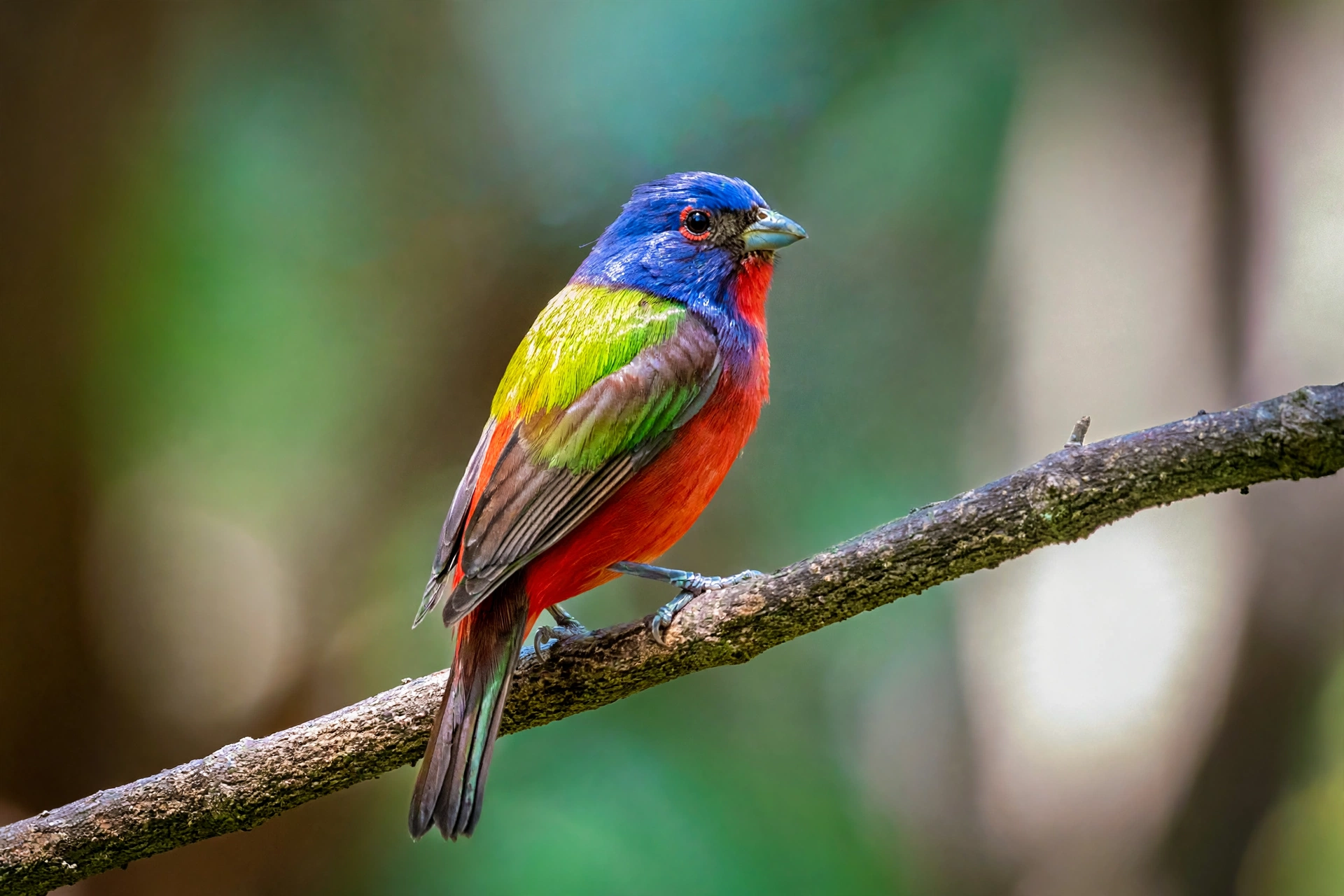
More cone types mean more possible combinations, and therefore more distinguishable colors. Researchers estimate that birds can discriminate a far larger palette than humans, including combination colors that simply do not exist in human experience. When a male painted bunting flashes his red, blue, and green plumage, he may be showing his rivals a display with extra ultraviolet dimensions we will never see.
How Bird Color Vision Works
Four Cones Instead of Three
Human color vision is trichromatic. We have three cone types, each most sensitive to red, green, or blue light. Our brain compares their signals to produce every color we perceive.
Birds have the same three, plus a fourth. In most species this fourth cone contains a pigment sensitive to ultraviolet or violet light, with peak sensitivity around 360 to 380 nanometers in ultraviolet-sensitive species. Pigeons are an interesting exception: their fourth cone peaks around 409 nanometers, in the violet range, with no dedicated ultraviolet receptor.
Each cone on its own only reports how much light it caught, not the wavelength. Color emerges when the brain compares signals across cone types. With four channels to compare instead of three, birds can make finer distinctions, especially in the short-wavelength part of the spectrum that we cannot access at all.
Birds also carry double cones, pairs of cone cells joined together. These contain long-wavelength pigment but appear to handle brightness, texture, and motion rather than color. They are one reason a bird can track a fast-moving insect while still judging its exact shade.

Oil Droplets: Tiny Filters Inside the Eye
Birds have another trick that mammals lost long ago. Inside nearly every cone sits a small sphere called an oil droplet, packed with carotenoid pigments, the same family of compounds that makes carrots orange.
Light passes through the droplet before reaching the visual pigment. The droplet acts as a filter, blocking some wavelengths and narrowing each cone’s sensitivity to a tighter band. Less overlap between cones means the brain gets cleaner, more separated signals, which improves color discrimination.
A 2015 study in the Journal of the Royal Society Interface found that each droplet type contains a complex mixture of carotenoids, with one dominant pigment setting the exact cut-off wavelength. In plain terms, birds carry a precisely tuned set of color filters inside their eyes. You can read the full research on the carotenoid palette that tunes avian color vision in the open-access paper.
There is a trade-off. Filtering throws away light, which reduces sensitivity in dim conditions. That is one reason nocturnal birds have reduced or unpigmented droplets: at night, every photon counts.

The Ultraviolet World We Cannot See
Colors That Do Not Exist for You
Some colors are not in the rainbow at all. Purple, for example, is what your brain produces when red and blue cones fire together without green. Scientists call these nonspectral colors.
Humans get one nonspectral color: purple. Birds may get up to five. In a landmark 2020 experiment, researchers trained wild hummingbirds to tell colors apart and found they could discriminate combinations like ultraviolet plus red and ultraviolet plus green. Analyzing thousands of feather and plant colors, the team concluded that birds likely perceive many natural colors as nonspectral.
A male hummingbird’s glittering throat may look magenta to you. To another hummingbird, it may be an ultraviolet-plus-purple signal you are physically unequipped to see. The hummingbird color vision experiments revealed just how much of the visual world sits beyond human perception.
How Birds Use Ultraviolet Light
Ultraviolet vision is not a curiosity. It shapes daily bird life in several practical ways:
- Mate choice: In blue tits, males with brighter UV-reflecting crown feathers are preferred by females. Budgies and zebra finches also use ultraviolet plumage cues when choosing partners. What looks like a plain yellow bird to you may be flashing hidden signals to its own kind.
- Foraging: Some berries, insects, and plant parts reflect UV strongly, standing out against foliage. Ultraviolet cues help birds spot ripe fruit and hidden prey, one more tool alongside the sharp eyesight they use when learning how birds find feeders in the first place.
- Secret communication: UV patterns in plumage act like a private channel. Most mammals cannot see ultraviolet, so birds can signal each other without alerting predators that share the duller mammalian view.
One caveat: not every bird sees UV equally. In some raptors, corvids, and flycatchers, the fourth cone peaks in violet rather than true ultraviolet. Researchers think strong UV sensitivity was traded away in these hunters because short wavelengths scatter more and blur fine detail, and a raptor’s livelihood depends on pinpoint sharpness.
Sharpness, Speed, and a Wider World
Raptor-Grade Sharpness
An eagle’s eye is roughly the same size as yours, which is remarkable in a bird weighing a fraction of what you do. That large eye packs in a dense array of photoreceptors, especially in the fovea, the retina’s high-resolution sweet spot.
Measurements put the wedge-tailed eagle’s visual acuity at about 2.5 times that of humans, and eagles in general are often described as seeing several times more sharply than we do. An eagle can spot a rabbit-sized animal from well over a kilometer away.
Sharpness varies by lifestyle. High-soaring hunters like eagles and vultures have the keenest distance vision, while ground-foraging raptors like kestrels score lower on acuity tests but excel at tracking movement.

Seeing the World in Slow Motion
Bird eyes also run at a faster frame rate. The flicker fusion rate, the speed at which separate flashes blur into steady light, reaches around 100 flashes per second or more in many birds, compared with roughly 50 to 60 in humans.
That faster sampling means finer motion detail. A bird threading through branches at speed sees each twig distinctly where you would see a blur. It is one reason small birds can dodge obstacles in flight that would defeat any human pilot. New Zealand Geographic describes how birds perceive motion in extraordinary detail, tuned to a far faster shutter speed than our own eyes.
This speed has a practical consequence for how birds experience human technology. A television screen or fluorescent light that looks steady to you may visibly flicker to a bird, since these devices refresh at rates their faster eyes can resolve.
Eyes on the Sides of the Head
Most birds carry their eyes on the sides of the head, giving a huge panoramic field of view. Each eye largely works on its own, which is great for spotting predators but gives less binocular overlap for judging distance.
Owls are the famous exception, with forward-facing eyes and strong binocular vision for pinpointing prey in the dark. Pigeons and many songbirds sit somewhere in between.
Side-mounted eyes have one more quirk: poor close-up focus. A bird examining food at its beak often tilts its head to bring one eye to bear, because its optics are tuned for distance. Watch a robin study a worm and you will see this head-cocking in action.
Side-mounted eyes come with a quirk you may have noticed: many birds bob their heads as they walk. The leading explanation is vision stabilization, holding the head still between steps so the visual world stays steady. You can read more about why birds bob their heads in our dedicated guide.
Birds also have a third eyelid, the nictitating membrane, a translucent sheet that sweeps across the eye to moisten and protect it without blocking vision. Raptors close it when feeding chicks, and diving birds like dippers use it as built-in goggles underwater.
Night Vision: The Owl Trade-Off
Owls show what happens when a bird optimizes for darkness instead of color. Their retinas are dominated by rods, the photoreceptors that detect light intensity rather than color.
Rods are exquisitely sensitive. A barn owl can hunt by starlight alone, detecting a mouse moving in near-total darkness. The price is color: with fewer cones doing the work, an owl’s world is rich in shades of gray but poor in hue.
Large eyes help too. An owl’s tubular eyes gather far more light than a songbird’s, and the trade is permanent. You cannot have both maximum sensitivity and maximum color discrimination in the same retina.
Owl eyes are so large relative to the skull that they are fixed in place, like built-in binoculars. An owl cannot roll its eyes the way you can. Instead it rotates its entire head, up to about 270 degrees, to scan its surroundings.
Owls back up their night vision with extraordinary hearing. Their facial discs funnel sound like satellite dishes. If you have ever wondered whether birds have ears at all, the answer is yes, and in owls they are precision instruments.
Bird Vision vs Human Vision
Here is how the two visual systems compare side by side:
| Feature | Birds | Humans |
|---|---|---|
| Color cone types | 4 (tetrachromatic) | 3 (trichromatic) |
| Ultraviolet vision | Yes, in most species | No |
| Wavelength range | About 300 to 700 nm | About 400 to 700 nm |
| Oil droplet filters | Yes, inside cone cells | No, lost in mammals |
| Flicker fusion rate | Around 100+ flashes per second | Around 50 to 60 per second |
| Sharpness | Raptors several times sharper; varies by species | 20/20 baseline |
| Night vision | Owls exceptional; most day birds modest | Poor |
| Field of view | Very wide, eyes on sides of head | About 180 degrees, forward-facing |
| Third eyelid | Yes (nictitating membrane) | No |
Frequently Asked Questions
Can birds see color better than humans?
In most ways, yes. Four cone types instead of three, ultraviolet sensitivity, and oil-droplet filters give most birds a wider range and finer discrimination than human vision. Raptors add superior sharpness on top of that.
Can birds see ultraviolet light?
Most can. Their fourth cone type is sensitive to violet or ultraviolet wavelengths between about 300 and 400 nanometers. Some species, including certain raptors and corvids, are shifted toward violet with weak true ultraviolet sensitivity.
Are any birds color blind?
No bird is fully color blind in the human sense, but vision varies widely. Nocturnal owls have rod-dominated retinas and see little color, trading hue for extreme light sensitivity. That is an adaptation, not a defect.
Can owls see color?
Only weakly. Owl retinas are packed with rods for night hunting, with relatively few cones. They likely perceive some color in good light, but their visual world is built on brightness and movement, not hue.
Do birds see the same colors we do?
They see our colors plus more. Every color you perceive, a bird likely perceives too, but their world adds ultraviolet and nonspectral combinations like ultraviolet-plus-green that have no human equivalent.
Conclusion
So, can birds see color? Not only can they see it, most of them see it better than we ever will. Four cone types, ultraviolet sensitivity, and precisely tuned oil-droplet filters give birds a wider palette and finer discrimination than human eyes can manage, while raptors add telescopic sharpness and most species process motion at double our frame rate.
The exceptions prove the design logic. Owls traded color for night vision because their hunting depends on it. Some raptors dialed back ultraviolet sensitivity to protect the sharpness their hunting depends on. Every bird eye is tuned to the life its owner leads.
Next time you watch a blue tit flash its crown or a kestrel hang motionless over a field, remember you are seeing a simplified version of the scene. The bird in front of you is watching a richer, faster, more colorful world than the one you live in.