 Skip to content

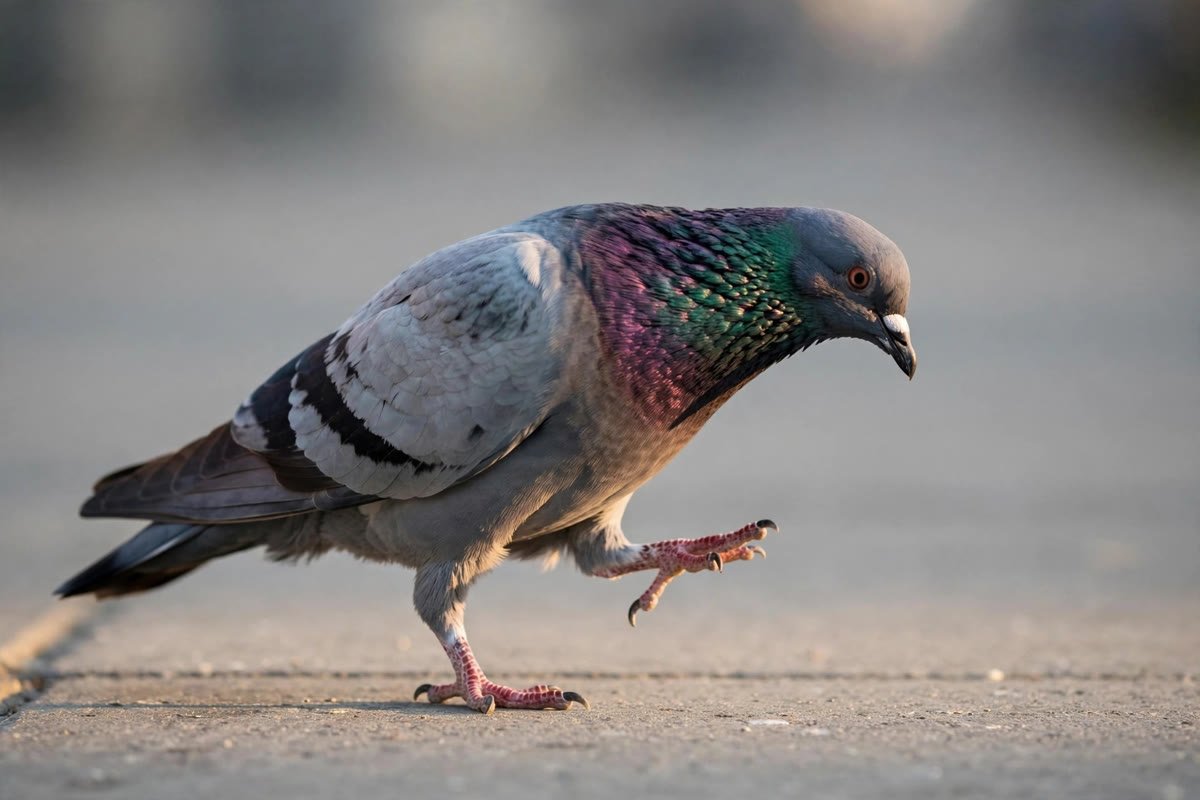
Watch a pigeon strut down a sidewalk and you will see it: the head shoots forward, pauses for a heartbeat, then shoots forward again. It looks almost mechanical, like a wind-up toy. Yet this odd little motion is one of the most precise visual systems in nature.
Why do birds bob their heads when they walk? The short answer is vision. Birds lock their heads still in space for a fraction of a second so their eyes can take a clear, blur-free picture of the world, then rapidly thrust the head forward to a new position and repeat the cycle. Without this stabilization, a walking bird would see everything as a smear of motion, making it nearly impossible to spot a seed on the ground or a cat in the bushes.
In this article, you will learn how the two-phase hold-and-thrust mechanism works, why birds move their whole heads instead of just their eyes, what the famous treadmill experiments proved, which species bob and which never do, and the most common myths about this behavior.

Why Do Birds Bob Their Heads When They Walk? The Short Answer
Birds bob their heads to keep their vision steady while their bodies move. A bird’s head goes through two phases with every step. During the “hold” phase, the head stays perfectly still relative to the ground while the body walks forward underneath it. During the “thrust” phase, the head snaps forward quickly to catch up.
This cycle matters because of how bird eyes work. Most birds have eyes on the sides of their heads with very limited ability to move them. They cannot roll their eyes to compensate for body movement the way humans do. So instead of moving their eyes, they move their whole head.
The hold phase gives the bird’s photoreceptors a steady moment, roughly 20 milliseconds, to capture a clear image and send it to the brain. Then the thrust phase repositions the head before the next hold. To our eyes, the cycle looks like a jerky back-and-forth bob. To the bird, it feels like watching a slideshow of sharp, stable images.
Hold and Thrust: How Head Bobbing Actually Works
The mechanics of head bobbing were worked out through careful experiments, and the details are more surprising than most people expect. Each half of the cycle does a different job.
The Hold Phase
During the hold phase, the bird’s head is locked in space. Frame-by-frame video analysis of walking pigeons, published by researcher Nikolaus Troje in the Journal of Experimental Biology in 2000, confirmed that the head really does stay motionless in world coordinates while the body continues moving forward beneath it.
This is the visually important half of the cycle. With the head fixed, the image on the retina stays stable long enough for the bird to process what it sees. Food, predators, and obstacles all become sharp and readable instead of blurring past.
The Thrust Phase
During the thrust phase, the head moves forward in one rapid, ballistic motion to a new position ahead of the body. This movement is so fast that the bird’s vision does not have time to process much during it, which is actually the point. A fast repositioning minimizes the time the eyes spend in blurry transit.
Researchers also believe the thrust phase helps with depth perception. The small, quick shifts in viewpoint between successive hold positions give the brain slightly different angles on the same scene. Comparing those angles may help the bird judge distances to food or landing spots.
Here is a detail that surprises people: most of the real motion is forward. What looks like a head rocking backward is largely an illusion created by the body moving forward under a stationary head. The head is not seesawing; it is pausing and leaping, pausing and leaping.
Why Birds Stabilize With Their Heads Instead of Their Eyes
Humans solve the same problem with eye movements. When you walk, two reflexes, the vestibulo-ocular reflex and the optokinetic reflex, rotate your eyes in the opposite direction of your head motion. This keeps your gaze fixed on a point while your body moves. It works because human eyes sit in flexible sockets and our high-acuity vision is concentrated in a tiny central spot called the fovea.
Birds took a different evolutionary path. Their eyes are large relative to their skulls and sit in rigid sockets with limited mobility. But their advantage is that high-acuity vision is spread over a much wider area of the retina than in humans. Pigeons, for instance, have two broad areas of high photoreceptor density in each eye, far larger than the tiny human fovea.
This wide zone of sharp vision comes with a cost. Keeping a large retinal area stable cannot be done by twitching an eyeball. The only way to hold the whole visual field still is to hold the entire head still. So birds do with their necks what humans do with their eye muscles, and the result is the distinctive bob.
It is worth noting how this relates to flight. A bird that can stabilize its head while walking uses the same basic trick in the air. The connection between stable vision and how birds actually stay airborne runs deep, because landing, dodging, and catching prey all demand a steady picture of a moving world.

The Treadmill Experiment That Settled the Debate
For decades, scientists argued about whether head bobbing was a visual behavior or just a mechanical side effect of walking, like the way your arms swing when you stride. The decisive experiments, carried out in the 1970s by researcher B. J. Frost, settled the question with an elegant setup: a treadmill for pigeons.
First, the researchers matched the treadmill belt speed to the pigeon’s walking speed. When the bird walked in place with no visual world flowing past it, the head bobbing stopped. If bobbing were a mechanical byproduct of leg movement, it should have continued. It did not.
Then they reversed the setup. They held the pigeon still and moved it passively through space, so the world flowed past the bird without any walking at all. The head started bobbing. This proved the behavior is driven by vision, not by leg mechanics. Head bobbing is an optokinetic response, the bird’s whole-head version of the eye reflex that keeps your own vision stable on a moving train.
A later anecdote from researcher Aaron Blaisdell’s lab makes the same point charmingly. When he picked up a pigeon and walked forward carrying it, the bird kept bobbing its head, because the world was still moving past the pigeon even though its legs were not moving at all.
Earlier work had already shown the behavior is hardwired, not learned. In the 1960s, experiments on chickens showed that chicks begin bobbing their heads about 24 hours after hatching. Chicks raised in a dark room for two weeks, and chicks whose leg movements were restricted, still developed the same head-leg coordination as normal chicks. The pattern is built in from birth.
Which Birds Bob Their Heads, and Which Ones Never Do
Not every bird bobs. The behavior shows up most clearly in birds that walk with a striding gait and have relatively long legs and necks. Birds with short, wide-set legs that waddle, or birds whose eyes are positioned differently, often skip it entirely.
Avian physiologist Reinhold Necker, who studied this question extensively, argued that stride length and eye position together determine whether a species needs to bob. Birds that take long steps get more visual benefit from stabilization, so they bob. Birds that take short, shuffling steps gain less from it, so they do not.
| Bird | Head bobs when walking? | Notes |
|---|---|---|
| Pigeon | Yes | The classic example, studied in treadmill experiments |
| Chicken | Yes | Chicks begin bobbing about a day after hatching |
| Quail | Yes | Strong bobbers among ground birds |
| Turkey | Yes | Noticeable on walking wild and domestic turkeys |
| Crane and heron | Yes | Long-legged waders bob distinctly |
| Crow | Yes | Visible when crows walk lawns and roads |
| Starling | Yes | Easy to watch in parking lots and on grass |
| Duck, goose, swan | No | Short, wide-set legs and a waddling gait |
| Owl | No | Forward-facing eyes and different visual strategy |
| Hawk and eagle | No | Raptors rarely walk far and do not bob |
| Penguin | No | Waddling stride, no head bobbing |
| Sparrow | No | Hopping birds do not show the classic bob |
The exceptions are instructive. Ducks, geese, and swans walk on short legs with small steps, so stabilization buys them little. Raptors and owls walk so rarely that the behavior never became central to their vision. Sparrows hop rather than stride, which is a different locomotion pattern altogether.
Watching for this behavior is a good field skill. Starlings, for example, are easy head-bobbers to observe on lawns and sidewalks, and learning their movements helps you separate them from other dark birds. If you want a primer on their famous group flights, read about what a murmuration of starlings actually is.
Common Myths About Head Bobbing
A behavior this visible attracts folklore. Here are the claims that do not survive the science.
- Myth: Birds bob their heads to keep their balance. Balance plays at most a minor role. The treadmill experiments proved the behavior follows visual flow, not leg mechanics, and it appears even when the bird is carried. Vision is the driver.
- Myth: The head moves backward and forward equally. The visible “back” part is mostly an illusion. The head holds still in space while the body advances, which looks like backward motion relative to the body. The true motion is hold, then thrust forward.
- Myth: Head bobbing means the bird is nervous or agitated. Walking pigeons and chickens bob constantly while calmly foraging. It is routine visual housekeeping, not a stress signal.
- Myth: Big brains would solve this without bobbing. Brain size is not the issue. The constraint is eye mobility versus retinal design. Birds distribute sharp vision widely across the retina, which forces a whole-head solution no brain could shortcut.
- Myth: All walking birds do it. Ducks, geese, penguins, raptors, and hopping songbirds do not. The behavior is common but far from universal.
How to Watch Head Bobbing Yourself
You do not need special equipment to see this behavior well. Pigeons on a city sidewalk or chickens in a yard are ideal subjects because they walk steadily in the open. Crouch to roughly the bird’s eye level and watch the head, not the body. You will see the pause, then the snap forward.
Slow-motion video on a modern phone reveals the hold phase beautifully. Film a walking pigeon at the slowest setting and step through the frames. The head hangs in space, frozen, while the body glides forward beneath it, exactly as the frame-by-frame studies described.
Early morning is a good time to watch, since many ground-feeding birds are most active then. If you are planning a watching session, check the best time of day to see birds for timing tips. New to the hobby? Our bird watching for beginners guide covers the basics of observing behavior like this in the field.

Frequently Asked Questions
Why do pigeons bob their heads more obviously than other birds?
Pigeons are the textbook example because they walk everywhere in the open, take long strides, and have the classic side-eyed, wide-field visual system that benefits most from head stabilization. Their bobbing is frequent and easy to watch on sidewalks and plazas. Other birds like chickens, quails, and cranes do it just as much, but pigeons perform in front of the largest audience.
Do birds bob their heads when they fly?
No, head bobbing in the hold-and-thrust sense is a walking behavior. In flight, birds stabilize their heads continuously using neck muscles and the vestibular system, without the rhythmic pause-and-snap pattern. Some swimming birds do show a bobbing-like motion, since swimming, like walking, moves the body steadily through space.
Can birds see clearly while their head is thrusting forward?
Probably not very well, and that is fine. The thrust phase is extremely brief, and the brain essentially discounts visual input during fast motion, the same way your brain ignores the blur during your own eye movements. The bird gets its useful information during the hold phases, when the head is locked still.
Why do some birds, like ducks, never bob their heads?
Ducks, geese, and swans have short, wide-set legs and take small waddling steps. With such a short stride, the visual blur per step is small, so full head stabilization offers little payoff. Research by avian physiologist Reinhold Necker points to stride length and eye position as the key factors deciding which species bob and which do not.
Is head bobbing a sign of a sick or stressed bird?
In a walking bird, no. Rhythmic head bobbing while striding is normal, healthy visual behavior. What warrants attention is unusual head movement at rest, such as tremors, twisting, or repeated shaking of a perched bird, which can indicate illness or neurological problems. Context matters: bobbing on the move is routine, bobbing while sitting still is not.
Do baby birds bob their heads?
Yes, and remarkably early. Experiments in the 1960s found that chicks begin head bobbing about 24 hours after hatching, even without ever seeing an adult do it. The behavior is innate, and it develops normally even in chicks raised without visual experience, which shows how deeply wired this visual strategy is.
Conclusion
The jerky walk of a pigeon turns out to be a precision instrument. Why do birds bob their heads when they walk? Because their eyes are built for wide, panoramic vision with limited mobility, and the only way to keep that wide field sharp during movement is to lock the whole head still in space, over and over, dozens of times per minute.
The hold-and-thrust cycle, the treadmill experiments that proved it is visual rather than mechanical, and the species that skip it all point to the same conclusion: head bobbing is vision engineering, not a quirk. It lets a chicken pick out a seed, a crane spot a fish, and a pigeon dodge a pedestrian, all at a full stride.
Next time you pass a pigeon on the sidewalk, stop for ten seconds and watch the pauses between the snaps. You are seeing one of evolution’s cleanest solutions to the problem of seeing clearly while moving, a trick humans perform with eye muscles and birds perform with their necks.




