Skip to content

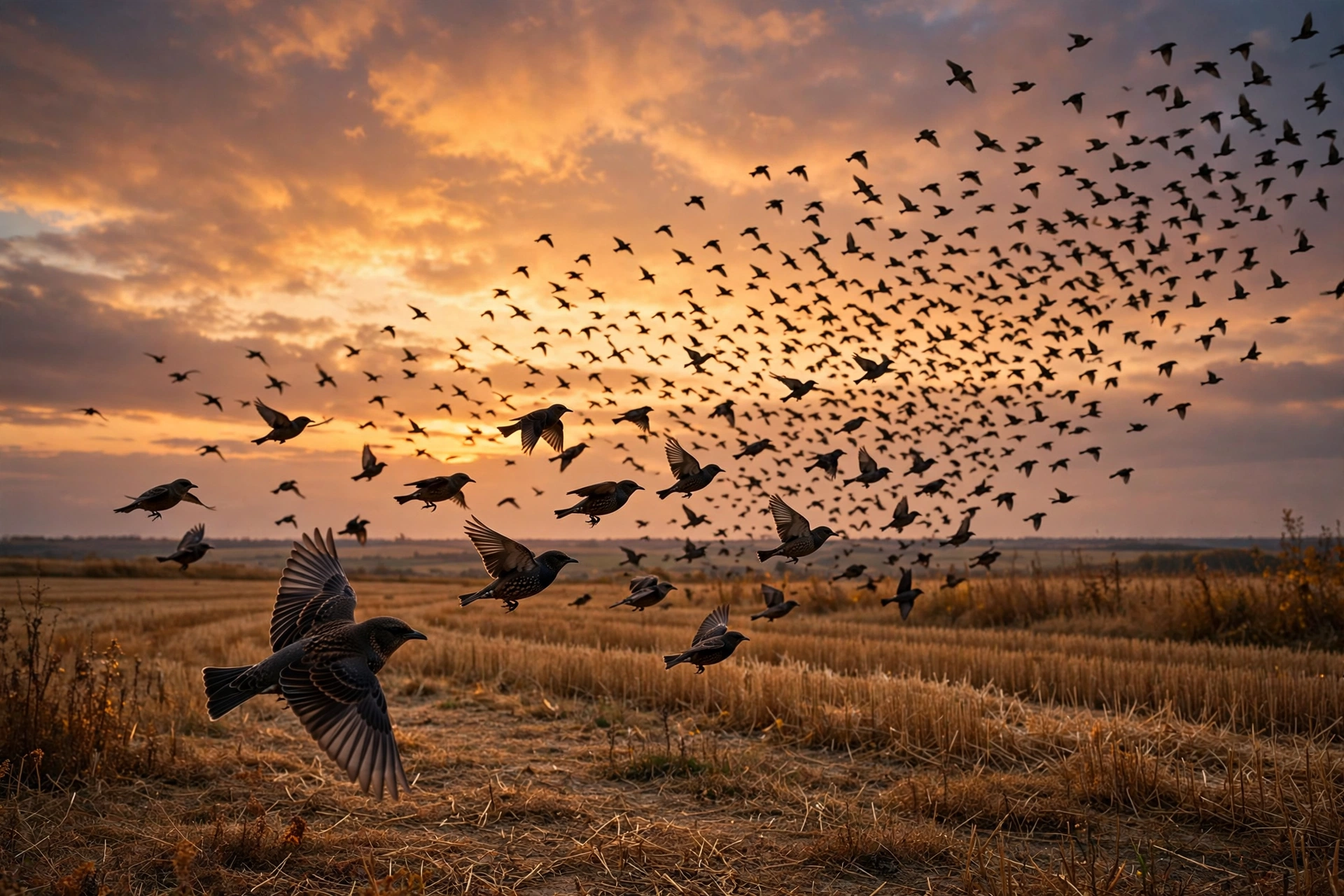
Step outside on a crisp October evening and look up. You may see a dark river of starlings pouring across the sky, or hear blackbirds dropping into a stand of trees at dusk. Fall is the season when birds gather in their biggest numbers, and the change is dramatic. Birds that spent all summer chasing rivals off their territories now crowd together without a fight. The robin that sang alone from your fence in June is suddenly one of fifty stripping the berries off a shrub.
The short answer is that flocking pays off when the seasons change. In summer, a breeding pair can defend a territory and raise chicks in privacy. In fall, insects vanish, nights turn cold, and predators grow bolder. Scientists have studied this shift for decades. Flocking birds find food faster with many eyes, confuse predators with coordinated flight, save energy in formation, and sleep warmer in communal roosts. In this article, we walk through the science of why birds flock together in fall, and why right now is the peak season to witness it.
The End of the Breeding Season Changes Everything
To understand fall flocking, start with summer. When birds breed, most species are aggressively territorial. A male blackbird or robin sings from a boundary post and attacks intruders, because defending an exclusive patch of insects and nesting cover raises his chances of fledging chicks. Hormones such as testosterone drive this aggression, and the payoff is real. Solitude, in summer, means more food per chick and fewer visits from nest predators drawn to noisy colonies.
When breeding ends, that equation flips. Chicks fledge, nests empty out, and the hormones that fuelled territorial aggression drop sharply. There is no longer a brood to protect and no longer a bounded patch worth defending, because the summer abundance of caterpillars and flying insects is disappearing. Birds that fought all June now tolerate each other at the same berry bush in September.
Meanwhile, the population itself has changed. A pair of robins that started the summer as two birds may end it as six, with their fledged young in tow. Multiply that across a neighbourhood and the local bird population swells, exactly when food is getting scarcer. Juvenile birds, inexperienced at finding food and avoiding predators, benefit enormously from joining groups where older birds lead the way. Fall flocking, then, begins as an economic shift: the costs of sharing suddenly fall below the costs of solitude.
Safety in Numbers: Escaping Predators
The oldest and best-supported explanation for flocking is protection from predators. Several distinct mechanisms work together, and each has been tested in the field.
The first is simple dilution. If a sparrowhawk can catch only one bird in an attack, a bird in a flock of one hundred has a one-in-a-hundred chance of being the victim. Biologist W. D. Hamilton formalised this in 1971 as the selfish herd theory: every individual tries to reduce its own danger by moving toward the centre of the group, so the group holds together. You can see this in a flock of starlings on the ground. The birds on the edges are visibly more nervous than the ones in the middle.
The second mechanism is vigilance. A single feeding bird must split its time between pecking and scanning the sky. In a flock, each bird can scan less and feed more, because the odds that at least one bird spots the hawk are high. Researchers have shown that feeding rates genuinely rise with flock size in many species, at least up to a point.
The third is the confusion effect. A predator attacking a swirling, darting flock faces a bewildering mass of moving targets and struggles to lock onto one individual. Starling murmurations may be the most spectacular example on Earth of this effect in action. Watch a murmuration and you will often see the flock pulse and contract the moment a peregrine falcon dives through it. The shape-shifting cloud is, among other things, a collective evasive manoeuvre, a phenomenon the National Audubon Society has explored in its coverage of starling behaviour.
Fall brings a particular pressure here. Young birds of the year are inexperienced and make easy targets, and many migrating hawks are passing through at exactly this time. Gathering in groups is one of the strongest defences a naive young bird has.
More Eyes Mean More Food
Food is the other great driver. In fall, many birds switch from protein-rich insects to seeds and fruit, which grow in patches. A single bird searching alone finds patches slowly. A flock searching together covers far more ground, and when one bird finds a rich seed head or berry cluster, the rest pile in. Even if each bird ends up with a smaller slice of the patch, the group finds patches so much faster that everyone eats better. This is sometimes called local enhancement, and it is well documented in foraging flocks.
A bolder idea, the information centre hypothesis proposed by Peter Ward and Amotz Zahavi in 1973, suggested that communal roosts act as information hubs where successful foragers are followed the next morning by unsuccessful ones. The evidence for this is mixed. Some studies on roosting ravens and crows found support, while others found none, and many ornithologists now treat it as only one of several reasons birds gather at roosts. It is a good example of cautious science: an elegant idea that the evidence only partly backs.
What is firmly established is the sentinel effect. In mixed groups, certain watchful species act as lookouts. The tufted titmouse, for example, issues soft contact calls while foraging, and chickadees and nuthatches key into those calls to judge whether the coast is clear. Everyone in the flock effectively borrows everyone else’s senses.

Keeping Warm: The Communal Roost
Fall nights grow cold, and small birds lose heat fast. A chickadee weighing eleven grams cannot survive many freezing nights without help. One solution is the communal roost: hundreds or thousands of birds gathering in a dense stand of trees, a reed bed, or a barn to spend the night together.
The thermal benefit is real. Huddled birds lose less heat than solitary ones, and some species take this to extremes. Winter wrens have been found roosting in cavities in groups, and cavity-roosting blue tits pile together in nest boxes on the coldest nights. European starlings and blackbirds pack into evergreen trees by the thousand, and American crows form roosts that can reach tens of thousands of birds, shifting around the landscape as the season deepens.
Roosts serve double duty. A big roost is also a safe place, because a predator approaching thousands of alert birds is far more likely to be detected and mobbed than one approaching a lone sleeper. And there is a social dimension too: many pair bonds and flock hierarchies are negotiated and maintained in the jostling at the roost. Guides such as Birdful note that the evening fly-in, when waves of birds pour into the roost trees at dusk, is one of the great wildlife spectacles of fall, and it is happening in many places right now.

Travelling Together: Migration Flocks
Fall is migration season, and migration adds another layer to flocking. Many species that are solitary or paired in summer travel in groups in fall. The most obvious are the waterfowl and waders. Geese fly in ragged V formations, cranes bugle in family lines, and swallows gather on wires in restless chattering crowds before they depart.
Formation flight appears to save energy. Studies on pelicans and geese have found that birds flying in the upwash of the bird ahead work less hard, with lower heart rates than solo flyers. The birds constantly adjust position, and the tired ones rotate back. Whether every V formation is perfectly tuned for this effect is still debated, but the energy argument is supported by real measurements.
Shared routes bring a second benefit. Migration is a navigation challenge, and young birds making the journey for the first time travel with experienced adults who know the waypoints, the stopover wetlands, and the thermal columns. Sandhill cranes migrate in extended family groups, and the young stay with their parents through their first full migration, learning the route. Flocking turns a solo gamble into a guided tour.
If you want to know which travellers are passing through your area this month, see our guide to birds that migrate in October, and for the full story of how they find their way, read why birds migrate.
Mixed-Species Flocks: Strength in Diversity
Not every fall flock is a single species. Some of the most interesting flocks are mixed, and they form for reasons that go beyond simple numbers.
In woodlands, the classic winter foraging flock centres on chickadees or titmice, with nuthatches, creepers, kinglets, and downy woodpeckers tagging along. Each species feeds at a different level and in a different way: nuthatches work down trunks, creepers spiral up them, kinglets glean the twig tips. They barely compete, but they all gain from the shared vigilance. The chickadee’s famous chick-a-dee-dee alarm call encodes information about the threat, and the whole flock responds.
Tropical and subtropical mixed flocks take this further, with dozens of species moving through the forest as a coordinated wave, each in its niche. The principle is the same everywhere: diversity lets a flock cover more feeding styles and more sets of eyes with less direct competition. The American Bird Conservancy highlights how protecting varied forest habitats keeps these complex flock communities intact.
Mixed flocks also reveal something about bird intelligence. Individuals recognise the alarm calls of other species and learn which flockmates are reliable sentinels. Birds are not just gathering blindly. They are choosing company that keeps them alive.
Murmurations: Flocking Taken to the Extreme
No discussion of fall flocking is complete without murmurations, the vast swirling clouds of European starlings that gather at dusk in autumn and winter. A single murmuration can hold hundreds of thousands of birds, twisting into ribbons, funnels, and pulsing spheres that look choreographed. They are not. Each starling follows simple local rules, reacting to the movements of its nearest neighbours, and the breathtaking patterns emerge from thousands of tiny individual decisions. Computer models have reproduced murmuration shapes from rules this simple.
Scientists believe murmurations serve the same core purposes as all flocking: predator confusion and information sharing about foraging grounds and roosts. The sheer scale may also relate to warmth, since murmurations form above the roost sites where the birds will spend the night. What is remarkable is that starlings only do this outside the breeding season. In summer they are territorial and scattered. In fall they become, briefly, one of the most social birds on Earth.
Murmurations deserve their own deep dive, and we have one: what is a murmuration explains how and where to see these displays. This article covers the broader science that murmurations are an extreme expression of.

The Benefits and Costs of Flocking
Flocking is not free. If it were, birds would flock all year. The table below summarises the trade-off that makes fall the flocking season.
| Benefit | How it works | Cost | How it bites |
|---|---|---|---|
| Predator dilution | Individual risk falls as group size rises | Disease spread | Close contact spreads parasites and infections faster |
| Shared vigilance | Each bird scans less and feeds more | Food competition | More beaks at the same patch means smaller shares |
| Confusion effect | Swirling masses defeat a predator’s aim | Conspicuousness | A huge flock is easier for predators to find |
| Information sharing | Flockmates lead each other to food | Aggression | Dominant birds displace subordinates at rich patches |
| Warmth in roosts | Huddling cuts overnight heat loss | Disturbance | Jostling neighbours can interrupt sleep and feeding |
| Energy-saving flight | Formation flight cuts the cost of travel | Coordination cost | Staying in formation demands constant adjustment |
In summer, the costs win: a defended territory full of insects is worth fighting for. In fall and winter, the benefits win: food is patchy, nights are cold, and predators are pressing. The annual switch between solitude and society is one of the most reliable rhythms in nature.
Why Fall Is Peak Flocking Season
Put the pieces together and fall emerges as the perfect storm for flocking. Breeding is over and territories have dissolved, so birds tolerate each other. The population is at its annual maximum, swollen with inexperienced juveniles that need the protection and guidance of groups. Insects are declining while seeds and fruit, the patchy foods that reward group searching, are peaking. Nights are cooling, making communal roosts valuable. And migration is funnelling travellers together along shared routes and into shared stopovers.
This is also why fall flocks feel so visible. Summer birds are spread thin and hidden in foliage. Fall flocks gather in the open, in fields, on wires, and in evening skies, and they are noisy about it. The blackbird clouds over stubble fields, the gabbling skeins of geese, the dusk pour of starlings into the reeds: these are fall signatures. If you have a feeder, you may notice the shift within days. Solitary summer visitors give way to waves of finches, sparrows, and blackbirds arriving together.
Climate and weather sharpen the timing. The first cold snaps push more birds into roosts and accelerate departures. A strong cold front in October can trigger visible waves of migrants in a single morning, with flocks that were scattered the day before suddenly on the move.
Frequently Asked Questions
Why do birds flock together in fall specifically?
Fall combines the end of breeding territoriality with declining food, cooling nights, and migration. Territories dissolve when chicks fledge, so birds tolerate each other. Patchy seeds and fruit reward group foraging, cold nights reward communal roosting, and shared migration routes bring travellers together. No other season stacks this many flocking incentives at once.
Do birds flock more in fall or winter?
Flocking peaks in late fall and continues through winter. Fall is when flocks form and migration swells their numbers. Winter roosts, such as crow and blackbird roosts, are often at their largest in midwinter when cold makes shared warmth most valuable. Fall is the more dramatic season to watch, because that is when the flocks assemble.
Why do some birds stay solitary while others flock?
It comes down to diet and defence. Birds that feed on scattered, hard-to-find food or that rely on stealth, such as many hawks and owls, gain little from company. Birds that eat patchy seeds and fruit, or that are vulnerable to predators while feeding on the ground, gain a lot. Even flocking species often go solitary in summer when a defended territory pays better.
Are murmurations only a fall phenomenon?
Murmurations are mainly an autumn and winter spectacle. Starlings gather in these vast displays from roughly October through February in many regions, before dispersing to breeding territories in spring. The biggest displays usually build through late fall as more birds join the roosts.
Do birds in a flock have a leader?
Usually not in the way people imagine. Most flocks have no single commander. Murmurations emerge from each bird reacting to its nearest neighbours. In migrating V formations, the lead bird does the most work and birds rotate through the position. Mixed-species foraging flocks often have nuclear species, such as chickadees, that others follow, but that is influence rather than command.
Can I attract fall flocks to my backyard?
Yes. Fall flocks are drawn to abundant, reliable food and safe cover. Platform feeders with black-oil sunflower seed, suet, and scattered millet attract finches, sparrows, and blackbirds. Dense shrubs and evergreens give flocks the cover they seek at dusk. A water source helps too. Once a few birds find your yard, their companions tend to follow, because that is exactly how flocking works.
Conclusion
Birds flock together in fall because the season rewrites the rules of survival. Summer rewards solitude: defend a territory, raise chicks, keep the insects to yourself. Fall rewards society: find patchy food faster with many eyes, dodge hawks with many wings, sleep warmer with many bodies, and let the young learn the migration routes from their elders. The science behind this spans elegant theories, like Hamilton’s selfish herd, and open debates, like the information centre hypothesis, but the core pattern is settled. When food thins and nights chill, birds gather.
The best part is the timing. Fall flocks are forming right now, in backyards and fields across the northern hemisphere. Step outside at dusk this week and watch the roost flight pour in, or listen for the first gabbling skeins of geese overhead. You are watching one of nature’s great seasonal turnarounds, and now you know the science behind it.