Skip to content

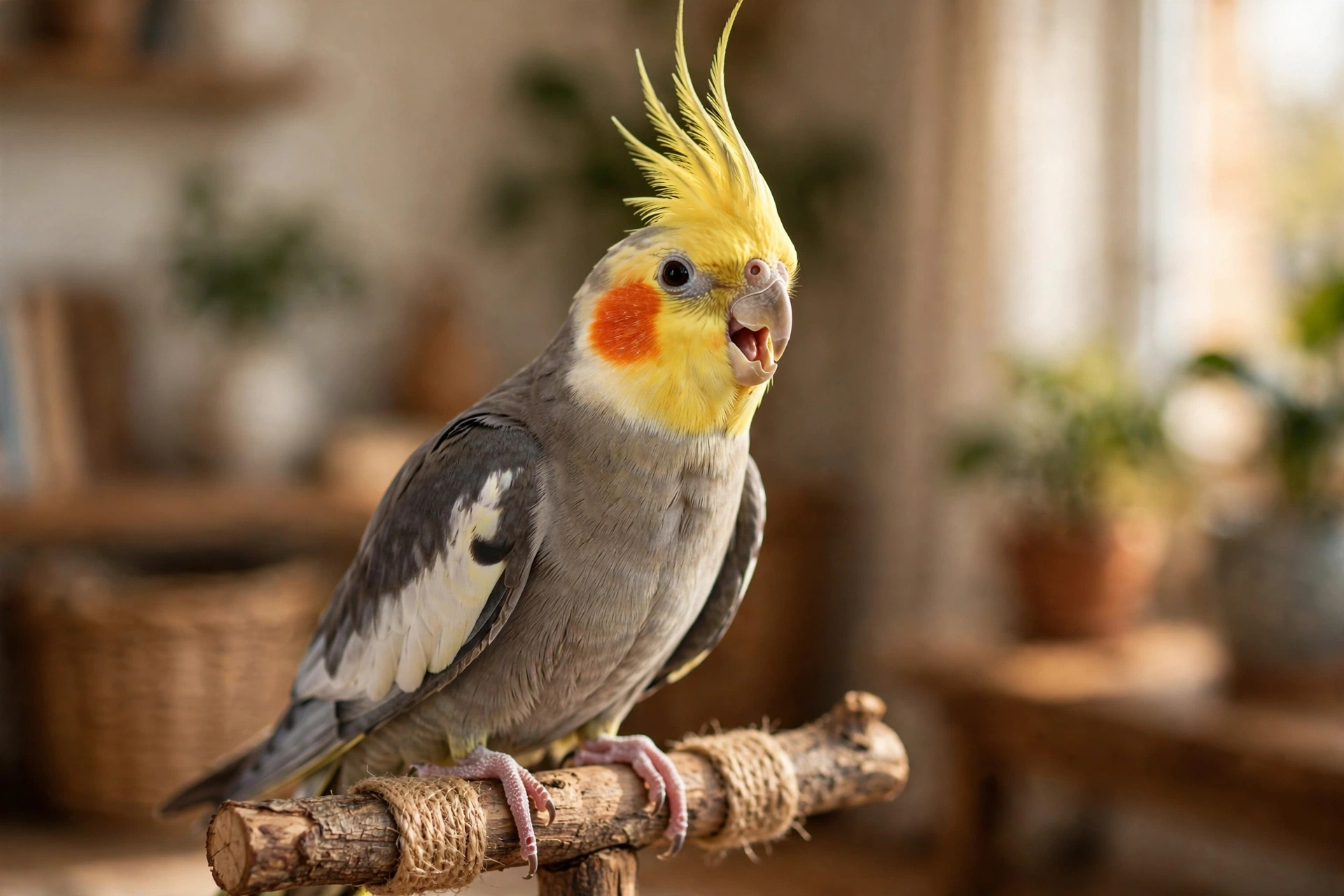
Cockatiels can talk, but they are whistlers first and talkers second. Many learn a handful of words and short phrases, and almost all of them pick up tunes, chirps, and the odd microwave beep. If you are hoping for a bird that chats like a tiny person, set your expectations honestly. If you want a feathered companion who whistles your favorite song and greets you with a squeaky “hello,” a cockatiel can be a wonderful fit.
This guide explains exactly what cockatiels can learn, why males usually out-talk females, and the step-by-step method that gives your bird the best chance of picking up words. You will also learn what to do when your bird simply will not talk, and how cockatiels compare with budgies and African greys as talkers.
How Cockatiels Make Sound: The Syrinx
Cockatiels do not have vocal cords like humans do. They produce sound with an organ called the syrinx, which sits where the windpipe splits into the lungs. This is why their voice sounds squeaky, breathy, and a little whistly. Even a word your cockatiel says clearly will sound different from human speech, and that is completely normal.
Every parrot has a syrinx, which is why cockatiels, budgies, and macaws can all mimic sounds they hear. But the syrinx of a small parrot like a cockatiel is built for quick, high-pitched sounds. That is why whistling and chirping come so naturally to them, while forming full human words takes much more practice.
Cockatiels use their syrinx all day long. They contact-call to their owners, chatter when they are happy, and hiss when they are annoyed. Talking is just one small part of their vocal world. A bird that never says a word can still be a very vocal, expressive companion. If you are curious about how birds hear the sounds around them, read our guide on whether birds have ears.
What Cockatiels Can Actually Learn
A motivated cockatiel can learn words, short phrases, whistle tunes, and household sounds. Research published in PLoS One found that cockatiels are more inclined to imitate sounds and melodies than words. In practice, that means your bird is likelier to whistle the theme from your favorite show than to say a full sentence.
Words and short phrases
Talking cockatiels usually learn between 10 and 25 words, and many top out at far fewer. Short, punchy words work best. The first words most owners report are greetings and the bird’s own name.
- Simple greetings: “hello,” “hi,” “bye bye”
- Classic favorites: “pretty bird,” “good bird,” “what’s up”
- The bird’s name: often the very first word they learn
- Context phrases: “want a treat,” “good morning,” “time for bed”
Cockatiels do not understand what the words mean in the way we do. They learn by association. Say “want a treat” every time you offer millet, and your bird connects that sound with that happy moment. This associative learning is the foundation of all cockatiel speech training.
Whistles and tunes
Whistling is where cockatiels truly shine. Many learn full tunes: the Andy Griffith theme, “Pop Goes the Weasel,” ringtones, and little melodies their owners hum around the house. Some birds invent their own songs by stringing together bits of tunes they have heard.
Here is one thing experienced owners will warn you about. Whistling is easier for a cockatiel than speaking, so a bird that starts whistling may never bother with words. If talking is your goal, teach words first and hold off on whistle training until your bird has a few reliable words.
Household sounds
Cockatiels are sound sponges. Owners regularly report birds that imitate the microwave beep, the telephone ring, the doorbell, running water, kissing sounds, coughing, sneezing, and laughter. These impressions are often startlingly accurate.
There is a funny side to this. Many owners say their cockatiel’s microwave impression has fooled them into checking the kitchen more than once. Think of this as bonus proof of how attentive these birds are to the soundscape of your home.

Males vs Females: Who Talks More?
Male cockatiels are far more likely to talk than females. This is one of the most consistent observations among breeders, vets, and owners. If talking ability is high on your priority list, a male is the safer bet.
The reason is natural behavior. In the wild, male cockatiels sing and whistle to attract a mate and show off their health. That instinct carries over into the home, where the male shows off for his owner instead. Females tend to watch and listen rather than perform. Both sexes can talk, but males are more motivated to try.
- Vocal tendency: males whistle, chirp, and chatter daily; females are generally quieter
- Speech success: males learn words more readily; females can learn but need more patience
- Training style: males respond quickly to praise and treats; females may need longer sessions
- Important note: not every male will talk, and some females surprise everyone by chatting away
Gender alone is no guarantee. An older rescue male with no history of human interaction may stay quiet, while a hand-raised female bonded closely to her owner may pick up several words. Bonding and training matter as much as gender.
If you are still choosing between species, our cockatiel vs budgie comparison covers personality, noise level, and which bird fits your lifestyle.
How to Teach a Cockatiel to Talk: Step by Step
There is no secret trick to teaching a cockatiel to talk. The method is repetition, positive association, and patience. What follows is the training approach most avian trainers and experienced owners recommend.
Set up for success first
Before training begins, your bird needs to be comfortable with you. A frightened cockatiel will not learn words. Spend time near the cage, talk softly, offer treats from your hand, and let the bird come to you. Training a bird that trusts you is ten times easier than training one that fears you.
Start young if you can. Cockatiels process sounds from hatching, and some start making talking noises around four months. They become more trainable after about eight months, around their first molt. An older bird can still learn, but young birds absorb new sounds faster.
The daily training method
Follow these steps consistently, and give your bird time. Most cockatiels that learn words take weeks or months, not days.
- Pick one word to start: Choose something short and fun, like the bird’s name or “hello.” Work on one word at a time until the bird says it reliably.
- Train in a quiet room: Turn off the TV, move away from barking dogs, and sit with your bird one on one. The target word should be the clearest sound the bird hears.
- Keep sessions short: Train for 5 to 15 minutes, two or three times a day. Longer sessions cause boredom, and a bored bird stops learning.
- Repeat with enthusiasm: Say the word clearly in a high-pitched, happy voice. Birds respond to bright, expressive tones. Repeat the word 5 to 10 times per session.
- Reward every attempt: If your bird makes any vocalization in response, even an approximate chirp, reward it immediately with a treat and praise. Say “good!” with real warmth.
- Link words to moments: Say “good morning” when you uncover the cage, “want a treat” when offering millet, “bye bye” when you leave. Context builds associations faster.
- End on a high note: Stop each session while the bird is still engaged. Never end training when you are frustrated or when the bird has checked out.
- Add words slowly: Once the first word is reliable, add a second. Keep early words distinct from each other so the bird does not blend them.
Tips that make training work better
- Bond first: a bird that wants to impress you will try harder than a bird that barely knows you
- Live interaction beats recordings: you can play recordings of your voice as a supplement, but personal training builds stronger learning
- Train when the bird is alert: mornings and early evenings are natural vocal times; never train a sleepy or stressed bird
- Speak at eye level: sit in front of the cage or hold the bird on your hand and face it as you speak
- Stay positive only: cockatiels do not respond to scolding or punishment; negative energy shuts learning down
- Try gentle movement: some owners find a soft bobbing motion while speaking gets the bird vocalizing

What to Do When Your Cockatiel Will Not Talk
Here is the honest truth: not every cockatiel will talk, and that is completely normal. Some birds simply prefer whistling. Some prefer chirping. Some are content to sit on your shoulder and grind their beak happily, which is a cockatiel’s way of saying all is well.
If months of training produce no words, first check the basics. Is the bird young and bonded to you? Are sessions short, quiet, and consistent? Is the bird healthy? A sudden drop in vocalization can signal illness, and birds hide sickness well, so see an avian vet if your bird goes quiet.
Next, reconsider what counts as success. A bird that whistles your ringtone, imitates the microwave, and greets you with excited chirps is a communicative bird. Talking is a bonus, not the measure of your bond. Many owners say they stopped caring about speech once they realized how expressive their bird already was.
Also remember that some cockatiels choose one skill. Trainers note that many birds will either talk or whistle, but not both, because each takes time and focus. If your bird has filled its days with beautiful whistled tunes, that is a wonderful outcome. Decide early which skill matters more to you, and focus your training there.
Finally, never compare your bird to internet stars. The viral videos of chatty cockatiels are the exceptions, not the rule. Your bird is not broken if it never says a word. Keep enjoying the bird you have, not the one you imagined.
Cockatiel vs Budgie vs African Grey: Talking Ability Compared
How do cockatiels stack up against other popular talking birds? This table gives you realistic expectations for each species.
| Trait | Cockatiel | Budgie | African Grey |
|---|---|---|---|
| Talking ability | Low to moderate | Moderate | Excellent |
| Typical vocabulary | 0 to 25 words | Dozens to 100+ words | Hundreds of words |
| Voice clarity | Squeaky, whistly, hard to understand | Fast, high-pitched, often surprisingly clear | Remarkably clear, near-human |
| Whistling talent | Excellent, often full tunes | Good | Good |
| Sound mimicry | Excellent (microwave, phone, doorbell) | Good | Excellent |
| Male vs female | Males talk much more | Males talk more | Both sexes talk well |
| Best for | Whistling, tunes, household sounds | Surprising vocab in a tiny bird | Serious talking and comprehension |
Budgies can learn surprisingly large vocabularies for their size, but their tiny fast voices can be hard to catch. African greys are the undisputed champions of talking birds, with clear voices and real contextual understanding. Cockatiels sit comfortably in their own lane: not the best talkers, but among the best whistlers and sound mimics in the pet bird world.
Morning vocalization is another shared trait. Cockatiels, like most birds, are chattiest at dawn. Our article on why birds chirp in the morning explains the dawn chorus instinct behind it.

Frequently Asked Questions
Can cockatiels talk like humans?
Cockatiels can mimic human words, but their voice is squeaky and whistly, so it never sounds quite human. Expect charming approximations rather than clear conversation. They are much better at whistling tunes and copying household sounds.
At what age do cockatiels start talking?
Most cockatiels that talk begin making speech-like attempts between 4 and 8 months of age. They become more trainable around 8 months, after their first molt. Starting training early, while the bird is young and forming its vocal habits, gives the best results.
How many words can a cockatiel learn?
A talkative cockatiel may learn 10 to 25 words and short phrases, but many learn fewer or none at all. Vocabulary size varies hugely by individual bird, gender, bonding, and training consistency. Quality matters more than quantity: a few clear words beat a mumbled dozen.
Do male or female cockatiels talk more?
Males talk more. Male cockatiels are naturally more vocal because singing and whistling are part of how they attract a mate in the wild. Females can learn words too, but they are generally quieter and need more patience during training.
Can a cockatiel learn to talk and whistle?
Some can, but many cockatiels choose one or the other. Whistling comes more easily to them, so a bird taught both may default to whistling and drop the words. If talking is your priority, establish several reliable words before introducing any whistle training.
Why won’t my cockatiel talk?
There are many normal reasons: the bird may be female, older, not yet bonded to you, or simply more interested in whistling. Some cockatiels never talk no matter the training, and that is normal. Check that training is consistent and quiet, and rule out illness with an avian vet if a previously vocal bird goes silent.
Should I use recordings to teach my cockatiel to talk?
Recordings can help as a supplement, but live interaction works better. Your bird learns faster when your voice, your presence, and a treat arrive together. If you use recordings, keep them short and always combine them with real one-on-one training sessions.
Will teaching my cockatiel to talk stress it out?
Not if you keep it fun. Short sessions, treats, praise, and stopping while the bird is still happy make training a game. If your bird fluffs up, backs away, or goes quiet, the session has gone too long. End on a positive note and try again later.
Conclusion
So, can cockatiels talk? Yes, but talking is not their superpower. Whistling, mimicking household sounds, and charming you with squeaky greetings are what these birds do best. A male cockatiel, hand-raised young and trained with short, positive daily sessions, has the best chance of learning words.
Keep your expectations honest and your training kind. Celebrate the microwave impressions, the whistled tunes, and the happy chirps. If words come, wonderful. If they never do, you still have one of the most affectionate and entertaining pet birds in the world. And honestly, a cockatiel that whistles your song when you walk in the room is saying plenty.
Further reading: Chewy’s top 10 cockatiel questions, answered with avian care guidance; the World Parrot Refuge training guide for repetition and reward techniques; and Psittacology on cockatiel talking for more on what these birds can learn.