Skip to content

Ask ten people to name the fastest bird in the world and nine will say the peregrine falcon. They are right, but the full answer is more interesting than the headline. The peregrine earns its crown in a hunting dive called a stoop, where it can top 200 miles per hour. In straight, level flight, the speed title belongs to a different bird entirely. And underwater, the champion is a bird that cannot fly at all.
This guide ranks the ten fastest birds with speeds in both mph and km/h, and it keeps the categories honest. Diving speed, level-flight speed, and swimming speed are three different games, and most fastest-bird lists mash them into one confusing pile. Here they are, separated, sourced, and ranked.
The Fastest Bird in the World: The Short Answer
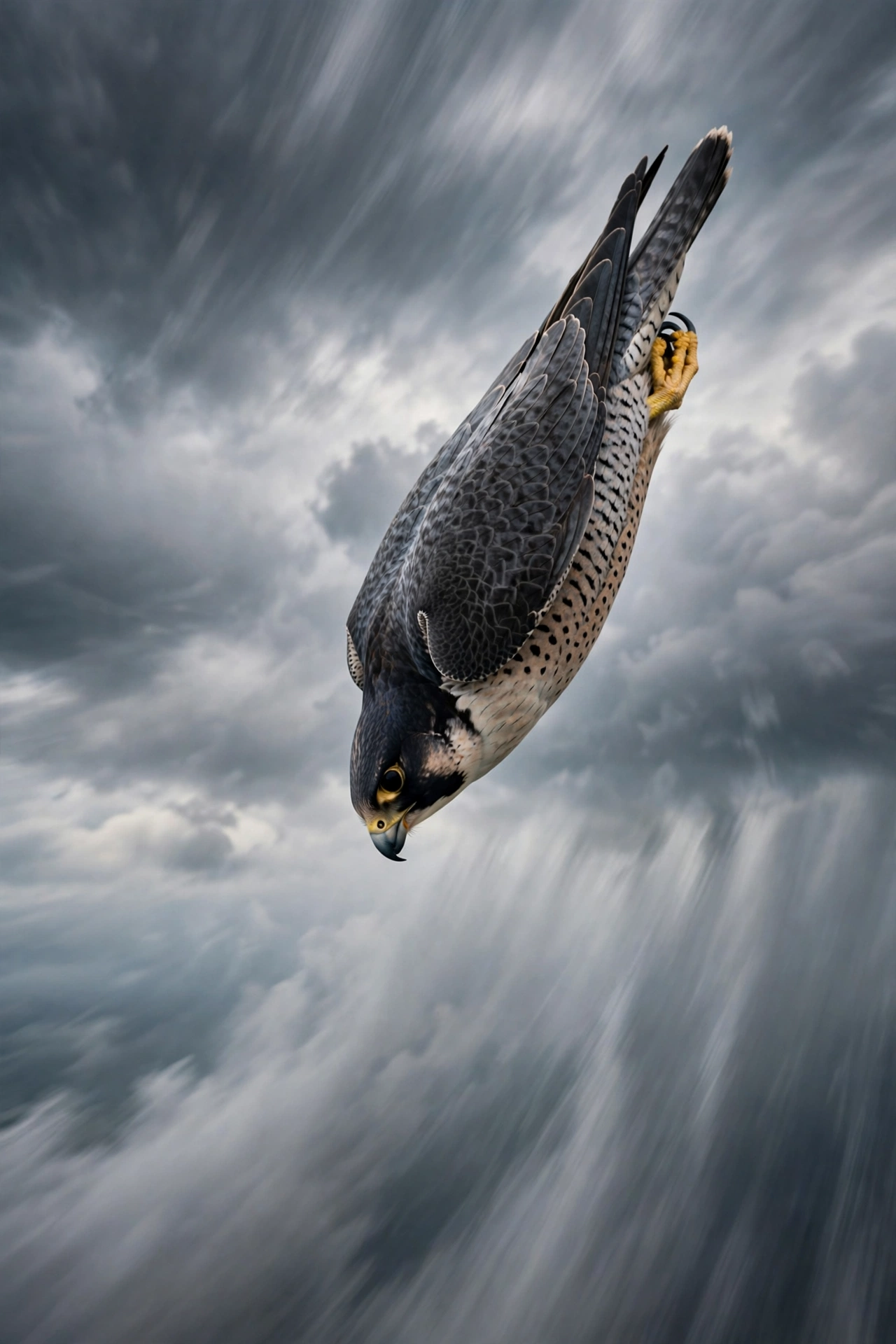
The fastest bird in the world is the peregrine falcon, and it is also the fastest animal on Earth. In its hunting stoop, a peregrine can exceed 200 mph (320 km/h). A peer-reviewed aerodynamics study confirmed that peregrines top 320 km/h in a full stoop, and the all-time record belongs to a captive falcon named Frightful, clocked at 242 mph (389 km/h) in 1999 after being released from an aircraft in measurements made with National Geographic, as Space Daily reported.
Here is the catch most lists skip: the peregrine is not especially fast in level flight. Cornell Lab of Ornithology data puts cruising peregrines at just 24 to 33 mph, rising to about 67 mph in a flat-out chase after prey. The 200 mph figure is gravity-assisted. The falcon climbs high, folds into a teardrop shape, and lets physics do the work.
A stoop usually begins with altitude. The falcon climbs hundreds or even thousands of feet above its target, spots the prey, then commits. A few powerful wingbeats start the descent, and then the wings fold back and gravity takes over. The steeper the dive, the faster the fall, which is why peregrines aim for a near-vertical line. At the bottom, the falcon does not grab its prey so much as strike it, balling its talons into a fist and letting momentum deliver a blow that can kill on impact.
Top 10 Fastest Birds in the World, Ranked
Speeds below mix dive and level-flight records, because that is how the real leaderboard looks. The “Type” column keeps each entry honest. Figures marked “reported” come from widely cited but less rigorously documented measurements; “confirmed” figures come from published or instrumented studies.
| Rank | Bird | Top speed | Type of flight |
|---|---|---|---|
| 1 | Peregrine falcon | 242 mph (389 km/h) | Dive (record); typically 200+ mph |
| 2 | Golden eagle | 150 mph (240 km/h) | Dive |
| 3 | Gyrfalcon | 130 mph (209 km/h) | Dive (reported) |
| 4 | White-throated needletail | 105 mph (169 km/h) | Level flight (reported, unverified) |
| 5 | Frigatebird | 95 mph (153 km/h) | Level flight (reported) |
| 6 | Rock dove (pigeon) | 92 mph (148 km/h) | Level flight (burst) |
| 7 | Spur-winged goose | 88 mph (142 km/h) | Level flight (reported) |
| 8 | Red-breasted merganser | 80 mph (129 km/h) | Level flight |
| 9 | Grey-headed albatross | 79 mph (127 km/h) | Level flight (wind-assisted) |
| 10 | Common swift | 69 mph (111 km/h) | Level flight (fastest confirmed) |
- Peregrine falcon: The undisputed champion. Its stoop begins hundreds or thousands of feet above the target, wings fold back, and gravity takes over. Average hunting stoops run 100 to 150 mph, with full vertical dives exceeding 200 mph. No other animal comes close. If you want to tell this speedster from its slower cousins, our hawk vs falcon identification guide breaks down the field marks.
- Golden eagle: The peregrine’s nearest rival, and a distant second. Golden eagles dive at up to 150 mph when stooping on prey in open country. Their dives are powerful but less vertical and less refined than a falcon’s, so drag caps their speed well below the peregrine’s.
- Gyrfalcon: The largest falcon, built for Arctic hunting, with dives reported near 130 mph. Reports vary and the figure is less rigorously documented than the peregrine’s, but the gyrfalcon’s bulk and pointed wings clearly put it in the same elite class.
- White-throated needletail: The great “what if” of bird speed. This Asian swift is widely cited at 105 mph in level flight, which would make it the fastest bird under its own power. But as Wikipedia’s flight-speed compilation notes, the measurement methods were never published or verified, so the record stands on shaky ground.
- Frigatebird: Ocean pirates with the largest wing-area-to-weight ratio of any bird. They are commonly cited near 95 mph, much of it harvested from wind gradients over tropical seas rather than pure muscle. They barely land, sometimes staying aloft for weeks.
- Rock dove: The humble pigeon surprises everyone on this list. Racing pigeons have been timed near 92 mph in bursts, a product of centuries of selective breeding layered on a wild bird that was already quick. Your city park pigeon is a retired athlete.
- Spur-winged goose: One of the heaviest birds to post a serious speed figure, around 88 mph. Large waterfowl generate enormous power on the downstroke, and this African goose proves that size is not the speed limit people assume.
- Red-breasted merganser: A sleek fish-chasing duck timed near 80 mph in level flight. Its narrow, high-aspect wings are built for underwater pursuit, which doubles as aerodynamic efficiency in the air.
- Grey-headed albatross: Around 79 mph, achieved by riding wind gradients over the Southern Ocean in a technique called dynamic soaring. The bird barely flaps. It harvests energy from the difference between fast air aloft and slow air near the waves.
- Common swift: The honest champion. At 69.3 mph (111.5 km/h), measured with calibrated tracking during its screaming social flights, the common swift holds the fastest rigorously confirmed level-flight record of any bird. It can spend months without landing, eating and sleeping on the wing. Those screaming flocks you hear at dusk are part of the same aerial life celebrated in our guide to why birds sing at dawn.

Dive Speed vs Level Flight: Why the Lists Disagree
Almost every argument about the fastest bird comes from comparing numbers that were never meant to be compared. A diving speed is gravity-assisted. A level-flight speed is muscle-powered. Ranking a peregrine’s stoop against a swift’s cruise is like comparing a skydiver’s fall to a sprinter’s dash. Both are speeds, but they measure different things.
The needletail controversy shows why sourcing matters. The 105 mph figure appears in list after list, yet the original measurement methods were never published or independently verified. It might be right. It might be generous. Nobody can check, because there is nothing to check against. The common swift’s 69.3 mph, by contrast, comes from instrumented, published measurements, which is why careful sources call it the fastest confirmed level flight.
Wind makes everything murkier. Some published speeds are airspeeds, the bird’s motion relative to the air. Others are ground speeds, which include whatever push the wind provided. A bird riding a strong tailwind can post a ground speed far beyond anything its muscles could produce, which is how some waterfowl records get inflated. Honest rankings say which kind of speed they mean. This one just did.
So the next time a headline declares a new fastest bird, ask one question first: fastest at what? A dive record, a level-flight record, and a swimming record are three different championships. The peregrine owns the first, the swift owns the confirmed version of the second, and the gentoo owns the third. Everything else is commentary.
How a Peregrine Falcon Survives 200 MPH
Falling at 200 mph should destroy a bird. The air hits like a wall, the lungs should burst, and the eyes should be blinded by the blast. The peregrine survives because millions of years of evolution turned it into a guided missile with built-in safety systems.
Start with the shape. In a stoop, the falcon tucks its wings into a teardrop, minimizing frontal area and drag. Its feathers are unusually stiff and tightly packed, so they do not deform or flutter under extreme air pressure. Small wingtip feathers act like the winglets on a jet, steadying the bird and letting it steer with precision at speeds where a twitch would be catastrophic.
Then the breathing problem. At 200 mph, ram air pressure would rupture ordinary lungs. Peregrines carry small bony cones called tubercles inside their nostrils that baffle and slow the incoming air, working on the same principle as the intake cones of a jet engine. The air that reaches the lungs arrives at survivable pressure, no matter how fast the bird is falling.
The eyes get their own protection. A transparent third eyelid, the nictitating membrane, sweeps across the eye during the dive like built-in goggles, shielding it from wind blast and debris while still letting the falcon see. And the falcon needs to see: its vision is famously acute, letting it track a pigeon-sized target from great distances while closing at highway speeds.
Finally, the pullout. Leveling off at the bottom of a 200 mph dive subjects the bird to forces far beyond what would knock a human pilot unconscious. The peregrine’s compact skeleton, dense bones, and powerful musculature absorb punishment that would break a lesser bird. Vision gets the glory in falcon stories, but the skeleton deserves equal billing. And while the eyes do the hunting, the ears still work mid-dive; birds do have ears, hidden beneath feathers, even at terminal velocity.

The Fastest Bird Underwater: The Gentoo Penguin
Speed has a third category, and its champion cannot fly at all. The gentoo penguin is the fastest underwater bird, reaching 22 mph (36 km/h) beneath the surface, faster than any other diving bird, according to National Geographic.
Penguins are flightless because their wings became flippers. That trade looks like a loss until you watch a gentoo hunt. Its streamlined body and powerful paddle-shaped wings propel it through water that is roughly 800 times denser than air, chasing krill and fish with agility no flying bird can match below the surface. It can dive hundreds of feet deep and stay down for minutes, making up to hundreds of foraging dives a day.
The gentoo’s 22 mph would not crack the top ten in the air, but the comparison is the point. Water punishes speed far more brutally than air does, and 22 mph underwater represents extraordinary power. Fastest is always relative to the medium.
FAQs
How fast is a peregrine falcon’s dive?
Typically over 200 mph (320 km/h) in a full hunting stoop, confirmed by a peer-reviewed aerodynamics study. The highest reliably measured figure is 242 mph (389 km/h), recorded in 1999 for a captive falcon named Frightful released from an aircraft in tests conducted with National Geographic. Ordinary hunting stoops usually run 100 to 150 mph.
What is the fastest bird in level flight?
The white-throated needletail is widely reported at 105 mph (169 km/h), but the measurement was never published or verified. The fastest rigorously confirmed level-flight speed belongs to the common swift at 69.3 mph (111.5 km/h).
Is a peregrine falcon faster than a cheetah?
Not even close, and the falcon wins by a landslide. A cheetah, the fastest land animal, tops out around 68 to 70 mph in a sprint. A peregrine’s stoop exceeds 200 mph, roughly triple the cheetah’s best. In level flight the race would be closer, but the falcon’s diving crown is unchallenged.
What is the fastest bird underwater?
The gentoo penguin, at up to 22 mph (36 km/h). It is the fastest swimmer among all penguins and all diving birds, using its flipper-like wings to chase krill and fish through Antarctic waters.
How fast do peregrine falcons fly normally?
Much slower than the legend suggests. Cornell Lab of Ornithology data puts cruising peregrines at 24 to 33 mph, with flat-out pursuit of prey reaching about 67 mph. The spectacular speeds happen only in the gravity-assisted stoop.
Can any bird fly 100 mph in level flight under its own power?
Possibly the white-throated needletail, reported at 105 mph, but the record is unverified. No bird has a rigorously confirmed level-flight speed above 100 mph. The confirmed record stands at 69.3 mph, held by the common swift.
How is a bird’s flight speed actually measured?
It depends on the era and the claim. The peregrine’s record speeds were measured with GPS trackers, radar guns, high-speed cameras, and frame-by-frame computer analysis of dives. The common swift’s confirmed record came from calibrated optical tracking during its social flights. Older records, like the needletail’s 105 mph, often trace back to stopwatch timing or pilot estimates, which is exactly why modern sources treat them with caution.

Conclusion
The fastest bird in the world is the peregrine falcon, full stop, at 242 mph in a dive that makes it the fastest animal ever measured. But the number that matters depends on the question you are asking. Fastest in a dive? Peregrine, by a mile. Fastest confirmed in level flight? The common swift, at a humbler but honestly earned 69 mph. Fastest underwater? The gentoo penguin, torpedoing through Antarctic seas at 22 mph.
That three-way split is the real lesson of the leaderboard. Speed in nature is never one thing. It is a negotiation between muscle, gravity, and medium, refined by evolution for a specific job: the falcon’s killing stoop, the swift’s endless aerial life, the penguin’s underwater hunt. The peregrine gets the crown, and it deserves it. Just remember that the crown has three jewels, and the bird wearing it cannot swim a stroke.