Skip to content

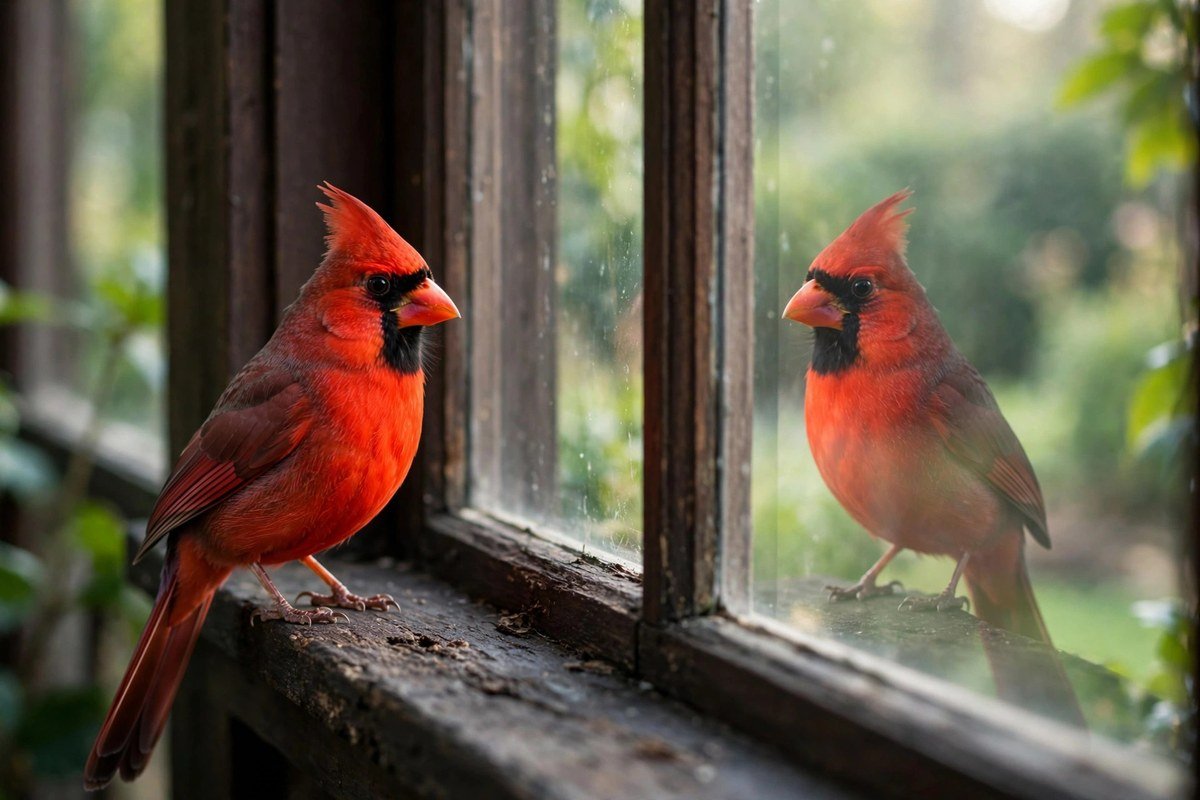
So why do birds peck at windows, over and over, day after day? The short answer is that the bird is not trying to get inside, and it is not confused about what glass is. It sees its own reflection and mistakes it for a rival bird intruding on its territory. This behavior has a name: reflection aggression. It is a territorial response, most common in spring and early summer, and the usual suspects are Northern Cardinals, American Robins, and Northern Mockingbirds.
The bird is not acting out of anger at you or your house. A male bird in breeding season is wired to chase rivals away, and when the rival is his own reflection, it never retreats, so he keeps attacking. The good news is that this behavior is almost always temporary and rarely harms the bird. Better still, it is one of the easiest bird problems to solve, because once you remove the reflection, the attacks stop.

Why Do Birds Peck at Windows: Reflection Aggression Explained
In spring, a male songbird becomes a different animal. Rising hormone levels make him fiercely territorial. He sings from high perches, chases intruders, and will physically attack any male of his species that wanders into his patch. That is the context for the pecking. A window angled toward the morning sun acts as a mirror, and when the bird flies up to it, he sees a perfect copy of himself staring back.
To him, that copy is an intruder. He puffs up, fans his tail, sings, and when the rival refuses to leave, he attacks. Glass changes nothing about this sequence. The reflection never flattens its posture, never backs down, and never flies away, so the bird keeps fighting until he is exhausted. Audubon’s reporting on this behavior notes that some individuals become so fixated on the phantom rival that they return to the same window day after day, because they have not adapted to the invention of glass.
Birds cannot recognize their own reflections. Only a handful of animals show self-recognition in mirrors, and songbirds are not among them. That means the bird will not learn that the image is fake, no matter how many times he attacks it. Females peck at windows too, though less often, usually when they are defending an active nest and read the reflection as an intruding female threatening their young.
Which Birds Peck at Windows Most Often?
Almost any territorial songbird can develop this habit, but a few species show up in nearly every report. Cornell’s window-safety guidance specifically flags spring and early summer as the season when male birds attack their own reflections in windows.
- Northern Cardinal: The classic window attacker. Cardinals hold territories year-round across much of the eastern United States, so their campaigns can drag on longer than those of migratory species. A red male sparring with his reflection is the image most people picture, and attracting cardinals to your yard comes with this quirky downside.
- American Robin: Another repeat offender. Robins are bold, territorial in spring, and comfortable around houses, which puts them in front of glass often. Our guide to identifying American robins covers how aggressively they defend breeding territory.
- Northern Mockingbird: Famously combative. Mockingbirds will attack windows, car mirrors, chrome bumpers, and hubcaps with equal enthusiasm.
- Eastern Bluebird: Especially males near nest boxes, where the stakes of holding territory feel highest.
- Sparrows and towhees: Smaller, but just as committed when the mood strikes.
The pattern is clear. These are all species with strong breeding-season territoriality, and males do most of the attacking.
Pecking or Crashing? Know the Difference
Before you act, make sure you are dealing with pecking and not collisions, because the two problems are different and so are the fixes. Pecking is slow and repetitive: the bird lands near the glass or hovers in front of it, taps with its bill, flutters, sometimes smudge-marks the pane with feather dust, and returns to the same spot daily, usually at dawn. It rarely injures the bird, though a bird that battles for weeks can become exhausted.
A collision is fast and accidental: the bird flies full speed into the glass, often during migration, and falls stunned, injured, or dead. Collisions are frequently fatal and need broader window-safety measures such as dense exterior markings across whole panes. If that is your problem, see our full guide to preventing window collisions. Everything below is about the slow, deliberate attack on a reflection.
Why Does It Start at Your Window?
Four ingredients combine to create a reflection-attacking hotspot. First is the glass itself. Tinted, low-emissivity, or simply clean and bright windows reflect the sky beautifully in morning light. Second is timing. Breeding season, roughly March through June in most of the US, is when territorial drive peaks. Third is the light. Reflections are strongest in the morning when the sun angle hits the glass just right, which is why the tapping so often starts at dawn, when birds are most active anyway.
Fourth is the launch pad. A pecking bird almost always attacks from a favorite perch, a feeder, a fence rail, a branch, or a downspout within a few feet of the window. That perch lets him stare at the glass, work himself up, and launch repeated attacks. Cars add another wrinkle: side mirrors, chrome trim, and shiny bumpers give cardinals and mockingbirds a small, perfect rival to fight at eye level.

How to Stop Birds Pecking at Windows
Every effective fix works the same way: break the reflection. The bird is reacting to what he sees from outside, so every treatment goes on the outside surface. Treatments on the inside of the glass usually fail, because the bird still sees a convincing reflection from where he stands. Start with the cheapest options and work up.
1. Cover the window from the outside
A sheet, blanket, piece of cardboard, or newspaper taped to the exterior pane is the fastest fix. It kills the reflection completely. Audubon recommends this as the simplest approach: hang the covering for a few days, and once the bird loses interest and moves on, take it down. It is not elegant, but it works fast, which matters when you are being woken at dawn.
2. Smear the glass with a soap film
Rub a bar of soap in streaks across the outside of the glass, or paint on tempera paint in a pattern. The cloudy film destroys the mirror finish while still letting some light through. Wild Birds Unlimited lists soap, newspaper, and tempera paint among the best temporary measures for window attacks. Soap washes off easily when the season ends.
3. Apply dense decals to the outside
Decals work only when they are dense and on the exterior surface. Cornell recommends markings spaced no more than two inches apart horizontally and four inches vertically, because a bird will try to slip through any convincing gap. A single hawk silhouette does nothing; Cornell’s research finds predator decals ineffective on their own. Cover the whole attacked area with dots, strips, or tape until the mirror effect is gone.
4. Install an exterior screen
A window screen mounted a few inches off the glass removes the reflective surface and gives the bird something visibly solid. Screens are one of the most practical long-term fixes for a window that gets attacked every spring, since you can leave them up and still open the window behind them.
5. Close blinds and adjust shading
Partially closed blinds or exterior shutters and awnings cut the light conditions that make glass mirror-like. Cornell suggests keeping interior blind slats only half open and using exterior awnings to block reflections. This alone rarely cures a determined attacker, but it helps as part of a layered approach.
6. Remove the launch pad
If the bird attacks from a specific branch, railing, or feeder, change that perch. Trim the branch back, place pots or hanging baskets on the railing, or move the feeder. As a general window-safety rule, keep feeders either within three feet of the glass or more than thirty feet away. A feeder in the middle distance is the worst of both worlds for collisions, and it makes a convenient grandstand for a reflection fighter.
7. Move plants and shiny objects
Houseplants right inside a window can add to the visual confusion, and anything shiny near the glass, like a gazing ball or chrome garden ornament, gives the bird more mirrors to fight. A bird-friendly garden is a joy, but keep the reflective decor away from problem windows.
8. Cover car mirrors and chrome
For car mirrors, tuck a plastic bag or an old sock over the mirror housing when the car is parked. For chrome bumpers and trim, drape a cloth over them. Parking in the garage for a few weeks during peak season works too. Mesh mirror covers that still show a reflection usually fail; use solid covers.
9. Wait it out
Reflection aggression is seasonal. Once breeding ends, hormone levels drop and the behavior fades on its own. If you can tolerate a few weeks, simply covering the window until the bird moves on is often enough. Cornell notes that a temporary cover tends to solve the problem and the bird soon moves on.
Reflection Fixes Compared: Cost, Effort, and Best Use
Use this table to pick the fix that fits your situation. Every option below goes on the outside of the glass.
| Method | Cost | Effectiveness | Best For |
|---|---|---|---|
| Sheet or cardboard cover | Free | Very high while up | An urgent attack this week |
| Soap film streaks | Nearly free | High for weeks | A quick DIY fix that still lets light in |
| Tempera paint pattern | Low | High for months | A whole season of attacks on one window |
| Dense exterior decals or tape | Low to moderate | High if spacing is tight | A recurring problem window |
| Exterior screen | Moderate | Very high | The same window every spring |
| Blinds half closed, exterior awning | Free to moderate | Moderate, works best combined | Reducing reflections generally |
| Move feeder or remove perch | Free | Moderate to high | A bird with one favorite launch spot |
| Cover car mirrors, park inside | Free | Very high | Mirror-attacking cardinals and mockingbirds |
One more note on cost: the soap, tape, and cardboard options are genuinely cheap, so price should never be the reason this problem drags on for a month. The expensive solutions are the ones you buy after under-treating the window, not before.

Frequently Asked Questions
Is the bird hurting itself when it pecks at the window?
Usually not in any serious way. Reflection attacks are far less dangerous than high-speed collisions. The real cost to the bird is wasted energy and time that could go to feeding, courting, and raising young. That said, a bird that hammers glass for weeks can arrive at the end of the season exhausted, so it is worth stopping the behavior rather than just watching it.
Why does it peck at my window every morning at dawn?
Two reasons stack up. Morning light strikes the glass at the angle that creates the clearest reflection, and dawn is when songbirds are at their most territorial and vocal. Birds are most active in the early morning, so the pecking schedule is really just the bird’s normal daily routine, pointed at your glass.
How long will the pecking last?
Anywhere from a few days to several weeks. Most campaigns end when breeding season winds down, or sooner if you remove the reflection. If you cover the window, many birds lose interest within a few days because the phantom rival has vanished. Without intervention, expect it to fade by midsummer.
Why does the bird attack only one window?
Only that window combines the right ingredients at the right hour: reflective glass angle, morning light, and a convenient launch pad nearby. Other windows on the house may not reflect clearly at the time the bird is most aggressive, or the bird simply has not noticed them. Treat the attacked window first; if the bird moves to another, treat that one the same way.
Do owl decoys or hawk stickers scare the bird away?
There is no solid evidence that they do. Cornell’s research finds that a single predator silhouette decal does not stop birds; only dense patterns that break up the whole reflective surface work. Decoys shaped like owls lose their effect quickly because birds habituate to anything that never moves. Spend your effort on breaking the reflection instead.
Will the same bird come back next year?
Quite possibly. Cardinals and mockingbirds often hold the same territory across years, and a bird that fought its reflection last spring may do it again. The upside is that you now know the fix. Treat the window proactively when you hear the first territorial singing of the season, before the habit restarts.
Conclusion
The next time a cardinal drums on your glass at dawn, you will know exactly what is happening. Understanding why do birds peck at windows takes the mystery out of it: a territorial male sees his reflection as a rival, and he is doing his job as a defender of his patch, even though the enemy is himself. The behavior is seasonal, rarely dangerous, and it says something good about your yard, namely that a bird considers it worth defending.
Fixing it is straightforward. Cover or mark the outside of the glass, remove the bird’s favorite launch perch, and cover car mirrors during the worst weeks. Skip the single hawk sticker and the owl sticker; what works is removing the mirror, not adding a scare.
Above all, resist the urge to shoo or punish the bird. He is not being spiteful; he is running a hardwired program that works in nature and only misfires around human glass. Break the reflection, and the dawn tapping gives way to ordinary birdsong again, which is the sound you wanted in the first place.