 Skip to content

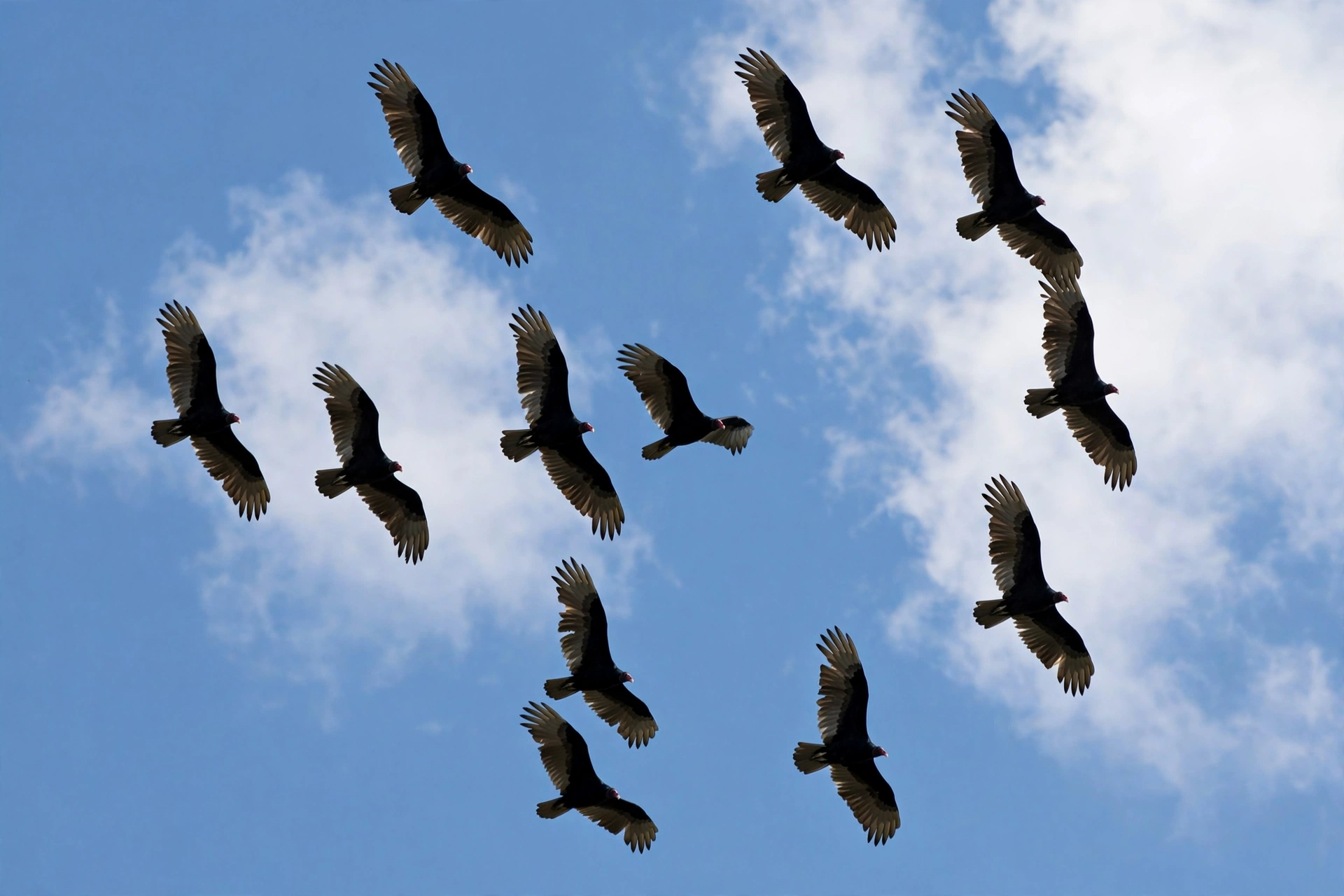
Look up on a warm afternoon and you may see them: dark birds wheeling in slow, lazy circles, barely moving their wings, drifting higher with every turn. Sometimes there are two or three. Sometimes there are dozens, spiralling upward together in a formation birders call a kettle. It looks deliberate, almost ceremonial, and it has earned vultures an undeserved reputation as omens of death.
The real explanation is far more interesting, and far more practical. Vultures circle because circling is the cheapest way to fly. This article explains the science behind the behaviour: what thermals are, how circling inside them gives vultures free altitude, why groups form kettles, how circling helps them find food, and what it actually means when vultures circle over your house. This guide stays tightly focused on the why of circling. For the broader picture of species, identification and range, see our complete guide to vulture species.
The Short Answer: Circling Means Free Altitude
A vulture circling overhead is almost always riding a thermal, a column of warm air rising from sun heated ground. By banking into a turn and staying inside that rising column, the bird gains height without flapping. Flapping is enormously expensive for a bird the size of a turkey vulture, which can approach a six foot wingspan. Soaring in circles is the economical alternative.
When several vultures share the same thermal, you get a kettle. The group is temporary and loose. Birds arrive independently, ride the lift for as long as it serves them, then glide away toward the next thermal or the next patch of ground worth searching. A kettle is less like a coordinated team and more like commuters who happen to catch the same lift.
Circling serves four jobs at once:
- Altitude gain: each turn inside a thermal carries the bird higher with almost no effort.
- Ground scanning: height gives a vulture a huge viewing area to search for carrion.
- Social signalling: other vultures notice a climbing bird and join the thermal.
- Travel: altitude gained in thermals converts into long, energy cheap glides.
That is the whole mystery in one paragraph. The rest of this article unpacks each piece, starting with the invisible engine that makes it all possible.
What Exactly Is a Thermal?
A thermal is a pocket or column of air that is warmer than the air around it, so it rises. The sun does not heat the ground evenly. A ploughed field, a dark car park, a rocky slope or a sun baked rooftop absorbs heat faster than the shaded woodland next to it. The air above the warm patch heats up, becomes lighter than the surrounding air, and starts to climb. That rising column is a thermal.
Thermals are invisible, but they follow a daily rhythm you can set your watch by. They are weak or absent in the cool of the morning, strengthen through late morning as the ground warms, peak in the early to mid afternoon, and fade toward evening. This is why vultures are often still perched with wings spread in the morning and only start kettling hours later. Watch a summer sky and you may spot the visible signature of a strong thermal: a puffy cumulus cloud, whose flat base marks roughly where the rising air finally cooled enough for moisture to condense.
Thermals vary in size and strength. A good one can lift a vulture hundreds of metres; the strongest can carry birds astonishingly high. Glider pilots chase the same lift vultures use, and the Sacramento Audubon Society notes that circling vultures are most likely taking advantage of these rising currents to glide without spending much energy. The birds worked out the technique millions of years before humans copied it.

Why Circling Keeps a Vulture Inside the Lift
Here is the key mechanical detail: thermals are narrow. The strongest lift sits in the core of the column, which may be only a few dozen metres across. A vulture cannot fly in a straight line through such a column and stay in the lift for more than a few seconds. To remain in the rising air, it must turn continuously, banking its wings and tracing circle after circle within the core.
This explains the unhurried, wobbling flight style that makes turkey vultures so recognisable. The bird constantly adjusts its bank angle and circle size, feeling for the strongest part of the lift, the way you might steer a sailboat to stay in the best wind. Turkey vultures hold their broad wings in a shallow V, a dihedral that helps them stay stable in turbulent air. The slight rocking from side to side is the bird trimming its position inside the thermal.
Once the vulture reaches the top of the usable lift, it stops circling and glides away in a straight line, slowly losing the height it just banked. The full soaring cycle runs like this:
- Find a thermal, often by watching other soaring birds already climbing in one.
- Circle inside the rising core, gaining altitude with barely a wingbeat.
- Leave the top of the thermal and glide toward the next destination.
- Find the next thermal before the stored height runs out, and repeat.
String enough of these cycles together and a vulture can cover huge distances while flapping only a fraction of the time. For a scavenger whose next meal might be kilometres away and is never guaranteed, that energy saving is not a luxury. It is the difference between surviving and starving.
What Is a Kettle, Exactly?
A kettle is simply a group of birds circling together inside the same thermal. The word is a birder’s term, and its exact origin is debated. The most repeated explanation is that the swirling birds resemble water roiling in a boiling kettle. Another account traces it to a kettle shaped landform at one of the early hawk watch sites. Either way, the name stuck, and it now describes any swirling group of soaring birds, not just vultures.
It helps to understand what a kettle is not. It is not a family group, and the birds are not coordinating with each other the way geese coordinate in formation. Each vulture is flying for itself, holding its own circle inside the shared lift. Birds join when they spot the thermal and leave when they have climbed enough or when the thermal weakens. Membership turns over constantly.
Kettles also mix species. Broad winged hawks, red tailed hawks, eagles and even storks form kettles, and migrating raptors of several species will share the same thermal. At autumn hawk watches, counters tally kettles that can number in the hundreds as mixed flocks ride ridge lift and thermals south. The vulture kettle over your neighbourhood is the everyday, small scale version of the same behaviour.
Kettles Double as a Search Party
Altitude is not just about travel. Height is a vulture’s search engine. From a few hundred metres up, a circling vulture surveys an enormous patch of ground, far more than it could ever cover at treetop level. And it does this with two of the finest sensory toolkits in the bird world.
The turkey vulture’s sense of smell is legendary and, among birds, highly unusual. Few birds have a well developed sense of smell at all, but the turkey vulture’s olfactory system is powerful enough to detect the gases of decay rising from a carcass, even one hidden beneath the forest canopy. Its eyesight is equally sharp, tuned to spot the still shapes of dead animals and the behaviour of other scavengers on the ground. Circling slowly at altitude lets the bird sweep both senses across the landscape with minimal energy cost.
There is a social layer too. Vultures watch each other constantly. When one bird breaks out of its circle and starts descending in a tightening spiral, nearby vultures read that as a possible food signal and follow it down. When a bird climbs steadily instead, others glide over to share the thermal it found. Birders sometimes describe a kettle as a dinner bell: the gathering itself advertises that something, whether lift or lunch, is worth investigating. This is why a single vulture dropping toward the ground can pull half the sky down with it within minutes.
The vulture’s search toolkit, in short:
- Smell: detects decay gases from remarkable distances, even under tree cover.
- Sight: scans huge areas from altitude for carcasses and for other scavengers.
- Social reading: follows the climbs and descents of other vultures as live information.
- Patience: circles cheaply for hours, waiting for the landscape to give something up.
Kettles on the Move: Migration Highways
Everything described so far also explains how vultures migrate. Northern turkey vulture populations travel thousands of kilometres between breeding and wintering grounds, and they do it almost entirely by soaring. Flapping that distance would cost more energy than the birds could possibly refuel along the way. Instead, migrants hop from thermal to thermal in the classic circle and glide rhythm, sometimes gathering in migrating kettles that number in the thousands.
This dependence on rising air shapes migration routes. Thermals form over land, not over open water, so soaring migrants funnel along ridgelines and coastlines and avoid long sea crossings. At famous bottlenecks, researchers count kettles the way others count individual birds, because the swirling groups are such a reliable unit of migration traffic. Similar energy saving logic drives other long distance migrants, as explained in our article on why geese fly in a V formation, and you can read about the timing of these journeys in our guide to spring and fall migration seasons.
Reading a Kettle: Turkey Vulture or Black Vulture?
In North America, most kettles hold turkey vultures, black vultures, or a mix of both. Telling them apart at height is a satisfying skill, and the differences are consistent once you know what to look for. The turkey vulture is the classic teetering soarer: wings in a pronounced shallow V, rocking gently side to side, flapping rarely and only with deep, fluid strokes. The black vulture flies flatter, with quicker, choppier wingbeats and frequent short glides between bursts of flapping.
| Feature | Turkey Vulture | Black Vulture |
|---|---|---|
| Head | Red and featherless in adults, grey in juveniles | Dark grey and wrinkled in adults |
| Wing shape in flight | Long, broad wings held in a pronounced shallow V | Shorter, broader wings held nearly flat |
| Underwing pattern | Silvery grey trailing edge along the full wing | Pale silvery patches at the wingtips only |
| Tail | Long, extends well past the wingtips | Short, barely reaching the wingtips |
| Flight style | Teetering soar, rare deep flaps | Quick choppy flaps alternating with short glides |
| Size | Larger, wingspan approaching six feet | Smaller, about 25 inches long with a 57 inch wingspan |
| Smell | Exceptional sense of smell, finds hidden carrion | Weak sense of smell, often follows turkey vultures to food |
| Temperament at carcasses | Usually yields to black vultures | Aggressive, frequently displaces turkey vultures |
The behavioural contrast matters to the kettle’s dynamics. Black vultures cannot smell a hidden carcass the way turkey vultures can, so they habitually watch turkey vultures and follow them to food, then use their aggression to take over the carcass. It is a lopsided partnership that plays out in kettles every day. For authoritative identification detail, see National Geographic’s Black Vulture profile.

Why Kettles Gather at Dusk: Communal Roosts
Some of the most spectacular kettles form in the late afternoon and early evening, and they have a different purpose. As the day’s thermals fade, vultures converge toward their communal roosts: stands of dead trees, towers, or secluded rocky ledges where dozens or even hundreds of birds spend the night together. The pre roost gathering often involves dramatic wheeling flights as birds arrive from different directions, circle, and settle in.
Roosting together offers real advantages. A large roost is a hub of social information, where unsuccessful foragers can follow successful ones out the next morning. There is also safety in numbers for birds that are clumsy and vulnerable on the ground. According to the Cornell Lab’s Turkey Vulture life history, birds outside the breeding season form roosts of dozens to a hundred individuals, and migrating flocks can number in the thousands.
You may also notice roosting vultures standing with wings spread wide in the morning sun. The exact function is still debated, but researchers suggest it helps the birds warm up, dry off, or cool down after the night. It is one more reminder that almost everything vultures do with their wings is about managing energy and temperature, not about drama.

What It Means When Vultures Circle Over Your House
This is the question behind most searches on the topic, so here is the direct answer. Vultures circling over your house are almost certainly riding a thermal, not watching your household. Houses, driveways, car parks and dark rooftops absorb heat and shed it into the air, making built up areas excellent thermal generators. A kettle over the neighbourhood usually means the local air is doing something useful, not that anything has died.
That said, a nearby carcass is the second most common explanation. If the circling is low, tight, and centred on one spot, especially if birds are descending rather than climbing, something dead may be nearby: roadkill, a fallen animal in a field, or refuse. Vultures are nature’s cleanup crew, and they investigate promptly. A quick, calm look around the property or the nearest road usually resolves the question.
What circling does not mean deserves equal emphasis. Vultures are not omens, and they do not gather above houses to predict misfortune. They also do not circle living creatures in anticipation. They eat animals that are already dead, and a kettle overhead is simply birds using the sky efficiently. Enjoy the show; it is one of the finest demonstrations of energy smart flight in the bird world.
Kettle vs Wake: The Right Word for Each Gathering
Vultures have collected a small vocabulary of group names, and each one describes a different activity. Using the right term marks you as someone who pays attention.
- Kettle: a group of vultures circling together in a thermal while airborne.
- Wake: a group of vultures gathered on the ground around a carcass, feeding.
- Committee: a group of vultures perched together, for example at a roost.
- Venue: another reported name for vultures resting together, used less consistently.
Kettle and wake are the two terms in wide, consistent use among birders and ornithologists. Committee and venue appear in lists of collective nouns but are used far less often in the field, so treat them as colourful extras rather than standard terminology. Watch a kettle descend onto a carcass and you can narrate the vocabulary shift in real time: the kettle becomes a wake the moment the birds touch down to feed.
Frequently Asked Questions
Do circling vultures mean something dead is nearby?
Sometimes, but not usually. Most circling is about thermals: gaining altitude, travelling, or scanning. If the birds are circling high and drifting, they are riding lift. If they are circling low over one fixed spot and descending, a carcass is more likely, and it is worth a look around.
Do vultures circle dying animals, waiting for them to die?
No. This is one of the most persistent myths about vultures. They circle thermals and carcasses that are already dead; they are not known to stake out living animals. Turkey vultures in particular almost never attack live prey, feeding instead on animals that have already died.
How high can vultures circle inside a thermal?
It depends on the strength of the thermal and the weather. Vultures routinely climb several hundred metres, and strong thermals on hot days can carry them far higher. Experienced glider pilots report sharing lift with vultures at altitudes that leave the birds as mere specks, which tells you how capable these soaring specialists are.
Why do vultures circle in the morning when the air is cool?
Mostly, they do not. Thermals need sun heated ground, so serious kettling usually starts in late morning and peaks in the afternoon. Early in the day you are more likely to see vultures perched with wings spread, warming up and waiting for the lift to switch on.
Can birds other than vultures form kettles?
Yes. Hawks, eagles, storks and pelicans all form kettles when they find good thermals. Autumn hawk watches are built around this: counters tally mixed kettles of broad winged hawks and other raptors riding the same lift southward during migration.
Are vultures dangerous to pets or people when they circle overhead?
No. Circling vultures are simply flying, and turkey vultures pose no threat to people or pets. They are scavengers that feed on animals already dead. Black vultures are more aggressive at carcasses but still direct that behaviour at food, not at onlookers.
Conclusion
Vultures circle for the most practical reason imaginable: it is the cheapest way to stay in the sky. A thermal is free lift, circling is the technique for staying inside it, and a kettle is what happens when several birds share the same rising column. From that height, vultures scan enormous areas with their remarkable senses, watch each other for clues about food and lift, and bank the altitude they need for long, economical glides.
The next time a kettle forms overhead, you will know what you are watching. It is not an omen and not a funeral procession. It is a group of superbly adapted soaring birds doing what they do best: reading invisible currents in the air and turning them into effortless flight. That is worth a few minutes of your afternoon, every time.





