Skip to content

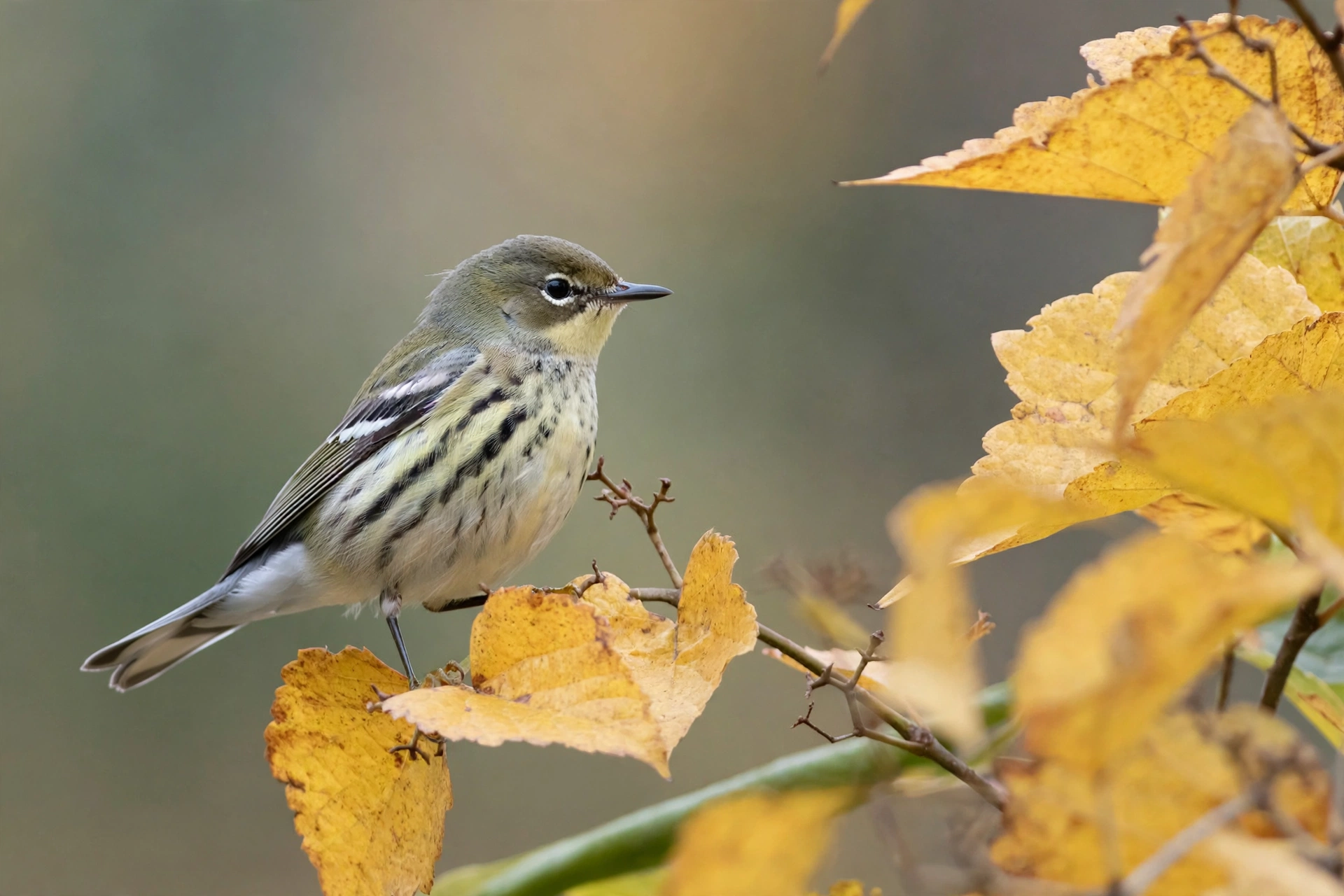
There is a special kind of heartbreak in autumn birding. The leaves turn, the migrants pour through, and every tree seems packed with small olive birds that vanish before you can raise your binoculars. In spring, warblers advertise themselves in breeding dress. Black-throated Greens blaze from the canopy, Magnolias flash their banded tails, and even beginners can put confident names to birds. Come September, the same species return in drab basic plumage, and identification becomes a genuine puzzle.
This transformation has a name among birders: confusing fall warblers. Adults have molted out of their bright feathers, and a large share of the birds you meet are juveniles wearing their first, subdued plumage. Colours fade, patterns blur, and views last only seconds. Yet autumn is arguably the best season to learn warblers properly, because it forces you to look past colour. This guide gives you a simple, repeatable system: structure and behaviour first, then the undertail, then wingbars and eye-rings, then habitat. Learn the trickiest pairs with it, and those drab olive mysteries will start resolving into named birds.
Why Fall Warblers Confuse Even Experienced Birders
Three things change between May and September, and each one strips away a layer of the identification system most birders rely on. First, adult warblers molt into basic plumage, trading bright breeding colours for something much more camouflaged.
Second, autumn flocks are full of juveniles. Many of the birds moving through in September hatched only weeks earlier, and they wear their first plumage: soft, dull, and missing the crisp patterns adults show. Juvenile warblers of several species can look strikingly similar.
Third, autumn views are brutally short. Fall migrants feed frantically to fuel long flights, and a feeding flock may stay in one tree for less than a minute. You get the classic autumn experience: a flash of olive, a flick of the tail, and a bird gone before a single field mark registers.
Think Structure and Behaviour First
Here is the liberating secret of fall warbler identification: plumage molts, but structure never does. A bird’s shape, proportions, and habits stay constant all year. Train yourself to read the silhouette before the colour, and autumn becomes far less intimidating.
Start with overall build. Is the bird compact and round-headed like a Nashville, or long-bodied with a long tail like a Pine Warbler? Check the bill next: warblers have thin, pointed bills, but there is real variation. Tennessee Warblers carry a notably thin, sharp bill, while Pine Warblers have a stouter, heavier one. Tail length matters too, especially how far the tail extends past the undertail coverts, and whether the bird pumps, cocks, or fans it while feeding.
Behaviour is just as telling. Watch how the bird feeds rather than what it looks like:
- Feeding style: Does it creep along trunks like a Black-and-white Warbler, hover-glean under leaves like an American Redstart, or work the ground under pines like a Pine Warbler?
- Tail habits: Magnolias habitually cock and fan the tail, Palm Warblers pump theirs constantly, and Pine Warblers hold a long tail loosely with a visible notch.
- Foraging height: Yellow-rumped Warblers often feed low in shrubs and even on the ground, while Blackpolls tend to stay high in the canopy.
- Flock behaviour: Fall warblers travel in mixed feeding flocks. Note which species your mystery bird associates with, since similar species often move together.
Colour can lie in bad light. Shape does not.
Check the Undertail Before Anything Else
Autumn warblers are almost always above you, which means you spend most of your time looking at their undersides. Turn that disadvantage into a method: make the undertail the first thing you check. The colour of the undertail coverts, the pattern on the tail itself, and any rump flash are often more reliable than any face mark.
Keep this cheat sheet in your head while you look up:
| What you see from below | Points toward |
|---|---|
| White undertail coverts, pale eyebrow, short tail | Tennessee Warbler |
| Yellowish coverts blending with the underparts, faint breast streaks | Orange-crowned Warbler |
| Long tail with bold white spots on the underside | Magnolia Warbler |
| Bright yellow rump flashing in flight | Yellow-rumped Warbler |
| White coverts on a streaky, wing-barred “baypoll” | Blackpoll Warbler |
| Buff-tinted coverts with a bay wash on the flanks | Bay-breasted Warbler |
The undertail check works because these patterns hold even in the drabbest plumages. When a bird lands, let your eyes drop below the belly before they climb to the face.

Wingbars, Eye-Rings, and Eye-Arcs: Reading the Fine Print
Once structure and undertail have narrowed the options, the fine print on the wing and face usually settles the matter. Fall warblers may be dull, but few are truly featureless, and the details that survive the molt are worth learning precisely.
Wingbars deserve a close look, and not just their presence. Ask how bold they are and what creates them. Blackpoll Warblers show crisp white wingbars with strong contrast against dark feather bases, while Pine Warblers show paler, lower-contrast bars on grayish feather bases. Tennessee Warblers often show only narrow, inconspicuous pale wingbars formed by the tips of the greater coverts. The absence of wingbars is information too: Nashville and Orange-crowned Warblers essentially lack them.
The face is the other high-value zone. A complete, bold white eye-ring points strongly to Nashville Warbler. A broken ring, pale arcs above and below the eye rather than a full circle, suggests Orange-crowned. A pale eyebrow (supercilium) above a plain face is classic Tennessee, while a stronger dark eye-stripe running through the eye favours Blackpoll over Bay-breasted. Learn these three face types, complete ring, broken arcs, and pale eyebrow, and half of the confusing fall warblers become far less confusing.
Blackpoll vs Bay-breasted: Solving the Baypoll
No pair defines confusing fall warblers like Blackpoll and Bay-breasted. They are so similar in autumn plumage that birders lump unidentified birds as “baypolls.” Yet most individuals can be named with confidence once you know the decisive marks.
The three decisive marks
Check these in order, and you will solve most baypolls on the spot. First, look for a strong blush of bay, a warm chestnut tone, on the flanks. Any bird showing it is a Bay-breasted. Second, look for obvious blurry dusky streaking on the upper breast and flanks. A bird showing it is a Blackpoll. Third, and often the easiest in good light, check the legs and feet. Any hint of yellow on the legs, feet, or toe pads makes it a Blackpoll; Bay-breasted legs are blackish or grayish at every age, with no yellow (a few show dull pinkish toe pads, but never yellow).
Secondary clues for ambiguous birds
Some birds refuse to show a decisive mark, and then the consensus of several smaller clues has to do the work. Blackpoll upperparts lean olive in tone, while Bay-breasted upperparts are a brighter, more yellowish green. On the underparts, a Blackpoll usually shows a lemony-yellow tint on a whitish breast, where a Bay-breasted shows a more buffy-yellow tint. Blackpoll undertail coverts are usually white; Bay-breasted coverts are usually buff-tinted. The base of the lower mandible tends yellowish on Blackpoll and pinkish on Bay-breasted. None of these is reliable alone, but together they build a strong case.
| Feature | Blackpoll Warbler | Bay-breasted Warbler |
|---|---|---|
| Flanks | Blurry dusky streaking, no bay wash | Bay (chestnut) blush on flanks, unstreaked |
| Legs and feet | Yellow on legs, feet, or toe pads | Blackish or grayish, never yellow |
| Upperparts | Olive-toned green | Brighter, yellowish-toned green |
| Underparts tint | Lemony-yellow on whitish breast | Buffy-yellow |
| Undertail coverts | Usually white | Usually buff-tinted |
| Lower mandible base | Yellowish | Pinkish |
| Eye-stripe | Stronger on average | Weaker, more variable |
For a deeper dive with photographs, see eBird’s guide to separating Blackpoll and Bay-breasted Warblers, which breaks down these same marks with annotated images.
Nashville vs Orange-crowned: The Eye-Ring Test
This is the other classic autumn headache, and the solution starts on the face. Nashville Warbler wears a complete, bold white eye-ring that stands out against a clean grey head, and the ring is visible at surprising distances. Orange-crowned Warbler shows only a broken ring: pale arcs above and below the eye, with the ring interrupted at the front and back. If you can see the eye well and the ring is unbroken, you are almost certainly looking at a Nashville.
The rest of the bird backs up the face. Nashville is the brighter, cleaner bird: grey hood, olive back, bright unstreaked yellow below with a white patch on the belly, and no wingbars. Orange-crowned is duller and plainer all over, with a faint dark eye-stripe, a suggestion of dusky streaking on the breast and flanks, and undertail coverts that blend into the dull yellowish underparts rather than contrasting with them. Orange-crowned also runs slightly slimmer with a longer tail and a fine, slightly decurved bill.

| Feature | Nashville Warbler | Orange-crowned Warbler |
|---|---|---|
| Eye-ring | Complete, bold white ring | Broken: pale arcs above and below the eye |
| Head | Clean grey hood contrasting with olive back | Dull face with faint dark eye-stripe |
| Underparts | Bright yellow, unstreaked, white belly patch | Duller yellow-olive with faint dusky streaks |
| Undertail coverts | Cleaner yellow | Dull, blending with the underparts |
| Bill | Fine and pointed | Slender and slightly decurved |
| Tail | Shortish | Longer |
When the light is poor and the eye-ring is uncertain, fall back on structure: the slimmer, longer-tailed, streakier bird is the Orange-crowned.
Magnolia Warbler: The Tail Pattern Gives It Away
Fall Magnolia Warblers can look frustratingly plain, grey-olive above and washed yellow below, with only faint streaks on the flanks hinting at their spring finery. Ignore the body and watch the tail. Magnolias habitually cock and fan a fairly long tail, and the underside carries bold white spots that are visible at almost any distance. No other common confusing fall warbler shows that spotted tail pattern, which makes it the single best mark for the species.
Supporting clues line up neatly. Fall Magnolias show a yellow rump, a broken eye-ring or pale eye arcs on a greyish head, and fine dark streaking along the flanks that many individuals retain. They are active, restless feeders that often hover briefly to snatch insects from leaf undersides. If the tail spots are there, you do not need anything else.
Yellow-rumped Warbler: The Easy Anchor
Every confusing warbler flock has an anchor species, the one you can name instantly and use to calibrate everything else. In autumn, that bird is the Yellow-rumped Warbler. The bright yellow rump patch flashes every time the bird flies, and it shows in even the drabbest first-fall birds. Eastern “Myrtle” birds add a white throat and pale yellow patches on the sides that survive the molt in muted form.
Yellow-rumps are also behaviourally distinctive. They feed lower than most warblers, often in shrubs and on the ground, and they linger later into the season than almost any other warbler, with some individuals wintering well north. They are slightly larger and longer-tailed than the trickier species, with a thin dark bill. When you find one, study it well: knowing exactly how a Yellow-rumped looks and moves gives you a living reference for judging the size and shape of every mystery bird beside it.
Tennessee Warbler: Pale Eyebrow, White Undertail
Tennessee Warbler is the plainest of the confusing fall warblers, and its plainness is the clue. Look for a small, short-tailed warbler with a thin, sharply pointed bill and a pale eyebrow stripe over a fairly unmarked face. The upperparts are yellow-green, the underparts whitish to yellow-washed, and strong wingbars are absent, though careful looks may reveal narrow, inconspicuous pale bars on the greater coverts.
The clincher is underneath: even the freshest fall Tennessee shows white, or at most faintly yellow-tinged, undertail coverts. That single mark separates it cleanly from the similar Orange-crowned, whose coverts match the yellowish underparts. Cornell Lab’s Tennessee Warbler identification page illustrates the pale eyebrow and plain face well. Tennessee is also one of the most abundant fall migrants in the eastern half of the continent, so it pays to know this bird cold: once you can name the plain ones, the marked ones stand out.
Pine Warbler vs Juvenile Magnolia: The Stout Bill Test
Fall Pine Warblers and juvenile Magnolias overlap in dull olive-yellow plumage, and both show wingbars, which makes this pair a quiet troublemaker. The fastest separation is the bill. Pine Warbler carries a noticeably stout, heavy bill for a warbler, built for its varied diet; Magnolia’s bill is finer and more delicate. If the bill looks chunky, think Pine.
Tail length is the next check. Pine Warbler’s tail extends well past the undertail coverts and the bird often holds it loosely, showing a deep notch between the feathers. Magnolia’s tail is long too, but the spotted underside usually gives it away first. Also study the wingbars: on Pine they are low-contrast, pale bars on grayish feather bases, while on Blackpoll-type birds the white tips contrast sharply with dark bases. Pine shows a bright spot in front of the eye and a cheek that contrasts with the throat, and it is strongly tied to pines, feeding along trunks and on the ground beneath them. A dull wing-barred warbler working pine bark with a heavy bill is a Pine Warbler until proven otherwise.
Field Tips: A Repeatable Routine for Every Mystery Warbler
Use this sequence every time a confusing fall warbler appears, and your accuracy will climb within a single season.
- Write down every feature as if drawing the bird. Note size, shape, bill, tail length, wingbars, face pattern, undertail, leg colour, and behaviour in that order. Field notes beat memory every time, and the discipline of describing forces you to actually see.
- Check the undertail first. Before chasing face marks, register the undertail coverts and tail pattern. White coverts, yellow coverts, spotted tail, or yellow rump will eliminate half the candidates in two seconds.
- Read structure, not colour. Ask whether the bird is compact or lanky, heavy-billed or fine-billed, short-tailed or long-tailed. Colour shifts with light; proportions do not.
- Note habitat and date. A wing-barred warbler deep in a pine stand in late October leans Pine; the same bird in a maple canopy in early September leans Blackpoll. Keep live migration forecasts handy so you know which species are actually moving through on a given night.
- Verify with the Merlin Bird ID app. Photograph or record the bird and let the app suggest candidates, then confirm the suggestion against the field marks in this guide rather than accepting it blindly.
- Bird the peak movement days. Migration comes in waves, and the biggest warbler days follow cold fronts. Planning outings around the October Big Day weekend puts you in the field when diversity is highest and practice is richest.

Frequently Asked Questions
When is the best time to see confusing fall warblers?
Warbler migration runs roughly from mid-August through October across most of North America, with the greatest diversity usually in September. Cold fronts trigger the biggest movements, so the morning after a front passes is prime time. Late October still produces stragglers and hardy species like Yellow-rumped and Pine Warblers.
Which fall warbler should beginners learn first?
Start with the Yellow-rumped Warbler. It is abundant, the yellow rump is unmistakable, and it feeds low enough for long, easy views. Once you know it thoroughly, you have a size and shape reference for judging every other warbler in the flock.
Do fall warblers sing, or only call?
Most fall warblers do not sing; they give short call notes and chips instead. Learning the dry chips of common species can identify birds you never see well. Recordings in the Merlin app are a practical way to study these calls before you go out.
Can photos really solve a confusing fall warbler?
Often, yes. A sharp photo freezes the leg colour, eye-ring, and undertail that a live bird hides in seconds. Photograph first and identify later is a legitimate strategy, especially for baypoll-type birds where one clear frame of the flanks or feet ends the debate.
What should I do if the bird shows no clear field marks at all?
Leave it unidentified. There is no shame in logging “warbler sp.” when the view was genuinely inadequate, and honest uncertainty beats a confident wrong answer. Note everything you did see; those details often make sense later once you have studied the species involved.
Do all of these species occur across North America?
No, and range is a useful filter. Blackpoll and Bay-breasted are primarily eastern migrants, Tennessee is mainly central and eastern, and Nashville and Orange-crowned are widespread, with Orange-crowned the more western of the two in many areas. Check a current range map before assuming a tricky eastern pair applies in the West.
Conclusion: Confusing Fall Warblers, Made Simple
Fall warbler identification feels hard because it asks you to work backwards: instead of matching a bright bird to a picture, you reconstruct a bird from shape, behaviour, and a handful of surviving marks. The system in this guide gives you that order of operations. Read structure first, because shape never molts. Check the undertail next, because you are usually looking up anyway. Then read the fine print of wingbars, eye-rings, and eye-arcs, and let habitat and timing narrow what remains.
Work the pairs deliberately. Solve baypolls with flank colour, streaking, and leg colour. Split Nashville from Orange-crowned on the eye-ring. Let the Magnolia’s spotted tail, the Yellow-rump’s flashing rump, and the Tennessee’s white undertail coverts do the easy work for you. Within a few outings, the olive blur in the canopy will start resolving into individuals you can name, and autumn will become what it should be: the most rewarding warbler season of the year.