 Skip to content

A pale shape crosses the beam of a porch light, wide as an open umbrella, and makes no sound at all. By the time you turn your head, it’s gone. That silence is the part people remember, not the wings, not the eyes.
But the absence of noise where there should have been noise. If that has happened to you and you have spent the days since wondering what exactly passed overhead, this guide is designed to answer that question.
The owl is a bird of prey, belonging to the order Strigiformes. Most species share a recognizable set of traits: a large, rounded head, forward-facing eyes set in a dish-shaped face.
Also, they have hearing sharp enough to locate prey they cannot see, curved talons for gripping, and flight feathers with soft, comb-like edges that break up the turbulence a normal wing would create. Put those features together and you get a predator built for low light and ambush rather than speed and pursuit.
Night hunting explains almost every one of those adaptations. Darkness rewards hearing over eyesight, patience over chase, and stealth over power and owls have specialized in all three.
What follows moves from the broad to the specific: how owls are classified, the main species you’re likely to encounter, what they look like up close, where they live, what they eat, how they behave and breed, and the questions people ask most often.
A Step-by-Step Procedure for Confident Owl Identification
Outcome: a confident species-level identification of an owl you have seen or heard, recorded in enough detail that someone else could verify it. Before you start, have a notebook or phone note open, and know roughly where you are — habitat and region narrow the list faster than any physical feature.
- Note the time and light conditions — full dark, dusk, dawn, or midday — before the bird leaves your view.
- Estimate the size against something fixed nearby: a fence post, a mailbox, a branch of known width.
- Look at the head for ear tufts, a rounded crown, or a flat, heart-shaped face.
- Record the eye color — yellow, orange, or dark brown-black.
- Describe the plumage pattern in plain words: barred, streaked, spotted, or plain.
- Listen for the call and write down its rhythm before you try to name it.
- Log the habitat — open field, dense conifers, bare ground, suburban street.
- Check for pellets or whitewash beneath perches to confirm a roost site.
- Compare your notes against a regional field guide or checklist, working from habitat first.
- Submit the sighting to a local birding database with date, location, and details.
What Is an Owl Bird?

An owl is a predatory bird with a flat or dish-shaped face, eyes fixed forward in the skull, and feet armed with four curved talons. It hunts live animals, swallows small prey whole, and does most of its work when the light is poor.
That last point is what separates owls from the other birds of prey. Hawks, eagles, and falcons belong to entirely different lineages; they hunt by daylight, rely on speed and long-distance vision, and have eyes set more toward the sides of the head.
Owls traded some of that speed for silence and hearing. Their eyes cannot move much within the socket, so the whole head turns instead — one reason owl behavior looks so deliberate.
Living owls fall into two families. Strigidae, the typical or “true” owls, is by far the larger group and includes the tufted, round-faced species most people picture. Tytonidae is the smaller family, containing the barn owls and their close relatives, recognizable by the long legs and the pale heart-shaped face.
Between them, those two families account for a great many recognized species, spread across every continent except Antarctica and onto remote islands besides.
Most are nocturnal. But a meaningful minority hunt in daylight or at the edges of it, which is why an owl seen at noon is unusual rather than impossible.
Types of Owls
The range of body plans inside this one order is genuinely wide from birds small enough to sit in a cupped hand to predators that take rabbits. Learning a handful of common species gives you a reference scale for everything else you see. The types of owls below cover the ones most often reported in North America, plus a few widespread relatives worth knowing.
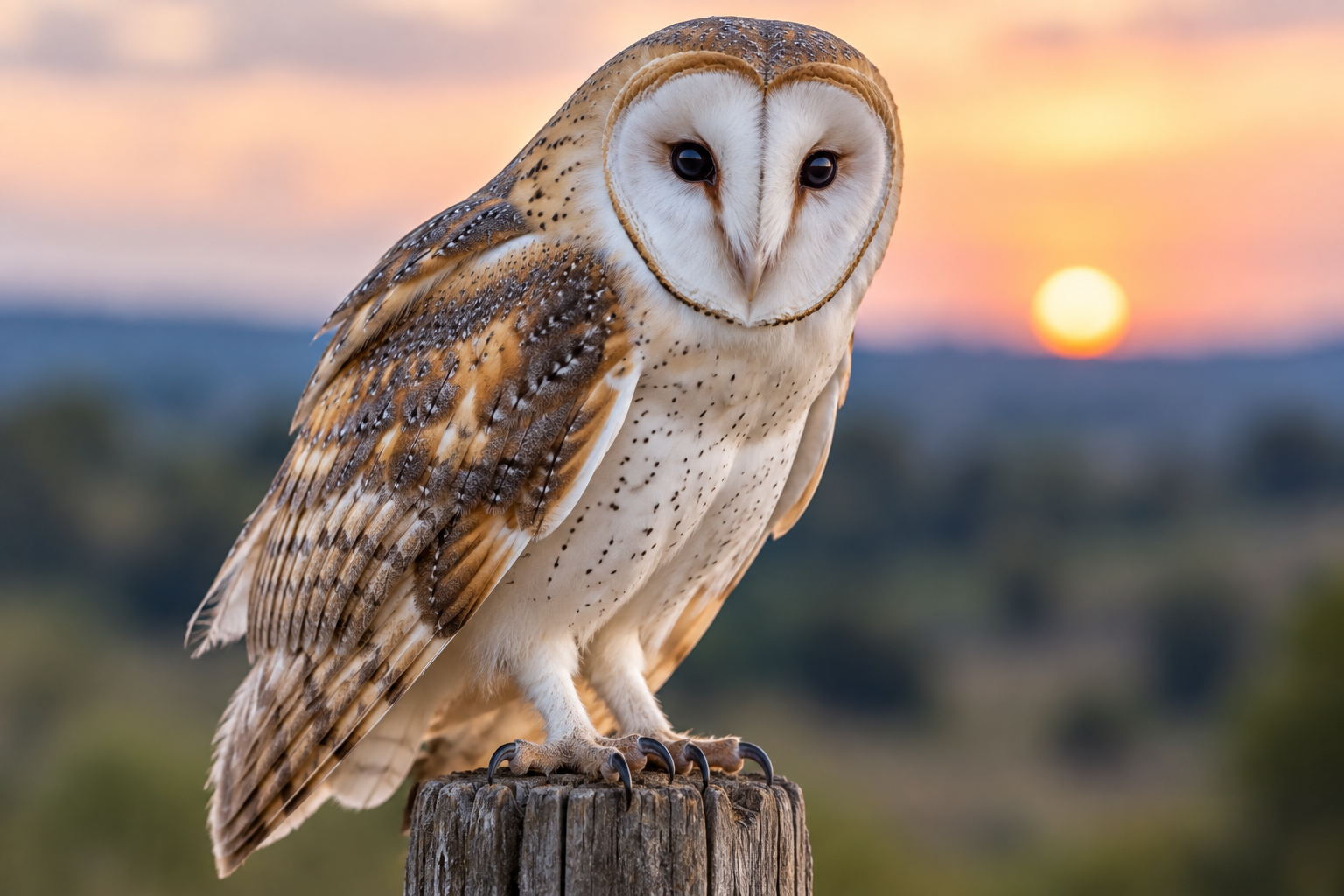
- Barn Owl. Pale buff above, white below, with a heart-shaped face and small, dark eyes. It hunts low over open ground and screeches rather than hoots. A barn owl seen in headlights looks startlingly white and is routinely mistaken for something rarer.
- Great Horned Owl. Large, heavily barred, with prominent ear tufts and yellow eyes. The great horned owl is the deep, evenly spaced hooter of suburban parks and woodlots, and it takes the broadest prey range of any owl on the continent.
- Snowy Owl. Heavy-bodied, round-headed, and mostly white with variable dark barring. Adult males run whitest; females and young birds show more markings. The snowy owl bird breeds on Arctic tundra and appears farther south in some winters, usually perched on the ground or on low structures in wide-open country.
- Burrowing Owl. Small, long-legged, brown with white spotting, and active in daylight. The burrowing owl nests underground in prairie dog towns and other excavated tunnels, and it will stand at the burrow mouth in plain view.
- Eastern Screech-Owl. Compact, tufted, and superbly camouflaged against bark in either gray or rufous plumage. Its call is a descending whinny or an even trill, not a screech.
Other owl types you may run into: the Barred Owl, with dark eyes and a rhythmic eight-note call; the Great Gray Owl, tall and long-tailed with a huge facial disc; the tiny Northern Saw-whet Owl, which repeats a single mechanical note; the slender Long-eared Owl and open-country Short-eared Owl, often confused with each other; and the Eurasian Eagle-Owl, one of the largest owls anywhere.
What Does an Owl Look Like?
- Owl eyes. Large, forward-facing, and immobile. The eye is tubular rather than spherical, which leaves almost no room for muscles to swivel it, so the bird compensates with an exceptionally flexible neck. Eye color is a genuine identification clue: yellow in many open-country and tufted species, dark brown to near-black in the Barred and Barn Owls, orange in a few others.
- Facial disc. The concave ring of stiff feathers around the face works like a dish antenna, collecting sound and funneling it toward the ear openings at the edges. Its shape differs by species — a broad, flat circle in some, a distinct heart in the Tytonidae — and many owls can adjust the feathers to focus more precisely. When you see an owl swivel and tilt its head at an odd angle, it is aiming that dish.
- Beak and talons. The beak is short, sharply hooked, and angled downward so it does not block the field of view. Feet carry four toes with curved talons and, in most species, a reversible outer toe that lets the foot close into a cage around struggling prey. Feathered legs are common; the Burrowing Owl’s bare, long legs are a striking exception.
- Feathers and silent flight. Owl plumage is unusually soft and loosely structured, and the leading edges of the primary flight feathers are fringed into fine combs. Those combs break the rush of air into smaller, quieter turbulence, and a velvety upper surface absorbs what’s left. The result is flight the prey cannot hear — and the owl’s own hearing is not masked by wing noise either.
Where Do Owls Live?
Owls occupy nearly every terrestrial habitat on earth, which is part of why the group is so varied. Dense forests shelter the cavity-nesting and ambush species. Grasslands and prairies suit low, coursing hunters that work open ground.
Deserts support small owls that nest in cactus and rock crevices. Mountains hold high-elevation specialists, and the Arctic tundra is breeding country for the white, ground-perching species. Wetland margins and marshes attract owls that hunt voles along the edges.
Two human-shaped habitats matter enormously. Agricultural areas hayfields, pasture, hedgerows, grain storage — concentrate rodents, and rodents concentrate owls. Urban and suburban environments offer mature trees, cemeteries, golf courses, parks, and steady prey around trash and bird feeders.
Barn Owls earned their name honestly. They roost and nest in barns, silos, church towers, abandoned buildings, bridge cavities, and nest boxes, hunting the surrounding fields at night. Give them open grassland and a dark, undisturbed cavity and they will often move in.
So yes, owls live near people, frequently without being noticed. A pair may raise young in a park a block from your house, and the only evidence most neighbors ever register is a call at 2 a.m. or a scatter of pellets on a sidewalk.
What Do Owls Eat?
Owls are carnivores, full stop. No owl species eats plants. Diets center on small mammals — voles, mice, rats, shrews, young rabbits — and extend to birds, insects, reptiles, amphibians, and fish depending on the species and the season. Small owls lean heavily on moths, beetles, and crickets. The largest species take prey as big as skunks and other owls.
The hunt usually starts from a perch. The bird sits still, scans and listens, then drops on a fixed line toward the sound, swinging its feet forward at the last moment so the talons strike first. Open-country species instead fly slow, low search patterns and hover briefly before dropping. Either way, the kill is made with the feet, not the beak.
Small prey goes down whole, fur, feathers, bones and all. Owls have no crop to store food, so everything passes into the stomach, where the digestible portion is absorbed and the rest is compacted into a pellet that the bird coughs back up hours later.
Those pellets are the single most useful thing an owl leaves behind. Dry, gray, oval, and full of intact bones and teeth, they pile up under regular roosts and tell you both that an owl is present and precisely what it has been eating.
How Do Owls See and Hear So Well?
Vision first. Owl eyes are enormous relative to skull size and packed with rod cells, the photoreceptors that handle dim light at the cost of color detail. Forward placement gives wide binocular overlap and good depth perception — essential when you are judging a drop onto a moving target. The tradeoff is poor close focus; an owl cannot see a nearby object clearly and uses the bristles around its beak and feet to feel instead.
Hearing does the harder work. In several species the ear openings sit at slightly different heights on the two sides of the head, so a sound arriving from below hits one ear a fraction earlier and louder than the other.
The bird reads that difference as vertical position while the usual left-right timing gap gives horizontal position. Combine the two and the owl has a sound fix accurate enough to strike prey moving under snow or leaf litter, with no visual contact at all. The facial disc feeds that system by gathering and directing sound toward the openings.
Are Owls Nocturnal?
Nocturnal means active mainly between dusk and dawn, resting through the day — and most owls fit that description. They roost in cover, stay motionless, and begin hunting as the light fails.
But treating nocturnality as a rule for the whole group causes misidentifications. Some species are diurnal, hunting through full daylight; the Burrowing and Northern Hawk Owls are regularly seen at midday, and Arctic breeders have little choice during the polar summer. Others are crepuscular, concentrating activity into the short windows at dawn and dusk when prey moves and light is still usable.
Daytime sightings also happen for ordinary reasons: a roosting owl flushed by crows, a hungry bird in hard winter weather, or a parent feeding demanding chicks.
Owl Behavior
Most owls are solitary outside the breeding season. A bird holds a territory, roosts alone, and hunts alone, which is why two calling owls in earshot are usually either a mated pair or rivals working out a boundary. A few species are exceptions — Long-eared Owls will roost communally in winter, sometimes dozens in one stand of conifers.
Migration varies by food supply rather than by calendar. Great Horned and Barred Owls typically stay on territory year-round. Short-eared and Snowy Owls move irregularly, pushed south in numbers during winters when northern rodent populations crash — an irruption, not a fixed migration route.
Vocal behavior is the practical entry point for identification. Deep, evenly spaced hoots advertise territory in the large tufted species. Screeches and raspy shrieks belong to the barn owls. Whistles, trills, toots, and whinnies come from the smaller owls. Birds also bark, hiss, and clack their beaks as alarm signals, and nestlings produce a persistent rasping beg that carries surprisingly far.
How Do Owls Reproduce?
Most owls are seasonally or long-term monogamous, and many pairs return to the same territory year after year. Courtship runs on sound first: duetting calls between neighbors, then closer exchanges, followed by the male delivering prey to the female and both birds preening each other at a prospective nest site.
Owls build almost nothing. They are cavity and platform users, taking tree hollows, old woodpecker holes, broken snags, barn lofts, cliff ledges, rock crevices, and the abandoned stick nests of hawks, crows, and squirrels.
Ground-nesting species scrape a shallow bowl in open country, and the tunnel-dwellers take over burrows dug by mammals. Nest boxes are readily accepted where natural cavities have been lost.
Clutches are small in large species and larger in the rodent specialists, and eggs are white and nearly round. The female does the incubating while the male hunts for both. Because laying is staggered, eggs hatch days apart, so a brood often contains chicks of visibly different sizes.
Young hatch downy and helpless, feather in over several weeks, and in many species clamber out onto branches “branching” before they can fly properly, staying dependent on their parents for weeks after that.
Owl Adaptations That Help Them Survive
- Hearing. A sound-collecting facial disc plus offset ear openings in several species allows prey to be located in total darkness, under snow or vegetation.
- Vision. Large, rod-rich, forward-facing eyes deliver usable sight at light levels where most birds are grounded, with strong depth perception for the final strike.
- Flight. Fringed feather edges and a velvety surface cut wing noise, keeping the owl inaudible to prey and keeping its own ears clear.
- Talons. Four curved claws on a powerful foot, with a reversible outer toe in most species, close into a cage that holds struggling animals.
- Camouflage. Bark-patterned, barred, or streaked plumage lets a roosting owl disappear against a trunk or a snowbank; many species also compress their feathers and narrow their profile when alarmed.
One correction worth making: owls cannot spin their heads all the way around. They rotate far beyond what a human neck permits — enough to look directly backward and a good distance past it — because their eyes barely move in the socket. Extra neck vertebrae and a blood-vessel arrangement that keeps circulation intact through the twist make that possible. A full circle does not happen.
Owl Bird vs Crow Bird
Owls and crows share territory and regularly fight over it, but they make their living in completely different ways. An owl is a solitary nocturnal predator that kills with its feet and swallows prey whole. A crow is a diurnal, highly social omnivore that eats carrion, insects, grain, eggs, and garbage, and solves problems in flocks rather than alone.
That mismatch explains mobbing. Crows find a roosting owl by day, when the owl is at its worst disadvantage, and harass it loudly until it leaves — one of the most reliable ways to locate an owl you would never have spotted.
Owl Bird vs Vulture Bird
Both are large, hook-billed birds, and the resemblance ends there. An owl hunts living prey, striking with strong feet and sharp talons built for gripping and killing. A vulture is a scavenger. Its feet are relatively weak and flat — closer to a walking foot than a weapon — because it never needs to subdue anything.
Their daily patterns differ just as sharply. Vultures soar high in daylight on rising thermals, locating carcasses by sight and smell. Owls sit, listen, and drop in the dark. Two specialists, two entirely separate problems solved.
Interesting Owl Facts
- Owls cannot chew. Small prey is swallowed whole and the indigestible parts come back up as a pellet.
- A group of owls is called a parliament — a literary invention that stuck.
- Not all white owls birds are Snowy Owls. A pale Barn Owl lit by headlights looks ghostly white and is misreported constantly.
- Owl eyes are tube-shaped and fixed in the skull, so the bird turns its head instead of its eyes.
- The smallest owls weigh about as much as a golf ball; the largest can take prey heavier than themselves.
- Most owls do not build nests. They borrow cavities, ledges, burrows, and other birds’ old stick platforms.
- Ear tufts are feathers, not ears, and have nothing to do with hearing.
- Chicks in one brood often differ in size because the eggs hatch days apart.
How to Identify an Owl in the Wild
Work through five features in a fixed order and you will narrow the field fast.
- Size. Judge against something measurable — a fence rail, a road sign, a nearby robin or crow. “Crow-sized” and “soda-can-sized” are more useful notes than a guessed measurement in inches.
- Face and head. Check for ear tufts, then the shape of the facial disc: a flat round dish, a distinct heart, or a small tufted head. Add eye color immediately, because yellow versus dark brown splits several lookalike pairs on its own.
- Plumage. Describe the pattern, not the shade. Horizontal barring, vertical streaking, fine spotting, and plain buff are all different starting points, and shades look unreliable in low light.
- Calls. Record the rhythm rather than the pitch. Count the notes, note whether the series rises, falls, or stays level, and whether it repeats. Rhythm is the most reliable single clue for nocturnal birds.
- Habitat. Filter by where you are standing. Dense conifers, open prairie, bare graded ground, and marsh edge each host a short and largely non-overlapping list of species.
How to Attract Owls to Your Yard
Owls come for food and shelter, so build both.
Leave structure in place. Keep dead snags and mature trees standing if they are safe, let a corner of the yard grow into rough grass and brush, and plant dense evergreens for daytime roosting. Rough cover supports voles and mice, and prey is the actual draw.
Put up a nest box sized for a species that already lives in your region — a small box for screech-owls or saw-whets, a large one for barn owls. Mount it on a trunk or pole at a decent height, face the entrance away from prevailing weather, add a few inches of wood shavings, and clean it out once a year outside the breeding season.
Then handle the hazards. Stop using rodenticides entirely; poisoned rodents move slowly, get caught easily, and carry the poison into the owl. Keep cats indoors at night. Shut off bright floodlights and aim any remaining fixtures downward. Watch a nest box from a distance and never climb to it while it is occupied.
Are Owls Dangerous?
Wild owls avoid people. A bird that notices you will usually flatten its feathers, watch, and then leave. Attacks are rare and almost always defensive — a nesting pair reacting to someone standing too close during breeding season, sometimes with a low pass at head height.
Observe from a distance, keep dogs leashed near known nests, skip playback recordings that pull birds off territory, and never handle an owl. If one is injured or grounded, call a licensed wildlife rehabilitator rather than picking it up.
Owls and Their Role in the Ecosystem
Owls sit near the top of the nocturnal food web and act as a steady brake on rodent numbers. A single pair working a field takes a large quantity of voles, mice, and rats across a breeding season, which limits crop and stored-grain damage and reduces the need for chemical control.
Their presence also signals a functioning system beneath them: intact prey populations, standing cavity trees, and undeveloped hunting ground. Because owls accumulate whatever their prey has eaten, they double as an early warning for poisons moving through the landscape.
Frequently Asked Questions About Owl Birds
- What is an owl? A bird of prey in the order Strigiformes, with a flat or dish-shaped face, forward-facing eyes, hooked beak, and curved talons, specialized for hunting in low light.
- How many kinds of owls are there? A large number of species are recognized worldwide, divided between two families — Strigidae, the typical owls, and Tytonidae, the barn owls and their relatives.
- Are all owls nocturnal? No. Most are, but some hunt in full daylight and others concentrate their activity at dawn and dusk.
- What do owls eat? Live animals only — chiefly small mammals, plus birds, insects, reptiles, amphibians, and fish, depending on species and season.
- Can owls turn their heads all the way around? No. They rotate much farther than a person can, far enough to look behind them and beyond, but not a full circle.
- Are owls wise? That reputation comes from mythology, not biology. Owls are highly specialized hunters, and their problem-solving does not stand out among birds.
- Why do crows attack owls? Crows mob roosting owls by day to drive a predator out of their area.
Conclusion: Understanding the Owl Bird
Owls are built around one problem catching living prey in the dark and every feature follows from it: the dish-shaped face, the fixed eyes, the silent wings, the gripping feet. That single design has produced remarkable variety, from tundra specialists to burrow dwellers to the pale bird hunting a hayfield behind a barn.
Take the curiosity that brought you here and turn it into records: note the habitat, the shape, the call, the pellets under a perch. Watch from a distance, leave the nest alone, and the sightings will keep coming.






[…] nights that send songbirds into torpor. If you want to meet the whole cast of resident species, our guide to owl types, facts, habitat, diet and behavior is a great starting […]