Skip to content

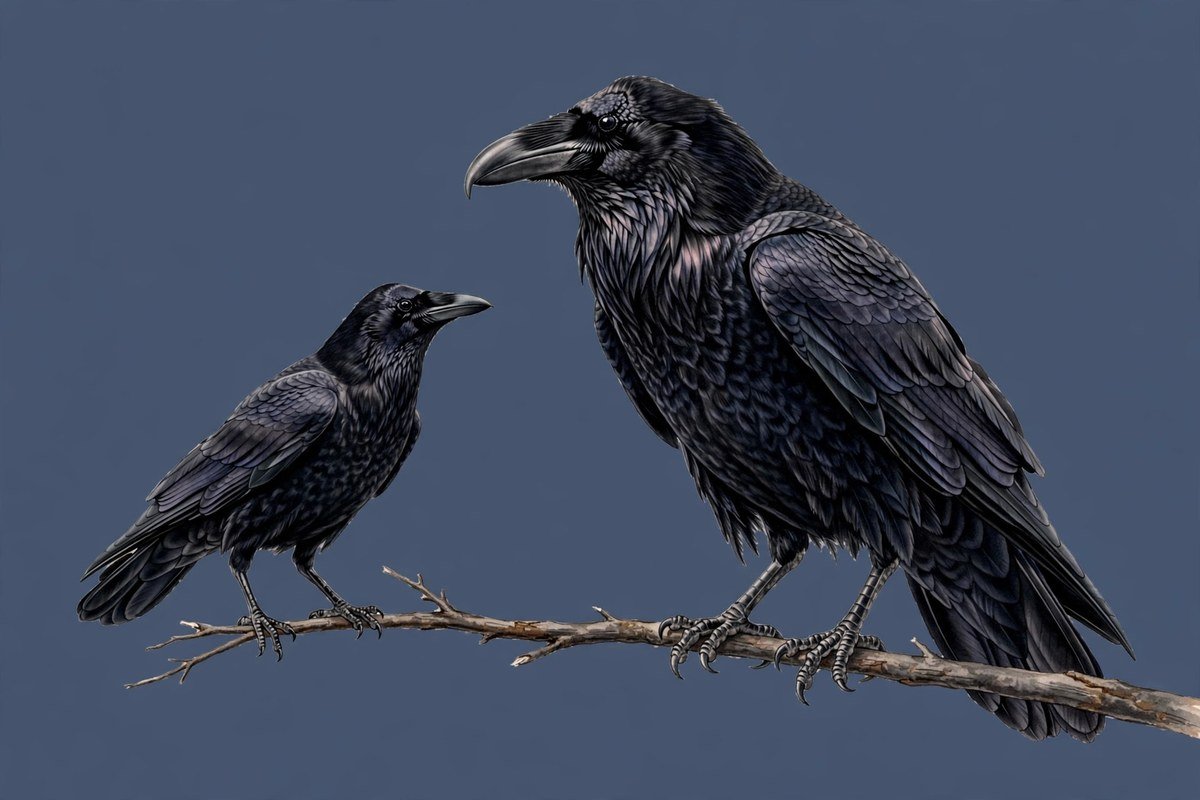
A big black bird crosses the sky and you freeze. Is it a crow or a raven? This crow vs raven question trips up almost every birder sooner or later, because both birds wear the same glossy black feathers and share the same sharp intelligence. Get the answer wrong and your checklist suffers, but the clues are easier than they look.
This guide breaks the difference between a crow and a raven into seven field marks you can actually use outdoors: size, tail shape, bill, throat feathers, call, flight style, and behavior. You will also find a side-by-side comparison table, notes on two sneaky lookalike species, and answers to the questions birders ask most often. By the end, you will know exactly which of these clever corvids you are watching.
Crow vs Raven: Side-by-Side Comparison
Start with the broad strokes. The table below lines up the two species across the features that matter most in the field.
| Feature | American Crow | Common Raven |
|---|---|---|
| Length | 17 to 21 inches | 22 to 27 inches |
| Wingspan | 33 to 39 inches | 46 to 59 inches |
| Weight | 11 to 21 ounces | 24 to 57 ounces |
| Tail in flight | Fan-shaped, rounded or straight edge | Wedge-shaped, pointed in the center |
| Bill | Slimmer, straighter, proportional | Massive, thick, curved on top |
| Throat feathers | Smooth and sleek | Shaggy, pointed hackles |
| Call | Sharp, high “caw caw” | Deep, throaty croak or “gronk” |
| Flight style | Steady flapping, rarely soars | Frequent soaring, glides, acrobatics |
| Social life | Flocks, noisy groups | Alone or in pairs |
| Habitat | Cities, suburbs, farmland | Wild country, mountains, desert, coast |

The 7 Field Marks That Set a Crow and a Raven Apart
Tables are handy, but birds rarely sit still for one. Here is how to read each clue in the real world, one field mark at a time.
1. Size: The Raven Is Bigger Than You Think
Size is the first thing most guides mention, and it deserves a warning. A raven is roughly one-third larger than an American crow, and that gap looks dramatic when the two stand side by side. In practice you almost never see them together, so lone birds can fool you.
Use size as a supporting clue, not the whole case. A raven approaches the bulk of a Red-tailed Hawk, with a thick neck and broad shoulders. A crow reads closer to a pigeon, compact and neat. If your first thought is “that bird is enormous,” the crow vs raven size question is probably already answered.
2. Tail Shape in Flight: Wedge vs Fan
Of all the visual marks, this is the one experienced birders trust most. When a crow spreads its tail in flight, the feathers are all about the same length, so the edge looks rounded or straight across like a fan. When a raven spreads its tail, the middle feathers are longer, and the tail tapers to a wedge or diamond point.
This mark works at long distances where bills and feathers blur. Watch the bird as it banks or brakes to land, because that is when the tail spreads widest. A pointed, diamond-shaped tail is a strong vote for raven, and a rounded fan is a strong vote for crow.
3. The Bill: Heavy and Curved vs Slim and Straight
A raven’s bill is a serious piece of equipment. It is thick, deep, and curved along the upper ridge, and the Cornell Lab notes it can look longer than the bird’s head. The bristle-like feathers at the base of the bill also run longer in ravens, giving the face a rough, untidy look.
A crow’s bill looks modest by comparison: slimmer, straighter, and neatly in proportion to its head. This mark shines when the bird is perched or feeding at close range. Some birders joke that a raven is just a bill with a bird attached, and the joke lands because it is nearly true.
4. Throat Hackles: Shaggy vs Smooth
Look at the throat of a perched bird, especially when it calls. A raven’s throat feathers are long, pointed, and shaggy, and they puff out into a visible mane of hackles during vocalizations. This ragged throat is one of the clearest close-range marks there is.
A crow’s throat stays smooth and sleek, with feathers lying flat against the neck even while it caws. Hackles show up well through binoculars and in photographs, so this is a good mark to confirm from a picture later. If you are identifying birds from photos and sounds, zoom in on the throat before you decide.
5. The Call: Deep Croak vs Sharp Caw
If you can hear the bird, you can usually name it. The American crow gives the classic caw: sharp, high-pitched, and repeated in quick bursts, like caw caw caw. It is nasal, brisk, and carries the unmistakable chatter of a flock.
A raven’s voice comes from much deeper in the chest. The typical call is a low, throaty croak or a hollow “gronk” that can sound like a frog or a knock on wood. Ravens also produce a wider menu of sounds, including gurgles, knocks, and bell-like notes that crows never make. Audubon’s field notes put it simply: crows caw, ravens croak. When in doubt, listen first and look second: voice settles more crow vs raven debates than any feather mark.
6. Flight Style: Soaring vs Steady Flapping
How the bird flies is nearly as reliable as the tail. Ravens soar. They catch thermals and ride them with wings held flat, gliding for long stretches without a single flap, and they love aerial play: barrel rolls, tumbling dives, and lazy loops during courtship.
Crows flap. Their wingbeats are steady, rowing, and businesslike, carrying them straight toward a destination with purpose. Crows can glide briefly, but they almost never hang motionless on a thermal the way a raven does. A large black bird circling effortlessly overhead for a full minute is almost certainly a raven.
7. Behavior and Company: Pairs vs Flocks
Count the birds around your mystery corvid. Crows are deeply social. They gather in noisy family groups, roost by the hundreds in winter, and mob predators in screaming gangs. A black bird hanging out with ten friends in a parking lot is a crow.
Ravens lean solitary. They travel alone or in bonded pairs, patrol wild country with a calm confidence, and rarely gather except at a rich food source like a carcass or dump. The pair bond is so strong that ravens are often described as traveling as couples. One bird, far from people, moving with unhurried confidence: think raven.

Where They Live: Range and Habitat Clues
Place narrows the odds before you even lift your binoculars. American crows are everywhere people are: suburbs, city parks, farmland, and roadsides across nearly all of North America. If the bird is working a dumpster behind a grocery store, it is a crow.
Common ravens favor wilder ground. They haunt mountains, deserts, coastlines, and open country, nesting on cliffs and foraging across big wild landscapes. That said, ravens have expanded into towns in some regions, so habitat is a hint, not proof. Always confirm with tail, voice, or bill rather than address alone.
Watch Out for These Confusion Species
Two more corvids can crash the crow vs raven party, and knowing them keeps you honest. The eBird team flags these lookalike pairings as classic identification pitfalls.
Fish Crow
The fish crow haunts the Atlantic and Gulf coasts and has been spreading inland along rivers and lakes. It looks nearly identical to an American crow, just slightly smaller and slimmer with a silkier sheen. The voice gives it away: instead of a clean caw, the fish crow gives a nasal “uh-uh,” as if someone were pinching its nose.
Visually, fish crows also hunch and fluff their throat feathers when calling, a habit that can briefly mimic a raven. But the tail is fan-shaped like the American crow’s, and the bird sticks close to water. Where the two crow species overlap, birders lean on voice above everything.
Chihuahuan Raven
In the deserts of the Southwest, from west Texas through New Mexico and southern Arizona into southeastern Colorado, the Chihuahuan raven replaces the common raven. It is noticeably smaller, closer to crow size, which makes the classic size clue useless.
Separate it with voice and a plumage trick. Its call is higher-pitched and less throaty than a common raven’s croak, though still lower than a crow’s caw. And when wind ruffles its neck feathers, the bases flash white instead of gray, a detail visible at close range. The wedge-shaped tail and soaring flight still say raven.

Behavior and Intelligence: Which One Is Smarter?
Both birds rank among the smartest animals on the planet, but they apply their brains differently. Crows are the social geniuses. They remember human faces, hold grudges against people who threaten them, teach their young to recognize danger, and solve multi-step problems in groups. City crows even drop hard-shelled food into traffic and wait for the light to change, a trick National Aviary bird experts cite as a signature of crow problem-solving.
Ravens are the wild problem-solvers. They plan ahead, stash food for later, use tools and gestures to point things out to each other, and have been recorded mimicking other animals and even human speech. Their aerial play, rolls, and games suggest a mind that enjoys itself. Neither species is “smarter” in a tidy way: crows outthink us socially, ravens outthink us alone.
Quick Field ID Cheat Sheet
Use this sequence the next time a black bird demands an answer. Start at the top and stop when a clue lands firmly.
- Listen: sharp repeated caw points to crow, deep throaty croak to raven.
- Check the tail in flight: fan-shaped means crow, wedge-shaped means raven.
- Watch how it flies: long soaring glides suggest raven, steady flapping suggests crow.
- Count the companions: a flock is crow behavior, a lone bird or pair leans raven.
- Get a close look: massive curved bill and shaggy throat hackles mean raven.
- Note the setting: wild mountains or desert favor raven, town and farmland favor crow.
Frequently Asked Questions
Which is bigger, a crow or a raven?
A raven is much bigger. A common raven runs 22 to 27 inches long with a wingspan of 46 to 59 inches, while an American crow is 17 to 21 inches long with a 33 to 39 inch wingspan. Think hawk-sized versus pigeon-sized.
Is a raven just a big crow?
No, they are separate species, though close relatives in the genus Corvus. A raven is not a crow that kept growing. The two differ consistently in size, tail shape, throat feathers, voice, flight style, and social behavior, and each holds its own range and habits.
How do I tell a raven’s call from a crow’s call?
Listen for pitch and texture. Crows give a sharp, high, nasal “caw caw caw,” often repeated quickly. Ravens produce a deep, throaty croak, sometimes described as a “gronk,” plus gurgles and knocking sounds. If the voice sounds like it comes from the bird’s boots, it is a raven.
Do crows and ravens fight?
Yes, and crows usually start it. Ravens are larger and would likely win one-on-one, but crows gang up: studies of crow-raven encounters found crows were the aggressors about 97 percent of the time, mobbing ravens in groups to drive them off. The same mobbing instinct shows in hawk vs falcon encounters, where small birds harass bigger raptors.
Can crows and ravens mate or hybridize?
No documented hybrids exist between American crows and common ravens. Despite their family resemblance, they are distinct species with different courtship, nesting habits, and genetics, and they do not interbreed in the wild.
Where am I most likely to see each one?
Crows favor human landscapes: suburbs, city parks, farmland, and anywhere food scraps are easy to find. Ravens favor wild country: mountains, deserts, coastlines, and remote open land. Both can wander, so confirm with field marks rather than location alone, and watch at the best time of day to see birds for your longest looks.
Conclusion
The crow vs raven puzzle looks hard only until you learn the pattern. Start with the tail in flight, because a fan means crow and a wedge means raven even at a distance. Let the voice confirm it: the sharp caw belongs to the crow, the deep croak to the raven. Then back it up with behavior, bill, and habitat, and you will rarely go wrong.
These seven field marks stack together into a habit. After a few weeks of checking tails, listening for croaks, and counting companions, the identification becomes automatic, and every big black bird overhead gets a name. For more identification practice, work through the quick ID guide for small brown birds and the American robin identification guide, which build the same careful-looking skills on familiar backyard species.