 Skip to content

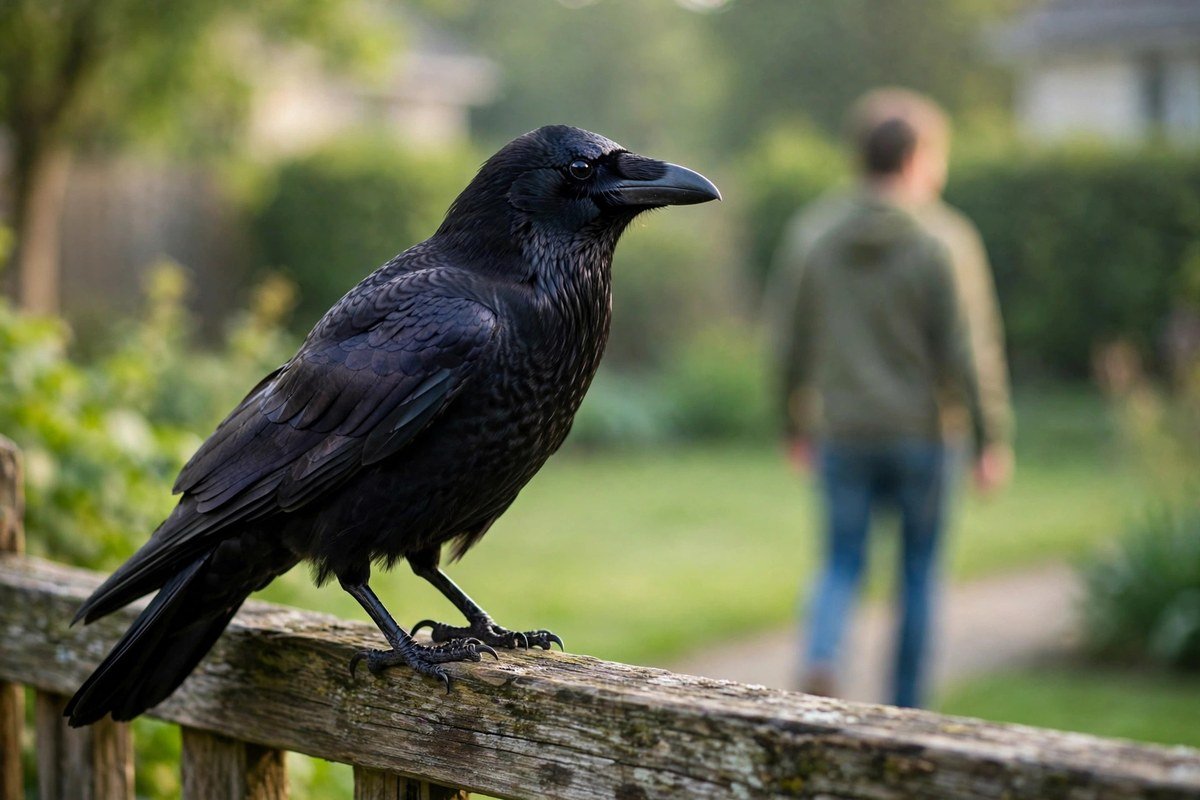
If you fill the same feeders every morning, do birds remember you, or are you just another warm shape standing near the food? Science has a clear answer, and it is more dramatic than most people expect. Many species do remember individual people, and some keep track of a single face for years.
The most famous proof comes from Seattle, where wildlife biologist John Marzluff and his team trapped and banded crows while wearing a caveman mask. The birds then scolded anyone wearing that mask for nearly two decades, long after the original crows were gone. But crows are not the only ones. Magpies learn which neighbors to swoop and which to spare. Pigeons tell a hostile stranger from a friendly one even when both swap coats. Chickens recognize more than 100 different faces. This article walks through the research behind bird face recognition, how long these memories last, and what it all means for the birds in your own backyard.

Do Birds Remember You? What the Science Says
The short answer is yes, but it helps to understand what “remember” means here. A bird does not reminisce about you the way a person does. Instead, it links a specific face to an experience, and that link guides how it behaves the next time it sees you. A face tied to danger gets alarm calls and mobbing. A face tied to food gets attention and approach.
Researchers draw a line between simple association and true recognition, and birds cross that line. In the strongest studies, birds react to the face itself, not to clothing, body shape, walking speed, or the setting. When scientists change everything about a person except the face and the birds still react, the face is what the bird filed away.
This is not limited to one clever species. Corvids like crows, ravens, jays, and magpies show the strongest memory, but pigeons and chickens, birds most people dismiss as simple, also pass carefully controlled recognition tests. Recognition seems to grow wherever birds and humans share space for long periods. Cities and suburbs are full of individual humans who behave very differently, and the birds that live there benefit from keeping score.
The Crow Mask Experiment That Changed Everything
In 2006, John Marzluff, a professor of wildlife science at the University of Washington, set out to answer a simple question: can a wild crow recognize one particular human face after a single bad encounter? Over four February mornings, his team caught seven American crows in nets at sites around Seattle, fitted them with colored leg bands, handled each bird for about 15 minutes, and released them unharmed.
Throughout the trapping, every researcher wore the same rubber caveman mask. The mask was the whole point. By hiding their real faces, the team isolated facial features from every other clue a bird might use, such as age, gender, build, clothing, or walking style. A second, neutral mask modeled on former vice president Dick Cheney was worn by people who simply walked the same routes and never trapped a bird.
What happened next became one of the most talked-about findings in animal behavior. Before the trapping, fewer than 5 percent of the crows scolded the caveman mask. Afterward, up to two-thirds of the birds scolded, mobbed, and sometimes dive-bombed anyone wearing it, as reported by Science magazine. It did not matter who wore the mask. Different people, different bodies, same furious response. The neutral mask got almost no reaction at all. You can read more about the researcher behind the work in Marzluff’s biography.
The published paper, “Lasting recognition of threatening people by wild American crows,” appeared in the journal Animal Behaviour in 2010 and documented the memory lasting at least 2.7 years. That figure is the measured floor of the study, not the ceiling. The team kept watching, and the scolding kept going. Field observations eventually stretched the timeline to about 17 years. In September 2023, Marzluff walked the campus in the caveman mask one more time, and this time no crow scolded him. The grudge had finally expired, likely outlasting the original seven crows, since wild American crows live about seven to eight years on average.
The strangest part was not the memory itself but how it spread. A 2012 follow-up paper by Heather Cornell, Marzluff, and Shannon Pecoraro in the Proceedings of the Royal Society B, titled “Social learning spreads knowledge about dangerous humans among American crows,” mapped three separate routes. Crows that were trapped learned the face directly. Crows that only watched the trapping, circling and calling in the mob overhead, picked it up as well. And young crows that had never witnessed any trapping learned to scold the mask from their parents, simply by observing the adults. Over five years the scolding response roughly doubled and spread at least 1.2 kilometers from the original sites. On one measured walk, Marzluff was scolded by 47 of the 53 crows he passed, far more birds than the seven he had ever trapped.
Brain imaging added a final piece. A 2012 study in the Proceedings of the National Academy of Sciences scanned wild crows viewing familiar faces and found activation in regions tied to vision, emotion, learning, and memory, a circuit that parallels the way mammals process faces. The crow brain is built differently from ours, but it solves the same recognition problem in a strikingly similar way.
Magpies, Pigeons, and Chickens Know Faces Too
Crows get the headlines, but they are far from alone. Australian magpies, which are not true corvids despite the name, have a documented talent for face recognition. Magpie researcher Darryl Jones of Griffith University has reported that a magpie can recognize up to 30 different human faces, roughly the average number of people who pass through one bird’s territory. Magpies famously swoop the same individuals again and again, which is why Australians joke that the attacks feel personal. They are. One of Jones’s research assistants left a magpie’s territory for 15 years and was attacked on his return visit.
Emeritus Professor Gisela Kaplan of the University of New England has spent decades studying magpie cognition. Her research found that magpies remember faces and places, plan ahead, solve problems, and even judge which humans have treated them well or badly, as described in the University of New England’s profile of her work. She notes that magpies hold long memories of humans they consider dangerous while forming lasting friendships with people who treat them kindly.
Pigeons surprised even the scientists. In experiments at the University of Paris, researchers worked with untrained feral pigeons in a park. Two similar-looking women visited repeatedly. One ignored the birds; the other chased them away. Later, neither bothered the pigeons, and on some visits the women swapped coats. The pigeons unfailingly avoided the woman who had chased them and stayed calm around the other, apparently keying on faces since the bodies, clothes, age, and build were matched, according to ScienceDaily’s summary of the pigeon research. A separate study from the University of Iowa, published in the Journal of Vision, showed pigeons processing human face identity and emotional expression in ways that echo human face perception, including the same difficulty ignoring identity when judging emotion.
Chickens may be the most underestimated of all. A 2017 review of chicken cognition by Lori Marino in the journal Animal Cognition reports that chickens can recognize up to 100 individual faces, both chicken and human, and associate those faces with positive or negative experiences. Other researchers report similar findings, though the exact number comes from a synthesis of studies rather than a single experiment, so treat “100 faces” as researchers’ best estimate rather than a hard count.
Northern mockingbirds deserve a mention too. A Cornell-cited review notes that mockingbirds, along with magpies and crows, have been reported to discriminate between individual humans based on past experience. If a mockingbird nests near your porch, it may well know exactly who you are.

Do Birds Know Their Owners?
Pet parrots take recognition a step further because they interact with one person daily for years. Parrots learn their owner’s face, voice, and routine, and many show obvious preference, flying to their favorite person while ignoring strangers. This is recognition built through hundreds of positive interactions rather than a single dramatic event.
Budgies and parakeets show quieter versions of the same ability. A budgie that has been gently handled will step up for its owner and may shy away from unfamiliar hands. If you are working on this yourself, a patient approach matters more than any trick, and our guide to tame and bond with a pet budgie walks through the process step by step. Parakeets also learn to connect specific people with specific sounds, which is part of why teaching a parakeet to talk works best with one consistent trainer.
It is worth staying honest about what this means. A parrot greeting its owner is not proof of human-like love or loyalty in the way we feel those things. It is proof of a strong, learned association between one individual and safety, food, and social contact. That is still remarkable, and it is one reason first-time bird owners are advised to keep routines steady. Your bird is studying you as closely as you study it.
How Birds Recognize You: Faces, Voices, and Habits
Faces come first, but birds read the whole person. Research points to several cues working together:
- Faces: the primary cue in the strongest experiments. When researchers held everything else constant and changed only the face, birds reacted to the face. Distinctive features like glasses, beards, and hats seem to help birds file a face away.
- Voices: many species learn individual human voices. Parrots obviously do, but wild birds too. Mockingbirds and magpies are skilled vocal learners, and both track who is talking nearby. Birds also use voice to identify each other, which is one reason some birds keep chirping after dark.
- Routine and timing: the person who appears at the feeder at 7 a.m. every day becomes a predictable, safe part of the landscape. Birds notice schedules fast.
- Movement and gait: how you walk, how quickly you approach, and whether your movements are smooth or jerky all feed into recognition. Slow, predictable movement reads as safe.
- Clothing: a weaker cue on its own, but a consistent bright jacket or hat can help a bird sort you from the crowd. The pigeon coat-swapping experiment suggests birds demote clothing below facial features when the two conflict.
Negative experiences get priority filing. A single scare can create a lasting impression, while trust builds slowly through repetition. That asymmetry makes evolutionary sense. Forgetting a predator can be fatal, but forgetting a friend just costs a meal.
How Long Do Birds Remember People?
Memory length varies by species and by how strong the experience was. Single dramatic events create the longest memories, while everyday familiarity is maintained through constant refresh. Here is what the research has documented so far:
| Species | What was remembered | How long it lasted |
|---|---|---|
| American crow | A threatening masked face | At least 2.7 years in the published study; field observations continued about 17 years |
| Australian magpie | A disliked researcher | Attacked him on return after 15 years away |
| Feral pigeon | A hostile versus neutral person | Reliably distinguished across repeated trials in the study period |
| Chicken | Individual human and flock faces | Recognized after several months of separation, per researchers’ reports |
Two patterns stand out. First, bad memories outlast good ones in the published experiments, though friendly recognition clearly exists in pet birds and feeder regulars. Second, social species can pass memories along, so the “memory” in a crow population can outlive every bird that witnessed the original event. Your backyard flock may carry opinions about the previous homeowner.
How to Become a Face Your Backyard Birds Trust
You cannot force a wild bird to like you, but you can give it every reason to file you under “safe.” The method is simple, and it works through the same recognition machinery the studies describe.
- Show up on a schedule. Refill feeders at roughly the same time each day. Predictable humans are safe humans in a bird’s assessment.
- Bring the goods. Fresh food and clean water are the fastest way to become a positive association. If you are starting from scratch, our guide to attract birds to your backyard covers feeders, water, and shelter basics.
- Move slowly and predictably. No sudden lunges toward the feeder, no chasing for a photo. Let birds set the distance.
- Never grab or trap. One frightening capture can undo months of trust, as the crow research demonstrates in reverse. Handle wild birds only when rescue truly requires it.
- Keep cats and dogs managed. Birds watch who brings predators. A yard where cats roam freely teaches every bird to stay alert around the whole household.
- Give it time. Weeks of calm, consistent presence beat any shortcut. Trust in birds is earned the slow way, one uneventful morning at a time.

Frequently Asked Questions
Do birds remember you if you feed them?
Evidence says yes. Birds that visit feeders learn to associate specific people with food, and studies on pigeons and chickens show they distinguish the person who feeds them from strangers. Regular, calm feeding builds a positive association that birds act on, approaching sooner and staying longer when their known feeder appears.
Can crows really hold a grudge against one person?
Within the limits of what science can show, yes. The University of Washington mask experiments demonstrated that crows link a specific face to a threatening experience and scold that face for years, even when different people wear the mask. They also pass the warning to flockmates and offspring that never witnessed the original event.
Do pet birds know their owners?
Parrots, budgies, and parakeets recognize their owners by face, voice, and routine, and they behave differently toward familiar people than strangers. This recognition is built through daily positive interaction. It reflects strong learned association rather than human-style emotion, but it is consistent and well documented by owners and researchers alike.
How long can a crow remember a human face?
The peer-reviewed paper documented at least 2.7 years after a single trapping event. Continued field observations found the local crow population still reacting to the same mask for about 17 years, with the response finally fading in September 2023. The 2.7-year figure is the confirmed measurement; the longer stretch comes from ongoing observation rather than a controlled experiment.
Do magpies recognize individual people?
Yes. Research on Australian magpies reports they can recognize up to 30 human faces, about the number of people in a typical territory, and they repeatedly target the same individuals for swooping while ignoring others. One researcher’s assistant was attacked on returning to a magpie’s territory after 15 years away.
Can birds recognize you by voice as well as face?
Many can. Parrots clearly learn their owner’s voice, and wild species like magpies and mockingbirds track individual voices too. In recognition, faces appear to be the strongest cue, with voice, routine, gait, and clothing adding supporting detail that helps birds confirm who they are dealing with.
Conclusion
So, do birds remember you? For a surprising number of species, the answer is a well-documented yes. Crows can link your face to a single bad experience and hold that file for years, then teach it to birds that never met you. Magpies keep a mental roster of the people in their territory and act on old scores. Pigeons sort the hostile from the harmless by face, and chickens may track a hundred different individuals. Even the parakeet in your living room knows exactly which human is its person.
The practical takeaway is simple and worth remembering the next time you step into the yard. Every interaction is a data point. Move gently, keep a routine, offer food and water, and never give the local crows a reason to start a file on you. Treat the backyard birds well, and you become a familiar face worth trusting, one they will recognize every single morning.




