 Skip to content

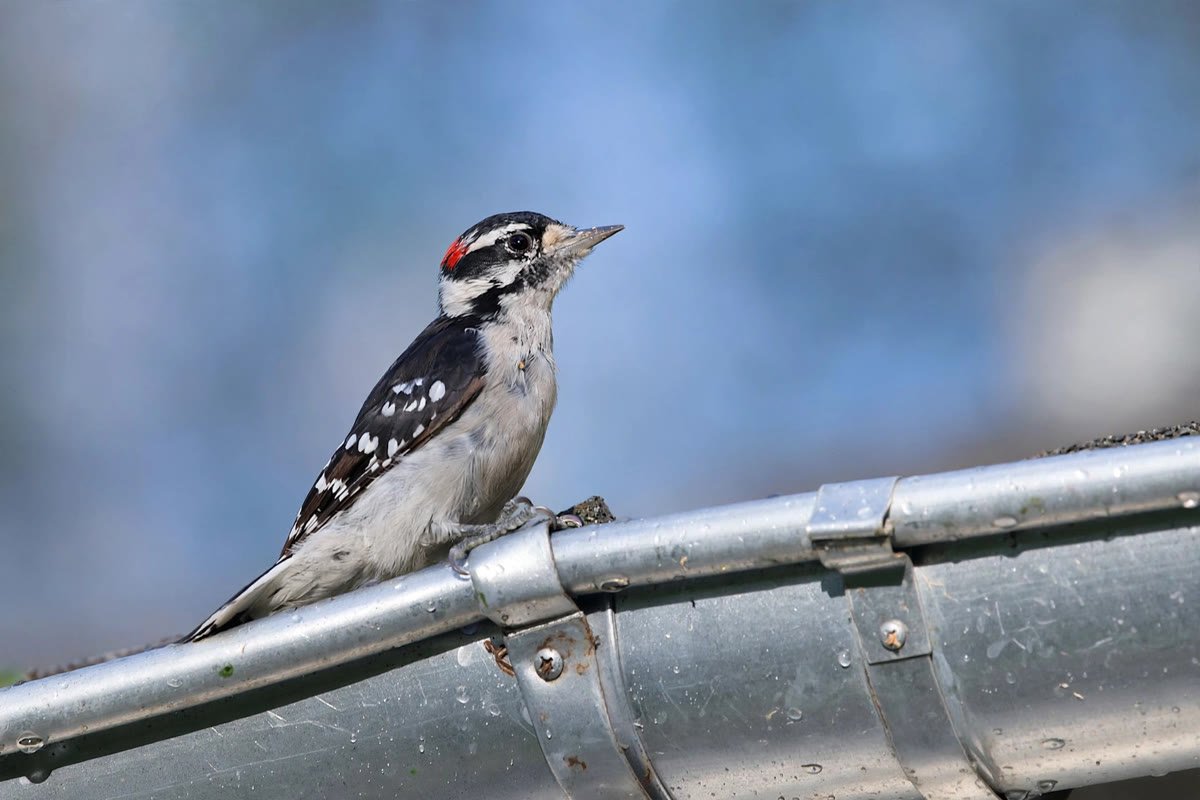
It starts at dawn. A rapid-fire jackhammer rattles your gutters, your chimney cap, or the metal flashing on your roof, loud enough to wake the whole house. You look outside and there it is: a woodpecker, hammering away at solid metal with everything it has.
Why do woodpeckers drum on metal? They are not eating, and they are not trying to break in. Drumming is communication. Woodpeckers drum to claim territory and attract mates, the same way songbirds sing, and metal surfaces produce a louder, farther-carrying sound than any tree. Your gutter is not a food source. It is an instrument, and the bird chose it because it rings.
In this guide, you will learn the difference between drumming and destructive pecking, why metal beats wood for a woodpecker’s purposes, which species do it most, when the season peaks, and how to stop the noise legally and humanely without harming the bird.

Why Do Woodpeckers Drum on Metal? The Short Answer
Woodpeckers drum on metal because they want to be heard. Drumming is a non-vocal signal, a rapid burst of strikes against a resonant surface, used to announce territory ownership and advertise for a mate. The louder the surface, the farther the message travels, and few things in a neighborhood ring like a metal gutter, chimney cap, or vent pipe.
This is completely different from pecking for food or excavating a nest hole. Foraging pecks are slow, deliberate, and irregular, aimed at extracting insects or chipping wood. Drumming is fast, rhythmic, and purely acoustic: the bird strikes and moves on, leaving the surface undamaged. If the pounding on your house follows a steady beat and the bird is not digging, you are hearing a love song played on sheet metal.
The behavior peaks in late winter and early spring, when woodpeckers are pairing up and drawing territorial boundaries. Once breeding season winds down, the drumming usually stops on its own, which is small comfort at 6 a.m. in March but worth knowing.
Drumming vs Pecking: How to Tell Which One You Are Hearing
Not all woodpecker hammering is the same, and the distinction determines what you should do about it. Here is how to read the behavior.
| Clue | Drumming (communication) | Foraging pecking (feeding) | Excavating (nesting) |
|---|---|---|---|
| Rhythm | Fast, even, machine-like bursts | Slow, irregular taps with pauses | Steady chipping, wood chips flying |
| Surface | Metal, or the most resonant wood available | Wood siding, trees, fence posts | Dead trees, soft siding, eaves |
| Damage | None, just noise | Small holes where insects were extracted | Large round or rectangular holes |
| Season | Late winter through spring | Year-round | Spring |
| Time of day | Early morning, often at dawn | Any daylight hour | Daylight hours |
| What to do | Reduce resonance, deter gently | Check for insect infestation in the wood | Protect the area; do not seal active nests |
If your bird is drumming on metal, you can relax about structural damage. The beak strikes do not dent gutters or chimney caps. The problem is purely acoustic, which also means the solutions are about sound and deterrence, not repair.
Why Metal Beats Wood for a Drumming Woodpecker
In a forest, a woodpecker seeking maximum volume finds a dead, hollow tree with good echoing qualities. Dead limbs and hollow trunks act as natural amplifiers, and experienced birds return to favorite drumming trees year after year.
Around houses, metal outperforms every tree. Gutters, chimney caps, vent pipes, metal flashing, TV antennas, and even satellite dishes vibrate with a resonance wood cannot match. Researchers at the Cornell Lab of Ornithology note that urban woodpeckers have learned to exploit this: surrounded by metal objects, they simply use the loudest thing in their environment to broadcast their message.
The species most often reported on metal include the northern flicker, the red-bellied woodpecker, and the downy woodpecker. Once a bird finds an effective surface, it typically returns to the same spot day after day through the breeding season. The bird is not confused or stupid. It has found a superb instrument and sees no reason to switch.
There is even an individual quirk to it. Cornell researchers have observed that not every woodpecker with access to metal uses it. Some birds take to metal drumming enthusiastically and keep it up for years, while others in the same neighborhood never bother. Personality, it seems, is not limited to mammals.
Know Your Drummer: Species Patterns Sound Different
Experienced birders can identify a woodpecker by its drumming alone, because each species plays at its own tempo. The hairy woodpecker delivers a fast, even drum roll. The downy woodpecker, its smaller lookalike, drums more slowly, just a few seconds at a time with pauses between bursts. Red-breasted sapsuckers play an irregular, syncopated pattern that speeds up and slows down.
The northern flicker, one of the most enthusiastic metal drummers in suburbs, produces a loud, steady tattoo that carries impressively. The pileated woodpecker, the crow-sized giant of eastern forests, drums more slowly but with tremendous power, and its deep, resonant rolls can be heard from far away even on wood.
Learning these patterns turns an annoyance into a free identification lesson. Next time the gutters start up, listen for ten seconds before you groan. The tempo tells you exactly who is on the drums, and matching the sound to the bird is one of the most satisfying skills in backyard birding.
When Drumming Season Peaks
Drumming follows the breeding calendar. It ramps up in late winter as days lengthen, peaks in early spring when territories are being claimed and mates courted, and fades as nesting begins. By summer, most of the dawn percussion has stopped.
Early morning is prime time. Like the dawn chorus of songbirds, drumming carries farthest in the still, cool air of first light, which is exactly when it is least welcome to sleeping humans. A bird that drums at 6 a.m. is not being inconsiderate. It is being effective.
Fall drumming happens but is much less frequent and usually brief. If you hear heavy metal drumming in October, it is often a young bird practicing or a brief territorial dispute rather than the full spring campaign. For context on how differently birds treat glass, see why birds peck at windows, another homeowner mystery with a completely different explanation.

How to Stop Woodpeckers Drumming on Your House
You cannot reason with a woodpecker, but you can make your house a worse instrument. Work through these steps in order, starting with the gentlest.
- Confirm it is drumming, not feeding: use the table above. If the bird is digging into wood, check for carpenter ants or wood-boring beetles first, because an insect problem needs its own fix.
- Reduce the resonance: the most effective step. Slip foam, rubber, or cloth padding behind the gutter or over the chimney cap where the bird strikes. A surface that does not ring loses its appeal fast.
- Block access temporarily: drape bird netting or hang strips of reflective tape, old CDs, or metallic streamers near the drumming spot. Movement and flashing light unsettle the bird. Move visual deterrents every few days so the bird does not habituate.
- Offer an alternative stage: mount a dead log or a purpose-built drumming post away from the house. Some woodpeckers transfer their performance to a better natural option if one is available.
- Be persistent for two weeks: drumming is seasonal and habitual. Consistent deterrence through the peak weeks usually breaks the routine, and the bird moves on.
- Wait it out if all else fails: spring drumming ends on its own. If the bird is only drumming and causing no damage, patience is a legitimate strategy.
What works on one bird may not work on another, so combine methods rather than relying on a single trick. Reflective deterrents pull double duty: the same flashing tape that startles a drummer can also help with glass, so if birds are hitting your windows too, see our guide on how to stop birds hitting windows. And if woodpeckers are also welcome visitors at your feeders, remember the drumming bird and the suet visitor are often the same individual living its complicated life.
What Not to Do: The Legal and Practical Limits
- Do not harm the bird: woodpeckers are protected under the Migratory Bird Treaty Act in the United States. Killing, injuring, or capturing one without a federal permit is illegal, and permits for nuisance drumming are essentially never granted.
- Do not use poison: it is dangerous, non-selective, and illegal for protected birds. It also risks poisoning hawks, owls, and pets that scavenge.
- Do not seal holes without checking: if the bird has excavated a cavity, eggs or chicks may be inside. Sealing an active nest is illegal and cruel.
- Do not rely on a single static deterrent: a plastic owl that never moves becomes garden furniture within days. Woodpeckers are observant and habituate quickly to anything motionless.
- Do not ignore real wood damage: drumming on metal is harmless, but persistent pecking that chips siding or opens holes signals insects or a nest attempt, which needs a different response than noise deterrence.
The legal protection surprises many homeowners, but it reflects the woodpecker’s ecological value. Abandoned woodpecker cavities shelter dozens of other species, from bluebirds and screech-owls to flying squirrels. The dawn drummer on your gutter is a keystone carpenter for the whole neighborhood.

Frequently Asked Questions
Will a woodpecker damage my metal gutters by drumming?
No. Drumming strikes are rapid and light, designed for sound rather than excavation. They do not dent gutters, chimney caps, or flashing. If you see actual dents or holes in metal, something else caused them. The only cost of drumming is noise and lost sleep.
Why does the woodpecker drum at the same time every morning?
Early morning air carries sound farthest, so dawn is the most effective time to broadcast a territorial claim. The bird is also following its own hormonal schedule: breeding-season hormones peak in the morning. The routine usually lasts a few weeks and fades as nesting begins.
Do both male and female woodpeckers drum?
Yes, though males drum more frequently and for longer. Both sexes use drumming for territory defense and pair communication. In some species, mated pairs drum back and forth to each other, a duet that helps maintain the pair bond through the breeding season.
How can I tell drumming apart from a woodpecker looking for insects?
Listen to the rhythm and watch the surface. Drumming is fast, even, and rhythmic on a resonant surface, with no wood chips or holes resulting. Foraging is slow and irregular, with pauses to listen and pry, and it targets wood, not metal. Excavating produces visible chips and progressively larger holes.
Is it legal to remove a woodpecker that will not stop?
Not without a federal permit, which wildlife agencies essentially never issue for drumming complaints. Woodpeckers are protected under the Migratory Bird Treaty Act. The legal remedies are deterrence, exclusion, and patience, not removal.
Why do woodpeckers drum on my house but my neighbor’s house is quiet?
Your house has the better instrument. The specific resonance of your gutters, chimney cap, or flashing attracted this particular bird, and woodpeckers are creatures of habit once they find a good stage. Small differences in metal gauge, mounting, and shape create big differences in sound, and your house won the acoustic lottery.
Conclusion
Why do woodpeckers drum on metal? Because it works. Drumming is how woodpeckers sing without a songbird’s voice, and a metal gutter broadcasts that song farther than any tree in the territory. The bird is not eating your house, attacking it, or malfunctioning. It is performing, at dawn, on the loudest stage it could find.
The good news is that the performance is temporary, harmless to your house, and manageable. Confirm you are dealing with drumming rather than feeding or excavating, deaden the resonance, add some movement-based deterrents, and give it a couple of weeks. Most spring drummers move on, and the quiet returns on its own.
And if you find yourself grudgingly impressed by the sheer volume one small bird can produce from a chimney cap, you are in good company. Researchers who study these birds say the same thing: when a woodpecker finds metal, it does not hold back. If you are curious about whether all that hammering hurts the bird itself, read do woodpeckers get concussions next.





[…] Territory matters too. Many woodpeckers defend the same patch of woods for years, and a bird that leaves in fall would have to fight its way back into a home range come spring. That is why the hammering you hear on a crisp October morning usually comes from the same pair that drummed there in April, a behavior you can read more about in our guide to why woodpeckers drum on metal. […]