 Skip to content

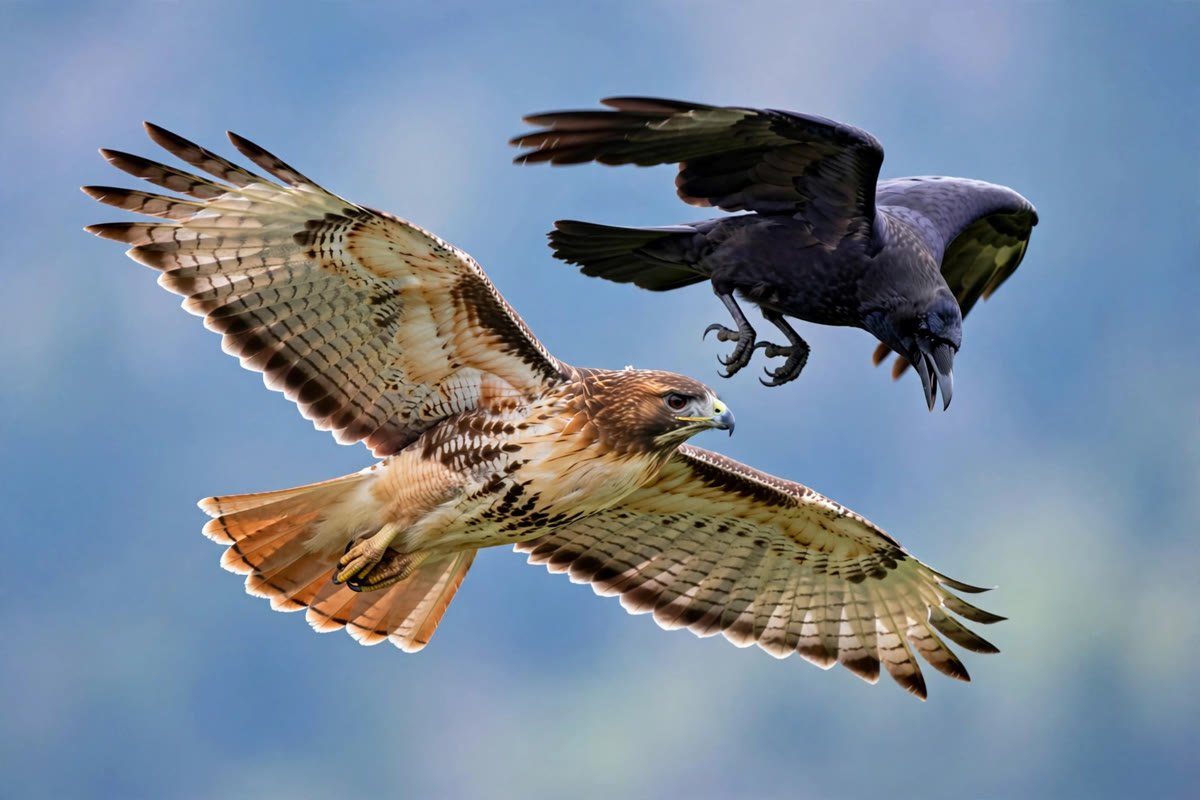
Look up on a spring afternoon and you might see a suicidal sight: a tiny kingbird riding the back of a red-tailed hawk, pecking at its head while the hawk, ten times its weight, flies steadily on. Around them, jays, robins, and chickadees join the screaming pursuit. The hawk eventually veers away. The small birds have won.
Why do small birds chase hawks? The behavior is called mobbing, and it is a calculated group defense, not a death wish. A hawk near a nesting area threatens eggs and chicks, so small birds gang up to harass it, spoil its hunt, and advertise that its cover is blown. It works because the math favors the mob: the hawk risks injury and wasted energy for a meal it may not catch, while each mobber risks relatively little.
In this guide, you will learn how mobbing works step by step, why evolution favors such apparent recklessness, which species are the champion mobbers, why the hawk usually refuses to fight back, when mobbing fails, and how to watch this aerial drama yourself.

Why Do Small Birds Chase Hawks? The Short Answer
Small birds chase hawks to drive a predator away from their nests and territories. When a hawk appears, nearby songbirds sound alarm calls that recruit neighbors, and the growing crowd takes turns dive-bombing, pecking, and screaming at the intruder. The harassment continues until the hawk leaves.
The strategy succeeds through economics, not force. A hawk hunts by surprise, and a mob destroys surprise completely. Every dive forces the hawk to dodge instead of hunt, every scream tells every prey animal in earshot exactly where the predator is, and the whole performance may teach the hawk that this particular territory is more trouble than it is worth.
Mobbing peaks during nesting season, when eggs and helpless chicks make the stakes highest, but crows and jays will mob hawks and owls year-round. It is one of the most common and most misunderstood behaviors in backyard birding.
What Mobbing Is and How It Works
Mobbing unfolds in a predictable sequence, and once you know the steps you will recognize it instantly.
- Detection: one bird spots the hawk or owl and freezes, then issues sharp, urgent alarm calls. Chickadees famously encode the threat level in their calls, using more “dee” notes for smaller, more dangerous predators.
- Recruitment: the alarm calls act as a rallying cry. Birds of several species converge on the sound, sometimes from hundreds of yards away. A mob often becomes a multi-species coalition.
- Harassment: the mob takes turns diving at the predator, striking its back and wings, pulling feathers, and screaming continuously. Eastern kingbirds are famous for actually landing on a hawk’s back mid-flight.
- Escalation or dispersal: if the hawk stays, the mob grows louder and bolder. If the hawk leaves, the mob follows it to the territory boundary, then disperses back to normal life within minutes.
Individual birds rarely make contact in a way that risks serious injury. The dives are timed to startle rather than to grapple, and the hawk’s attention is split a dozen ways. It is the avian equivalent of a crowd driving off a troublemaker: nobody wants a fair fight, because the crowd does not need one.
The Soundtrack of a Mob: Learning Alarm Calls
You will usually hear a mob before you see it. The soundscape is unmistakable once you know it: harsh, urgent, repetitive calls, very different from relaxed feeding chatter or melodic song. Crows produce a hard, staccato cawing that carries for blocks. Jays scream their strident alarm notes over and over. Chickadees layer their famous chick-a-dee call with extra “dee” syllables, and research has shown the number of dees tracks the threat: more dees for smaller, more dangerous predators.
Learning these calls pays off fast. The next time a wave of agitated calling erupts from your yard, you will know a predator is nearby before you ever spot it. Follow the sound and you will often find the hawk or owl at the center of the storm, sometimes perched and enduring the abuse, sometimes already departing with its escort. Some birders keep a mental map of local mobbing hotspots, since hawks patrol regular routes and the mobs mark their passage like signal flags.
Why Risk It? The Evolutionary Math
At first glance, mobbing looks like madness. Why would a four-ounce bird attack a predator that could kill it with one strike? The answer lies in what biologists call the evolutionary trade-off, and it has several layers.
Protecting the Next Generation
The strongest driver is offspring defense. A hawk near a nest threatens the entire reproductive investment of the season: eggs or chicks that represent weeks of effort. Parent birds will accept extraordinary personal risk to protect them, because from evolution’s perspective, the genes matter more than the individual carrying them.
The “You’ve Been Spotted” Signal
Mobbing also works as honest advertising. A hawk’s hunting depends on the element of surprise, and a screaming mob announces to every animal in the area that the surprise is gone. Researchers describe this as pursuit deterrence: the message is “we see you, hunting here is now a waste of your energy.” Hawks that get mobbed regularly may learn to avoid the area entirely.
Teaching the Young
Mobbing has an educational function. Young birds watching a mob learn which species are dangerous and how the community responds. The next time a hawk appears, the inexperienced birds already know the drill. The mob is both a defense and a classroom.

The All-Star Mobbers
Nearly any small bird will join a mob, but some species are legendary for it.
- American crows: the heavyweight champions of mobbing. Intelligent, social, and fearless, crows organize some of the largest and most persistent mobs, targeting hawks, owls, and eagles. To understand their social lives, read why crows gather in roosts.
- Blue jays and Steller’s jays: loud, aggressive, and quick to rally the neighborhood. Jays often lead mobs and keep them going long after other species drift away.
- Eastern kingbirds: the daredevils. Kingbirds routinely ride on the backs of hawks and crows in flight, pecking at their heads. Pound for pound, no bird mobs harder.
- Northern mockingbirds: famously pugnacious, mockingbirds chase crows, hawks, cats, and occasionally humans away from their nests with relentless determination.
- Black-capped chickadees: the alarm system. Chickadees are often the first to spot a predator and the most sophisticated in grading the threat, and their calls recruit everyone else.
- Red-winged blackbirds: during nesting season around marshes, blackbirds mob anything that flies over their territories, including harriers, herons, and the occasional confused duck.
Knowing the cast helps you read the scene. If you see crows gathering and calling harshly in midday, look up and outward: there is almost certainly a hawk or owl at the center of their attention. And if a hawk sighting has you wondering about the bigger picture, our guide to what it means when you see a hawk covers both the ecology and the folklore.
Why the Hawk Usually Doesn’t Fight Back
This is the question that puzzles every witness. The hawk could clearly kill any single mobber. Why does it just take the abuse and leave?
The answer, as a Cornell Lab of Ornithology specialist once explained it, comes down to energy economics. The hawk was looking for an easy snack, perhaps from a nest, not a grueling aerial battle. To turn on the mob, it would have to work hard, maneuvering against agile small birds, while burning energy and risking injury to its eyes or wings. A damaged wing can be a death sentence for a raptor.
So the hawk does the rational thing: it absorbs the indignity, flies elsewhere, and hunts where nobody is watching. The mob’s victory is not physical but economic. It made the cost of staying higher than the cost of leaving, which is all any defense needs to do.
There are exceptions. A hawk with a nest nearby, or one defending a mate, may turn on the mob aggressively rather than retreat. And hawks that get mobbed daily in the same spot sometimes habituate and simply ignore it. But the usual outcome, the hawk gliding off with an escort of screaming songbirds, is the system working as designed.
When Mobbing Fails
Mobbing is effective, but it is not magic. It fails in a few predictable situations.
- The hawk is defending its own nest: a parent hawk protecting chicks will fight rather than flee, and the mob quickly learns the difference.
- Habituation: hawks mobbed daily in the same territory can become desensitized, treating the noise as background.
- Nighttime owls: mobbing a nocturnal owl at its daytime roost works, but small birds cannot sustain a mob after dark when the owl has the advantage.
- Overconfidence: occasionally a mobber misjudges and gets caught. It is rare, because the dives are designed for safety, but the risk is never zero, which is exactly why the behavior is so remarkable.

Frequently Asked Questions
Is mobbing the same as a territorial fight between equals?
No. Territorial fights happen between members of the same or similar species competing for mates or nesting sites. Mobbing is specifically a group of smaller birds harassing a larger predator, and its goal is expulsion rather than conquest: the mob wants the predator gone, not defeated. Once the hawk leaves the area, the mob disbands immediately.
Do hawks ever catch the birds mobbing them?
Rarely. Mobbing dives are calibrated to startle without grappling, and small birds are far more maneuverable than a hawk in level flight. The hawk’s best chance would be an ambush, which is exactly what the mob prevents by keeping the predator in sight and screaming. Documented cases of a mobber being caught are uncommon.
Why do crows mob owls during the day?
For the same reason songbirds mob hawks: an owl near a crow roost or nesting area is a lethal threat after dark. Crows use daylight, when the owl is sluggish and nearly blind, to harass it into relocating. A mobbed owl often moves to a new roost, which is precisely the outcome the crows want.
Can a single bird mob, or does it take a group?
Both happen. Groups are more effective and more common, but a single kingbird or mockingbird will absolutely take on a hawk alone. Solo mobbing is most frequent during nesting season, when a parent defends its own nest without waiting for backup. The behavior scales from one brave bird to a multi-species crowd.
Do birds mob predators other than hawks?
Yes. Mobs target owls, eagles, snakes, foxes, cats, squirrels near nests, and even humans who wander too close to a nesting colony. Anything the local birds perceive as a threat to their young can trigger a mob. Gulls mob eagles at coastal colonies with the same fury songbirds aim at hawks.
How can I watch mobbing without disturbing the birds?
Keep your distance and let the event come to you. Mobs are loud and visible, so binoculars from a respectful range work perfectly. Do not approach the hawk or the nest being defended, and never intervene on either side. If you are new to watching behavior in the field, our bird watching for beginners guide covers field etiquette.
Conclusion
Why do small birds chase hawks? Because it works. Mobbing turns a predator’s greatest asset, surprise, into a liability, replacing it with noise, harassment, and a ruined hunt. The small birds accept a small individual risk to protect their young, educate their neighbors, and teach the hawk that this territory is not worth the trouble.
The hawk’s refusal to fight back is not cowardice but calculation. Every species in the sky runs an energy budget, and a mob makes the numbers come out wrong for the predator. That is the quiet brilliance of mobbing: the prey wins without ever needing to be stronger, only louder, bolder, and better organized.
So the next time you hear a commotion overhead and see a tiny bird riding a hawk like a feathered jockey, stop and watch. You are witnessing one of nature’s most democratic defenses, a neighborhood watch with wings, and it succeeds almost every time. For help telling the raptors apart while you watch, try our hawk vs falcon identification guide.





