Skip to content

Nothing announces spring in eastern North America like a flash of flame orange at the feeder. If you are wondering how to attract orioles to your yard, the formula is simpler than most people expect: offer the sweet foods these birds crave, put them out before the birds arrive, and give them the trees they need to raise a family. Baltimore orioles breed across the eastern United States and southern Canada, and they visit backyards readily when fruit, nectar, and insects are all within reach.
Here is the honest catch: it is early October, and the orioles are gone. Most departed for Central and South America by late summer. That timing is actually an advantage.
Fall is the perfect season to clean and repair feeders, plan native plantings, and map out where an oriole station will go. Do the groundwork now, and your yard will be ready when the first males whistle down from the treetops in spring.
Meet the Baltimore Oriole (and Its Cousins)
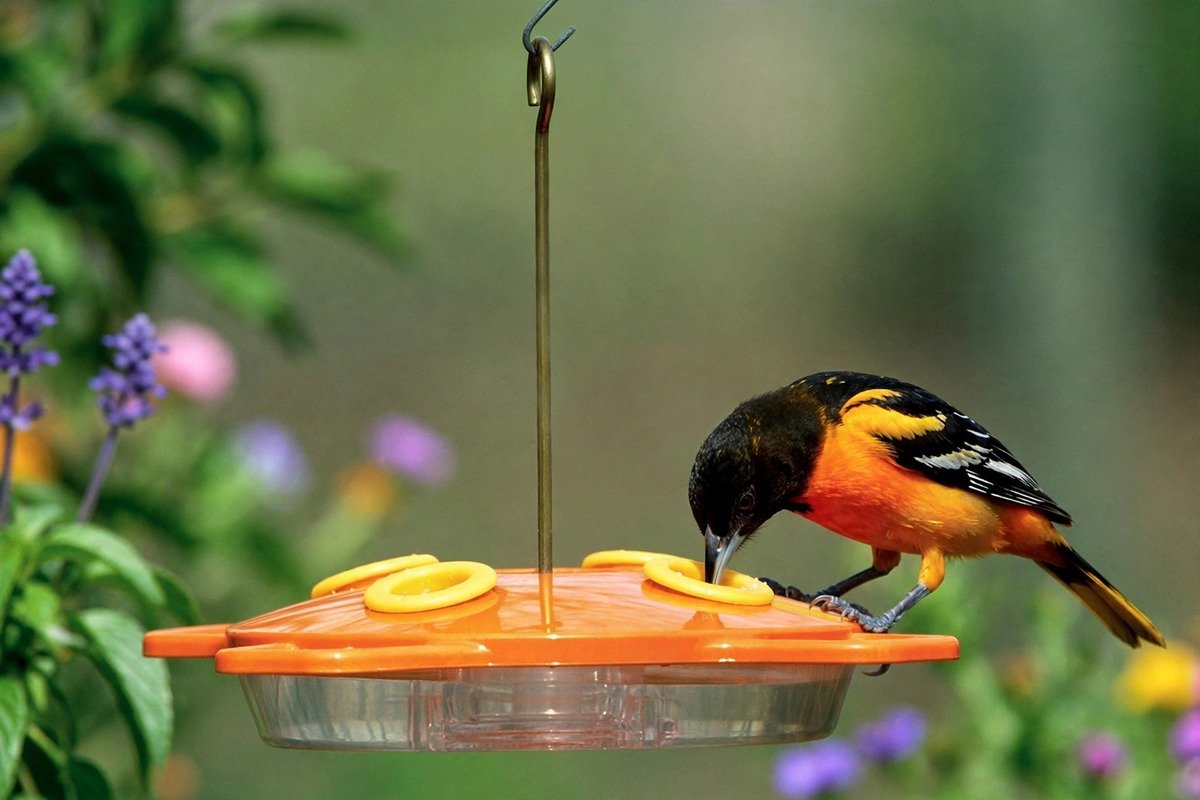
The adult male Baltimore oriole is unmistakable: brilliant orange underparts and shoulder patches, a solid black head and back, and black wings marked with white bars. Females and immature birds are subtler, with olive-brown upperparts and warm amber-yellow underparts. The species is Maryland’s state bird and belongs to the blackbird family, a group that also includes meadowlarks. Its scientific name is Icterus galbula.
If you live in the eastern United States, you may also see the orchard oriole, a smaller cousin with deep chestnut plumage instead of bright orange. As Birds & Blooms’ orchard oriole guide notes, orchard orioles breed from the Gulf Coast to the Great Lakes and arrive around early May. In the western states, Bullock’s orioles and hooded orioles fill the same role. All of them respond to the same foods, so the advice in this guide works for whichever oriole visits your region.
Orioles change their diet with the seasons, which is the key to feeding them well. Through the breeding season they are primarily insect eaters, gleaning caterpillars, beetles, and grasshoppers from tree foliage. During migration they shift to high-sugar foods like nectar and ripe fruit for quick energy.
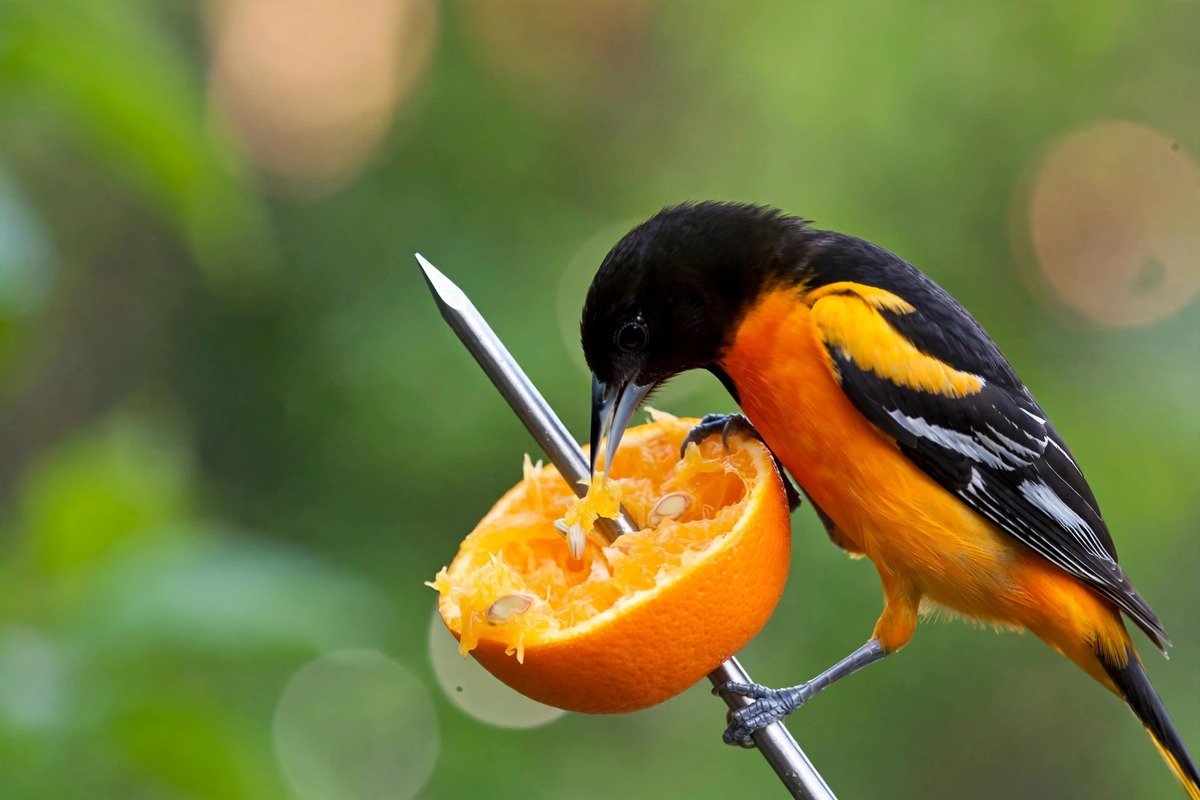
They even have a trick for soft fruit: the Cornell Lab of Ornithology notes that orioles stab their closed bill into the pulp, then open it to cut a juicy swath they drink with brushy-tipped tongues. That behavior, called gaping, is one reason halved oranges work so well. The Cornell Lab’s Baltimore Oriole overview is a solid reference for the species’ diet and nesting habits.
When Orioles Arrive (and Why October Is Prep Season)
Arrival dates vary by region, so calibrate your calendar to where you live. In Maryland, Baltimore orioles typically return sometime in March or April, according to the state Department of Natural Resources. Farther west, the Wild Bird Habitat Store advises having feeders ready by April 25, since orioles reach the central Great Plains between April 25 and May 15. Orchard orioles push north a bit later, with early May the prime window, and northern areas see their first birds around the first week of May in the Upper Midwest.
Departure is just as predictable. Orioles are early fall migrants: many Baltimore orioles head south in July and August, with females often leaving by mid-August and males lingering into September. Orchard orioles raise a single brood and are usually gone by the end of July. By October, the yard belongs to the winter birds, which is exactly why this month is ideal for preparation rather than feeding.
Use the off-season for four jobs: scrub and repair your feeders, order jelly cups and orange spikes before the spring rush, decide where a dedicated oriole station will sit, and plant native trees and shrubs while nurseries still have fall stock. Fall-planted natives get a head start on root growth, so they leaf out stronger when the orioles return. A little planning now beats a frantic hardware-store run in late April.
How to Attract Orioles to Your Yard: The 4 Foods That Work
Orioles mostly ignore birdseed, so a standard seed feeder will not bring them in. What they want is sugar in its simplest forms: jelly, fruit, and nectar, plus protein from insects when chicks are in the nest. Offer at least two of the four foods below and you cover both the energy needs of spring migrants and the protein needs of summer parents.
Grape Jelly: The Classic Oriole Magnet
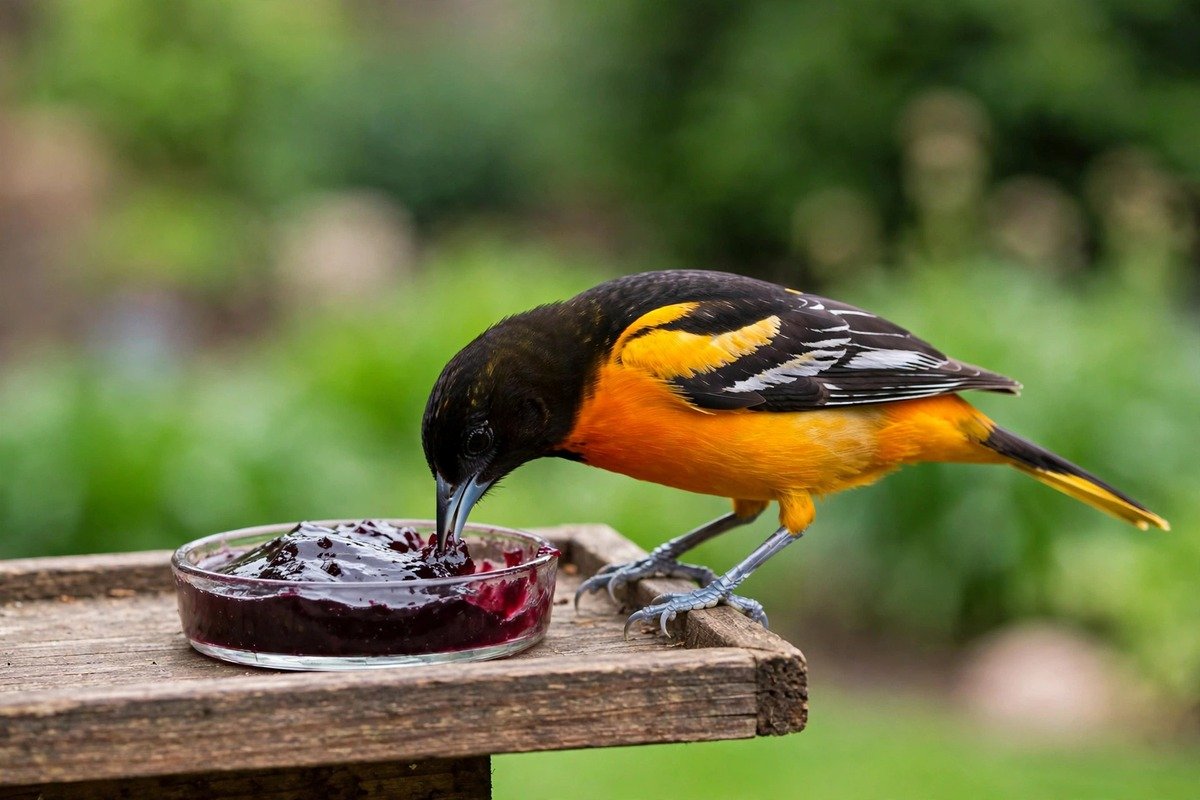
Grape jelly is the single most popular oriole food in backyards, and orioles consistently choose it over other offerings. Use plain grape jelly, not jam or preserves, since the smooth texture is what the birds handle best. Serve small amounts, just a tablespoon or two, in a shallow dish or a feeder cup. Big globs waste jelly and raise the risk that a bird brushes sticky feathers against it, a hazard the Cornell Lab specifically warns about.
Freshness matters as much as quantity. Jelly ferments and grows mold in warm weather, so replace it every couple of days and wash the dish with hot water each time you refill. If ants or wasps discover the dish, move the feeder to a new spot every few days; Emma Greig of the Cornell Lab’s Project FeederWatch recommends exactly this trick, noting that birds find the moved feeder faster than insects do. For hanging feeders, an ant moat (a small water cup above the feeder) stops crawling insects without chemicals.
Orange Halves: The Visual Signal
Cut an orange in half and impale it on a feeder spike, a sturdy nail, or a platform feeder, and you have the simplest oriole feeder ever made. Orioles find food by sight, and the bright orange color acts like a flag for birds flying overhead. National Audubon Society specialist Chad Witko explains that orange catches an oriole’s eye the way red catches a hummingbird’s eye, because the birds associate the color with ripe fruit they ate all winter.
Swap the halves every one to two days so the fruit stays fresh and mold-free. Dried-out or fuzzy oranges attract no orioles and plenty of flies. Orioles also love other ripe fruit: Cornell notes they favor the darkest mulberries, the reddest cherries, and the deepest-purple grapes while ignoring underripe green or yellow fruit. Ripe bananas, berries, and overripe cherries all work when oranges are not in season.
Oriole Nectar: The 1:6 Recipe
Orioles drink sugar water just like hummingbirds, but they prefer it weaker. Where hummingbird nectar mixes one part sugar to four parts water, oriole nectar uses one part sugar to six parts water, a ratio confirmed by Audubon biologist Chad Witko in National Geographic’s guide to attracting orioles. Mix one-third cup of plain white sugar into two cups of water, bring it to a boil to dissolve the sugar and slow fermentation, then cool it completely before filling the feeder.
Never add red dye, honey, brown sugar, or artificial sweeteners. Plain white sugar and water is the entire recipe, and leftovers keep in the refrigerator for up to two weeks. Change the nectar every three to four days in warm weather and scrub the feeder each time, since fermented nectar can harm birds. Orioles need larger feeding ports and sturdier perches than hummingbirds, so use a feeder designed for orioles rather than a standard hummingbird model.
For a longer-term nectar supply, plant the flowers orioles visit naturally. Trumpet honeysuckle, hollyhock, and rose of Sharon all draw orioles, and choosing nectar-rich flowers that also draw hummingbirds doubles the value of every planting.
Mealworms and Other Insects
Once nesting begins, protein takes priority. Parent orioles feed their chicks almost entirely on insects, especially caterpillars, so a dish of live or dried mealworms near the oriole station gives breeding pairs an easy protein source. Offer them in a small cup or tray with a rain cover, and you may watch parents carry beakfuls straight back to the nest.
The easiest way to supply insects is to stop removing them. Ease off insecticides in the yard, because the caterpillars on your oaks and maples are exactly what oriole chicks eat. A mealworm dish also benefits other insect lovers: it is one of the most reliable tools for attracting bluebirds, which share the oriole’s taste for live food. Orioles rarely touch seed, so keep a separate feeder stocked with the best birdseed mixes for different backyard birds to keep the cardinals, finches, and chickadees happy while the orioles work the sweet stuff.
Choosing an Oriole Feeder
You do not need an expensive setup, but the right feeder makes a real difference. Orioles are larger than hummingbirds with stouter bills, so feeders built for them have bigger ports, roomier perches, and sturdy construction. Look for a model that combines at least two food types: jelly cups plus orange spikes is the classic combination, and many designs add a nectar well too.
| Feeder type | What it holds | Best for |
|---|---|---|
| Jelly dish feeder with spikes | Grape jelly cups and orange halves | First-time oriole feeding; highest success rate |
| Oriole nectar feeder | 1:6 sugar water in larger-port reservoirs | Long spring visits and hot weather |
| Platform feeder with fruit spikes | Orange halves, banana chunks, berries | Offering fresh fruit alongside other foods |
| Mealworm cup feeder | Live or dried mealworms | Nesting season protein for parents and chicks |
Color is part of the design, not decoration. Oriole feeders are usually orange because the color itself attracts the birds, the same way red draws hummingbirds. Curious about the science? Our guide to which colors attract birds explains how different species key into different hues.
Place the oriole station where it is visible from above and from nearby perches: orioles scan for food while flying, so a feeder tucked under a dense roof gets missed. Keep it within sight of trees but out in the open.
Give the oriole station some separation from your busiest seed feeders. A quiet corner of the yard feels safer to a newly arrived migrant, and it keeps aggressive grackles and starlings from dominating every dish. If you are new to all of this, our general bird-feeding basics cover feeder placement and hygiene rules that apply across the whole yard.
Habitat: The Trees Orioles Nest In
Food brings orioles to the yard, but trees make them stay. Baltimore orioles nest high in tall deciduous trees in open or semi-open areas: suburban streets, park edges, farmyards, and streamside groves all work. American elms were once the favorite nest tree; with elms diminished by Dutch elm disease, orioles now favor maples, oaks, cottonwoods, sycamores, willows, poplars, birches, apples, and black cherries, according to the Maryland DNR’s Baltimore Oriole fact sheet.
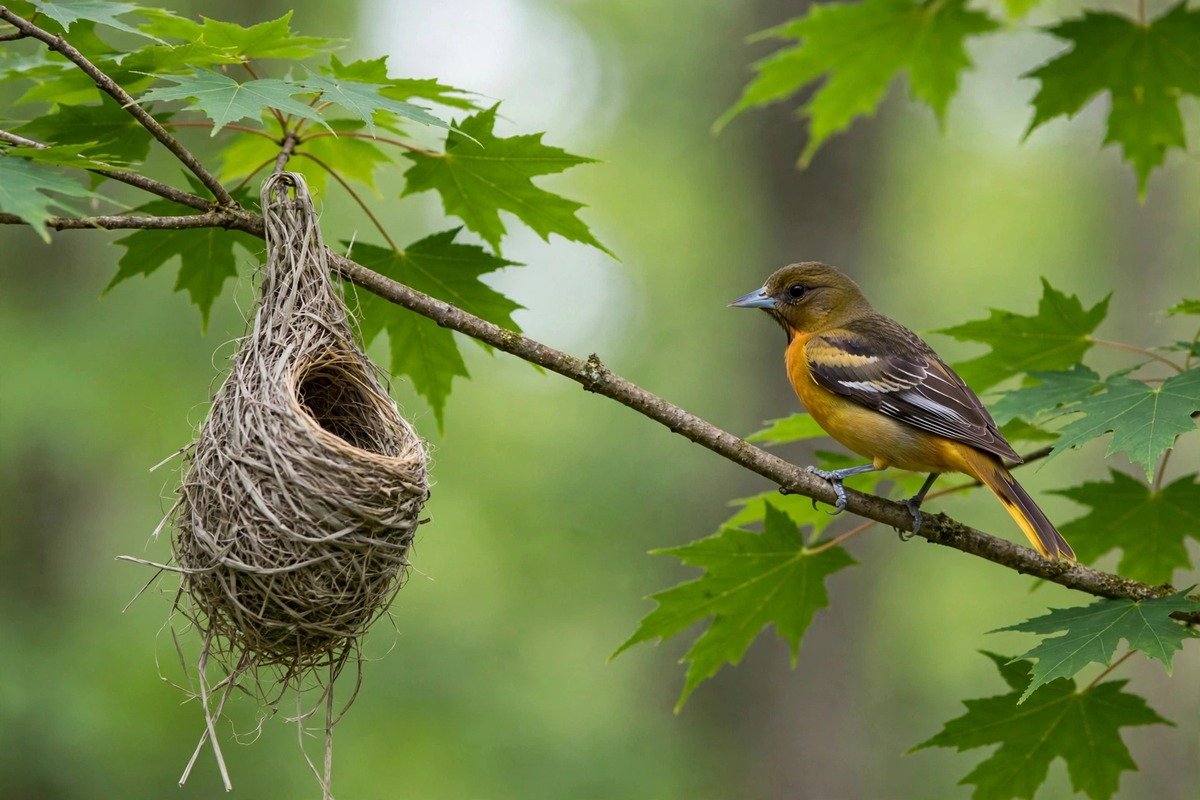
The nest itself is a marvel. The female weaves a deep, sock-shaped pouch from plant fibers, grasses, bark strips, and vines, suspending it from the tip of a slender branch where predators struggle to reach. National Aviary ornithologist Robert Mulvihill notes that orioles prefer tall shade trees with long branch architecture, and they love maples for this purpose.
Construction takes about a week of steady weaving, and the finished nest holds four to six eggs laid in May or June. Chicks hatch in 12 to 14 days and leave the nest about two weeks later.
You can help without climbing a ladder. Leave last year’s milkweed and dogbane stalks standing into spring, since orioles strip long plant fibers from them for weaving. Short pieces of natural-colored yarn or string, no longer than four inches, left in a mesh bag near the feeder station also get collected as nest material. Avoid long threads or synthetic fibers that can tangle around legs and necks.
Keeping Orioles Coming Back All Summer
Once a pair nests in your trees, consistent care keeps them around until migration. Fresh water matters as much as food: a shallow birdbath with a dripper or mister gives orioles a place to drink and bathe, and moving water catches their eye from a distance. Clean the bath every few days in summer heat.
Plant for the long term. Serviceberry, mulberry, cherry, elderberry, raspberry, and crab apple produce the fruits orioles eat through summer and fall, while trumpet honeysuckle and other tubular flowers supply nectar. As National Geographic’s reporting emphasizes, native plants beat supplemental feeding in the long run, because orioles evolved alongside these species for both food and shelter. Oaks deserve special mention: their foliage hosts the caterpillars that make up so much of the oriole diet.
Keep feeders stocked through the whole season, even when visits slow down in midsummer. Parents often drift away from jelly and nectar while they are busy feeding insects to chicks, then return with the fledglings in tow. If your station goes empty during that quiet stretch, the family may simply move on to a neighbor’s yard instead.
What NOT to Do
- Do not overfill the jelly: a shallow serving prevents sticky feathers, which can impair flight and insulation. Small amounts, refreshed often, beat a heaping dish.
- Do not use red dye or honey: dye adds nothing for orioles, and honey ferments quickly and can grow harmful mold. Plain white sugar and water is the complete nectar recipe.
- Do not let food spoil: fermented jelly and cloudy nectar can sicken birds. If you cannot clean feeders every few days in warm weather, wait until you can.
- Do not expect a birdhouse to work: orioles weave open hanging nests and will never use an enclosed nest box. Put your effort into nest trees and nesting materials instead.
- Do not declare war on every wasp: bee guards on nectar ports and regularly moved jelly dishes manage most insect competition. Pollinators sharing a little jelly are doing their own job in the garden.
Frequently Asked Questions
What is the best jelly for orioles?
Plain grape jelly, not jam or preserves. Choose a simple product without artificial sweeteners, serve just a tablespoon or two at a time, and replace it every couple of days. Experienced birders consistently find that plain grocery-store grape jelly works as well as specialty oriole jellies, and small servings keep feathers clean.
Do orioles eat birdseed?
Rarely. Orioles are built for insects, fruit, and nectar, and they generally walk past seed feeders. Keep your seed feeders for the cardinals, chickadees, and finches, and give orioles their own station with jelly, oranges, and nectar.
When do orioles leave in fall?
Earlier than most songbirds. Many Baltimore orioles begin heading south in July and August, with females often departing by mid-August and males lingering into September. Orchard orioles leave even sooner, usually by the end of July after raising one brood.
Will orioles nest in a birdhouse?
No. Orioles do not use cavities or enclosed boxes of any kind. The female weaves a hanging pouch nest from plant fibers at the tip of a tree branch. If you want nesting orioles, plant tall deciduous trees like maples and oaks, and offer short pieces of natural fiber as nest material in spring.
Do orioles come back to the same yard?
Often, yes. Orioles show loyalty to productive breeding areas, so a yard with reliable food, fresh water, and good nest trees can host oriole families year after year. The first season may take patience, but once birds associate your yard with food, they are likely to return each spring.
Can I attract orioles in the western United States?
Yes, with the local species. Bullock’s orioles range across the American West and hooded orioles visit the Southwest and Mexico, and both respond to the same grape jelly, orange halves, and 1:6 nectar. Put feeders out by mid-March in the Southwest, where hooded orioles arrive earliest.
Conclusion
Learning how to attract orioles to your yard comes down to thinking like a spring migrant: tired, hungry, and scanning for the color orange. A dish of grape jelly, a halved orange on a spike, and a feeder of weak 1:6 nectar give arriving birds the quick energy they need, while tall maples or oaks and a pesticide-light yard give them a reason to nest. Add fresh water and native fruiting plants, and you cover every season of the oriole year.
October is not the month for orioles, but it is the month for getting ready. Clean the feeders, plant the trees, and mark your calendar for late April. When that first flute-like whistle rings down from the treetops next spring, your yard will be waiting, and the brightest bird of the season will know exactly where to land.