
Quick Answer
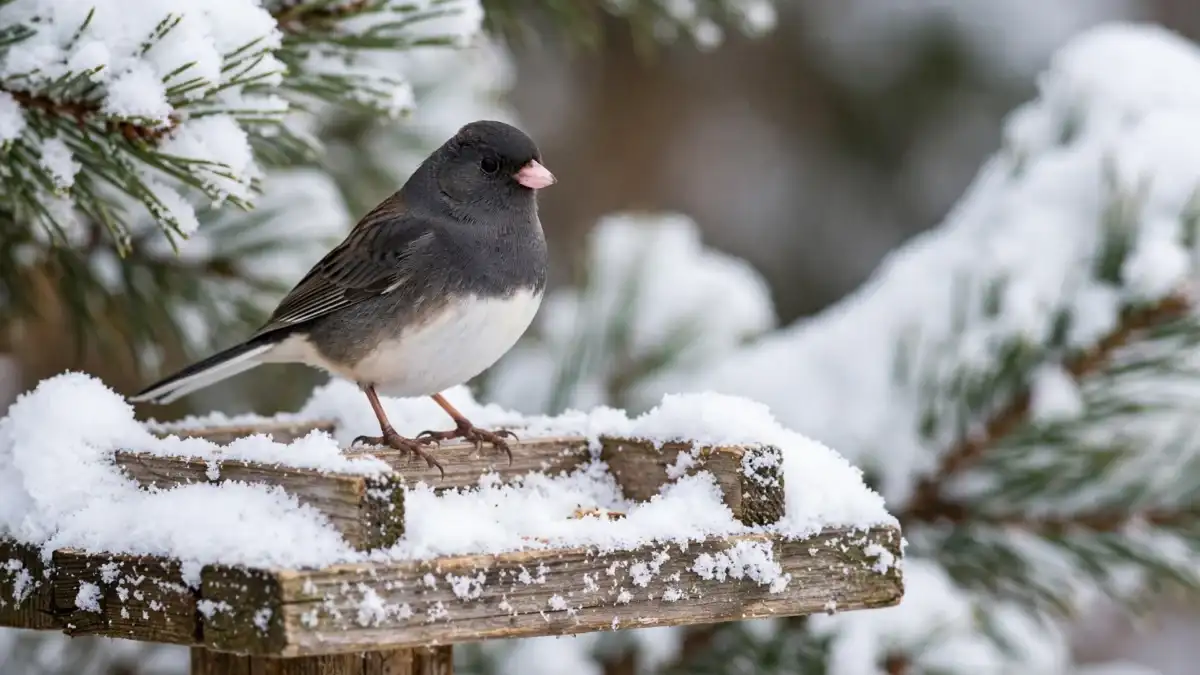
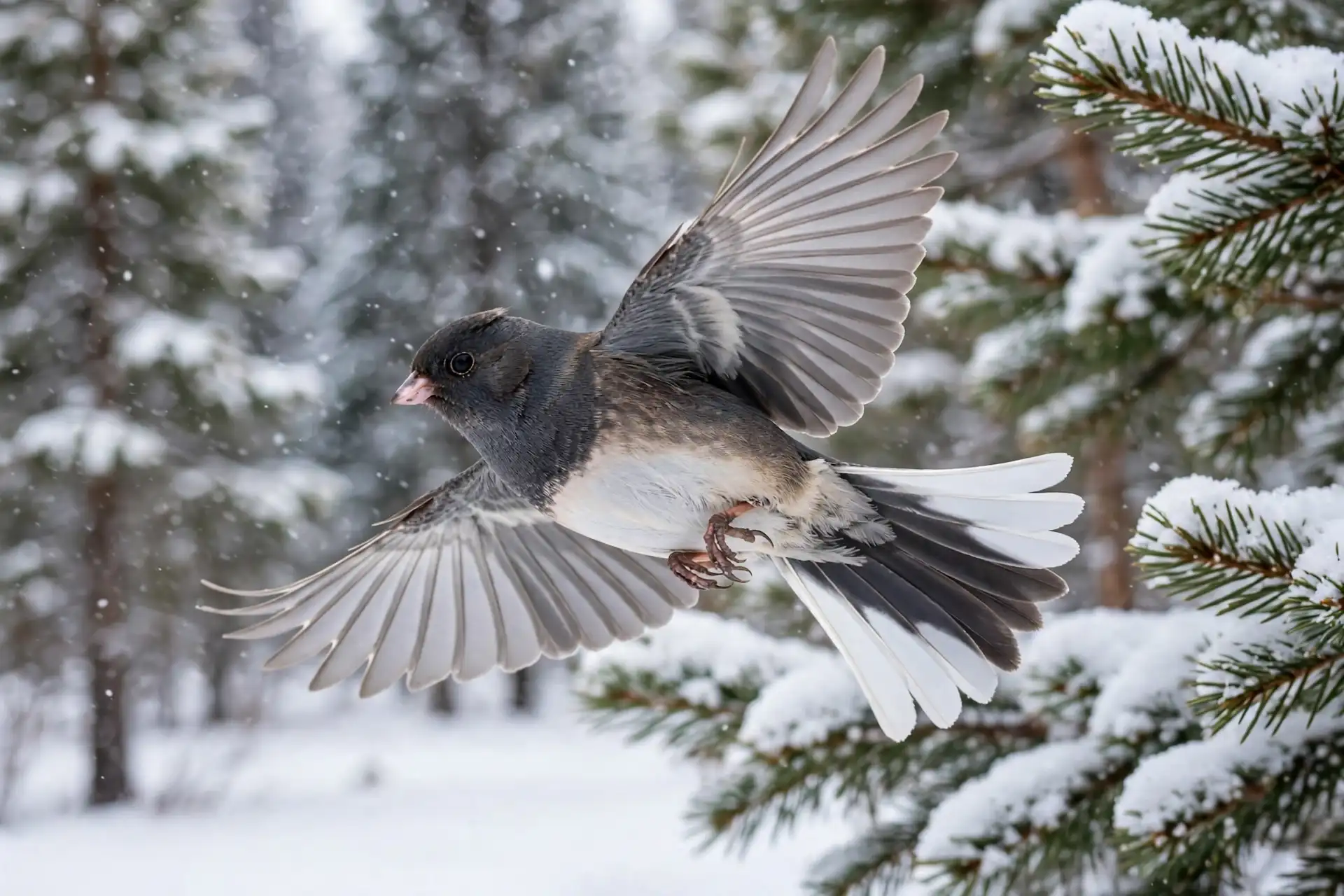
The dark-eyed junco is a small grey and white sparrow, Junco hyemalis, and most people know it as the snowbird. It is about 6.25 inches long, with a dark eye, a pale pink bill, a clean white belly, and white outer tail feathers that flash when it flies. In most of the United States it arrives in October and stays until mid-April, feeding on the ground under feeders in loose winter flocks.
What Is a Dark-Eyed Junco?
A junco is a small sparrow, about 6.25 inches from bill to tail, with a wingspan of 9.25 inches and a weight of about 0.67 oz. It is roughly the size of a house sparrow, but slimmer and longer tailed, and it spends far more of its time on the ground. When it feeds it hops rather than walks, and it gives a quick double scratch in the leaf litter that throws leaves aside to uncover the seeds below.
Start with the head, because that is where the name comes from. The eye is dark brown and almost vanishes into the dark hood. The bill is pale pink, short and cone shaped, the classic seed eating bill of a sparrow, and it stands out clearly against the dark face. There is no pale eye ring and no strong face pattern. That plain face is useful in itself, because it rules out several other sparrows at a glance.
The back and wings are grey in the common eastern form, and the belly is clean white from the throat to the undertail. The tail is dark in the centre and white along the outer edges, and those white outer tail feathers are what most birders notice first in flight. When a junco is flushed from the ground it rises with a flash of white on each side of the tail, then drops back down a short distance away. Females are on average paler and browner than males, and juveniles are streaked on the chest, head and back.
How to Identify a Dark-Eyed Junco in the Field
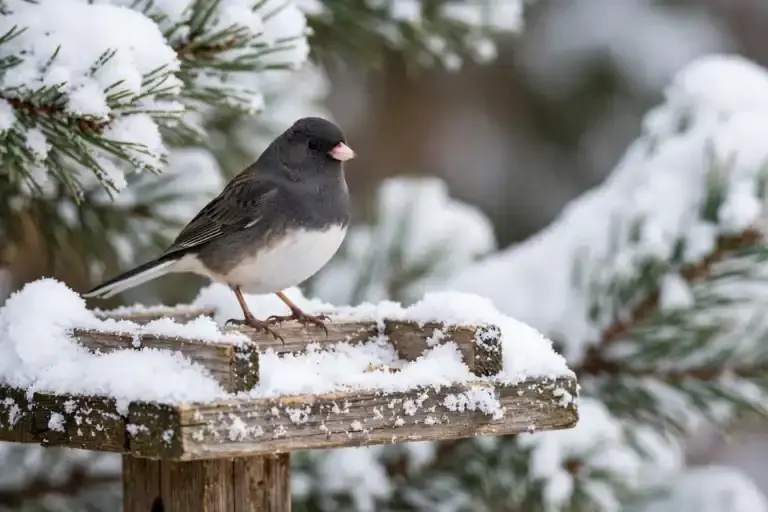
Begin with the overall impression. A dark-eyed junco looks like a small grey and white bird with no streaks on the breast, a dark eye, a pale pink bill and a white belly. If the bird in front of you has a streaked breast, a pale eye ring or a dark bill, it is probably not a junco. The clean breast matters, because so many sparrows have streaked or spotted breasts, and this bird does not.
Then look at the tail. The white outer tail feathers show in flight, and they also show when the bird flicks its tail on the ground, which juncos do often. The tail is fairly long for a sparrow, and the bird often holds it slightly raised as it hops. The white edges are bright and clean, not buff or grey, and they contrast sharply with the dark centre of the tail.
Behaviour helps as well. Dark-eyed juncos feed on the ground, usually under a feeder or along a weedy edge, and they rarely feed from a hanging tube feeder. They hop, scratch with both feet at once, and pick up seeds from the ground or from a flat tray. In winter they are social birds, and a single bird on its own is unusual.
The Five Forms of the Dark-Eyed Junco
One of the most interesting things about this bird is that it comes in several very different looking forms, and all of them belong to a single species. Until the 1970s these forms were treated as 5 distinct species, and birders who learned them under the old names still use those names today. The forms interbreed where their ranges meet, and intermediate birds are common, so the boundaries are not as sharp as a field guide makes them look.
The Slate-colored Junco is the form most people in the East and North will see. It is solid dark grey on the head, back and sides, with a clean white belly and white outer tail feathers. Slate-colored juncos breed across Canada and Alaska, and they winter across the eastern and central United States.
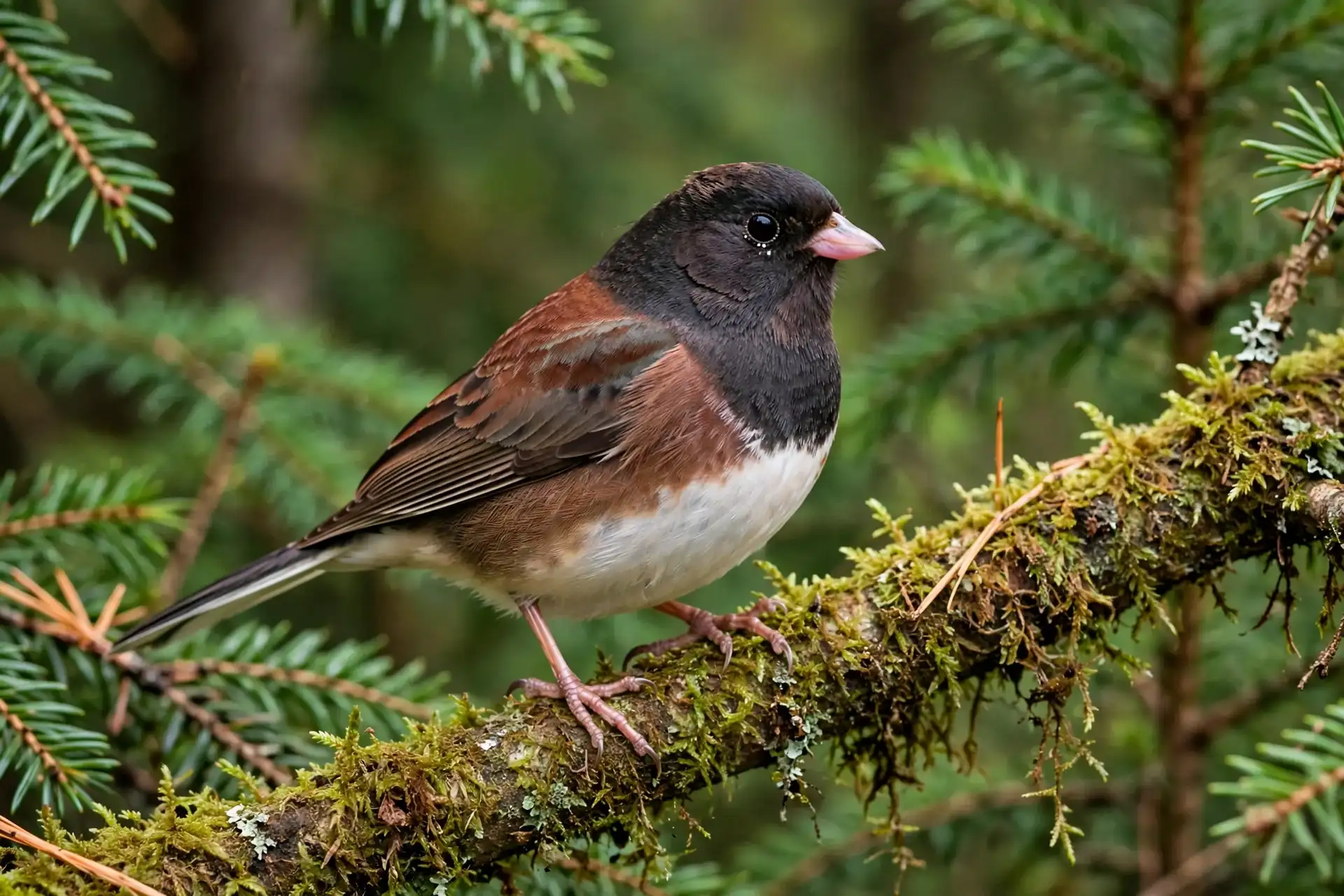
The Oregon Junco is the common form in the West. The male has a dark brown or black hood, a chestnut brown back, rusty or buff sides and a clean white belly. Oregon juncos breed in the western mountains and along the Pacific Coast, and they winter across the West and into the Southwest.
The Pink-sided Junco is a paler western form with a pale blue grey hood and pinkish flanks. It breeds in the northern Rockies and winters in the central Rockies and the Great Plains, in states such as Montana, Wyoming and Colorado. The pink wash on the sides is the mark to look for, and it is brightest on adult males.
The Gray-headed Junco is a southern Rockies form with a grey head and sides, a reddish brown patch on the back and a pale bill. It breeds in the mountains of Arizona, New Mexico, Colorado and Utah, and it winters at lower elevations in the same region.
The White-winged Junco is the largest and palest form, with white wing bars and a paler grey body. It breeds in the Black Hills of South Dakota and Wyoming and winters nearby. It is the rarest of the five forms for most readers, but it is a good example of how much variation a single species can hold.
Song and Calls of the Dark-Eyed Junco
The song is a simple, even musical trill that lasts about 2 seconds. It is a dry ringing trill on a single pitch, with no rise or fall. Males sing most often in spring on the breeding grounds, from a perch in a conifer or from the top of a shrub.
The calls are more useful in winter, because that is when most people meet juncos. The commonest call is a short hard tsip, given singly or in a rapid series when birds are feeding or moving. Excited birds give high pitched twitters, and a flock that is flushed will often give a burst of twittering calls as it rises.
Range and Habitat Through the Year
Dark-eyed juncos breed across virtually all of North America, from Alaska and Canada south through the western mountains and down the Appalachians. They breed in coniferous and mixed forests, and on grassy balds and shrubby edges in the mountains.
In winter the range expands dramatically. Juncos that breed in the far north move south, and juncos that breed in the mountains move downhill, so that in winter the species covers nearly all of the lower 48 states. The winter range extends from southern Canada across the United States to northern Mexico, and in most areas birds are present from early October to mid-April. For the timing of the fall arrival in your area, see When Do Juncos Arrive? The Fall Return of the Snowbird.
Winter habitat is very different from breeding habitat. In winter juncos use fields, suburbs, park edges, roadsides, farms and gardens, and they are one of the most regular birds at backyard feeders. They feed on the ground under feeders, along weedy edges and in leaf litter, and they roost in conifers at night.
Winter Flocks and Behavior
Winter is when the dark-eyed junco is at its most social. Birds that were spread out in pairs in summer gather into loose flocks in fall, and those flocks stay together through the winter. A flock may contain a dozen birds or many more, and it will often feed with other sparrows, especially white-throated sparrows and American tree sparrows. The flock moves together, feeds together and roosts together.
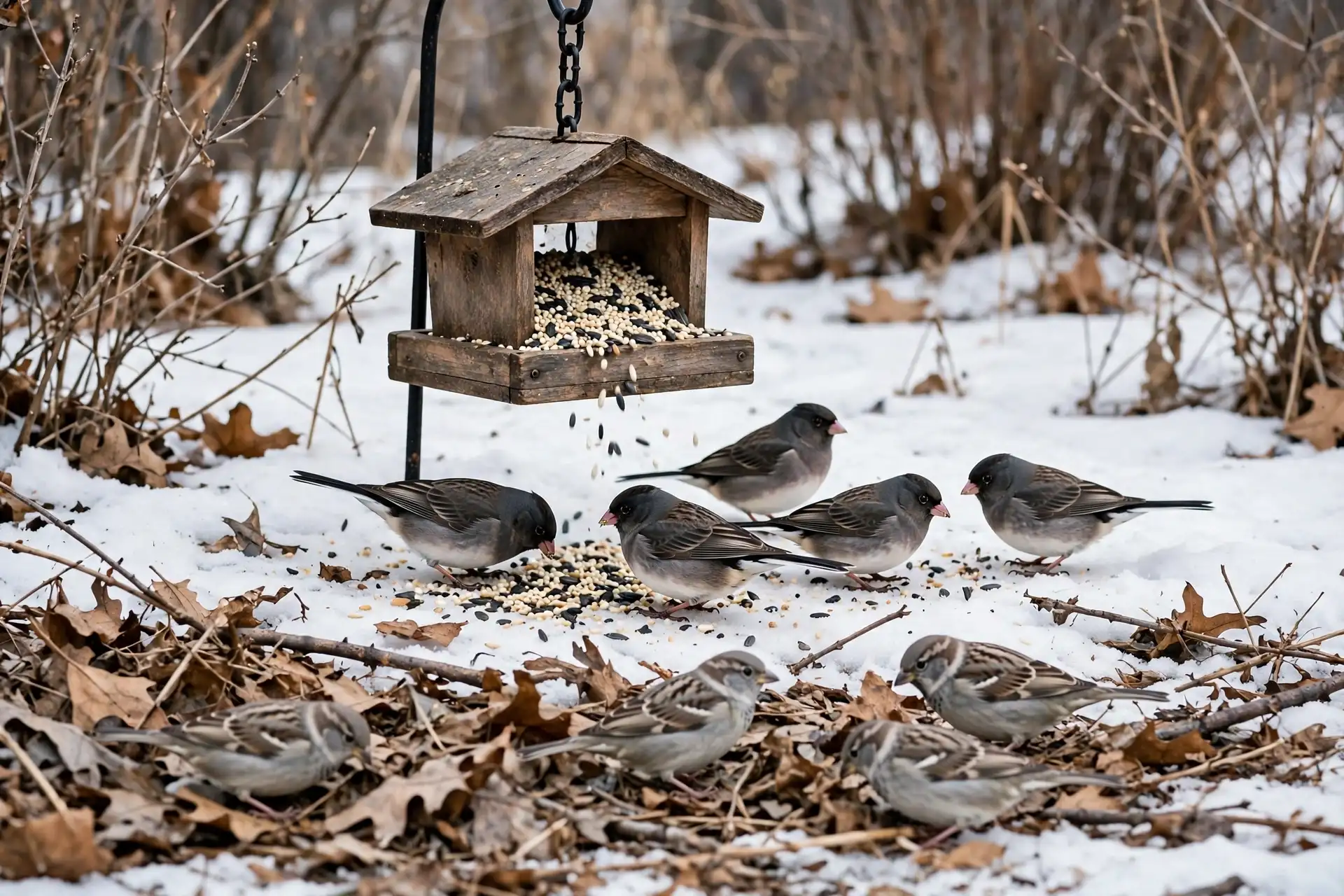
Feeding is a ground level activity. Juncos hop along the ground, scratching with both feet at once to uncover seeds in leaf litter and snow. They pick up seeds one at a time, crack them in the bill and swallow them. They rarely perch on a tube feeder, and they are much more likely to feed on the ground under a feeder or on a flat tray.
Within a flock there is a clear pecking order, and it is easy to see if you watch for a few minutes. Adult males feed first, followed by young males, adult females and finally young females, and birds will flick their tails and lunge at each other to hold a place.
At dusk the flock breaks up and the birds fly into conifers for the night. They roost in evergreens, often in a tight group, and the dense foliage gives them shelter from wind and cold. In very cold weather they fluff their feathers to trap air, and they can survive nights well below freezing. Juncos stay in North America all year, shifting south in winter rather than leaving the continent.
What Dark-Eyed Juncos Eat and What to Put Out
In winter the diet of the dark-eyed junco is mostly seeds. About 75 percent of the diet is seeds in the nonbreeding season, including chickweed, buckwheat and lambsquarters, and the birds also take seeds from grasses, weeds and conifers. In the breeding season they add insects, especially caterpillars, beetles and other small invertebrates, and they feed insects to their nestlings.
At a feeder the best foods are the ones juncos can eat on the ground. White proso millet is a favourite, and cracked corn and black oil sunflower are also taken readily, especially when they are offered on the ground or on a low tray. Nyjer seed is less useful for juncos, because they are ground feeders and they do not cling to a tube feeder. A simple ground tray, or a scatter of seed under a shrub, will bring juncos in quickly, and they will return every day once they have found it.
Keep the feeding area clean and dry. Rake up old seed and hulls, move the feeding spot from time to time, and offer only as much seed as the birds will eat in a day. For a full guide to winter feeding, see What to Feed Birds in Winter: The Complete Guide.
Nesting and Breeding
Dark-eyed juncos nest on or near the ground, which is unusual for a songbird and one of the reasons they are vulnerable to predators. The female builds an open cup nest in a depression in the ground or on a sloping bank, well hidden by vegetation. The nest is made of grasses, moss and rootlets, and it is lined with finer grasses and hair.
The female usually lays 3 to 5 eggs, with 4 being the usual number. The eggs are pale with fine brown speckles, and the female incubates them for 12 to 13 days. The young leave the nest about 11 to 12 days after hatching, and they are fed by the parents for a few more days. Juncos will raise 2 to 3 broods in a season.
The ground nest means that juncos are at risk from cats, snakes and other ground predators, and also from mowing and disturbance. If you find a junco nest in your garden, leave it alone and keep cats indoors. Do not handle the nest or the eggs, and do not try to move the nest, because the parents may abandon it.
Dark-Eyed Junco Look-Alikes
The dark-eyed junco is easy to identify once you know it, but it can be confused with other sparrows, especially in winter when several species feed together on the ground. The three most likely confusions are the towhees, the American tree sparrow and the chipping sparrow.
Eastern and Spotted Towhees are much bigger than a junco, with a longer tail, red eyes, a black bill and bright rufous sides. A towhee is a large sparrow with a bold pattern, and it is usually seen scratching in leaf litter with both feet, just like a junco, but it is almost twice the bulk. If the bird has red eyes and rufous sides, it is a towhee, not a junco.
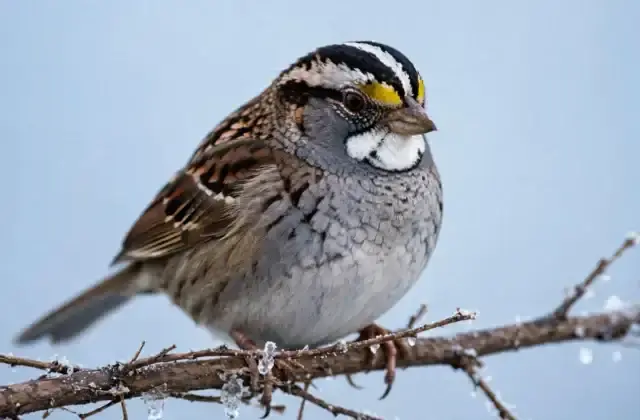
The American Tree Sparrow is a closer match. It is a medium sized sparrow with a rufous crown, a gray face, a plain breast with a single dark central spot and a bicolored bill that is dark above and yellow below. The junco has no rufous crown, no central breast spot and no bicolored bill. A plain gray breast with no spot points to a junco, and a plain gray breast with a dark spot in the center points to a tree sparrow.
The Chipping Sparrow is a summer bird in most of the North, so it is less likely to be confused with a junco in winter. A chipping sparrow has a rufous crown, a pale eyebrow, a dark line through the eye and a dark bill, and it is smaller and slimmer than a junco. For more help with small brown birds at a feeder, see Small Brown Birds in My Yard: A Quick ID Guide.
How to Watch and Attract Dark-Eyed Juncos
Attracting dark-eyed juncos is simple. Scatter white proso millet and cracked corn on the ground under a feeder, or offer them on a low tray, and keep a shrub or an evergreen nearby for cover.
Do not try to attract juncos with a tube feeder alone. They are ground feeders, and a tube feeder will bring in chickadees and finches but not juncos. A ground tray, a low platform or a simple scatter of seed on cleared ground is what they need. Keep the area free of snow if you can, and keep cats indoors, because juncos feed on the ground and they are vulnerable to cats.
The best time to see juncos is from October to April, and the best time to learn the forms is in winter, when birds from different breeding areas are mixed together at feeders. Mass Audubon describes the dark-eyed junco as the harbinger of winter in New England, and Illinois Extension calls it the funky, fidgety wild bird of Illinois winters. Winter finches often visit the same feeders, so check the winter finch forecast 2026-27 for what else to expect.
Frequently Asked Questions
What is a dark-eyed junco?
A dark-eyed junco is a small grey and white sparrow, Junco hyemalis, commonly called the snowbird. It is about 6.25 inches long, with a wingspan of 9.25 inches and a weight of about 0.67 oz. It has a dark eye, a pale pink bill, a clean white belly and white outer tail feathers that flash in flight.
When do dark-eyed juncos arrive and leave?
In most of the United States dark-eyed juncos arrive in October and stay until mid-April. They breed in Canada, Alaska and the western mountains in summer, and they move south and downhill in winter. Females tend to migrate farther south than males, and males tend to return north earlier in spring.
What do dark-eyed juncos eat in winter?
In winter about 75 percent of the diet is seeds, including chickweed, buckwheat and lambsquarters, plus seeds from grasses, weeds and conifers. At a feeder they take white proso millet, cracked corn and black oil sunflower on the ground or on a low tray. In the breeding season they add insects, especially caterpillars and beetles.
How do I tell a dark-eyed junco from other sparrows?
Look for a clean unstreaked breast, a dark eye, a pale pink bill and white outer tail feathers that flash in flight. Towhees are much bigger, with red eyes and rufous sides. American tree sparrows have a rufous crown, a dark central breast spot and a bicolored bill.
Do dark-eyed juncos nest on the ground?
Yes, dark-eyed juncos nest on or near the ground in a sheltered depression, hidden by vegetation. The female builds an open cup nest of grasses, moss and rootlets, and she usually lays 3 to 5 eggs, with 4 being the usual number. Incubation lasts 12 to 13 days, and the pair will raise 2 to 3 broods in a season.