
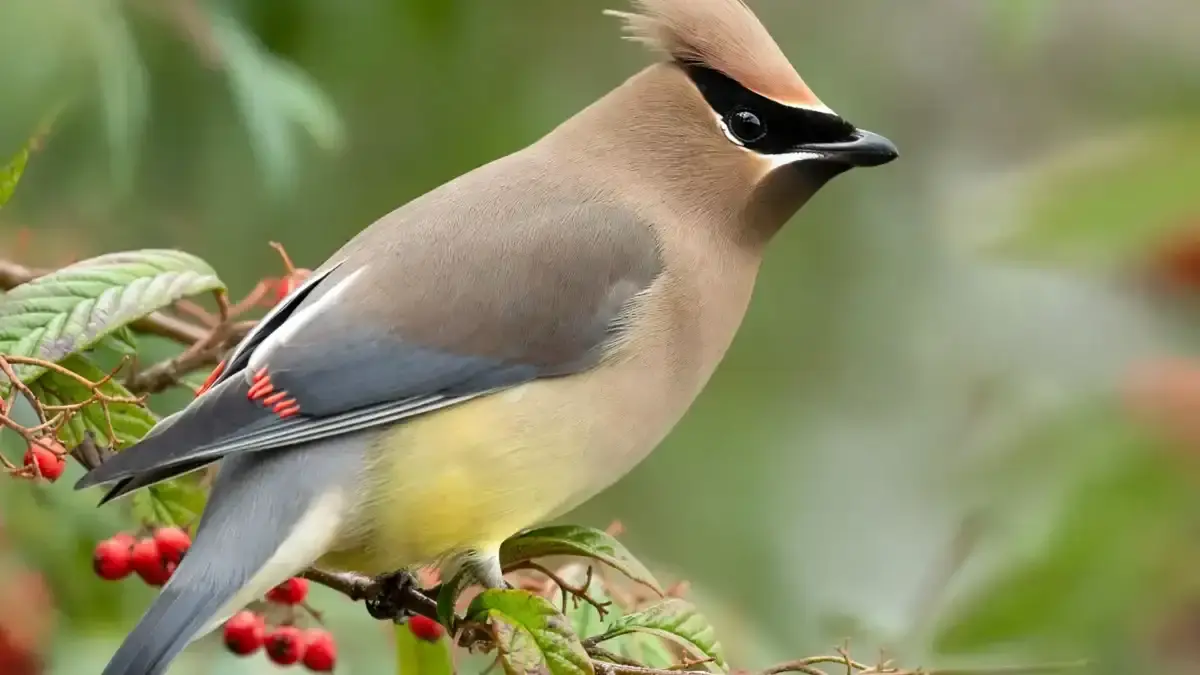
A flock of cedar waxwings can empty a berry tree in an afternoon, then vanish before you have fetched your binoculars. That sudden arrival is part of the appeal. These sleek, silky birds travel in sociable, fruit-chasing flocks, and they look unlike almost any other backyard bird in North America.
The cedar waxwing (Bombycilla cedrorum) is a sleek, crested North American songbird with a black mask, pale yellow belly, yellow tail band, and red waxy wing tips. It feeds mainly on fruit year-round, adds insects in summer, breeds in Canada and the northern United States, and winters south to Mexico and Central America.
How Can You Identify a Cedar Waxwing?
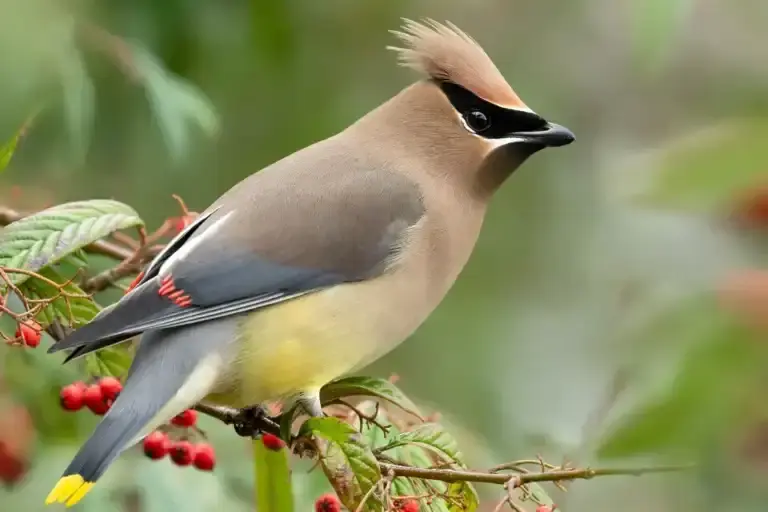
Look first for the combination, not a single mark. A cedar waxwing is smooth and silky, with a warm brown head and breast fading to grey on the wings and a pale yellow belly. Its crest sweeps back from the head, a narrow black mask runs through the eye and is edged in white, and the dark tail ends in a bright yellow band.
Adults often show small, brilliant-red, wax-like tips on the secondary wing feathers. Those tips give waxwings their name, although their exact purpose is still unknown. Not every adult shows them clearly, and juveniles lack them, so do not rely on the red tips alone.
Size helps, too. Cornell Lab of Ornithology gives a length of 14 to 17 cm (5.5 to 6.7 in), a wingspan of 22 to 30 cm (8.7 to 11.8 in), and a weight of about 32 g (1.1 oz). In the field, that places a cedar waxwing between a sparrow and a robin, with a large head, short neck, short wide bill, and broad, pointed wings.
What do male, female, and young cedar waxwings look like?
Males and females look very similar, which makes sexing a single bird in the field unreliable. The male’s chin is often darker than the female’s, but the difference is subtle and varies between birds. In the breeding season, females in one Pennsylvania study averaged slightly heavier than males, but that is not a field mark you can use through binoculars.
Juveniles are easier to separate. They are browner above, streaked below, and lack the red wax tips. They still show the diagnostic yellow tail band, which is a useful clue when a streaky young bird lands in a berry tree with adults.
How do you tell a cedar waxwing from a Bohemian waxwing?
The Bohemian waxwing (Bombycilla garrulus) is the only real lookalike in North America, and the two species can occur together in winter. Check three places. First, the undertail: a cedar waxwing has white or buff feathers under the tail, while a Bohemian has rusty-cinnamon feathers there. Second, the belly: a cedar waxwing has a pale yellow belly, while a Bohemian is grey below. Third, the wing: a Bohemian shows bold white and yellow marks on the folded wing, while a cedar waxwing has no white or yellow wing bars, only the red tips and pale edges.
A Bohemian is also larger and greyer overall, at 16 to 19 cm (6.3 to 7.5 in) long and 45 to 69 g, compared with the cedar waxwing’s 14 to 17 cm and about 32 g. In Britain, where the Bohemian is the only waxwing, it is known simply as the waxwing. That matters for readers outside North America: a “waxwing” in a British garden is almost certainly a Bohemian, not a cedar waxwing.
Where Do Cedar Waxwings Live?
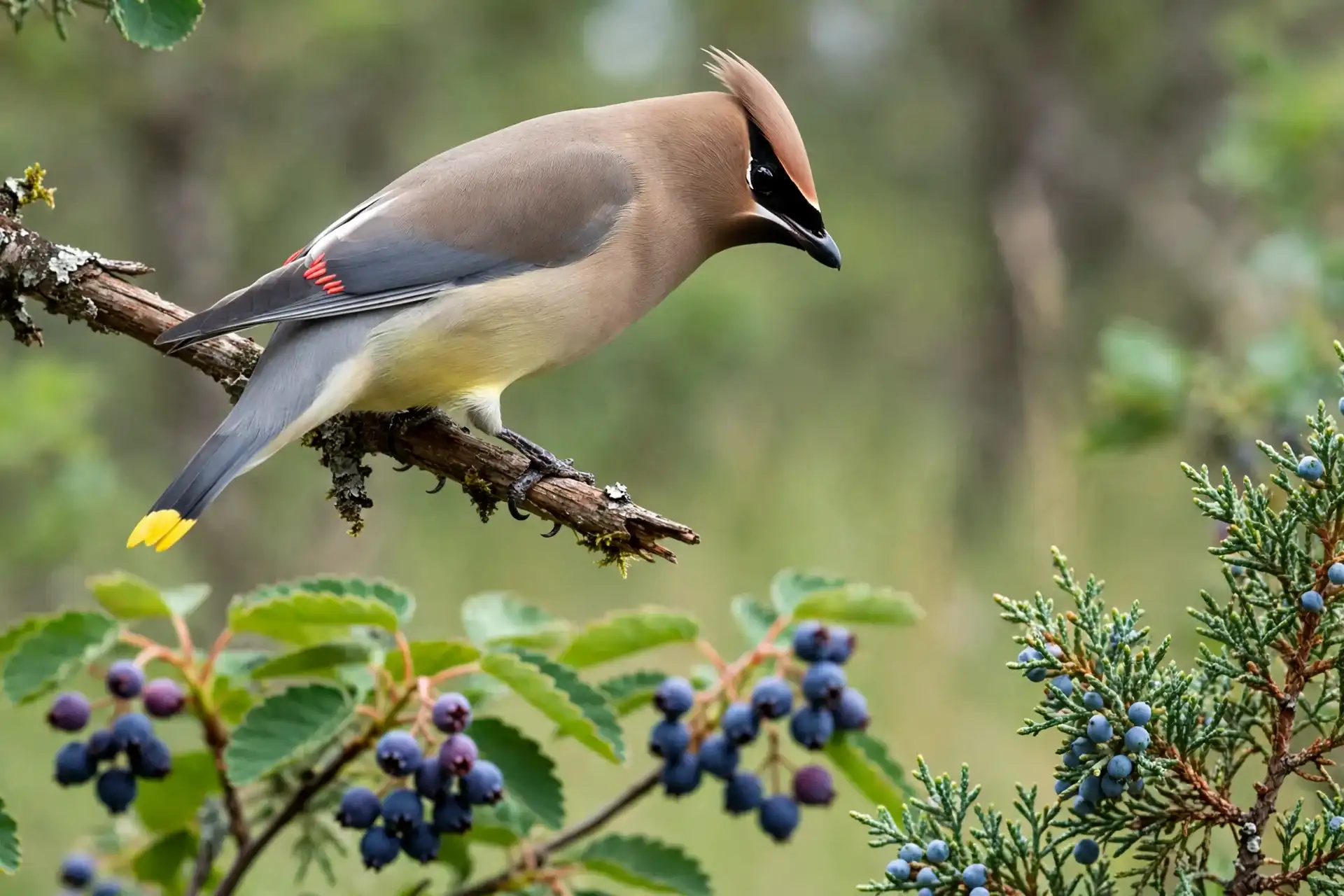
Cedar waxwings live across North America, but they do not stay put. They breed in open wooded areas in southern Canada and the northern half of the United States, and winter in the southern half of the United States, Central America, and the far north-west of South America. Vagrants have occasionally reached Iceland and Great Britain, but those are exceptions, not part of the normal range.
Their preferred habitat is open woodland, especially woodland edges, orchards, parks, gardens, and second-growth forest where fruiting trees and shrubs are available. Cornell describes them in deciduous, coniferous, and mixed woodlands, particularly along streams, and also in old fields, grasslands, sagebrush, and even desert washes. In winter, they are most abundant around fruiting plants in open woodlands, parks, gardens, forest edges, and second-growth forests.
Do cedar waxwings migrate?
Yes, but not on a fixed timetable. Cedar waxwings are nomadic and irruptive: they move from place to place depending on where they can find good sources of berries. Audubon notes that migratory flocks of 30 to 100 begin to form in August, and that both breeding and wintering areas may change from year to year, depending on food supplies.
In practice, that means a waxwing can be a summer breeder in one place, a winter visitor in another, and absent altogether in a third year, even if the habitat looks the same. In Florida, for example, they arrive in October and stay until May, and are found there in winter only. In Maryland, they are found year-round and breed statewide. Check local timing, not a single national calendar, before assuming they have “left” or “arrived”.
| Season | Where cedar waxwings are most often found |
|---|---|
| Breeding (late spring to late summer) | Southern Canada and the northern United States, in open woodlands with fruiting trees and shrubs. |
| Autumn movement | Nomadic flocks of 30 to 100, sometimes hundreds, following ripening fruit south. |
| Winter | Southern United States, Mexico, Central America, and the far north-west of South America; also the Caribbean in some years. |
| Year-round in parts of the range | Some areas, such as Maryland and parts of the north-eastern United States, hold birds through the year. |
What Do Cedar Waxwings Eat?
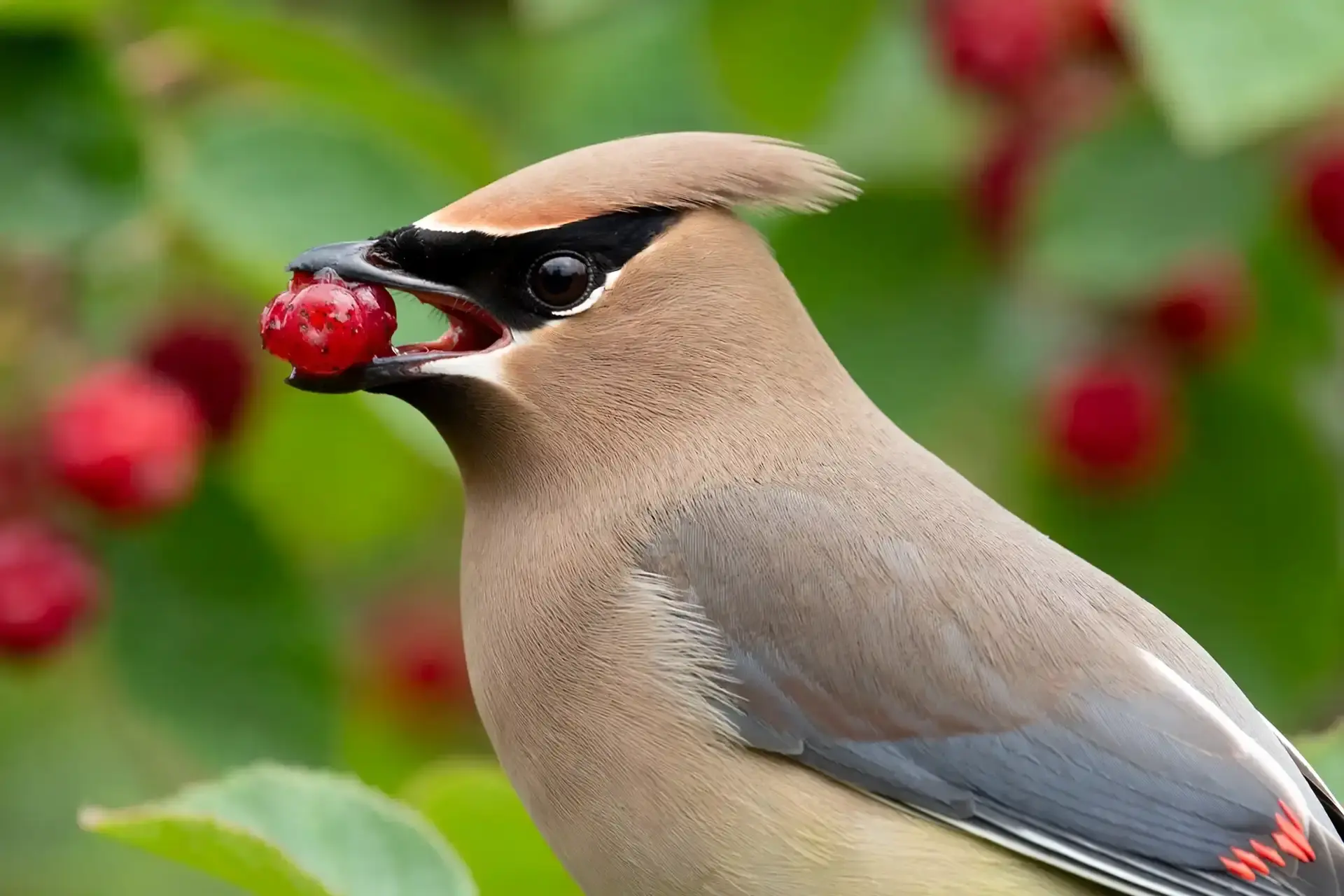
Fruit is the short answer, and it is also the long answer. Cedar waxwings feed mainly on fruits year-round, which is unusual for a songbird. Cornell lists serviceberry, strawberry, mulberry, dogwood, and raspberries in summer, and cedar berries, mistletoe, madrone, juniper, mountain ash, honeysuckle, crabapple, hawthorn, and Russian olive in winter. Maryland’s wildlife agency puts the fruit share at almost 90%, with cedar berries first, followed by cherry, dogwood, blackberry, chokeberry, hackberry, mulberry, serviceberry, viburnum, grapes, crabapples, mountain ash, elderberry, holly, and poison ivy.
They swallow berries whole, one by one, usually while perched on a twig. They can also grab berries while hovering briefly just below a bunch. Unlike most fruit-eating birds, which regurgitate seeds, cedar waxwings digest the whole fruit and pass the seeds in their droppings, which helps disperse the plants they feed on.
Insects matter most in summer, when protein is needed for nesting and feeding young. In summer, cedar waxwings supplement their fruit diet with mayflies, dragonflies, and stoneflies, often caught on the wing, and they also pick scale insects, spruce budworms, and leaf beetles directly from vegetation. That shift is seasonal, not a change of identity: fruit remains the staple, insects are the summer supplement.
Can you offer fruit to cedar waxwings?
Yes, in small amounts, and fruit is a better offer than seed. Waxwings do not eat seed, so a seed tube will not attract them. A platform feeder, fruit tray, or shallow dish with halved grapes, chopped apple, or berries can work, especially in winter when natural fruit is scarce. For serving details, see the BirdsBuzz guides on can birds eat grapes, can birds eat strawberries, and can birds eat cranberries.
Offer only a small amount, use fresh, ripe, washed fruit, and remove uneaten fruit within a day or two. That last point matters for waxwings more than for most birds, because of fermented fruit.
Why do waxwings sometimes seem drunk?
Because they can be. Cedar waxwings eat almost nothing but fruit in winter, and they eat it in large quantities. When berries are overripe and have begun to ferment, the alcohol can intoxicate the bird. BirdsBuzz explains this in detail in Can Birds Get Drunk? Fermented Berries Explained, including the waxwing’s larger liver and expandable oesophagus, which help it process alcohol but do not make it immune.
A waxwing that has gorged on fermented rowan berries, crabapples, or juniper berries can become dazed, fly into windows, or become too impaired to fly. Do not offer fermented, mouldy, or overripe fruit, and do not leave fruit out overnight in warm weather. If you find a dazed wild bird, do not try to feed or handle it yourself; contact a licensed wildlife rehabilitator for advice.
How Do Cedar Waxwings Behave?
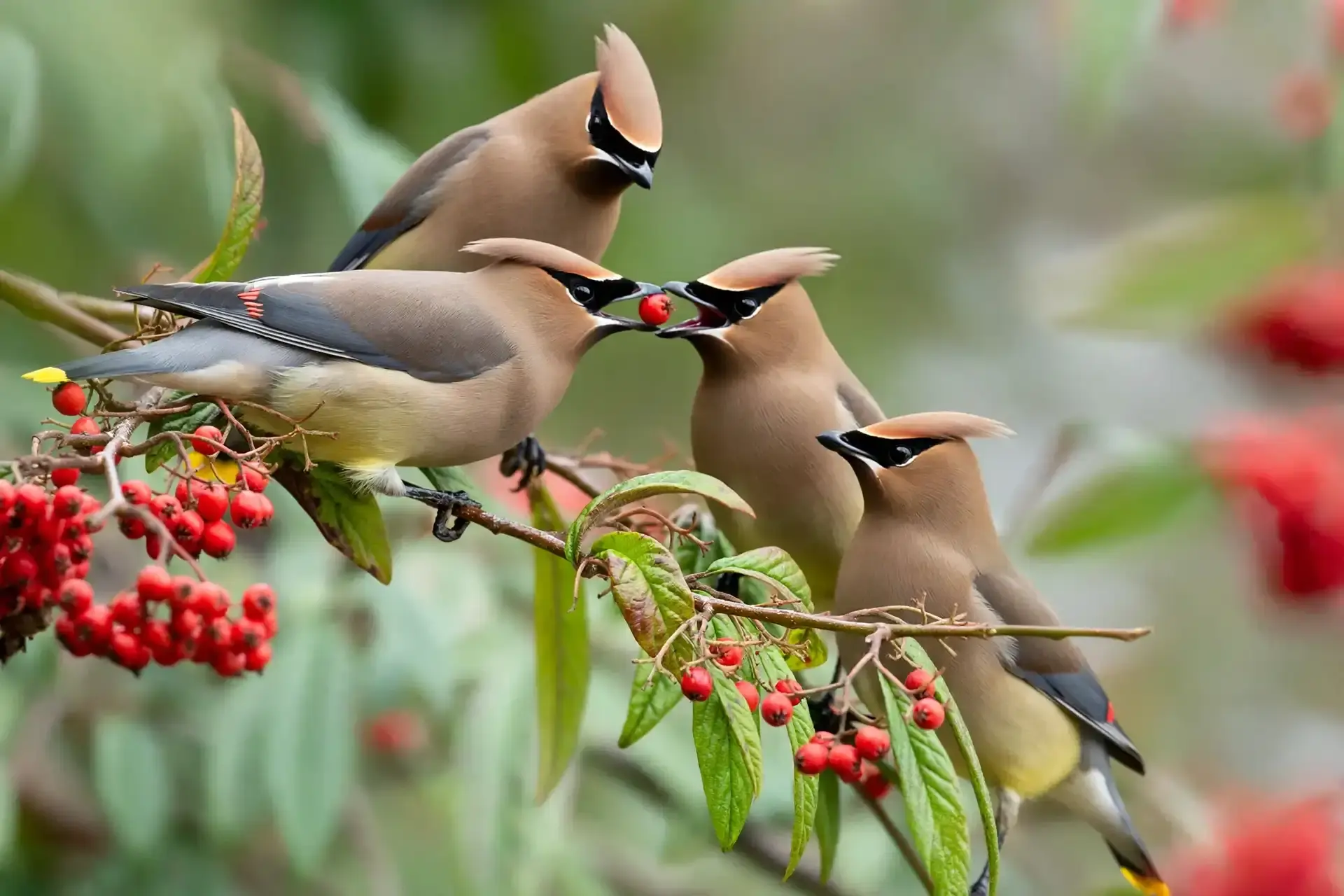
Cedar waxwings are sociable in almost every season. Outside the breeding season they feed in large flocks, sometimes numbering hundreds, and they are non-territorial birds that will often groom each other. When a flock descends on a berry tree, the birds flutter among the branches, pluck berries one by one, and move on together when the tree is stripped.
One of their best-known behaviours is berry passing. When the end of a twig holds berries that only one bird at a time can reach, members of a flock may line up along the twig and pass berries beak to beak down the line, so that each bird gets a chance to eat. It is a practical solution to a crowded branch, and it is also one of the easiest waxwing behaviours to watch without disturbing the birds.
What does a cedar waxwing sound like?
Cedar waxwings do not sing. Their calls are thin, high-pitched whistles and trills, often described as a lisping tseee or seee. Audubon describes “a high-pitched trill and thin lisp, tseee whistle”, and notes that flocks can be heard before they are seen.
That call is a useful field clue. If a flock of sleek, brown birds lands in a berry tree and fills the air with thin, high whistles, check for the black mask and yellow tail band before assuming they are starlings or robins. In flight, waxwings have a strong, steady flight style with fairly constant wingbeats.
What is cedar waxwing courtship like?
Courtship is a quiet, hopping exchange. During courtship, males and females hop towards each other, alternating back and forth and sometimes touching their bills together. Males often pass a small item, such as a fruit, insect, or flower petal, to the female. After taking the fruit, the female usually hops away and then returns, giving the item back to the male. They repeat this a few times until, typically, the female eats the gift.
Pairs are monogamous for the season, and they often nest in loose clusters of a dozen or so nests, rather than defending a single territory. That loose, social nesting fits the rest of their behaviour: waxwings do most things in company.
When and Where Do Cedar Waxwings Nest?
Cedar waxwings nest late, compared with many songbirds. The mating season begins around the end of spring and runs through late summer, and nesting is timed for when berries are plentiful. In Maryland, that means July to August. That late timing is practical: nestlings are fed mainly on insects at first, then on fruit as they grow, so a late nest matches the fruit supply.
Pairs look for a nest site together, but the female makes the decision. She typically chooses the fork of a horizontal branch, anywhere from 1 to 15 m (3 to 50 ft) high, in trees such as maple, pine, red cedar, white cedar, apple, pear, hawthorn, and bur oak. Sometimes they use vertical forks, vine tangles, or a single horizontal branch.
The female does almost all the nest building. She weaves twigs, grasses, cattail down, blossoms, string, horsehair, and similar materials into a bulky open cup about 13 cm (5 in) across and 8 cm (3 in) high, lined with fine roots, grasses, and pine needles. Construction takes five to six days and may require more than 2,500 individual trips to the nest. Waxwings occasionally save time by taking nest material from other birds’ nests, including Eastern Kingbirds, orioles, robins, and Yellow Warblers.
The nesting facts are consistent across Cornell, Audubon, and university sources: a clutch of 2 to 6 pale blue or blue-grey eggs, sometimes spotted with black or grey; incubation by the female only for 11 to 13 days; young leaving the nest about 14 to 18 days after hatching; and one to two broods per year. Both parents feed the nestlings. Hatchlings are naked, blind, helpless, and weak, and weigh about 3.1 g at hatching.
Cedar Waxwing vs Bohemian Waxwing: How to Tell Them Apart
If you are in northern Canada, Alaska, or northern Europe in winter, the comparison matters. If you are in the southern United States, Mexico, or Central America, a waxwing is almost certainly a cedar waxwing, because Bohemian waxwings do not migrate as far south.
| Field mark | Cedar waxwing | Bohemian waxwing |
|---|---|---|
| Scientific name | Bombycilla cedrorum | Bombycilla garrulus |
| Length | 14 to 17 cm (5.5 to 6.7 in) | 16 to 19 cm (6.3 to 7.5 in) |
| Weight | About 32 g (1.1 oz) | 45 to 69 g (1.6 to 2.4 oz) |
| Belly | Pale yellow | Grey |
| Undertail coverts | White or buff | Rusty-cinnamon |
| Folded wing | No white or yellow bars; red waxy tips only | Bold white and yellow marks |
| Overall colour | Warm brown, fading to pale yellow | Greyer overall, cinnamon forehead |
| Normal range | North America, south to Panama | Far north in North America and Eurasia; irregular winter movements south |
Use the undertail and belly first, then the wing. Colour can shift with light, camera settings, and feather wear, so a single photograph can mislead. A clear view from behind, showing white undertail coverts and a pale yellow belly, is stronger evidence for a cedar waxwing than a single red wing tip.
How Can You Attract Cedar Waxwings to Your Garden?
Plant fruit, not seed. The most reliable way to attract cedar waxwings is to grow the trees and shrubs they already eat: serviceberry, dogwood, juniper, hawthorn, crabapple, mountain ash, elderberry, holly, and winterberry, which ripen at different times. Native species are usually best for your region. Plant in groups, leave some fruit through winter, and provide water nearby. Waxwings are vulnerable to window collisions and roadside feeding, so place fruiting shrubs away from large reflective windows where you can, and do not spray fruiting trees. For feeder hygiene and safe foods, see the BirdsBuzz guide on bird food.
Are Cedar Waxwings at Risk?
No, not at present. The cedar waxwing is listed as Least Concern on the IUCN Red List, most recently assessed in 2020, with a global population trend listed as increasing. The IUCN assessment gives 64,000,000 mature individuals, and Cornell, citing Partners in Flight, gives the same global breeding population of 64 million and rates the species 6 out of 20 on the Continental Concern Score, indicating low conservation concern.
Populations were stable between 1966 and 2019, and in some areas showed increases, according to the North American Breeding Bird Survey. The increases are probably in part because fields have reverted to shrublands and forests, and because berry trees such as mountain ash are widely used in landscaping.
Conclusion
The cedar waxwing is easy to miss and hard to forget. Learn the black mask, crest, pale yellow belly, yellow tail band, and red waxy wing tips, listen for the thin, high tseee call, and watch berry trees in autumn and winter. When a flock arrives, it will usually tell you where the fruit is.
Your next step is the simplest one: plant one native fruiting shrub or tree, such as serviceberry, dogwood, or juniper, and watch it through the fruiting season. If waxwings find it, they will return, often in a flock, and often with that quiet, berry-passing behaviour that makes them one of North America’s most sociable birds.
Frequently Asked Questions
Are cedar waxwings rare?
No. Cedar waxwings are common across North America, with an estimated global breeding population of 64 million and a Least Concern status. They can seem rare because they are nomadic: a flock may be absent for a year, then arrive in large numbers when fruit ripens.
Do cedar waxwings eat seeds?
No, not normally. They feed mainly on fruit year-round and supplement that with insects in summer. A seed feeder will not attract them; a platform feeder with fresh fruit, or a fruiting shrub, is a better offer.
Why do cedar waxwings have red tips on their wings?
The red tips are waxy secretions on the secondary wing feathers. Their exact purpose is still unknown. They are present on many adults, absent on juveniles, and are not a reliable way to tell males from females.
Can cedar waxwings get drunk on fermented berries?
Yes. Waxwings eat large quantities of fruit, and overripe berries can ferment and produce alcohol. A waxwing that gorges on fermented fruit can become dazed or too impaired to fly. Do not offer mouldy or overripe fruit, and contact a licensed wildlife rehabilitator if you find a dazed wild bird.
Where is the best place to see a cedar waxwing?
Look in open woodlands, orchards, parks, gardens, and woodland edges with fruiting trees and shrubs, especially serviceberry, dogwood, juniper, hawthorn, and crabapple. Listen for thin, high whistles, and check berry trees in autumn and winter, when flocks are largest.