Introduction
There are three different types of hawk here. A hawk soaring along a highway, a shadow flying through your trees, and a wide-winged hawk soaring high using thermals. However, they can be easily identified. There are lots of hawk species in North America, but most can be split into two main categories, the soaring buteos and the swift accipiters. Once you know the shape, tail shape and flight pattern, you will know the name. This guide gives a complete overview of the hawk family, with all common species including their size, tail shape and flight pattern. It also explains how they hunt. Simply read through once and look them up. Whether the bird is soaring over a field or flying fast past your feeders, you will be able to identify them using the clues. The next time you see a hawk you will know the name!
The Two Groups: Buteos and Accipiters
All the hawks of North America can be divided up into two categories which tell you almost everything you need to know about their lifestyle. Buteos are the soarers, while the accipiters are the forest hunters. Once you can tell the difference between the two, you will find most hawk identification comes easy.
Buteos: The Soaring Hawks
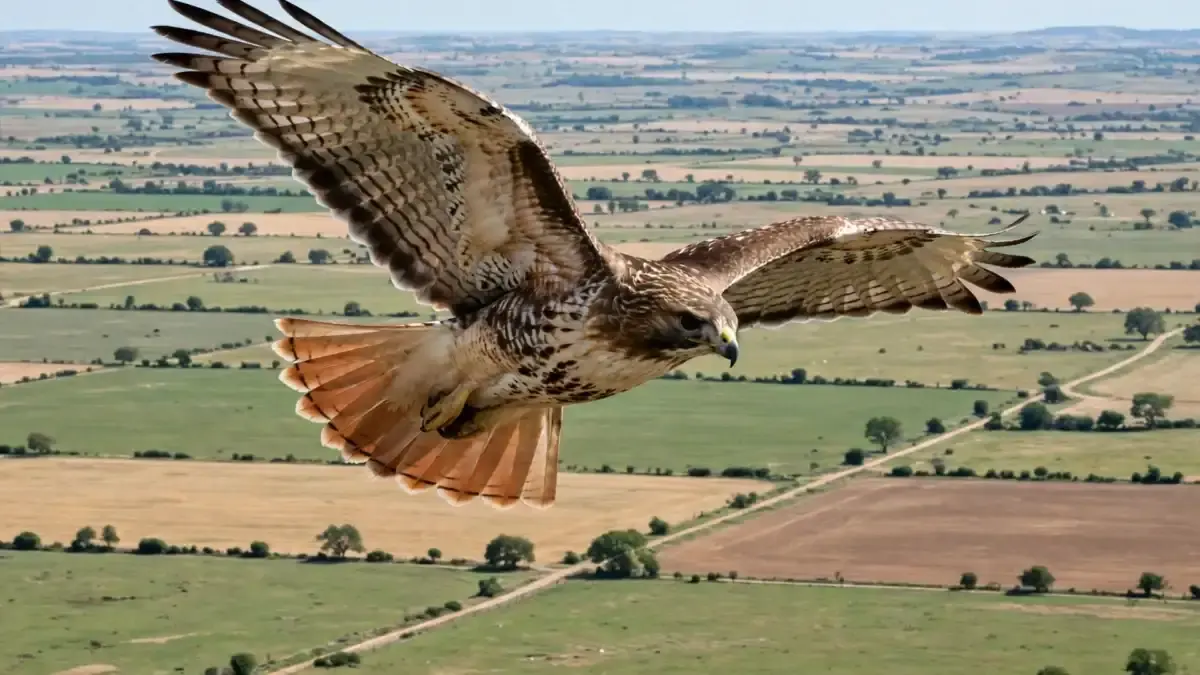
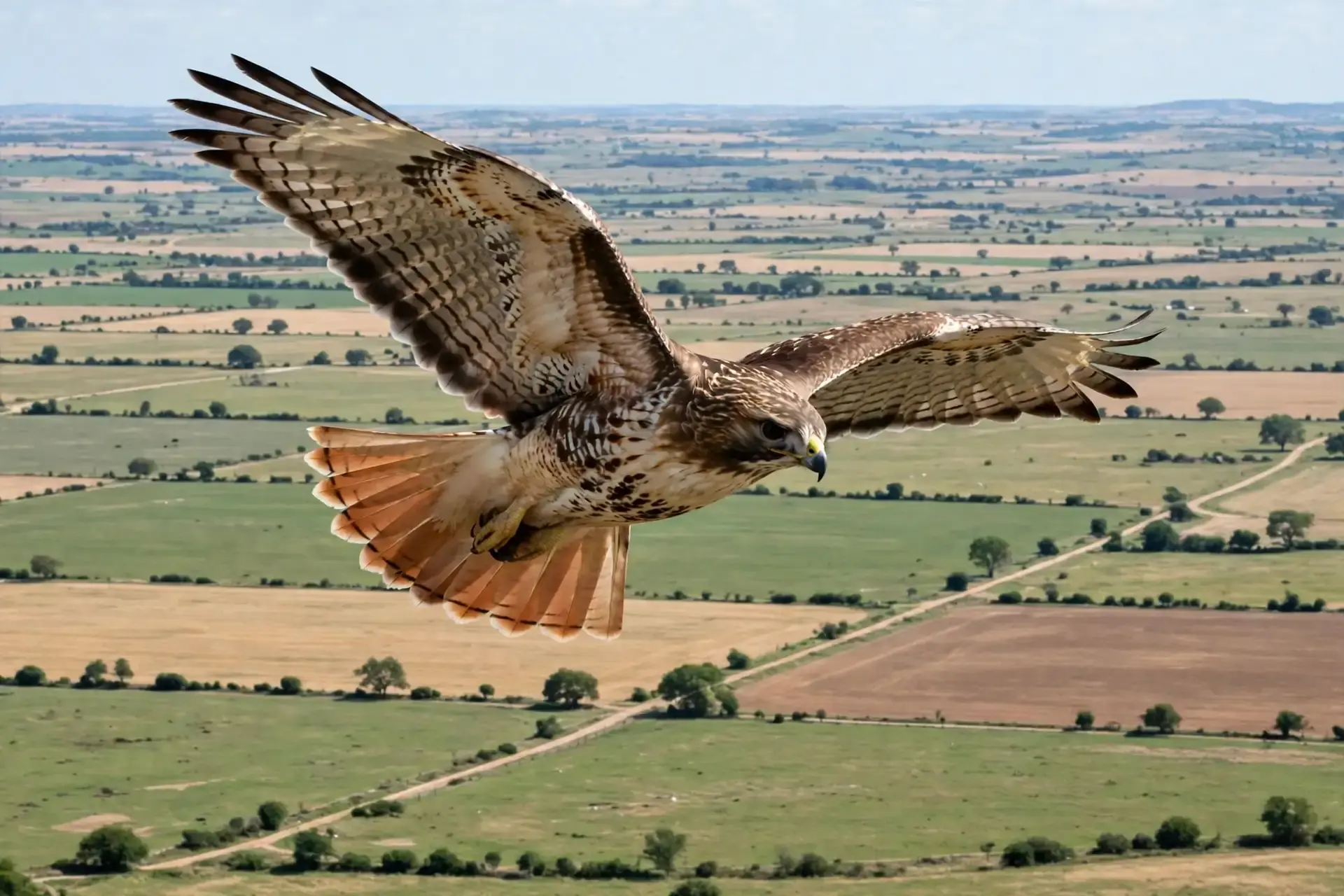
Buteos have broad, rounded wings and short, fan-shaped tails. They soar using thermals (rising columns of warm air) over open areas and circle high without much wing movement. They fly slowly and steadily. When hunting, they will drop from a perch or a soar down to catch small mammals on the ground. The red-tailed hawk, red-shouldered hawk, and broad-winged hawk are all buteos. They can be seen soaring over open areas such as fields, highways, and woodland edges. They often sit on poles or bare branches for hours.
Accipiters: The Forest Hawks
Accipiters have short, rounded wings and long tails. That shape is built for quick bursts through dense woods, where a long wing would catch on branches. They hunt songbirds, chasing them through trees with sudden turns and short, fast wingbeats. Cooper’s, sharp-shinned, and northern goshawks are all accipiters. They will be seen darting around your backyard, sitting low in cover, or streaking past your feeders. Their flight is a flap, flap, glide rhythm that is very different from a buteo’s steady soar.
Red-Tailed Hawk
The red-tailed hawk (Buteo jamaicensis) is probably the most common and the most often seen hawk in North America. They are found in nearly all habitats, including desert, prairies, farmland, suburbia, and city parks. If you see a large hawk perched on a highway lamp post or fence post, it is most likely to be a red-tail.
They are easy to identify. They have a rufous-red tail and have a dark bar on the leading edge of the underside of the wings (patagial bar). They often have a dark streaked band on the belly. Juveniles lack the red tail, making them more difficult to identify, but they can still be recognized by the dark patagial bar and dark band on the belly. They have a large wingspan of 110 to 141 cm and have a heavy build.
Red-tails soar steadily on flat wings and circle for long periods above open country. They sit on high perches and wait for prey to pass by before diving on voles, mice, rabbits, and ground squirrels. They will also feed on snakes, lizards, and the occasional bird.
Broad-Winged Hawk
The broad-winged hawk (Buteo platypterus) is a small, stocky buteo found in eastern forests. It is smaller than a red-tail, with a wingspan of 81 to 100 cm. The broad-winged hawk spends most of its life concealed in the canopy, watching for frogs, insects, and small mammals from a shaded perch. It has broad black and white bands on its tail, which are the clearest field mark when the bird flies overhead.
Broad-wings are famous for one thing: migration. In fall, they gather in huge flocks, called kettles, that ride thermals south in streams of thousands of birds.
Broad-winged hawks are not easily found in summer. Listen for their high-pitched whistling call and scan the canopy for a small buteo sitting quietly on a low branch on the edge of the forest.

Red-Shouldered Hawk
The red-shouldered hawk (Buteo lineatus) is an intermediate-sized buteo inhabiting moist deciduous forests and riverine areas. As the name suggests, the red-shouldered hawk has rusty red patches on the shoulder which are visible when the bird is perched. The breast has warm orange barring. During flight, the wings have a pale crescent marking toward the tip, and the tail has thin black and white bands.
Red-shouldered hawks live near water and feed along streams, marshes, and flooded woodland. They feed on frogs, crayfish, snakes, and small mammals. Their loud, whistling call has a distinctive ‘kee-aah’ sound and is very noticeable in the trees. In the spring, they often call in duets.
They are less tolerant of open country than red-tails, so look for them at forest edges near water, perched low over a stream or a wet meadow.
Cooper’s Hawk
The Cooper’s hawk (Astur cooperii, recently reclassified from Accipiter) is the backyard accipiter. It is 14 to 20 inches long, with a wingspan of 24 to 37 inches. It has short, rounded wings and a long, rounded, white-tipped tail, making it very fast in cover. It also has a large, blocky head that sticks well out in front of the wings in flight. The back is blue-gray, and the chest is barred with fine rusty orange.
Cooper’s hawks are predators that strike suddenly in backyards and woodlots. A Cooper’s will often swoop out of cover to give a sparrow or dove a thrilling chase around the hedge before catching it in flight. They also hunt small mammals and will often visit feeders to hunt for the birds attracted to the seeds. Often, if there is a sudden stillness at a feeder and all the birds suddenly disappear, then you know there is probably a Cooper’s nearby.
In flight, look out for the large head, straight wing leading edge, and rounded tail with clean white tip. To see how it compares to its lookalike, take a look at our Cooper’s hawk vs sharp-shinned hawk identification guide.

Sharp-Shinned Hawk
The sharp-shinned hawk (Accipiter striatus) is the smallest accipiter in North America. It is one of the smallest hawks in North America. It is 9 to 13 inches long, with a wingspan of 16 to 26 inches. The sharp-shinned hawk is similar in size to a jay. It has short, rounded wings, a long tail that is square or notched at the tip, and a small head. When flying, the head does not stick far out at the front. The sharp-shinned hawk has a fast flight pattern of flapping, flapping, and gliding. They can weave through trees at an incredible speed.
These agile birds hunt small songbirds. During fall and winter, they will often visit backyard feeders as they follow migrating flocks. They chase warblers, sparrows, and finches through bushes and can turn on a wingtip.
Distinguishing between a sharp-shinned hawk and a Cooper’s hawk is one of the most difficult identifications in North America, since a large female sharp-shinned can be similar in size to a small male Cooper’s. Size alone will mislead you. However, the tail shape and head proportions are more important. The sharp-shinned has a square or notched tail, small head, and very pencil-like legs. The Cooper’s has a round tail with a distinct white tip and a large, blocky head. If unsure, then look at how it flies: the sharp-shinned will have a distinctive forward wing position, and the head will be barely visible.

Northern Goshawk
The northern goshawk is the largest and most powerful accipiter in North America. It measures 19 to 26 inches long and has a wingspan of 40 to 47 inches. The goshawk prefers mature forest and is uncommon, so sighting one is a special day for most birders. Adults have slate-gray upper parts, with a pale, finely barred chest. They have a distinctive white eyebrow stripe and a striking red eye. Juveniles are brown and heavily streaked.
Goshawks are woodland hunters that catch grouse, hares, squirrels, jays, and crows in short, fast pursuits. They are bold and fast, and they will aggressively defend their nests, sometimes diving at people who wander too close.
It is a matter of luck and patience. Search large areas of mature coniferous or mixed woodland and listen for the harsh, repeated kak-kak-kak alarm call. Watch out for a large gray accipiter whizzing across a forest road.
Ferruginous Hawk and Rough-Legged Hawk
Two other buteos should be mentioned. The ferruginous hawk is the largest buteo in North America. This pale bird lives in open grasslands and deserts in western North America. It hunts prairie dogs and ground squirrels from the ground or a low perch, and its legs are feathered all the way to the toes. The rough-legged hawk breeds in the Arctic but spends the winter in the northern United States. It hovers over open areas searching for voles. It also has feathered legs, and the tail has a wide dark band toward the end.
Hawk vs Falcon: The Quick Difference
While hawks and falcons share a similar appearance, they are from different families. Hawks will have broad wings and fan-shaped tails. They will attack and catch their prey with their feet. Falcons have long, slender sickle-shaped wings and a narrow tail. They will attack their prey at high speed and often strike their prey mid-air with a closed foot. In flight, they will have a more pointed and swept wing shape compared to the hawks, which have broad, rounded wings. See our complete hawk vs falcon identification guide for more information.
Cooper’s vs Sharp-Shinned: The Hardest Call
The Cooper’s and sharp-shinned hawks cause more arguments than any other pair in North America due to their similar shapes, colors, and behaviors. To distinguish between the two species, it is best to look at multiple features. The Cooper’s has a rounded tail with a broad white tip, whereas the sharp-shinned has a square or notched tail. The Cooper’s also has a large, blocky head which sticks out well ahead of the wings, whereas the sharp-shinned has a small head which barely comes out. The legs on the Cooper’s are thicker, whereas the sharp-shinned have very thin pencil-like legs. The Cooper’s has a straighter leading edge on its wing and flies with a more constant flapping motion, whereas the sharp-shinned flaps quickly and appears to be thrust forward. Our detailed guide to Cooper’s hawk vs sharp-shinned hawk identification walks through every mark with photos.
How Hawks Hunt
Hawks all have different hunting styles. Perch hunters will sit still for long periods of time, waiting to spot any slight movements on the ground below. Buteos will circle high up, looking for movement, and then tuck their wings in and dive down. They also hunt from a perch. They will sit still for long periods of time and then swoop down to catch a vole or rabbit. Accipiters will pounce on their prey. They will suddenly fly from cover and chase the songbirds around, with twists and turns, or by still hunting from a hidden perch inside a bush. Goshawks will also have a fourth hunting style; they will rapidly chase after their prey through the forest, in a fast, low chase. They will chase after a grouse for a hundred meters or more. All hawks kill with their feet. They have sharp talons to grip and pierce. The hooked bill is used to tear up their food.
Reading a Hawk in Flight
The easiest way to identify a hawk from afar is by flight pattern. Buteos will have flat, broad wings with slow and heavy wing beats. The wings will be held still in a shallow V. Accipiters will have a flap-flap-glide pattern. They will have fast wing beats and then fold their wings to glide for a short period of time. Falcons have rapid, stiff wing beats and pointed wings. They rarely glide. The tails are also important. Buteos have short, fan-shaped tails. Accipiters have long, straight tails. Falcons have very narrow tails. When hawks are circling in a thermal, you can see the difference. Red-tails will have flat wings. Broad-wings will have slightly forward wings. Accipiters rarely circle for long periods of time. They will just cross over and move on.
Where to Find Each Hawk
Every hawk has its preferred habitat; knowing this will save you hours of searching. Red-tailed hawks are everywhere in open areas such as highways, fields, prairies, and suburbs. They perch on poles and fence posts. Broad-winged hawks can be found in deciduous woodland in the east. Listen for their whistling call from the canopy. Red-shouldered hawks can be found in wet woods and river bottoms. Cooper’s hawks can be found in woodlots, parks, and backyards where there are songbirds. Sharp-shinned hawks follow songbirds through woodland edges and gardens. They are most commonly seen in fall. Northern goshawks can be found in large areas of old growth forest. They are usually far away from roads. Ferruginous and rough-legged hawks can be found in open grassland and farmland in the west and north. The best place to see all of these hawks is at a hawk watch in fall. There are dozens of different species flying over in one morning.
Hawk Migration
Most North American hawks are migratory. One of the best wildlife spectacles of the continent is watching them migrate during the fall months. Huge kettle movements of broad-winged hawks can be seen; thousands of sharp-shinned hawks fly by along ridges and coastlines. Red-tails also migrate steadily, with many staying in the same fields they nested in. Accipiters follow their songbird prey, so their migration peaks when warblers and sparrows are migrating. For the full timing and routes, see our guide on do hawks migrate.
Hawk Species Comparison Table
| Species | Group | Wingspan | Key field mark |
|---|---|---|---|
| Red-tailed hawk | Buteo | 110 to 141 cm | Rufous-red tail, dark patagial bar |
| Broad-winged hawk | Buteo | 81 to 100 cm | Broad black and white tail bands |
| Red-shouldered hawk | Buteo | Medium buteo | Rusty red shoulders, barred orange chest |
| Cooper’s hawk | Accipiter | 24 to 37 inches | Rounded tail with white tip, big blocky head |
| Sharp-shinned hawk | Accipiter | 16 to 26 inches | Square or notched tail tip, small head |
| Northern goshawk | Accipiter | 40 to 47 inches | Slate-grey back, white eyebrow, red eye |
| Ferruginous hawk | Buteo | Largest buteo | Pale, feathered legs, largest buteo |
| Rough-legged hawk | Buteo | Large Arctic buteo | Feathered legs, dark tail band |
Frequently Asked Questions
What is the most common hawk in North America?
The red-tailed hawk is probably the most common hawk in North America. They can be found in almost every habitat, including deserts and city parks. They are the large hawk that is commonly seen perched on poles along highways and fence posts.
How do I tell a Cooper’s hawk from a sharp-shinned hawk?
The tail and head can also be used to help identify the species. A Cooper’s hawk has a rounded tail with a broad white tip and a large, blocky head. Sharp-shinned hawks have a square or notched tail tip and a small head that barely sticks out ahead of the wings.
Do hawks eat cats and small dogs?
Very rarely. Hawks hunt prey that they can carry and so a cat or small dog would be far too heavy and dangerous for most hawks. Red-tails and Cooper’s hawks hunt rodents, rabbits and songbirds.
Are hawks dangerous to people?
No. They are very shy birds and only aggressive when defending their nests. Even then, the danger is minimal. Occasionally a goshawk may swoop at someone close to its nest but serious injury is very unlikely. Leave some space around the nest in spring and summer.
What do hawks eat?
It depends on the group. Buteos will hunt small mammals, including voles, mice, rabbits, and ground squirrels, as well as snakes and lizards. Accipiters will hunt songbirds and small mammals, caught in fast chases through trees. Goshawks hunt grouse, hares, squirrels, jays, and crows.
Where is the best place to watch hawks migrate?
The best place to watch hawks is at a ridge or coastal site during fall. Some famous locations can give you thousands of hawks in a day: broad-winged kettles, sharp-shinned streams, and red-tails moving steadily south. Bring binoculars and watch the sky, not the trees.
What is the largest hawk in North America?
The ferruginous hawk is the largest buteo in North America. This pale colored hawk lives in western grasslands. The northern goshawk is the largest and most powerful accipiter. It is 19 to 26 inches long with a wingspan of 40 to 47 inches.
Can I attract hawks to my yard?
While you can’t feed hawks like songbirds, a large amount of songbirds will attract a Cooper’s or sharp-shinned hawk in the fall and winter. Place feeders close to some cover so small birds can take shelter. Enjoy seeing a hawk as a sign of a healthy yard, not as a pest.
Conclusion
Identifying hawks begins with identifying the group. A broad-winged hawk will soar high with its broad wings held flat. An accipiter will be long and narrow, darting through the trees with fast wingbeats. Once you have identified the group, you can identify the hawk by its tail, head, and flight. Red-tails dominate the open areas. Broad-winged hawks will be seen in kettles, Cooper’s and sharp-shinned hawks will hunt your backyards, and the goshawk prefers deep forests. Once you know the two groups and different tail shapes, you will know what hawk you are looking at. On a clear day during the fall, look up at the sky above the ridge. You will soon see the hawks sorting themselves out. Knowing the two groups will help you understand all the hawks you meet.