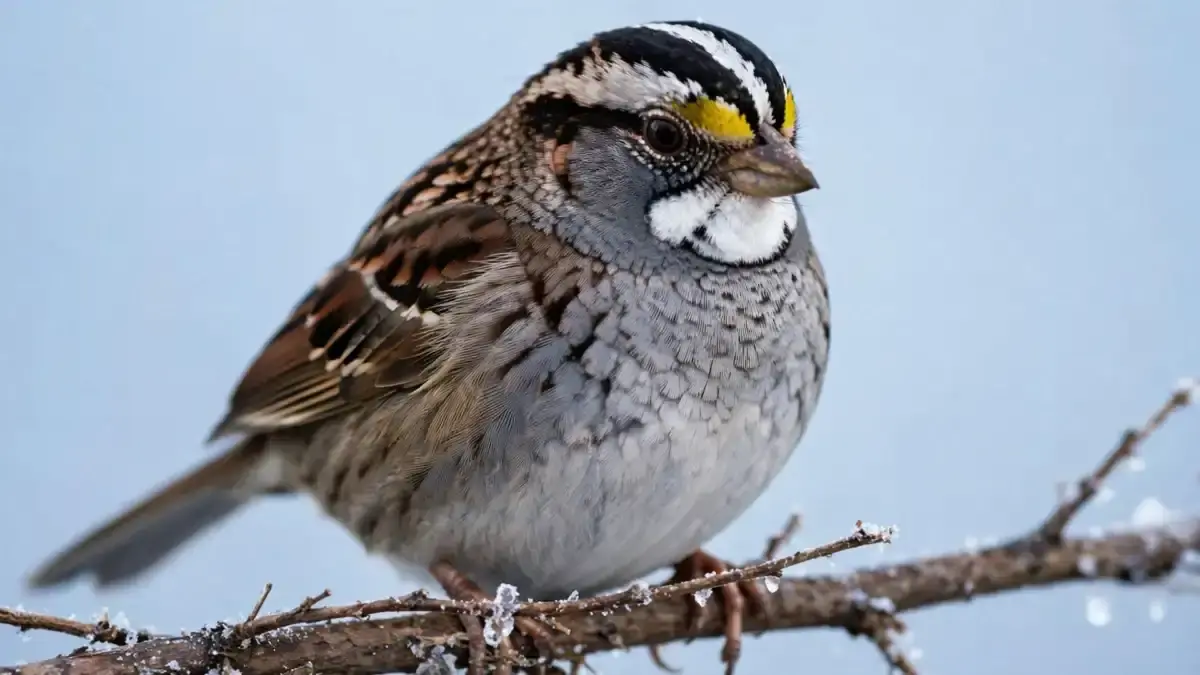
If you hear a clear, pure whistle drifting out of a winter thicket, or you spot a sparrow with a neat white patch on its throat scratching in leaf litter, there is a strong chance you have found a white-throated sparrow.
This bird, Zonotrichia albicollis, is one of the most recognizable winter sparrows in the eastern United States. It breeds mostly across Canada and the far northern United States, then moves south for winter, becoming a familiar visitor to brushy yards, parks, and woodland edges.
Identification comes down to a small set of marks used together. Look for a crisp white throat, a yellow spot between the eye and the bill, bold head stripes, a brown streaked back, and a plain gray breast.
The song helps just as much as the plumage, because its whistled phrases carry well on a quiet winter morning. This guide covers identification, the two color morphs, US winter range, and a yard setup for these ground feeders.
How to Identify a White-Throated Sparrow at a Glance
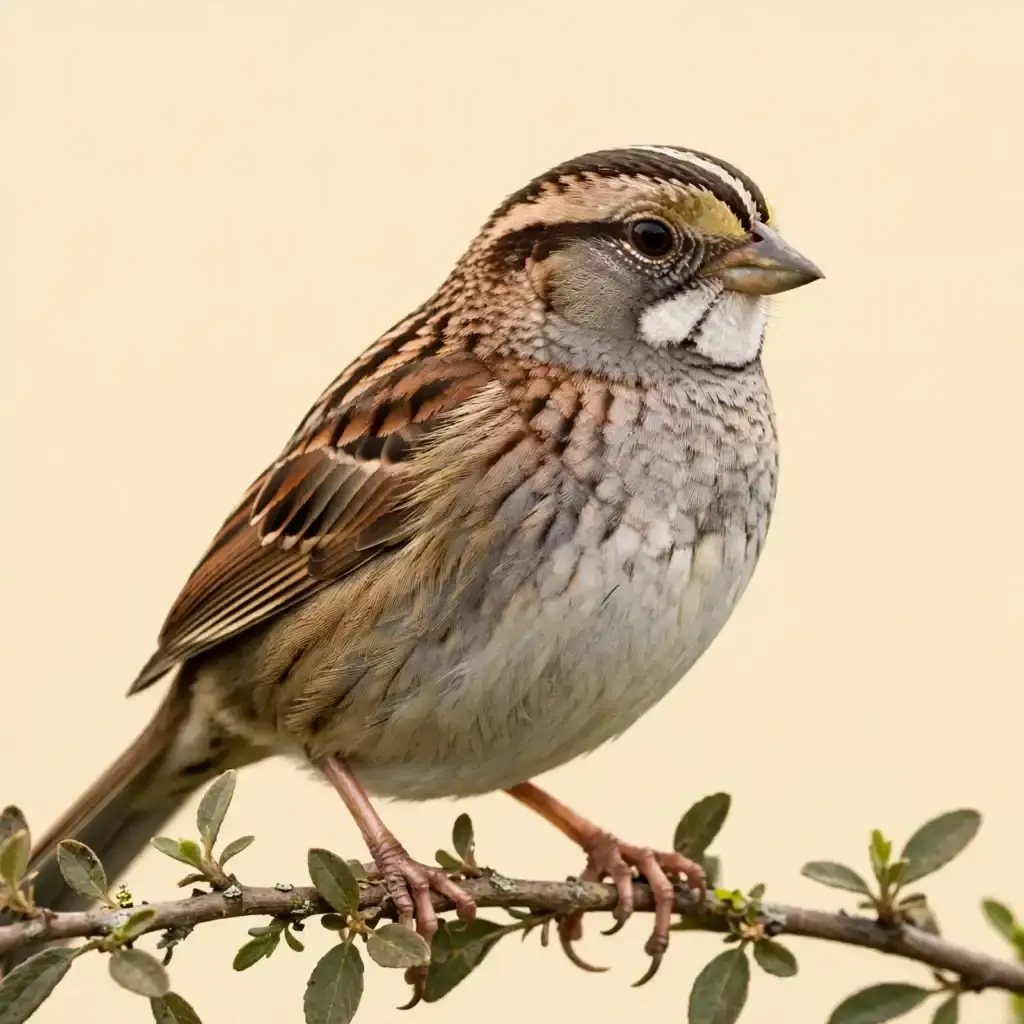
A white-throated sparrow is a fairly large, full bodied sparrow, about 6 to 7.5 inches long, with a rounded head, a fairly prominent bill, long legs, and a long, narrow tail. It often looks chunkier and longer tailed than the smaller sparrows feeding beside it. Its back is brown with darker streaking, while its breast is plain gray, without the heavy streaking seen on several similar species.
The head pattern does most of the identification work. Start with the throat, a clean, well defined white patch bordered by a thin dark line on each side. Next, check the small yellow patch between the eye and the bill, known as the lores.
That yellow mark is small, but it is a strong clue, and it separates this species from the white-crowned sparrow, which lacks it. Above the eye, look for a pale stripe, and on the crown, look for a central stripe flanked by darker stripes. The exact colours depend on the morph, covered below, but the pattern itself stays consistent.
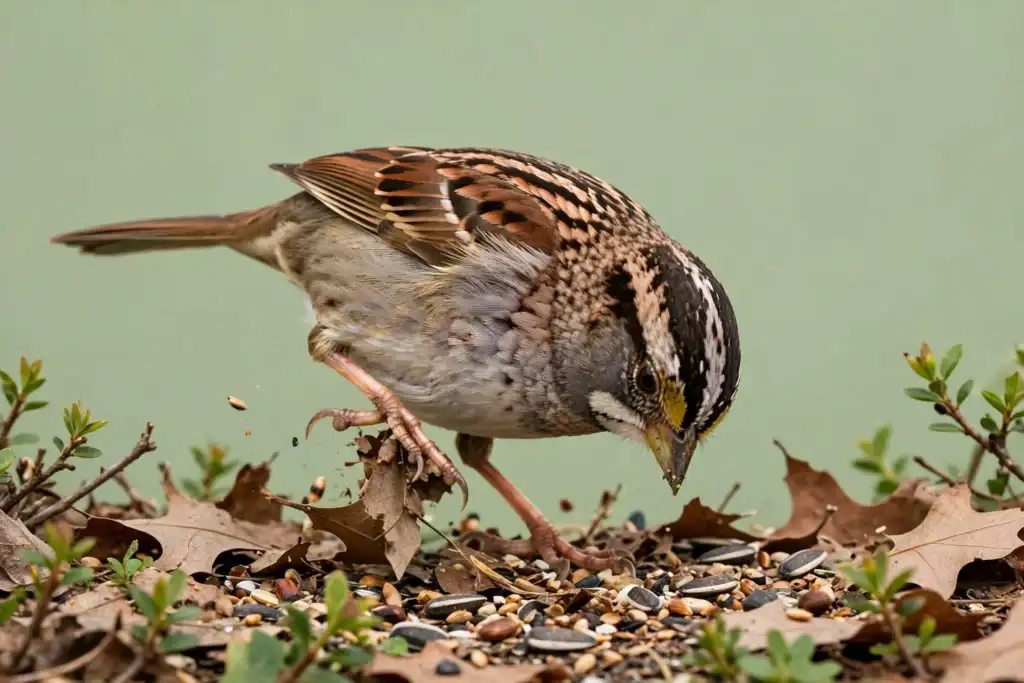
In winter, behaviour is another useful clue. White-throated sparrows forage mostly on the ground, often under or close to dense thickets. They hop forward and scratch backward in the leaf litter with both feet, a double footed kick that tosses leaves aside and exposes seeds underneath.
They also feed on low branches and in small bushes, and they visit feeders, especially for fallen seed beneath them. A sparrow that keeps returning to cover after short feeding trips, rather than feeding far out in the open, fits this species well.
The White-Throated Sparrow Song: What to Listen For
The white-throated sparrow song is a series of clear, thin, wavering whistles. Birders commonly render it as “Oh-sweet-Canada, Canada, Canada” in Canada, and as “Old-Sam-Peabody, Peabody, Peabody” in much of the United States.
Both renderings describe the same kind of song: a longer opening whistle, followed by repeated shorter whistles, usually on a similar pitch, sometimes shifting slightly up or down. The phrase is short, pure toned, and easy to pick out once you have heard it a few times.
This species sings during the breeding season, often even in the middle of the day, and it also sings on its winter range. That winter singing is a gift for backyard birders. A bird hidden in a thicket can give itself away with a single phrase, and a listener can then watch the edge of the cover for movement. Singing in winter does not mean the bird is lost or out of season. It is normal behaviour for this species, and it is one reason the song is such a reliable winter identification clue.
The song is not the only sound to learn. White-throated sparrows also give a sharp chip note, often from an alert bird on a conspicuous perch. That chip is harder to separate from other sparrow chips on its own. So treat it as supporting evidence rather than a clincher.
Researchers have also documented a newer song form in which the repeated triplets are replaced by doublets, described as sounding more like “Oh-sweet-cheery, cheery, cheery.” Regional variation is normal, so focus on the pure whistled quality and the phrasing, not on matching one mnemonic exactly.
White-Striped vs Tan-Striped: Two Looks, One Species
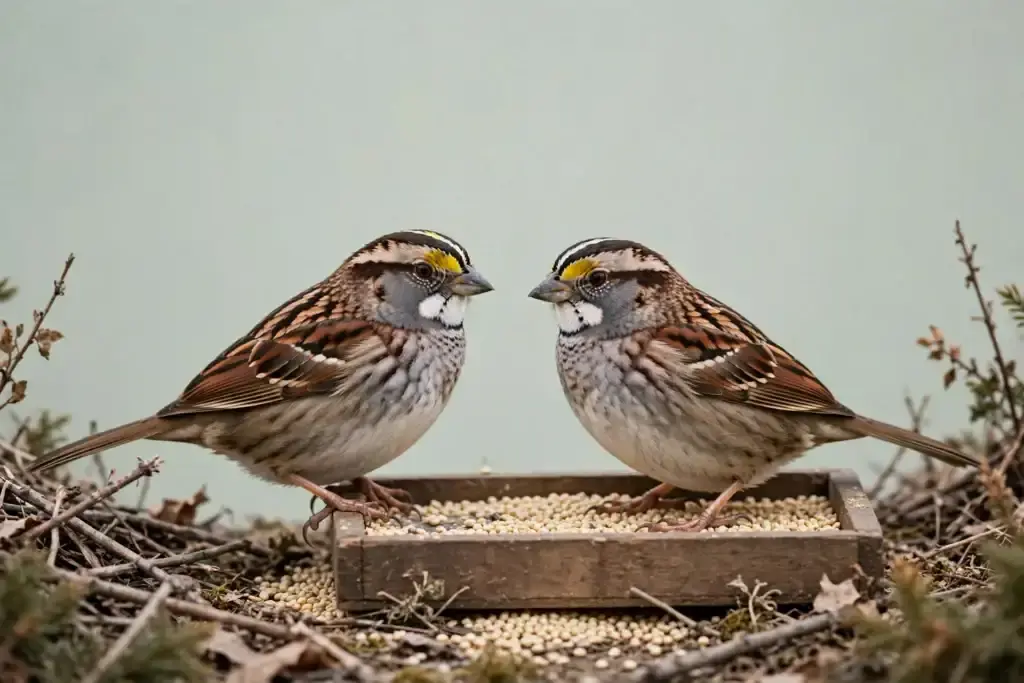
White-throated sparrows come in two colour morphs, white-striped and tan-striped. These are two plumage forms of the same species, not two species, and not two sexes. That point is worth stating plainly, because the brighter bird is often mistaken for the male and the duller bird for the female.
In fact, both males and females can be either morph. Morph does not determine sex, and a white-striped bird in your yard could be male or female, just as a tan-striped bird could be either.
The difference is in the head stripes. On a white-striped bird, the crown stripe and the stripe above the eye are bright white, set against bold black stripes, and the white throat usually looks especially clean and well defined.
On a tan-striped bird, those same stripes are tan, set against dark brown, and the overall head pattern looks softer and less contrasting. The yellow lores are present in both forms, although they can look duller on tan-striped birds. Both forms share the white throat, the brown streaked back, and the plain gray breast.
| Feature | White-striped morph | Tan-striped morph |
|---|---|---|
| Crown stripe | Bright white, bold against black | Tan, softer against dark brown |
| Stripe above the eye | Bright white | Tan |
| Overall head contrast | High, crisp | Lower, muted |
| White throat patch | Usually very clean and well defined | Present, sometimes less crisp |
| Yellow lores | Usually bright | Present, sometimes duller |
| Sex | Can be male or female | Can be male or female |
White-Throated Sparrow Winter Range in the US
White-throated sparrows breed mostly across Canada, in coniferous and mixed forests, with breeding also reaching into the northeastern United States and the northern Midwest and Great Lakes region.
They favour forest openings and edges with low, dense vegetation, including areas regrowing after logging, fire, or insect damage, and the edges of ponds, meadows, and bogs. That northern breeding range explains why so many US birders meet this species mainly as a winter bird.
In winter, white-throated sparrows are familiar across most of eastern and southern North America, and also occur in California. The winter range covers much of the eastern United States, from southern New England south through the mid-Atlantic and Southeast, and west into parts of the southern Great Plains.
They are much less common in the West overall, although a smaller wintering population occurs along the Pacific coast. If you live in the East or Southeast, a striped sparrow at a ground feeder in winter is very likely to be this species. If you live in the West, the same bird is possible but less expected, so check the marks with extra care.
Winter habitat is the key to finding them. They prefer the edges of woodlots, thickets, overgrown fields, wooded parks, suburbs, and backyards, anywhere with dense low cover close to feeding ground. A brushy hedge, a tangle of shrubs, a brush pile, or an unmown field edge can hold a flock all winter.
They are less likely to feed in a wide open lawn with no cover nearby, even if seed is present. When you search for them, work the edges: the line where shrubs meet lawn, where a woodlot meets a field, or where a garden bed meets a hedge.
White-Throated Sparrow vs Similar Sparrows
Sparrows confuse many birders, and white-throated sparrows are no exception. The table below compares this species with three birds it is most often confused with in winter. Use it as a starting point, then confirm with the full set of marks.
| Species | Throat | Head pattern | Breast | Best separator |
|---|---|---|---|---|
| White-throated sparrow | Bright white, well defined | Striped crown, yellow lores | Plain gray, unstreaked | White throat plus yellow lores together |
| White-crowned sparrow | Pale gray, not bright white | Bold black and white crown, no yellow lores | Plain gray | Gray throat and no yellow spot before the eye |
| Song sparrow | Whitish, often with a central breast spot | Brown striped crown, no yellow lores | Heavily streaked | Streaked breast and central spot |
| Dark-eyed junco | Not a throat patch bird | Plain gray or dark head, no crown stripes | Plain gray or white belly | Plain head, pink bill, white outer tail feathers in flight |
The white-crowned sparrow is the closest lookalike. It is also a large sparrow with a boldly striped head and a plain breast, and the two species can feed in the same yards.
The throat settles most cases: white-throated has a bright white throat patch, while white-crowned has a pale gray throat that blends into the breast. The yellow lores are the second check. White-throated sparrows show yellow between the eye and the bill; white-crowned do not. If both marks point the same way, you can be confident.
What White-Throated Sparrows Eat in Winter
In winter, white-throated sparrows eat mainly seeds, berries, and grasses. They take weed and grass seeds from the ground, pick berries in autumn and early winter, and add buds from shrubs and trees in early spring.
During the breeding season, the balance shifts: insects make up a much larger share of the diet, and nestlings are fed mainly on insects. That seasonal shift is typical for sparrows, and it explains why a winter feeder strategy built around seed works so well for this species.
At feeders, their favourites are millet and sunflower seed. White millet is often singled out as a top choice, and black oil sunflower is also readily taken. They will also take cracked corn and other small seeds, especially when seed falls to the ground from a hanging feeder above.
That ground feeding habit is central: even when a hanging feeder is full, many white-throated sparrows prefer to feed on the ground beneath it, picking up spilled seed in the leaf litter. A yard that offers seed only in a high tube, with bare ground below, will attract fewer of them than a yard that also offers seed at ground level.
How to Attract White-Throated Sparrows to Your Yard
Attracting white-throated sparrows starts with cover, not with seed. These birds feed close to shelter, and they retreat to thick cover when alarmed. A feeder hung in the middle of an open lawn may draw finches and chickadees, but sparrows will often hang back.
Move the feeding area, or add a second one, within a short dash of a thick shrub, a hedge, or a brush pile, and sparrows are far more likely to use it. The Cornell Lab’s backyard guidance makes the same point: a brush pile gives white-throated sparrows a place to take cover between trips out to feed.
Once cover is in place, offer the right food at the right height. Scatter white millet and sunflower seed on the ground near the shrubs, or use a low platform tray close to cover. Keep the tray low and stable, and keep it near, but not inside, the thicket, so birds can feed and still see approaching danger. Refresh seed in small amounts rather than piling up a large amount that gets wet and spoils, and clean the tray regularly.
For more on building a bird friendly yard, see the BirdsBuzz guide on how to attract birds to your backyard. For seasonal feeding detail, the BirdsBuzz guide on what to feed birds in winter covers winter foods in depth, and the guide to best bird seeds for different birds in the USA helps match seed types to the birds in your yard.
A Simple Winter Yard Setup That Works
A winter setup for white-throated sparrows does not need to be elaborate. It needs four elements, working together: cover, ground level food, fresh water, and a little undisturbed leaf litter. Start with one sheltered corner, rather than trying to change the whole yard at once. A corner with a hedge, a shrub group, or a brush pile is ideal, because it already offers the dense low cover these birds prefer.
From there, build outward in small steps:
- Cover first: keep a dense shrub, hedge, or brush pile near the feeding area, so birds can dart to safety
- Ground seed: scatter white millet and sunflower seed on the ground or in a low tray near that cover
- Leaf litter: leave a strip of leaves under the hedge instead of raking it bare, so birds can scratch for hidden seed
- Standing seed heads: leave dried flower seed heads standing until spring, as extra natural food
- Fresh water: offer a shallow bath near cover, refreshed regularly, and kept free of ice when possible
- Quiet routine: refill at similar times, move slowly near the feeding area, and keep pets away from the cover edge
Frequently Asked Questions
Are white-throated sparrows common in winter in the US?
Yes, in much of the eastern and southern United States they are common winter birds, familiar in woodlots, thickets, parks, suburbs, and backyards with dense low cover. In the West they occur in winter too, but in much smaller numbers, mainly along the Pacific coast.
How can I tell a white-throated sparrow from a white-crowned sparrow?
Check the throat and the lores together. A white-throated sparrow has a bright white throat patch and yellow between the eye and the bill. A white-crowned sparrow has a pale gray throat and no yellow lores. Those two marks together separate most birds.
Do white-striped sparrows mean male and tan-striped mean female?
No. Both males and females can be either morph, and morph does not determine sex. White-striped birds have bright white head stripes against black, while tan-striped birds have tan stripes against dark brown. Pairs are often mixed, with one bird of each morph.
What is the white-throated sparrow song?
It is a clear, thin, whistled phrase, often rendered as “Oh-sweet-Canada, Canada, Canada” or “Old-Sam-Peabody, Peabody, Peabody.” The opening whistle is longer, followed by repeated shorter whistles. The species also sings on its winter range, which makes song a useful winter clue.
What do white-throated sparrows eat at feeders?
Their feeder favourites are millet, especially white millet, and sunflower seed. They feed mainly on the ground, so seed scattered near cover, or in a low platform tray, works better than a high tube alone. They also eat spilled seed beneath hanging feeders.
Conclusion
White-throated sparrows reward a simple approach: learn a few clear marks, listen for a pure whistled song, and look in the right habitat. The bright white throat and yellow lores, the striped crown, the plain gray breast, and the ground scratching habit together make a confident identification.
Even when the bird is a softer tan-striped individual or a young bird in its first winter. The two morphs add interest without changing the identification, because both forms belong to the same species, and neither morph tells you the sex of the bird.
Their winter range across the eastern and southern United States puts them within reach of many backyard birders. Give them dense cover, ground level seed, leaf litter to scratch in, and fresh water, and they will often do the rest, arriving with mixed winter flocks and staying as long as the habitat holds. Keep the yard a little wild at the edges, listen for that clear whistle on cold mornings, and this winter sparrow can become one of the most familiar voices in your yard.
Try the winter yard setup in this article this week: pick one sheltered corner, add ground seed near cover, leave leaf litter under the hedge, and keep water available. Then read the linked BirdsBuzz guide on how to attract birds to your backyard next, and use it to build out the rest of your bird friendly yard.
Sources for species facts: Cornell Lab All About Birds, White-throated Sparrow and Smithsonian’s National Zoo, White-throated Sparrow.