
Introduction
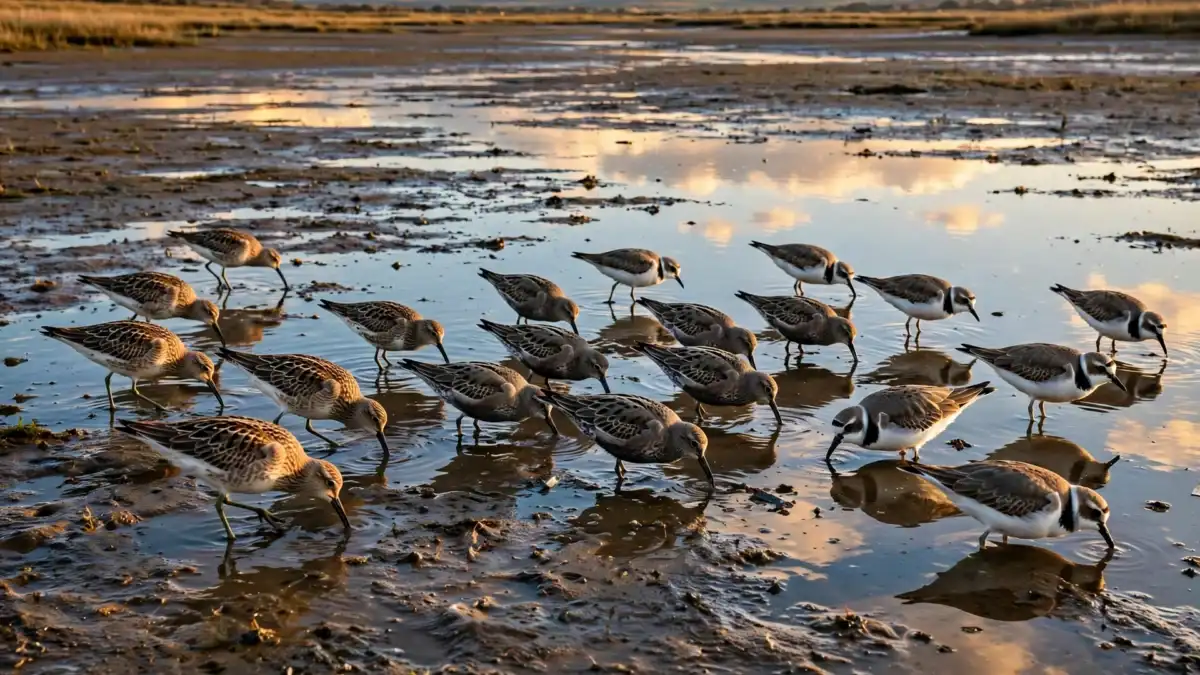
If you stand on any mudflat at low tide the most active birds will be shore birds. They are a group of small, long-legged birds which constantly move around the wet ground. They can be quite confusing at first but once you know what type of bill, legs and feeding technique they have they become easy. Shore birds include plovers, sandpipers, avocets, stilts and oystercatchers. Most of them are amazing migrants who breed in the far north and migrate to coastal areas thousands of miles away. In this guide we will cover what shore birds are, where they live, what their bills are like to suit their prey, what the most common ones are to learn and how to spot them from herons and ducks.
What Are Shorebirds?
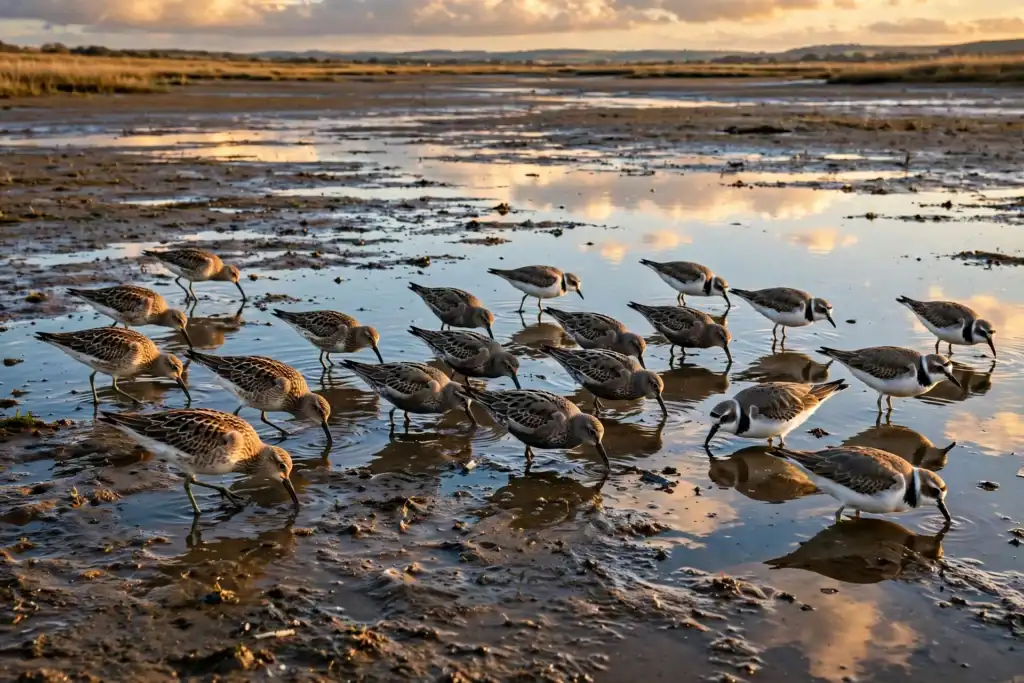
Shorebirds are part of the large order of Charadriiformes which also includes gulls and alcids. There are four families of shorebirds found in North America, and knowing these will make an otherwise confusing flock of birds easy to identify quickly.
The plovers and lapwings (family Charadriidae) are the compact, big-eyed hunters with short bills. The sandpipers and allies (family Scolopacidae) are by far the largest family, holding the tiny sandpipers called peeps, plus yellowlegs, curlews, godwits, dowitchers, turnstones, snipes, and phalaropes. The avocets and stilts (family Recurvirostridae) are the elegant long-legged waders of shallow wetlands. The oystercatchers (family Haematopodidae) are big, heavy-billed specialists of the shellfish beds.
They can be very large. The smallest shorebird in the world is the Least Sandpiper. It is about 1 ounce and 5 to 6 inches long. The largest shorebird is the Long-billed Curlew. It can measure up to 25 inches long, with a scimitar-like bill. All other shorebirds are in between these extremes.
The key thing which unites this group of birds is their lifestyle. Shorebirds feed around the shoreline using their legs to either walk or wade, and they pick or probe for animals in the mud, sand and shallow water.
Where Shore Birds Live
The classic habitat of shorebirds is the tidal mudflat. When the tide goes out, the muddy flats are exposed, teeming with worms, small clams and crustaceans. Shorebirds forage over the open ground. When the tide comes back in they fly to high tide roosting areas such as sandbars, marshes and beaches. They form dense, inactive flocks.
Sandy beaches provide another important area. The open sand provides habitat for sanderlings and little plovers. Oystercatchers patrol the shell beds and rocky shore. Salt marshes provide protected creeks and pools for yellowlegs and willets.
Many species of shorebirds can also be found inland. Sandpipers can often be seen feeding on flooded grasslands, lake shores, riverbanks, damp grasslands and sewage ponds during migration. The Spotted Sandpiper can be found around ponds, lakes and streams throughout the continent in the summer.
Breeding habitats are also varied. Many species breed on the Arctic tundra. The Long-billed Curlew breeds in short grass prairies. Avocets and stilts nest around shallow wetland areas in the West and killdeer breed in open areas nearly anywhere.
Built for the Shoreline
The bill of shorebirds can be used to determine how deep they will feed. The short thick bills of plover allow them to feed on the surface whereas medium bills can dig a few inches below the surface. Longer bills enable them to dig deeper with the curved bill of avocet, the downward-curving bill of curlew and the long bill of godwit all digging different areas.
Bill-tip feeding is a delicate process so many shorebirds feed using their sense of touch. The avocet feeds by feeling for prey. The Least Sandpiper uses surface tension on the tip of its bill to trap small prey and bring them to its mouth.
Leg length determines the depth of water an animal can feed in. Black-necked Stilts have the longest legs of any bird (excluding flamingos) in relation to their body size meaning they can walk into deeper water. Short legs mean they are restricted to shallower, drier areas.
Most have cryptic plumage. They have brown, gray and rusty mottled colors to match muddy, sandy and marshy environments. Many change their plumage between breeding season and winter so experienced birders will often identify shorebirds by their shape and behavior. Color can be used as a secondary identification feature.
Feeding Styles: Four Ways to Work a Flat
By watching how the shorebird feeds, you can often identify which group they belong to. Foraging is one of the most important clues said Kevin Karlson, an instructor at the Cornell Lab.
Probing is the sandpiper way. The small peeps walk with heads down, picking and pushing their bills into wet mud again and again. A dunlin works like a sewing machine, driving its long, droop-tipped bill into the mud in rapid stitches to feel for worms and small crustaceans.
Plovers run and stop. As they have big eyes they are visual hunters. They run for a few steps, stop and then look around. When they spot some prey on the surface, they will quickly run forward and peck. This will happen throughout the day.
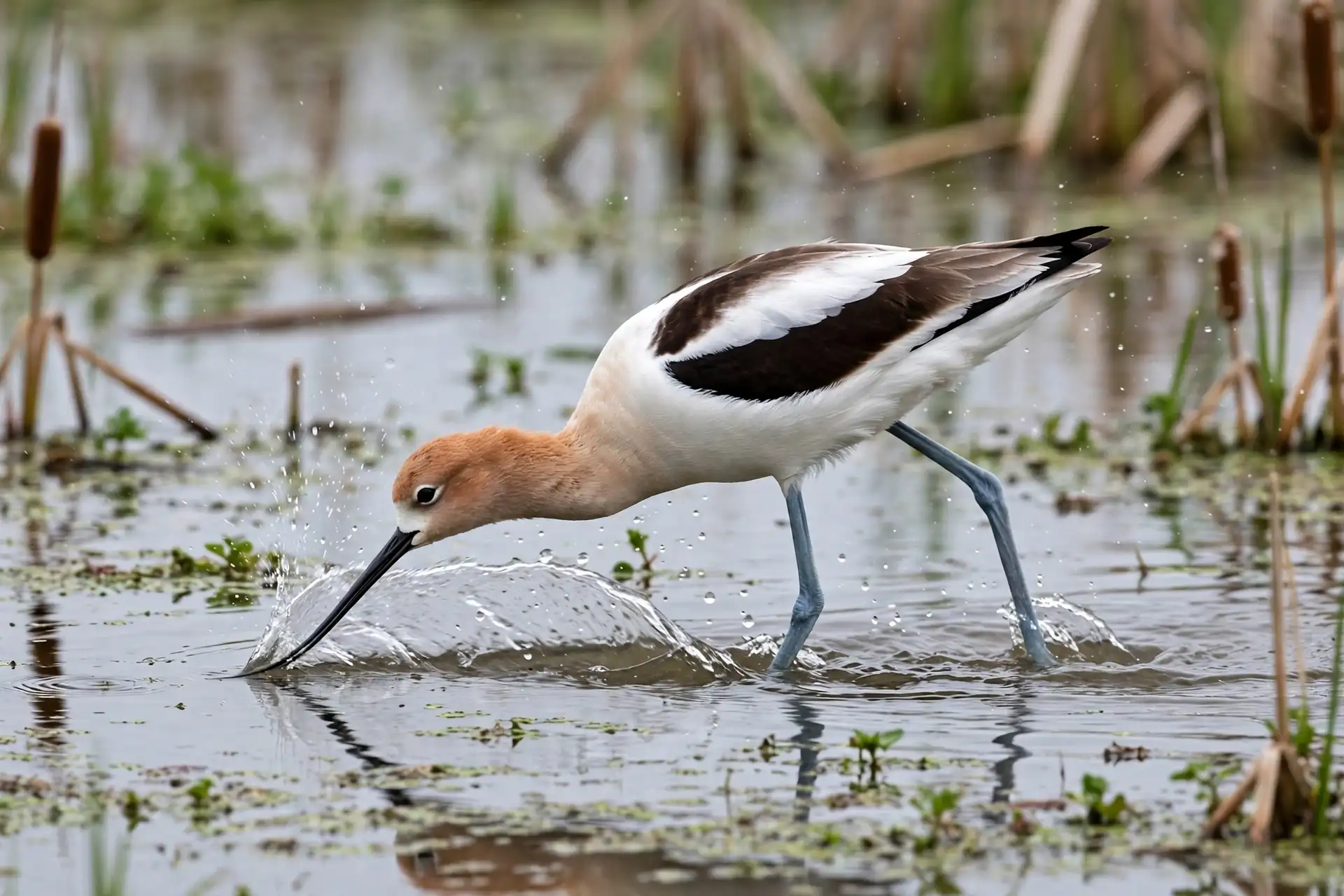
The avocet is a sweeping bird. The American Avocet walks in shallow waters and sweeps its long, curved bill from side to side just below the surface, catching small crustaceans and insects by feel.
The oystercatcher uses a combination of prying and hammering. It can poke its knife-like bill into the slightly opened shell of the bivalve to cut through the adductor muscle, or hammer a hole in the shell using its strong beak.
Yellowlegs are another style of shorebird. They walk along the shallow waters and snatch food as they go. Phalaropes completely go against the norm of shorebirds by being able to feed while swimming.
Common Shore Birds to Know
Start with these eleven species. Together they cover the main families, the main feeding styles, and the birds a beginner is most likely to meet.
Killdeer: One of the largest of the plovers (10.5 inches), the killdeer is the shorebird most familiar to most people. It has a long, thin body with the typical plover features – large round head, large eye and short bill. The long, pointed tail and wings help to distinguish it from the stockier plovers.
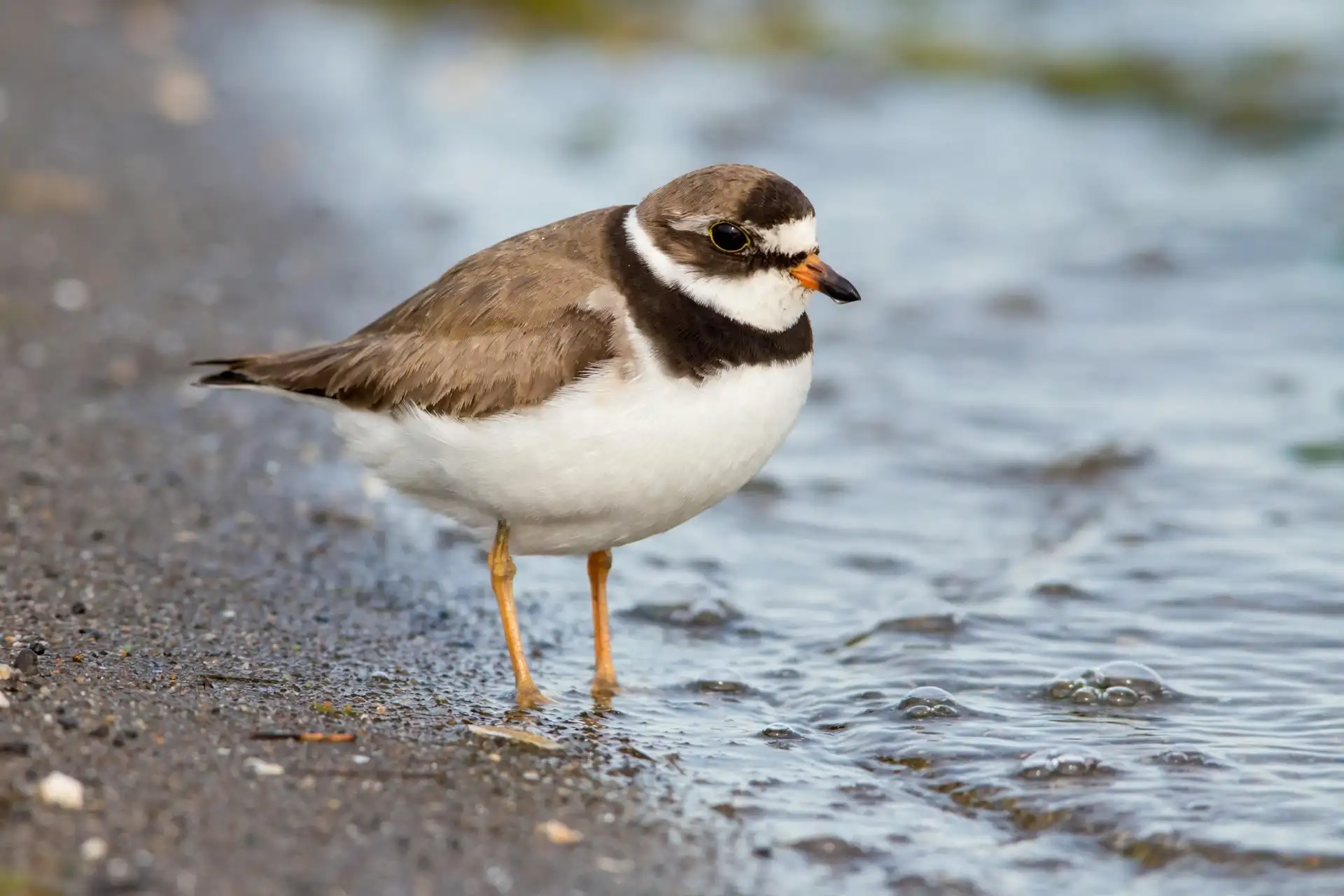
Semipalmated Plover: Small compact shorebird with short bill, rounded head, large eyes and chunky body. Found on sandy beaches and open muddy areas, this bird will be running and stopping, like a little wind-up toy.
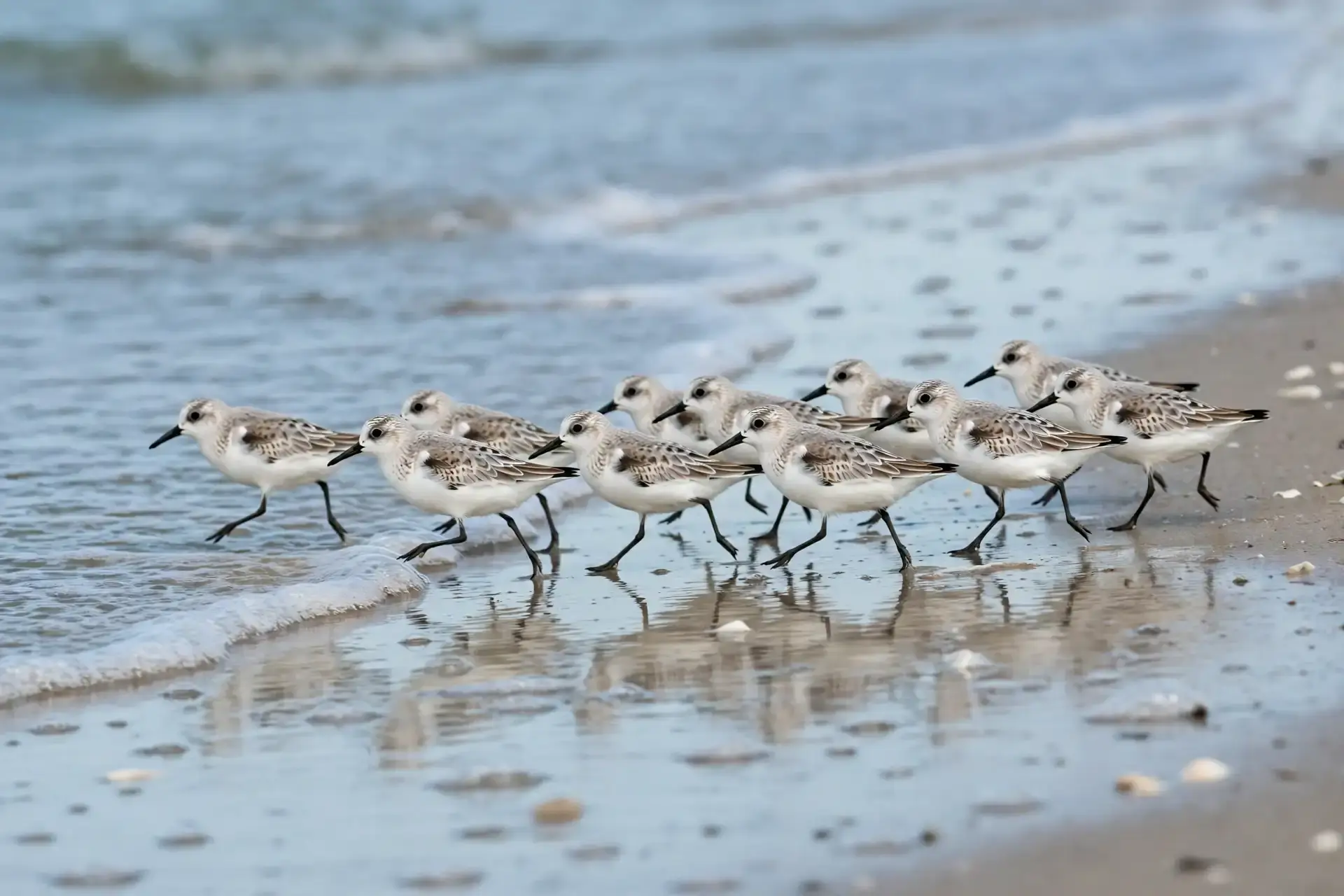
Sanderling: This small, round sandpiper has a thick bill that is about as long as its head. The sanderling has white and light gray feathers. This is the only shorebird that spends the winter along the entire U.S. coast. It dashes back and forth in the waves.
Dunlin: A wader living on muddy shores with a long, downward-curving bill. In summer they have a rusty back and striking black belly spot. In winter they are more drab with a gray-brown coloring. The best identification feature is the downward-curving bill.
Least Sandpiper: The smallest shorebird in the world. It is sparrow-sized at 5 to 6 inches. A small bird with a short downward curving bill and yellow-green legs. Often gets stained with mud. It feeds in a hunched position on the edges of mudflats and marshes.
Spotted Sandpiper: An up-and-down sandpiper. Birds have distinctive dark spots on their white chests during the breeding season. They are always walking up and down with their rumps, along the edges of ponds and streams, mostly solitary.
Willet: A large gray bird with long legs and a heavy straight bill. It is quite drab but can be identified by its size and heavy bill. Willets can be found feeding in marshes and on open coasts.
Greater Yellowlegs: A large, slender bird with long yellow legs, long neck and thick-based bill which is slightly upturned. Walks with long strides on mudflats and marshes and sometimes runs after prey. Will use a range of habitats including tidal flats and flooded fields.
American Avocet: A distinctive bird with a long slender up-curved bill. Blue gray legs, black and white body with a cinnamon head and neck in breeding plumage. Feeds by sweeping in shallow saline water.
Black-necked Stilt: Black and white birds with very long, slender pink legs and a long straight beak. Their long legs enable them to wade much deeper than most shorebirds their size. They are noisy and active birds which inhabit shallow wetlands.
American Oystercatcher: Big Atlantic coast bird with a black head, brown back and white belly and a long heavy orange-red beak. Feeds on shellfish beds at low tide by opening oysters and clams or pounding them open.
Shore Birds vs Wading Birds vs Waterfowl
Beginners often lump every long-legged bird at the water’s edge into one group, but birders draw useful lines. Herons and egrets are wading birds: much taller hunters with dagger bills, built to stand still and strike at fish in deeper water. Shorebirds are smaller, more active, and built to probe or pick in mud and shallows. For the tall hunters in full, see our heron species guide.
Waterfowl are different. Ducks and geese have broad flat bills and fully webbed feet to allow them to swim. They feed by dabbling or diving. Shorebirds rarely swim and their bills and feet are adapted for life on land. See our duck species guide for more information on the fully aquatic birds.
Migration: The Long Haul North
Shorebirds are some of the most traveled animals on Earth. Many species of shorebird live in the Arctic regions of North America during the breeding season, and travel as far as the southern regions. The Least Sandpiper migrates from the northern tundra to as far as Chile and Brazil. Some shorebirds can travel up to 22,000 miles in a year (Manomet Conservation Sciences).
Long-distance migration depends on feeding at stopover sites along the migratory route. If migrants cannot feed then they will lack the energy to breed. For example if a bird cannot feed at its stopover site it may use up all its fat stores and therefore arrive in the Arctic too weak to nest.
The red knot shows how tight the timing can be. Each May, thousands of these robin-sized sandpipers pause on Atlantic beaches during a 9,000-mile flight from Tierra del Fuego to the Canadian Arctic. At Delaware Bay they feast on horseshoe crab eggs, laid just as the birds arrive. When crab harvest crashed the egg supply in the late 1990s, the birds suffered, and the Atlantic red knot was listed as threatened under the Endangered Species Act in 2015.
Identifying Shore Birds: A Beginner’s System
Shorebirds can be tricky to identify. But with the help of the Cornell Lab’s approach, there is an easy way to identify them quickly using their structures and behaviors.
Focus on a single bird within the flock. Compare this bird to the ones around it. This will make it much easier to judge the size of the bird. Gather three pieces of evidence.
Bills are varied in shape, size, curvature and tip shape. They can be long, short; curved upward, downward or straight; and have pointed or rounded tips. Legs and necks vary in length, and some birds have stocky bodies while others have slender bodies. The way they feed helps to separate families more than their plumage. Some probe, some run and stop to peck, some walk and some sweep.
Habitat and flock form will help. A single bobbing sandpiper will be on the edge of a stream but a large swirling flock are on the mudflats. Only look at color patterns and markings last as they can look very different between spring and fall.
Threats and Conservation
Shorebird populations are in steep decline. A study co-authored by Manomet found that shorebird populations have suffered one of the steepest declines of any North American bird group. Of the 28 species studied, 26 are in decline. Since 1980, shorebird numbers have fallen by approximately one third.
Because of their stopover behavior they are vulnerable. Even if a single key area of mudflat is lost or built on, an Arctic breeding species can still suffer population decline. This is because the entire population uses just a few feeding areas. Species associated with disappearing tidal flats have suffered most.
Give feeding or resting flocks space, and do not disturb birds by chasing them. Migrating birds can become too thin to breed if they have to use energy to get away from people. If you can take dogs onto the beach, keep them on a leash and away from birds. (Audubon)
Recovery is possible. Targeted work on the American Oystercatcher has lifted its East Coast population by 45 percent, a result Manomet points to as proof that focused protection works.
Shore Bird Comparison Table
| Bird | Bill | Where to Look | Key Identification Mark |
|---|---|---|---|
| Killdeer | Short and stout | Open shores, mudflats, fields | Large round head and big eye; long, pointed tail |
| Semipalmated Plover | Short and stubby | Sandy beaches, mudflats | Plump body, round head, large eyes |
| Sanderling | Stout, about head length | Ocean beaches at the surf line | Runs back and forth with the waves; pale in winter |
| Dunlin | Long, drooping at the tip | Mudflats, estuaries | Black belly patch in breeding plumage |
| Least Sandpiper | Thin, slightly downcurved | Mudflat and marsh edges | Tiny size; yellow-green legs |
| Greater Yellowlegs | Thick-based, slightly upturned | Marshes, tidal flats, flooded fields | Very long yellow legs; high-stepping walk |
| American Avocet | Long, thin, upcurved | Shallow wetlands, salt ponds | Sweeps bill side to side; cinnamon head in breeding season |
| American Oystercatcher | Long, stout, red-orange | Atlantic beaches, shellfish beds | Black head, white belly, heavy red-orange bill |
Frequently Asked Questions
What is the difference between a shorebird and a wading bird?
Shorebirds are small birds which actively feed by pecking and prodding. Wading birds such as herons and egrets are much larger. They are very still and have long, knife-like beaks to catch fish in deeper water. Shorebirds rarely stop moving and are always walking and feeding.
What do shore birds eat?
Mostly small invertebrates such as worms, small clams and snails, crustaceans and insects and their larvae. Each species eats whatever it can catch with its bill. Plovers catch insects on the surface whereas curlews dig up deep-burrowing shrimp.
Why do shorebirds have so many different bill shapes?
Bill shape matches feeding depth. Short bills skim the surface to feed, medium bills probe into shallow mud, and long bills dig down to feed. Two species can feed together on one flat without much competition as they feed from different depths.
What is the smallest shorebird in the world?
The Least Sandpiper. Cornell Lab lists it at about 1 ounce and 5 to 6 inches long, roughly sparrow-sized. Its yellow-green legs and slightly downcurved bill separate it from the other tiny sandpipers, called peeps.
Do shorebirds swim?
Most do not. Shorebirds feed by walking and wading, and their long legs are built for it. Phalaropes are the exception: they feed while swimming on open water, picking prey from the surface.
When is the best time to see migrating shorebirds?
Spring passage runs mainly through April and May, and fall passage begins as early as July and stretches into October. Visit a mudflat or estuary at low tide during those windows, when feeding flocks concentrate on exposed ground.
Why do sanderlings chase waves?
The waves do the hard work. As they recede, tiny crustaceans and worms are exposed in the damp sand. The sanderling dashes in, grabs a mouthful, and dashes out again.
How can I help shorebirds?
Allow feeding and resting flocks to be undisturbed by giving them space. Never deliberately disturb them. Dogs must be kept on leashes and away from the birds on beaches where dogs are permitted. Helping to protect stopover wetlands and estuaries will help the whole migration chain.
Conclusion
Shore birds are a great group to look at. There are several different specialists here with bills adapted to feed from different layers within the same mudflat. Many of these birds have just completed a journey spanning two continents. You should learn the four families and the bills/feeding techniques before focusing on the coloring. Start with the 11 common species above and next time there is a low tide everything will make more sense.
Sources
- https://academy.allaboutbirds.org/sample-lesson-shorebird-identification/
- https://www.allaboutbirds.org/guide/Greater_Yellowlegs/id
- https://www.audubon.org/news/saving-red-knots-one-crab-time?nid=6346&origin=public-policy&site=ct
- https://www.manomet.org/noboundaries/
- https://www.manomet.org/publication/statement/