Introduction
Owl sounds are the soundtrack of the night woods, and they are stranger than most people expect. Only some owls hoot. Others screech, whinny, bark, or hiss, and one famous species named for screeching never screeches at all. Each owl sound carries a message about territory, courtship, or alarm, and most owls are far easier to hear than to see. Learn the voices in this guide and a walk after dark becomes a roll call: you can name the owls around you without ever spotting one.
Why Owls Call
Most owls are nocturnal, and darkness changes how a bird communicates. A display of feathers that works at noon is invisible at midnight, so owls rely on sound. Calling lets an owl stake out a hunting territory, attract a mate, and stay in contact with its partner and young, all without being seen.
Sound also suits the night itself. After dark the air is often still, the insect chorus fades as temperatures drop, and a deep hoot can carry a long way through quiet woods. Owls call most in the breeding season, when territories are being claimed and pairs are forming. Many species start courtship calling in late winter, weeks before eggs are laid.
Young owls have their own sounds. Nestlings and fledglings beg with hisses, squeaks, and rasps that tell parents where they are and how hungry they are. Adults answer intruders with alarm barks and bill snapping. A hoot, then, is only one entry in a whole vocabulary, which is why this guide covers more than hooting. If you want the deep dive on hooting itself, including why owls hoot at night, our guide on why do owls hoot at night goes further.
Great Horned Owl: The Classic Hoot
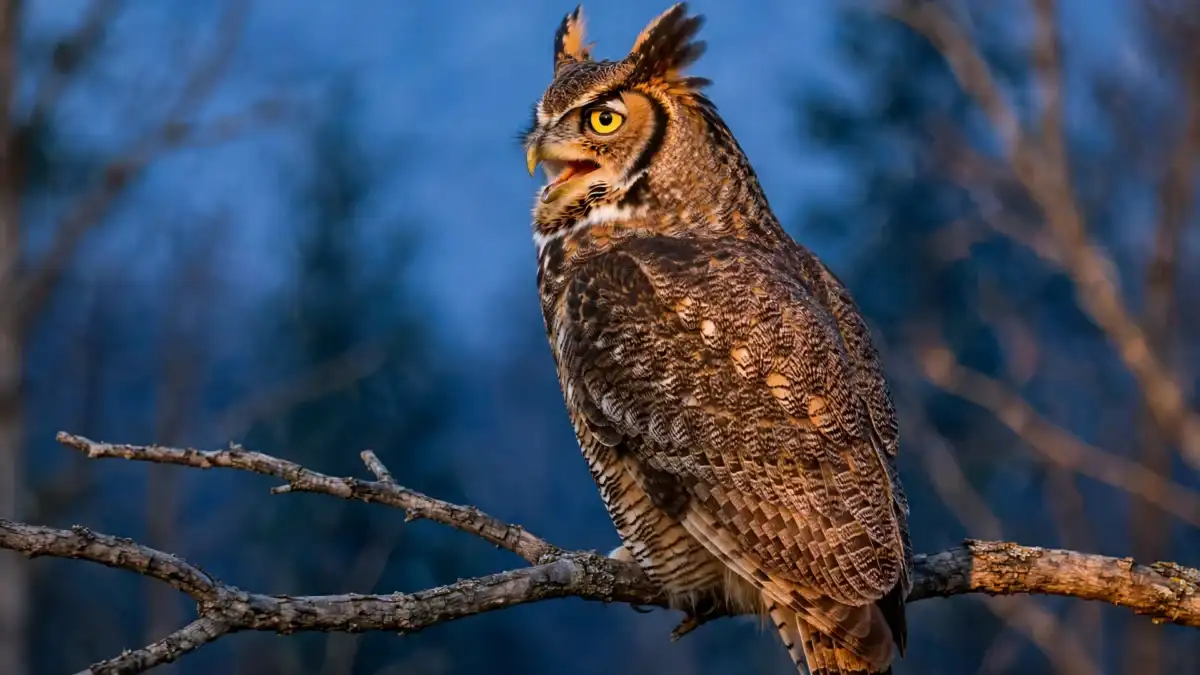
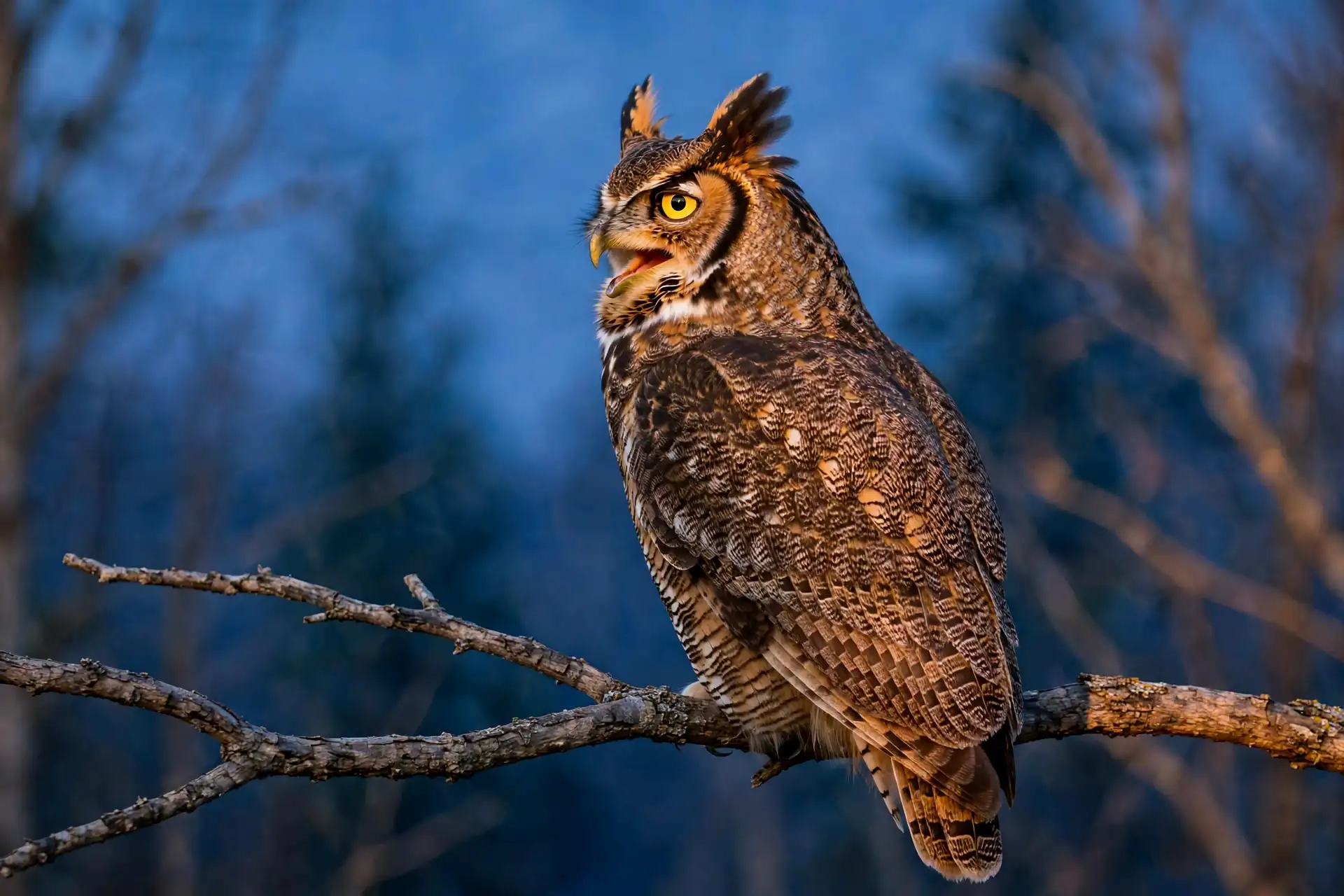
The great horned owl owns the hoot most people imagine. The Cornell Lab of Ornithology describes its advertising call as a deep, soft stuttering series of hoots with a variable rhythm: hoo-h’HOO-hoo-hoo. A territorial male delivers this from a high perch, often a dead tree or rooftop, beginning at dusk and sometimes continuing deep into the night.
Males typically sing four or five hoots in a series, while females sing six to eight. Oddly, the female’s hoots are higher pitched than the male’s, even though she is the larger bird. When a mated pair duets, the two rhythms interleave, and the size difference between their voices is easy to hear.
Beyond the hoot, this species has a busy repertoire. Females give a contact call while sitting on eggs so the male knows where to deliver food. Both sexes bark, grunt, and shriek when the nest is threatened, and nestlings beg with raspy screeches. If you hear the classic hoot in North America, this is almost certainly your bird.
Barred Owl: Who Cooks for You?

If one owl call is famous, it is this one. The barred owl’s rich, ringing hoot is the call birders remember with the mnemonic “Who cooks for you? Who cooks for you-all?” The phrase is not a rough guide. It matches the rhythm and cadence of the call so closely that hearing it once is usually enough to know the bird for life.
Barred owls are among the most vocal owls in North America. Mated pairs duet in a wild exchange birders call caterwauling: hoots, cackles, and gurgles traded back and forth until the woods sound crowded with owls. The species also gives a drawn out ascending hoot that ends with a vibrato flourish.
Unlike most owls, barred owls sometimes call in broad daylight, and they often answer people who imitate the call. That willingness makes them one of the easiest owls to meet by ear. They favor mature forest near water, and their population has spread across North America, reaching the Pacific Northwest in recent decades.
Eastern Screech-Owl: A Whinny, Not a Screech

Here is the guide’s first surprise. Despite its name, the eastern screech-owl does not screech. Its two main calls are a descending whinny, a soft horse-like neigh that drops in pitch, and an even pitched monotone trill lasting about three to five seconds.
Cornell describes the whinny as a territorial call, often given in late summer. The trill works differently: family groups and mates use it to stay in touch. A single bird may also combine the two, whinnying first and trilling after, and pairs sometimes duet with both calls woven together.
This small owl, no bigger than a robin, lives in woodlands, orchards, and suburban parks across eastern North America. It comes in two color forms, gray and reddish, and it nests in tree cavities and nest boxes. Listen for the whinny on calm late summer and autumn evenings, when this little owl is most talkative.
Barn Owl: The Screech That Never Hoots
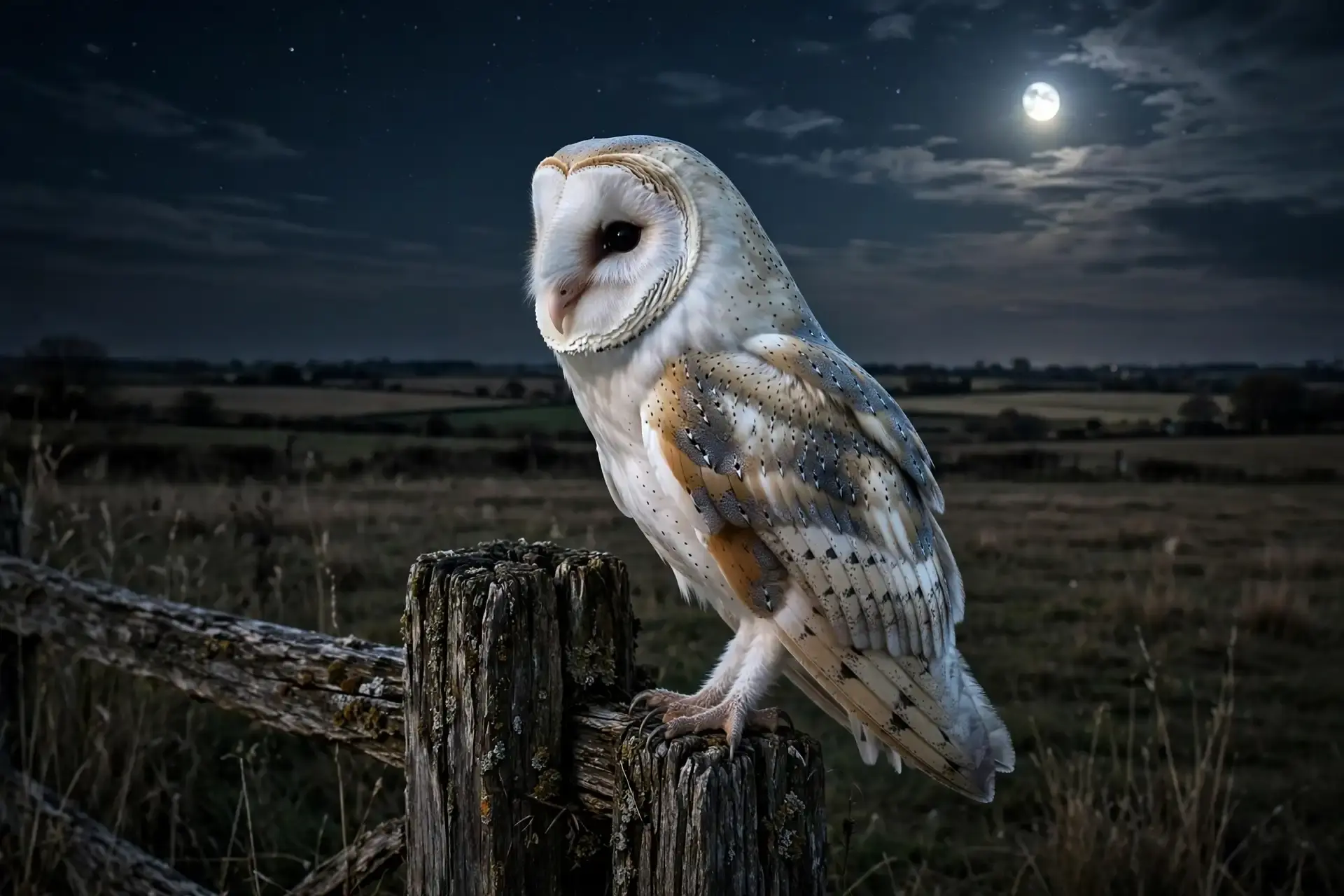
The barn owl breaks the other rule. It does not hoot at all. Its signature call is a harsh, rasping screech, a drawn out shriek that sounds nothing like the soft hoots of the forest owls. A listener caught off guard in a dark barn or churchyard could easily mistake it for something supernatural, which is how the species earned its ghostly reputation.
Barn owls are birds of open country: farmland, marshes, and grassland, nesting in barns, silos, hollow trees, and nest boxes. They hunt almost entirely by sound, flying low over fields and listening for rodents in the grass below. Their heart shaped face funnels sound to their ears, and they can locate prey in total darkness by hearing alone.
The screech is a contact and advertising call. Nestlings beg with hisses and snores, adults hiss when cornered, and both sexes use softer twittering calls around the nest. If you hear a screech over open fields at night, think barn owl first.
More Owl Voices
Snowy Owl
The snowy owl is a bird of the open tundra, and away from its breeding grounds it is virtually silent. On the tundra, males give deep, powerful hoots that Cornell reports can carry for miles across the flat ground, along with gruff barks, cackles, and whistles. Females answer more softly, and both sexes hiss when the nest is threatened. Winter visitors far to the south are usually quiet, so a snowy owl is one owl you will almost certainly see before you hear.
Burrowing Owl
The burrowing owl is a small, long legged owl of open ground, and it is unusually active in daylight. Its main call is a soft two note coo-cooo, given mostly by males during courtship and near the burrow. Around the burrow the species is talkative, with around seventeen different vocalization types documented. The most famous is the young owl’s alarm call, a dry rasp that mimics a rattlesnake so closely that ground squirrels and other burrow neighbors take it seriously.
Northern Saw-whet Owl
The northern saw-whet owl is one of the smallest owls in North America, and its name is a clue to its voice. The male’s advertising call is a series of clear whistled toots, too-too-too, repeated steadily for minutes at a time. Cornell notes that this call is a common evening sound from January through May, during the courtship season. The name saw-whet is usually explained by the call’s resemblance to a saw being sharpened on a whetstone.
Owl Sounds at a Glance
| Owl | Main sounds | Best time to listen |
|---|---|---|
| Great Horned Owl | Deep stuttering hoots, barks, grunts | Dusk and night, late fall to early spring |
| Barred Owl | “Who cooks for you? Who cooks for you-all?” hoots, caterwauling duets | Year-round, sometimes even by day |
| Eastern Screech-Owl | Descending whinny, monotone trill | Calm evenings, late summer and fall |
| Barn Owl | Harsh rasping screech, hisses | Night over farmland and marshes |
| Snowy Owl | Deep hoots, barks, cackles on the tundra | Breeding season on Arctic tundra |
| Burrowing Owl | Soft coo-cooo, rattlesnake-mimic rasp | Daytime and dusk near burrows |
| Northern Saw-whet Owl | Repeated whistled too-too-too | Evenings, January through May |
How to Listen for Owls
Listening for owls is a skill, and a few habits sharpen it quickly. Go out on calm, dry nights, because wind and rain muffle calls and owls call less in bad weather. Start at dusk, when great horned and barred owls often begin, and give each spot ten quiet minutes before moving on.
Learn one call at a time. The barred owl’s question and the great horned owl’s stuttering hoot cover a large share of what most listeners will ever hear, and both are distinctive enough to learn from a recording in one sitting. Free apps and the Cornell Lab’s Macaulay Library hold reference recordings of every species in this guide.
Watch for pellets and whitewash under roost trees as daylight evidence of a listening spot. Our guide to owl pellets shows what regurgitated pellets reveal about an owl’s meals and where to find them.
Keep ethics ahead of curiosity. Use recordings sparingly, if at all, because playback can pull an owl off its territory or away from its nest, and never use it with rare or nesting birds. Stay on paths, keep lights low and brief, and let the owls come to you. If you want owls as regular neighbors, our guide on how to attract owls covers nest boxes and habitat.
Frequently Asked Questions
Why do owls make sounds at night?
Owls are mostly nocturnal, so sound is their main way to communicate after dark. A call carries through dark woods where a visual display would be lost, and the quiet night air lets it travel far. Most calling is about territory and courtship: claiming a hunting area, attracting a mate, and keeping contact with a partner and young.
Which owl hoots “Who cooks for you?”
The barred owl. Its rich, ringing hoot follows the rhythm of the phrase “Who cooks for you? Who cooks for you-all?” so closely that the mnemonic is famous among birders. Mated pairs often answer each other in a noisy duet of hoots, cackles, and gurgles called caterwauling.
Do all owls hoot?
No. Hoots are the specialty of the larger forest owls such as the great horned owl and barred owl. The barn owl screeches and never hoots, the eastern screech-owl whinnies and trills instead of screeching, and the burrowing owl coos. Each species has its own vocabulary, and several of the famous names are misleading.
What does a barn owl sound like?
A harsh, rasping screech, drawn out and eerie, with no hooting at all. Barn owls also hiss when threatened and make softer twittering calls near the nest, while nestlings beg with hisses and snores. Over open farmland at night, that screech is one of the most recognizable owl sounds there is.
Why is it called a screech-owl if it does not screech?
The name is a historical accident that stuck. The eastern screech-owl’s real calls are a descending whinny and an even monotone trill, nothing like a screech. Early naming often lumped small owls together, and the misleading name survived long after the bird’s actual voice was understood.
When is the best time to hear owls?
Late winter and early spring, when courtship calling peaks for many species, and the first hours after dusk on a calm night. Great horned owls start calling in late fall and winter, barred owls call year-round, and saw-whet owls sing from January through May. Summer nights are quieter, once young are raised and territories settle.
What should I do if I hear an owl near my home?
Enjoy it, and keep your distance. Owls near houses are usually hunting rodents or holding a territory that includes your yard. Listen from a window or a quiet spot outside, avoid shining bright lights at the bird, and never try to feed it. If you hear begging young, leave the area so the parents can feed them in peace.
How can I tell owl sounds apart?
Start with the two most common patterns: the great horned owl’s deep stuttering hoot and the barred owl’s “Who cooks for you?” Then add the barn owl’s screech and the screech-owl’s whinny, which are distinctive once heard. Compare what you hear with recordings, learn one call at a time, and note the habitat and season, because both narrow the choices quickly.
Conclusion
Hoots are only the beginning. Every owl has a voice of its own, from the barred owl’s famous question to the barn owl’s ghostly screech and the saw-whet’s steady tooting. Learn the seven voices in this guide and the night stops being silent: it becomes a conversation you can finally follow.
Sources and Further Reading
- Great Horned Owl: Sounds, All About Birds, Cornell Lab of Ornithology
- Barred Owl: Sounds, All About Birds, Cornell Lab of Ornithology
- Eastern Screech-Owl: Sounds, All About Birds, Cornell Lab of Ornithology
- American Barn Owl: Identification, All About Birds, Cornell Lab of Ornithology
- Snowy Owl: Sounds, All About Birds, Cornell Lab of Ornithology
- Burrowing Owl: Sounds, All About Birds, Cornell Lab of Ornithology
- Northern Saw-whet Owl: Sounds, All About Birds, Cornell Lab of Ornithology
- Snowy Owl, Audubon Field Guide
- Burrowing Owl, Audubon Field Guide