
Introduction
If you ask a birdwatcher in Ohio, an amateur gardener in London and a tramp in New Zealand to show you a robin, you will get three completely different birds. As British colonists spread across the world, they named many small birds with red/orange chests as robins. This guide has grouped the world’s robin species into 3 families. Find out more about these robins from North American lawns to an island in New Zealand where a species was saved from just 5 individuals.
One Name, Three Families
The original robin is a small European bird, and for centuries the name belonged to it alone. When English speaking settlers reached North America, Australia, and New Zealand, they met red breasted birds they had never seen before and reached for the name they knew. The result is a naming tangle that only makes sense once you look at the family tree.
The term ‘robin’ is not an official classification and so there is no official list of robin species. Instead, it is a common name given to describe the small body shape and reddish breast of these birds. As a result 3 different families have taken on this name.
True thrushes (Turdidae): The American robin is a genuine thrush, a member of the genus Turdus alongside the song thrush and the Eurasian blackbird. If you want the wider clan in one place, our guide to thrush species covers its relatives around the world.
Old World flycatchers and chats (Muscicapidae): The European robin, along with the robins of Asia and the robin-chats of Africa is in this family. It was previously included in the thrush family, but genetic evidence has shown it belongs in the flycatcher family. It is in the subfamily chats, and closely related to nightingales.
Australasian robins (Petroicidae): This family of robins is only found in Australia, New Guinea, New Zealand and the Pacific Islands. They are not closely related to either of the previous groups. The red breast has evolved independently.
That shared red breast is a coincidence of plumage, not a sign of kinship. Once you know which family a robin belongs to, the rest of its story, its size, its song, and its habits, falls into place.
The American Robin
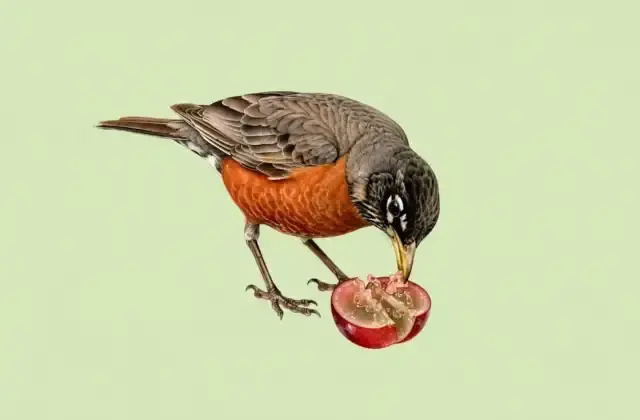
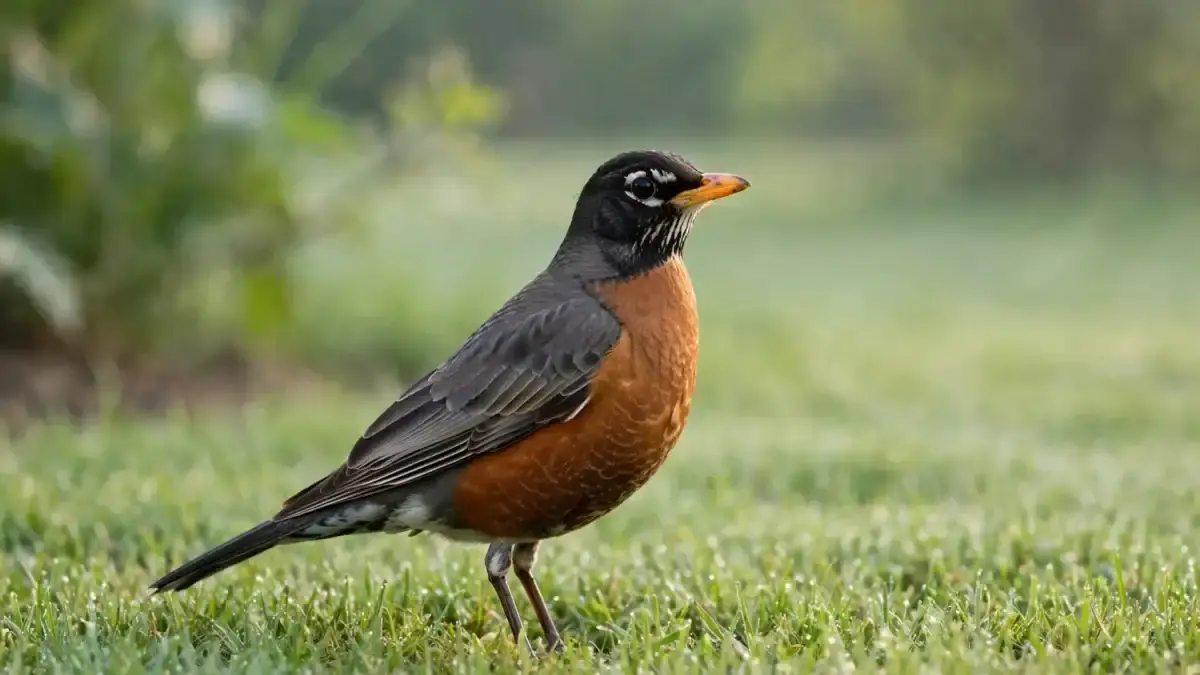
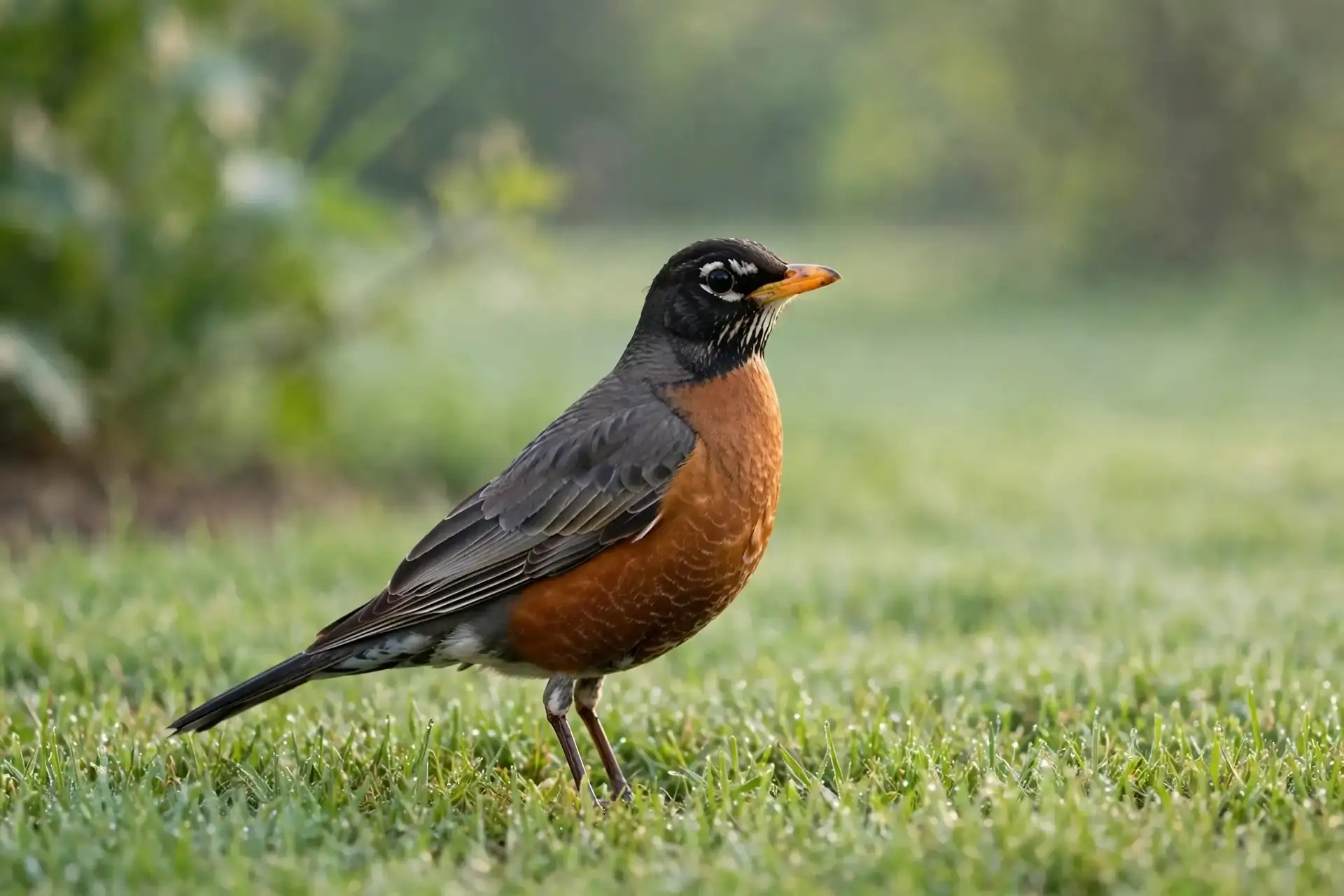
The american robin (Turdus migratorius) is the bird most North Americans picture at the word robin. It is a big, upright thrush with a gray brown back, a darker head, a white streaked throat, and a brick red breast. Linnaeus described it in 1766, and even its scientific name tells a story: Turdus is Latin for thrush, and migratorius points to its wandering habits.
Cornell Lab of Ornithology calls it the largest North American thrush, and a useful reference point for the size and shape of thrushes in general. It measures 7.9 to 11.0 inches (20 to 28 cm) long, weighs 2.7 to 3.0 ounces (77 to 85 g), and spans 12.2 to 15.8 inches (31 to 40 cm) across the wings.
This species is extremely numerous. In 2019, Partners in Flight estimated there to be 370 million individual American robins, making it the most numerous terrestrial bird in North America. There are seven subspecies, ranging from dark individuals in Newfoundland to pale individuals in an isolated population in the Sierra de la Laguna mountains of Baja California.
On a lawn, the robin hunts in a pattern anyone can watch: a run of short, rapid steps, a pause, a tilt of the head, then a lunge. Cornell describes how it runs on the ground, pausing frequently to scan, and uses its bill to probe the soil and pull out earthworms. Despite the old idea that the bird is listening for worms underground, the head tilt is about looking, and our guide to how do robins find worms explains the evidence.
Robins have varied diets according to the season. During spring and summer they eat invertebrates (earthworms, beetle larvae and caterpillars). During fall and winter they feed on fruit and berries. Large flocks form at this time of year, and the birds roost together at night in thick cover.
Northern robins are migrants. Birds that breed in Alaska, Canada, and the northern United States move south for the winter, some traveling as far as central Mexico, while many robins farther south stay in place all year. Our guide to do robins migrate maps the pattern in detail.
The species carries cultural weight too. It is the state bird of Connecticut, Michigan, and Wisconsin, one of the earliest singers in the dawn chorus, and the bird whose pale blue eggs gave the English language the color name robin’s egg blue.
The European Robin
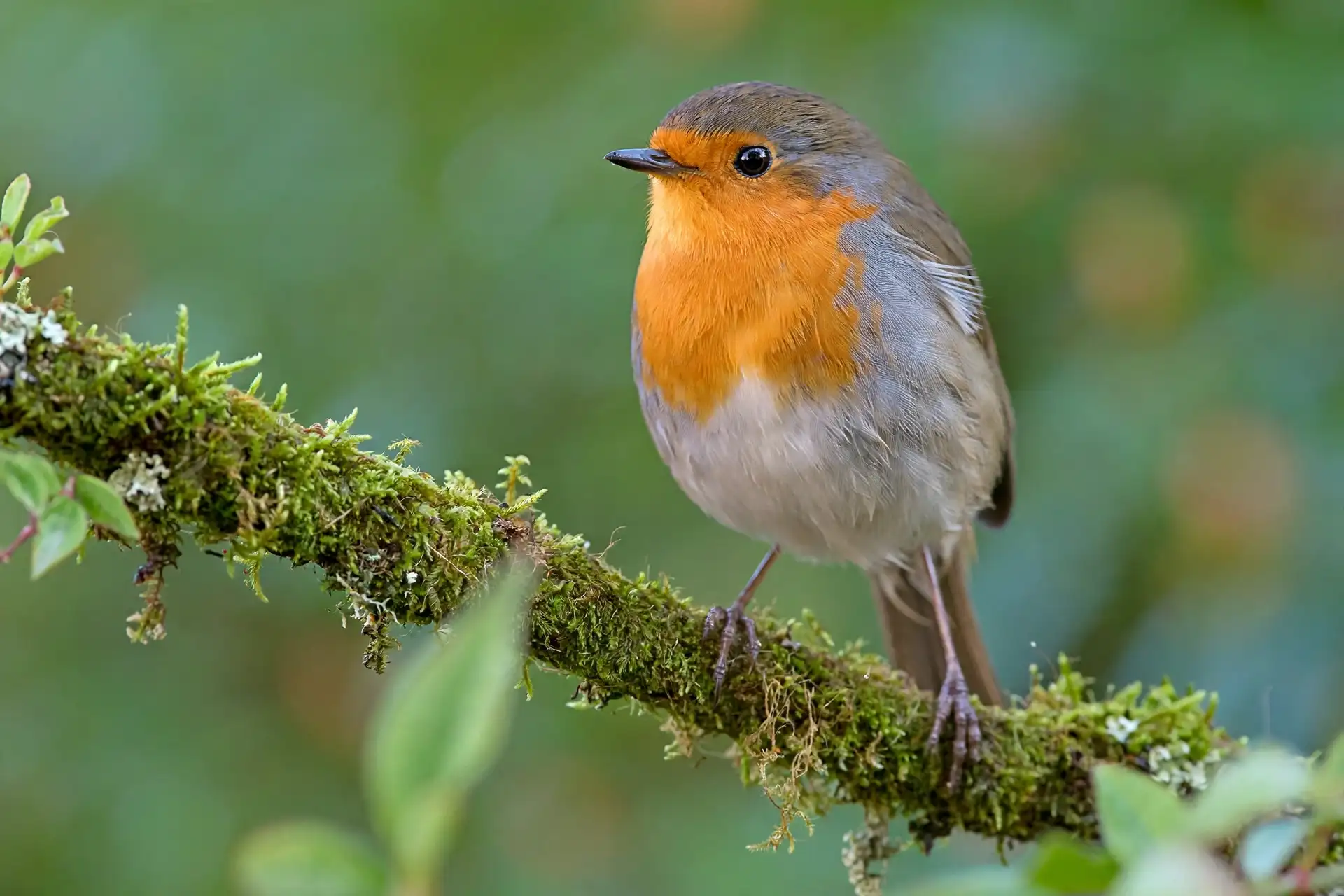
The European robin (Erithacus rubecula) is the bird that started the name. It is a small, round bodied bird, just 12.5 to 14.0 cm (about 5 inches) long, with brown upperparts, a whitish belly, and a face and breast of clear orange red edged with gray.
Males and females look identical, which is unusual among the world’s robins. In most other red breasted species in this guide, the bright colors belong to the male alone, and the female wears a quieter version of the pattern.
Its range covers Europe east to western Siberia and south to North Africa. Most populations are sedentary, holding the same territory through the whole year, and only birds in the far north move away from the harshest winter weather.
Taxonomically, this is a chat, not a thrush. Linnaeus described it in 1758, and for two centuries it sat in the thrush family, which is why older books call it a small thrush. Modern classification places the genus Erithacus in Muscicapidae, the Old World flycatcher family, in the subfamily that also holds the nightingales. Erithacus now holds this single species, since its former Asian relatives were moved into other genera such as Larvivora.
In Britain and Ireland it is simply the robin, a fixture of gardens, woodland edges, and Christmas cards. Voters chose it as the unofficial national bird of the United Kingdom in a poll publicized by The Times in the 1960s, and it won the title again in a 2015 public vote, taking 34 percent of the ballot.
Robins of Asia

Asia holds a rich set of robins, and every one of them belongs to Muscicapidae, the same family as the European robin. Most are forest or scrub birds in the chats group, several are celebrated singers, and a few are so tied to one island chain that they are found nowhere else.
The Japanese robin (Larvivora akahige) is a shy bird of shaded forest floors in Japan. The male wears an orange head and breast over gray upperparts, and the species is one of Japan’s most admired songbirds, long prized for its clear, ringing voice.
Its close relative, the Ryukyu robin (Larvivora komadori), lives only in Japan’s Ryukyu Islands. The male is patterned in red and black, a striking bird of the island forests, and the species is classed as near threatened because its world range is so small.
The Indian robin (Copsychus fulicatus) is a bird of dry scrub, gardens, and village edges across the Indian subcontinent. The male is dark with a white wing patch and a chestnut vent, and it often cocks its tail upright as it hops over open ground in search of insects.
The Oriental magpie-robin (Copsychus saularis) is the most musical of the group. Glossy black and white, with a long tail that it cocks and fans as it sings, it performs from rooftops and garden posts across South and Southeast Asia. It is the national bird of Bangladesh.
At the western edge of Asia, the white-throated robin (Irania gutturalis) breeds on rocky slopes from Turkey to Central Asia and winters in East Africa. The male pairs a clean white throat with a black face and orange flanks, and it is the only species in its genus.
Africa adds one more branch to the family: the robin-chats of the genus Cossypha, bold patterned birds of forest and garden that sing rich duets. They complete the Old World picture, a whole hemisphere of robins that belong to the flycatcher family, not the thrushes.
Robins of Australasia

Cross into Australia, New Guinea, New Zealand, and the Pacific, and the robins change family entirely. The Australasian robins form Petroicidae, a family of around 50 species found nowhere else on Earth, reaching across the Pacific as far east as Samoa.
The best known genus is Petroica, named for the red and pink markings of many of its members. These are small, plump, big headed birds that typically hunt from a low perch, dropping to the ground to seize insects, spiders, and other small prey.
The scarlet robin (Petroica boodang) lives in woodland across southern and eastern Australia, including Tasmania. The male is jet black above with a scarlet breast, a white belly, and a bold white patch on the forehead, while the female is gray brown with a wash of red.
The flame robin (Petroica phoenicea) has a distinct altitudinal migration across southeastern Australia (including Tasmania). Individuals breed in forested habitats in upland areas during summer and migrate to open habitat in lowlands during winter. One of only a few migratory robins in Australia.
The Pacific robin (Petroica pusilla) carries the family out across the ocean. It lives on islands in Melanesia and Polynesia, and it was treated as the same species as the scarlet robin until taxonomists split the two in 1999, a sign of how similar these island and mainland cousins look.
Not every member of the family is red. Petroicidae also includes yellow robins, pink robins, and plain gray and brown species, which is why scientists treat the family name, not the breast color, as the real definition of an Australasian robin.
Island Robins and the Black Robin Comeback
Island robins live dangerously. Small ranges and introduced predators have pushed several species toward extinction, and none went closer to the edge than the black robin of the Chatham Islands, an archipelago that lies about 800 km (500 miles) east of New Zealand.
The black robin (Petroica traversi), called karure by the Moriori people, was once spread across the Chatham Islands. Cats and rats destroyed it on island after island, and by the early 1970s only 18 birds remained, all on tiny Little Mangere Island. The survivors were moved to nearby Mangere Island, but the numbers kept falling.
In 1980, just five black robins were left alive, and only one of them was a fertile female. The conservation team named her Old Blue. Her mate was Old Yellow, and every black robin alive today descends from that single pair, one of the tightest genetic bottlenecks of any bird that has survived.
The rescue, led by Don Merton of the New Zealand Wildlife Service, used a technique called cross-fostering. The team took the first clutch of eggs from each robin pair and placed them in the nests of the Chatham Island tomtit, a close relative. The tomtits raised those chicks, and the robins, having lost their eggs, laid a second clutch and raised that brood themselves, doubling the output of every pair.
This has been very successful. As of 2013 there were over 250 black robins, and by 2026 there were approximately 390 black robins distributed between Mangere Island and Rangatira (South East Island). Although the black robins are not out of danger, as all individuals share Old Blue’s genes, and all individuals still live on just two small islands, they are an example of what can be achieved with determined conservation.
Other island robins tell the same story in miniature. The Norfolk robin (Petroica multicolor) of Norfolk Island was recognized as its own species in 2015, split from the Pacific robin, a reminder that island populations often turn out to be distinct species once scientists look closely.
Robin Species at a Glance
The table below lines up ten of the best known robin species with the region they call home, the family they truly belong to, and the trait that makes each one memorable.
| Species | Region | Family | Notable trait |
|---|---|---|---|
| American robin (Turdus migratorius) | North America | Turdidae | Largest North American thrush, with about 370 million birds |
| European robin (Erithacus rubecula) | Europe to western Siberia and North Africa | Muscicapidae | The original robin, and Britain’s unofficial national bird |
| Japanese robin (Larvivora akahige) | Japan | Muscicapidae | Celebrated songster of shaded forest floors |
| Ryukyu robin (Larvivora komadori) | Ryukyu Islands, Japan | Muscicapidae | Near threatened island endemic in red and black |
| Indian robin (Copsychus fulicatus) | Indian subcontinent | Muscicapidae | Dry country robin that cocks its tail upright |
| Oriental magpie-robin (Copsychus saularis) | South and Southeast Asia | Muscicapidae | National bird of Bangladesh |
| Scarlet robin (Petroica boodang) | Australia, including Tasmania | Petroicidae | Scarlet breast with a white forehead patch |
| Flame robin (Petroica phoenicea) | Southeastern Australia, including Tasmania | Petroicidae | Migrates between upland forest and lowland plains |
| Pacific robin (Petroica pusilla) | Melanesia and Polynesia | Petroicidae | Island robin spread across the South Pacific |
| Black robin (Petroica traversi) | Chatham Islands, New Zealand | Petroicidae | Recovered from five birds in 1980 |
Frequently Asked Questions
Are the American robin and the European robin related?
Not closely. The American robin is a true thrush in the family Turdidae, while the European robin is a chat in the Old World flycatcher family, Muscicapidae. They share a red breast and a name, but their kinship is distant.
Why are so many unrelated birds called robins?
British settlers carried the name with them around the world. In North America, Australia, and Asia, they gave the familiar name to local birds with red or orange breasts. The name describes a look, not a lineage, which is why it landed in at least three different families.
Is the European robin a thrush?
No. Although it was classified with the thrushes for around 200 years, genetic evidence has shown that the genus Erithacus belongs within the Old World flycatcher family. It is now in the same group as chats, along with nightingales.
What family do Australian robins belong to?
Australian robins belong to Petroicidae, a family of around 50 species found only in Australasia and the Pacific islands. Despite their red breasts, they are not close relatives of either the American robin or the European robin.
Which is the rarest robin in the world?
The black robin of the Chatham Islands is the standout case. In 1980 only five birds survived, including one fertile female known as Old Blue. Cross-fostering and predator free islands have rebuilt the population to around 390 birds, but it remains one of the rarest robins on Earth.
Which robins are national birds?
The Oriental magpie-robin is the national bird of Bangladesh, where its song is part of daily life. The European robin holds an unofficial version of the same honor in the United Kingdom, winning public votes for the title in the 1960s and again in 2015.
Do all robins have red breasts?
No. The red breast is common in the best known species, but the Australasian family includes yellow, pink, and plain brown robins, and the black robin is black all over. In many species only the male carries bright colors, while the female is soft brown or gray.
Do robins migrate?
Some do, and some do not. American robins in the north migrate south for the winter, and flame robins move between mountain and lowland habitats, while most European robins hold the same territory all year. Migration in robins is a local answer to food and weather, not a family rule.
Conclusion
One name, three families, and dozens of birds: that is the real story of the world’s robins. The American robin is a thrush, the European robin is a flycatcher, and the robins of Australasia are a family unto themselves. Learn which family your local robin belongs to, and the name stops being a puzzle and starts being a map of how birds, and people, spread across the world.