
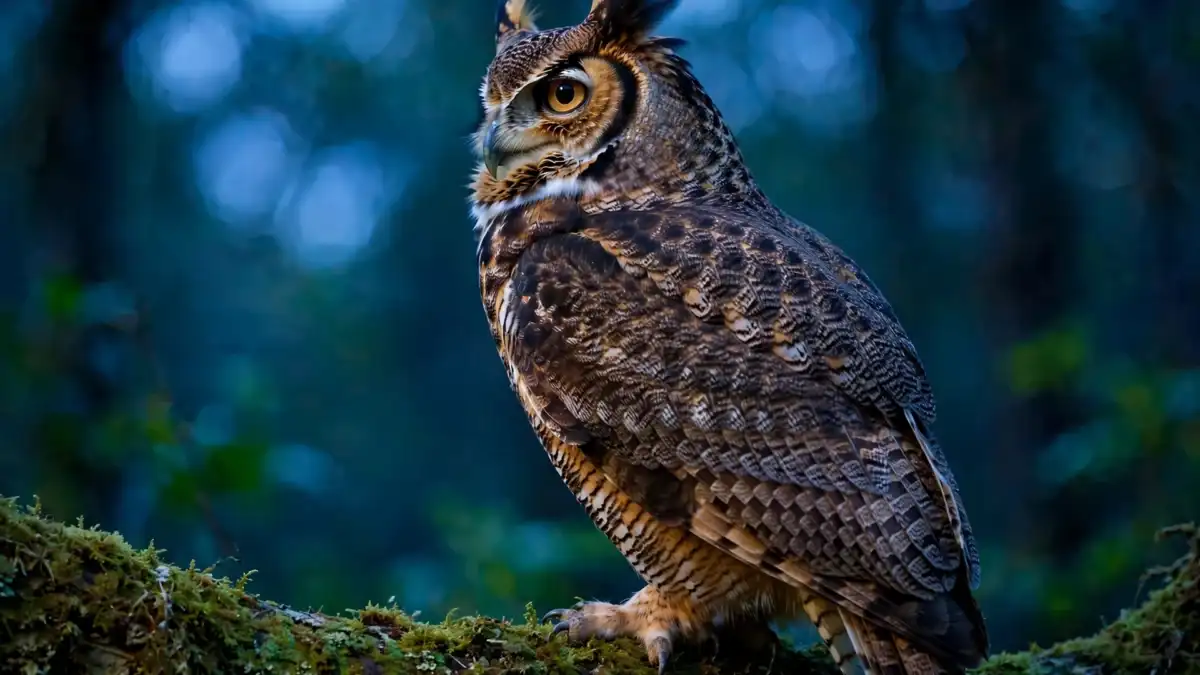
An owl can turn its head about 270 degrees in either direction, three quarters of a full circle. That is far enough to look almost directly behind itself without moving its body. The trick is not magic, and it is not a full 360 degree spin, even though it can look that way when an owl whips its head from one shoulder to the other. Three adaptations make it possible. Most owls have 14 neck vertebrae, twice the seven humans have. Their eyes are fixed in bony rings and cannot swivel, so the neck does all the work. And the arteries in an owl’s neck have slack and reservoir space, so blood keeps reaching the brain while the neck twists. Together, these features let an owl scan, hunt, and watch for danger without giving away its position.
The Short Answer: About 270 Degrees, Not a Full Circle
Most owls rotate their heads roughly 270 degrees to the left or right. That figure comes from direct observation and from the anatomical studies that followed, including the well known Johns Hopkins work published in Science in 2013. A 270 degree turn means the owl can face almost completely backward, stopping 90 degrees short of a full circle.
So why does it look like a full spin? Speed and sequence create the illusion. An owl hears a sound behind it, turns its head one way to the limit, then sweeps back through the front to the other shoulder in one continuous motion. Your eye follows a head that has covered well over 400 degrees of travel, and your brain rounds that up to a full circle. The owl never actually completes a 360 degree rotation in one direction.
The number is not identical for every owl. Reported figures cluster around 270 degrees, with barn owls usually placed at the top of the range and heavier species a little lower. The differences are small, and the mechanism is the same across the family. No owl spins its head all the way around, and no owl needs to.
Why the Head Has to Turn at All
Owls cannot move their eyes. A human eye is a ball that rolls freely in its socket, which lets you glance sideways without moving your head. An owl’s eye is tube shaped, more like a short telescope than a ball, and it sits locked in a ring of bone called the sclerotic ring. The eye cannot roll in any direction. To change where it looks, an owl must move its whole head.
This is a trade, and the owl gets a good deal from it. Tubular eyes are large, and they pack in far more rod cells than a human eye. Rods detect dim light, so an owl sees far better than you do on a moonless night. Some estimates put a barn owl’s low light sensitivity at roughly 100 times that of a human. The price of that night vision is a fixed gaze, and the neck pays that price.
Both eyes point forward, giving the bird strong binocular vision and excellent depth perception. Each eye covers roughly 70 percent of the visual field, and together they produce a combined field of about 110 degrees. That overlap lets an owl judge distance precisely before it strikes. But forward facing eyes leave a huge blind area behind the head, and the 270 degree turn fills it.
14 Neck Vertebrae: Twice the Human Count
Humans have seven cervical vertebrae, the bones of the neck. Most owls have 14. That single difference is the foundation of the whole trick. Each vertebra adds one more joint, and each joint adds a few degrees of rotation. Spread the turn across 14 small joints instead of seven, and no single joint bends very far.
The vertebrae are shaped for this job. Their saddle shaped joints slide and pivot smoothly in several directions. Strong elastic ligaments hold the column together, and the joints are cushioned so the bones do not grind during rapid turns. An owl can snap its head around to track a sound, then hold it steady, without strain.
Two vertebrae at the top of the column do the heaviest work. The atlas connects directly to the skull, and the axis below it carries a peg like projection called the dens. Together they form a pivot joint, the same basic design that lets you nod and shake your head, but in the owl this joint is larger and far more mobile. Even so, there is a hard limit. Ligaments, muscles, and the spinal cord itself set a stop at about 270 degrees, and the owl’s anatomy is tuned to reach that limit safely, never past it.
Arteries With Slack: How the Brain Keeps Its Blood Supply
Bones are only half the story. The real puzzle is blood flow. If you twisted your own neck 270 degrees, the arteries feeding your brain would kink and pinch shut, and you would faint. An owl does the same twist several times a day without a flicker. The answer came from Johns Hopkins researchers who used angiography and CT scans on a dozen owls.
The team, led by medical illustrator Fabian de Kok-Mercado, found four adaptations that protect the blood supply. First, the bony tunnels the arteries pass through, called transverse foramina, are nearly ten times wider than the arteries themselves. The artery has room to shift sideways inside the tunnel instead of being crushed against bone as the neck twists.
Second, the arteries themselves have slack. In humans, the vertebral arteries enter the neck low down and run fairly taut. In owls, they enter higher, at around the 12th cervical vertebra rather than the 14th, which leaves extra length for the vessel to stretch and unwind during a turn instead of pulling tight.
Third, the arteries connect to each other under the spine through small vessels that act as a backup route. If one path is squeezed during a turn, blood reroutes through another, so the brain never depends on a single pinched artery.
Fourth, the arteries widen into small reservoirs just below the brain. These expandable sections hold extra blood, so the brain keeps receiving oxygen even if flow dips briefly at the extreme of a turn.
These findings appeared in the February 1, 2013 issue of Science. They explain a feat that had puzzled naturalists for centuries.
Owl vs Human Neck: A Side by Side Comparison
The differences between an owl neck and a human neck are easy to see when they sit side by side. The table below lays them out.
| Feature | Owl | Human |
|---|---|---|
| Cervical vertebrae | 14 | 7 |
| Head rotation | About 270 degrees each way | About 80 to 90 degrees each way |
| Eyes | Tubular, fixed in bony sclerotic rings | Spherical, roll freely in sockets |
| Artery tunnels (foramina) | Nearly 10 times wider than the artery | Only slightly wider than the artery |
| Artery entry point | Around the 12th cervical vertebra | Around the 6th cervical vertebra |
| Blood reservoirs | Expandable sections below the brain | None |
| Main head movement | Whole head and neck rotation | Eye movement plus limited head turn |
Human head rotation is often quoted at about 90 degrees each way, but in practice most people manage closer to 80 degrees comfortably. Owls manage more than three times that, and the gap comes from every row of the table working together, not from any single feature.
Hunting in the Dark: Why the Turn Matters
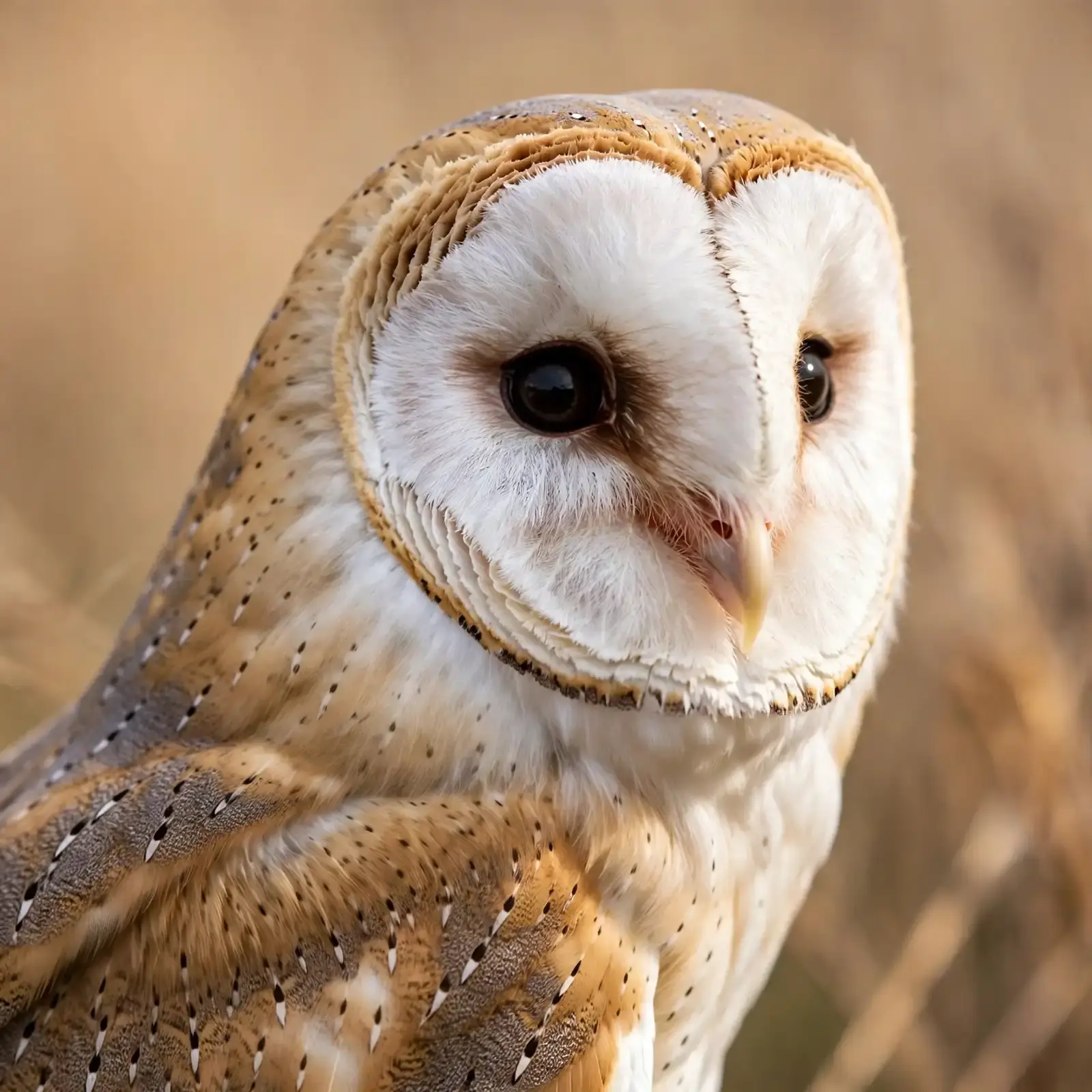
The 270 degree turn is not a party trick. It is a hunting tool, and it works with two other systems: hearing and silent flight. An owl that can scan in every direction without moving its body stays invisible to prey and to predators. Movement gives a hunter away. A still body with a turning head does not.
The facial disc plays a central role. The ring of stiff feathers around an owl’s face works like a satellite dish, funneling sound to the ears. Many owls have asymmetrical ears, one set higher than the other, so sound reaches each ear at a slightly different time and volume. The brain turns those tiny differences into a precise map of where a sound came from. A barn owl can locate a mouse in total darkness by sound alone, and strike accurately.
Head turning sharpens that map. When an owl hears a rustle, it works through a short sequence that takes only a few seconds.
- Hear: the ears pick up the rustle and the facial disc funnels the sound inward.
- Turn: the head rotates until the sound is centered between both ears.
- Lock: the eyes come onto the same target the ears found.
- Strike: the owl launches in silence, still listening as it flies.
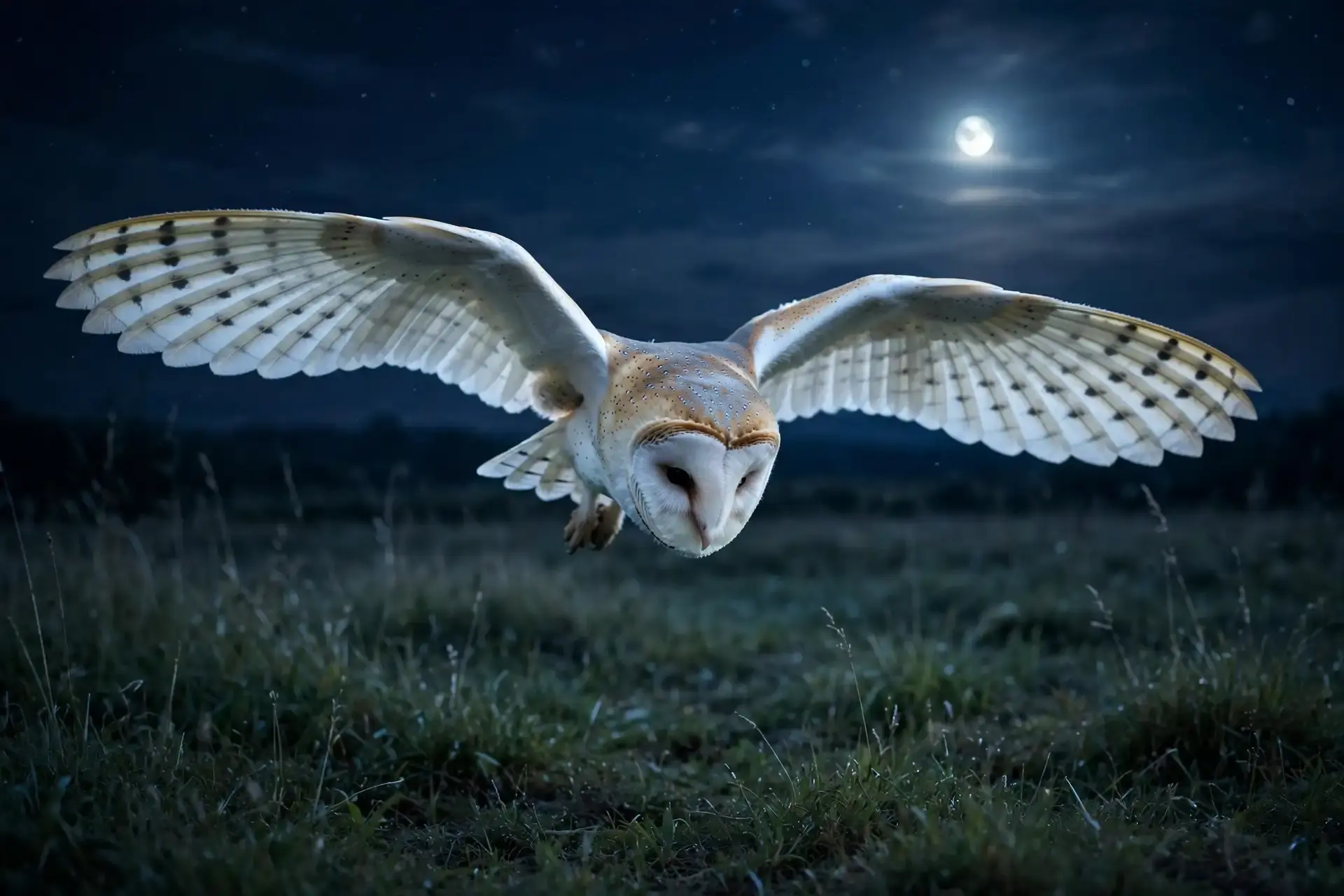
Silent flight completes the system. Serrated leading edges on the wing feathers break up turbulence, and a velvety surface absorbs the rest. An owl can fly toward prey that has no idea it is coming, and it can keep listening while it flies. The head turn, the ears, and the quiet wings form one hunting machine. What an owl eats varies by species and habitat. For the full picture, see what owls eat, from voles and mice to insects, fish, and other birds.
Head Bobbing: The Owl’s Built-In Rangefinder
Watch a barn owl for a few minutes and you will see a second strange movement. The owl bobs its head up and down, sways it side to side, and sometimes tilts it at an odd angle. It looks comical, but it is a precision instrument.
Because an owl’s eyes cannot move, the bird cannot use the quick eye flicks humans use to judge distance. Instead, it moves its whole head and watches how objects shift against each other. This is called motion parallax. A nearby object appears to move more than a distant one when the viewpoint shifts, and the owl’s brain reads that difference as distance.
Head bobbing also compensates for the narrow field of view. Each eye sees a limited slice of the world, and bobbing sweeps that slice across the scene. The owl builds up a fuller picture from a series of small movements, like a person scanning a dark room with a narrow flashlight beam.
Young owls bob more than adults. Their neck muscles are still developing, and their heads are heavy relative to their bodies. The bobbing helps them practice the coordination they will need as hunters. It also explains why owlets often sleep face down, resting their heavy heads on the branch, because their neck muscles cannot yet hold the head upright for long.
Do All Owls Turn Equally Far?
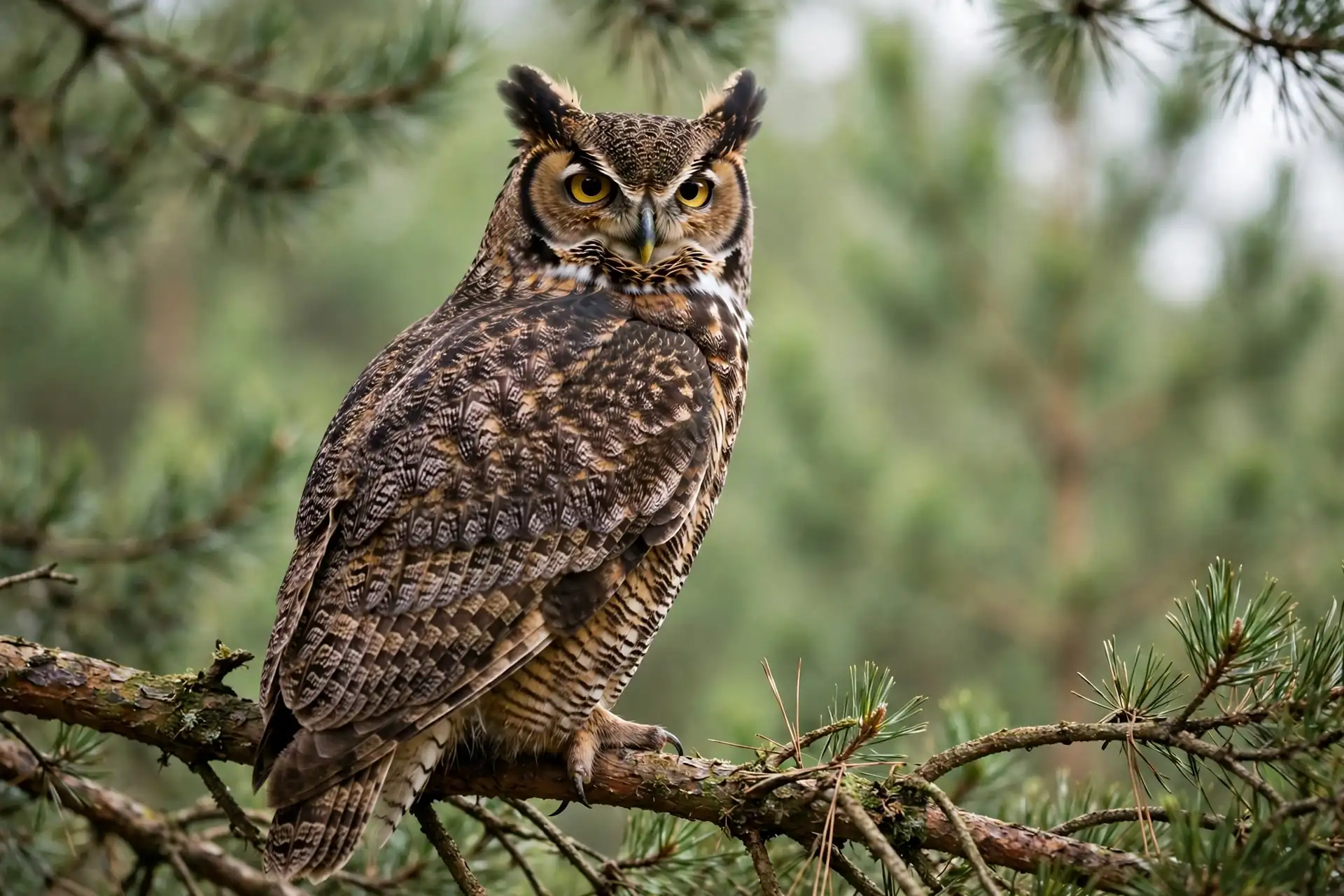
No, and the differences follow body size and lifestyle. Lighter species such as barn owls and screech owls sit near the top of the range, close to 270 degrees. Heavier species with large heads, such as great horned owls, tend toward the lower end. Their head is heavier, their neck is thicker, and the same 14 vertebrae carry more weight, so the practical limit is a little smaller.
The variation is modest. Every owl species studied turns its head far beyond what any mammal can manage. The difference between the most and least flexible common species is a matter of tens of degrees, not hundreds. No common owl is limited to a 90 degree turn, and none reaches a full circle.
Habitat shapes how much an owl uses the ability. Forest owls turn their heads constantly to scan between branches. Barn owls use the turn to track sounds while perched on a fence post or a beam. Age matters too. Adults reach the full range, while young owls are still building neck strength, so their turns are shorter and slower.
What a Turning Head Tells You in the Field
An owl’s head movements are a readable signal if you know what to look for. A slow, smooth turn usually means the owl is scanning its surroundings, and it has not yet fixed on anything in particular.
A sudden snap to one side means the owl heard something. The head locks onto the sound source and stays there. If the owl then leans forward and bobs, it is triangulating, pinning down the distance before it commits to a flight. That is the moment before a strike, so watch quietly and do not move.
Repeated turning from side to side, combined with a puffed up body and half closed eyes, can signal unease. The owl is watching for a threat and deciding whether to stay or leave. If you see this while you are close, back away slowly.
Myths About Owl Head Rotation
Several myths surround this ability, and most fall apart quickly once you know the anatomy.
- Owls can turn their heads 360 degrees: False. The real limit is about 270 degrees. The illusion comes from fast two way sweeps that cover more than 400 degrees of total travel.
- An owl’s head can fall off: False, and it is worth saying plainly because children ask it. Ligaments, muscles, and the spinal column hold the head firmly in place. The neck is built to twist, not to detach.
- Owls swivel their eyes like humans: False. The eyes are fixed in bony rings. The head does all the moving, which is exactly why the neck is so flexible.
- Owls get dizzy from turning: There is no evidence for this. The blood supply adaptations keep the brain oxygenated, and the inner ear handles the motion. An owl that turns its head rapidly shows no sign of disorientation.
- Only owls can turn their heads this far: Mostly true among familiar birds, but other birds have flexible necks too. Most birds have between 13 and 25 cervical vertebrae, far more than the seven humans have. Owls are simply the most dramatic example.
How to Watch Owls Turn Their Heads Without Disturbing Them
The best time to watch is dusk, when owls leave their roosts to hunt. Arrive before sunset, pick a spot near a field edge or a woodland clearing, and stay still. Owls notice movement far more than a quiet shape, so a motionless observer at a distance is usually ignored.
Use binoculars rather than approaching. A good pair lets you see the head turn clearly from 30 meters away. A red filtered flashlight is better than a white one if you need light, because red light disturbs night vision less. Never shine a bright light directly at an owl, and never use a camera flash at close range.
Listen first. Owls often announce themselves before you see them. Learning why owls hoot at night will help you recognize the calls and know which species is nearby. Once you hear a call, scan the treetops and fence posts slowly. The owl is often perched in the open, turning its head to scan the same field.
If you want regular visits, make your yard inviting. A nest box, a brush pile, and a chemical free lawn all help. For a full plan, see how to attract owls to your yard.
Frequently Asked Questions
Can owls turn their heads 360 degrees?
No. Owls rotate their heads about 270 degrees in either direction, three quarters of a full circle. The idea of a full spin comes from watching an owl sweep its head from one shoulder to the other in a single fast motion. The total travel looks like a full circle, but the head never rotates a complete 360 degrees in one direction.
Why do owls turn their heads so far?
They have to. An owl’s eyes are fixed in bony rings and cannot move, so the head must turn to change the line of sight. The wide turn lets the owl scan almost the full circle around itself without moving its body, which keeps it hidden from prey and predators. For a deeper look, this explanation of why owls turn their heads so far covers the anatomy in plain language.
Do owls get dizzy when they turn their heads?
There is no evidence that they do. Their arteries have slack, wide bony tunnels, backup routes, and reservoir sections that keep blood flowing to the brain during the turn. An owl can snap its head around and immediately lock onto a target with steady vision.
Can owls turn their heads upside down?
Owls can tilt and roll their heads to surprising angles, and a hunting owl often cocks its head sideways to center a sound between its ears. They cannot rotate the head a full 360 degrees in any direction, including upside down. The range in every direction is bounded by the same ligaments and blood vessels.
Why do baby owls sleep face down?
Owlets have heavy heads and neck muscles that are not yet strong enough to hold the head upright for long. They often sleep lying face down, with the head resting on the branch or the nest floor. As the muscles develop, they sleep upright like adults. The behavior is normal and not a sign of illness.
How far can a barn owl turn its head?
Barn owls are among the most flexible, with rotation close to 270 degrees in either direction. They also use head bobbing heavily to judge distance, because their fixed eyes and narrow field of view make motion parallax essential for hunting. BirdNote explains the effect in this Living on Earth segment on the screech owl, which describes how the apparent full circle is part illusion and part anatomy.
Conclusion
An owl turns its head about 270 degrees because its body is built for it: 14 neck vertebrae, fixed tubular eyes, and arteries with the slack and reservoirs to keep the brain fed. The turn fills the blind spot behind the head, aims the ears and eyes at prey, and lets the owl hunt without betraying its position. Watch for it at dusk, from a respectful distance, and you will see one of the neatest pieces of engineering in the bird world.