

The American robin is the first bird most North Americans will come across. With its bright orange breast, it can be seen on lawns at dawn, singing clearly, opening the morning chorus, and heralding spring even when snow is still on the ground.
However, the robin you probably think you know is only half the story. During the summer months, this bird can be seen hunting for earthworms on lawns, but during the winter months they come together in large flocks and feed in tall fruiting trees. The bird that sings from a rooftop at sunrise may vanish from your yard entirely by December.
This guide provides all the information you need to identify an American robin, its song and calls, diet changes from worms to fruit, nesting habits, winter migration, and the birds it is most often confused with.
Identification at a Glance
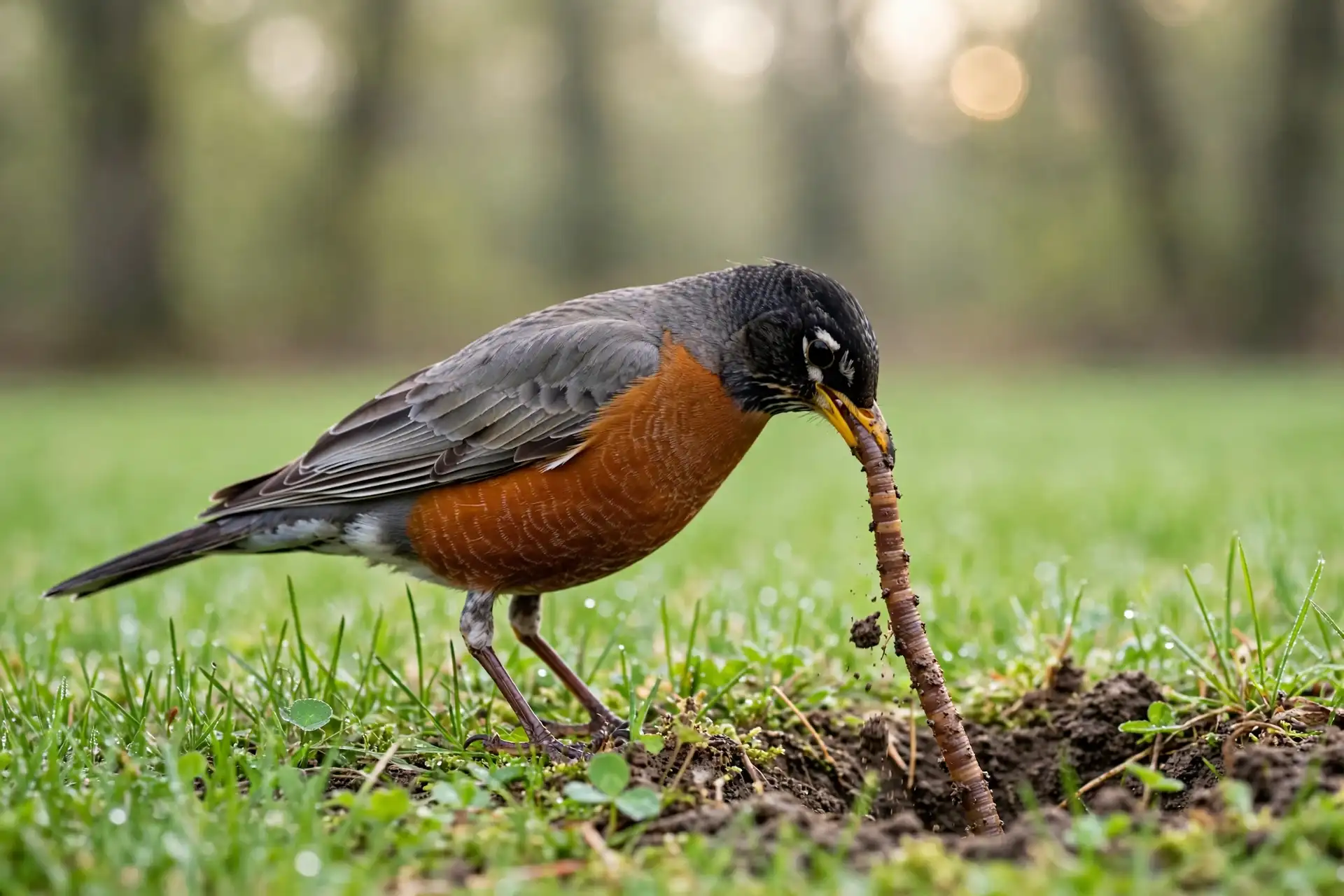
The American robin (Turdus migratorius) is a large thrush native to North America. It is part of the Turdidae family, which also includes the wood thrush and the hermit thrush. The classic thrush shape of the American robin allows it to stand upright, with a long bill for pulling worms from turf and strong legs for hopping across lawns. It is significantly larger than a sparrow and has a more bulky shape than a bluebird, but is less bulky than a pigeon. Adult robins are 20 to 28 centimeters long, with a wingspan of 31 to 41 centimeters.
The orange-red or brick red breast is the first clue that you have a robin. The head is black (males) or dark gray (females). The eyes are surrounded by a prominent white eye ring. The upper back and wings are a lighter gray. The tail is blackish with white tips to the outer tail feathers. The throat is white with fine black streaks. From underneath, the bird has a rich orange belly which gradually turns paler on the lower belly and whitish on the undertail coverts. The bill is yellow with a dark tip in spring and summer. It gets darker during the winter. The legs and feet are dark brown.
Robins are easy to watch because they forage in the open. The usual pattern is run, pause, tilt, and strike: the robin dashes a short distance across the lawn, stops upright, and tilts its head to look for a worm below the grass, then lunges to pull an earthworm from the soil. Cornell Lab notes that robins locate worms by sight, not by hearing them move underground, so the head tilt is the bird looking, not listening. On lawns, expect to see robins early in the morning and after rain, when worms are nearest the surface.
In flight, the robin has a steady, direct flight with quick wingbeats. It does not have the undulating flight of many finches and woodpeckers. The orange breast and dark head can be seen, and the white outer tail feathers can be seen flashing. In winter flocks, they often flush together and land together in the same fruiting tree, moving in loose waves rather than tight formation.
| Feature | Adult male | Adult female | Juvenile |
|---|---|---|---|
| Head | Black, sharply dark | Dark grey, softer contrast | Brownish, lightly streaked |
| Breast | Deep brick red, rich and bright | Paler orange, washed out | Pale with heavy dark spots |
| Back and wings | Dark grey-brown | Paler grey-brown | Mottled brown with pale spots |
| Throat | White with black streaks | White with fainter streaks | Streaked and speckled |
| Eye ring | Clear broken white ring | Clear broken white ring | Faint white ring |
| Bill | Yellow with dark tip | Yellow with dark tip | Darker, duller yellow |
Male vs Female
Both sexes have a similar appearance. The male has a black head, deep brick-red breast, and dark gray back. The female is very similar but paler. She has a dark gray head, pale orange breast, and light gray back. The difference between the two sexes is most noticeable in good light when viewed up close. In poor light, or from a distance, they can appear identical. Many birders just record the bird as a robin without trying to sex it. Behavior does not help much either: both sexes sing in spring, both defend territory, and both feed young.
Juvenile Robins
Juvenile robins look very different from adults and are the most commonly reported mystery bird. Juveniles have a pale speckled breast, a brownish back, and a more muted head pattern. The key feature is the speckled breast. This can make them look like a thrush, or even a young starling at first glance. They often have a paler bill base and can look untidy while molting into their adult colors during their first summer. Most juveniles will look close to adult by autumn, with some having a few spots on the breast into their first spring.
Song and Calls
The American robin has a clear whistling song, often described as cheerily, cheer up, cheer up, cheerily, cheer up. Each phrase is short, rising and falling, and the song carries well across a neighborhood at dawn. The males sing the most during spring. They sing from high places such as rooftops and bare branches. The first song of the day can be heard before sunrise. Robins are some of the earliest birds to sing in the morning chorus. In many areas, they are the first birds to sing in the morning.

The song is used for defense in their territory, while also advertising the male to females. Unpaired males sing the most. The song is also used to keep the pair in contact during the breeding season. Females will also sing, but not as much. They will usually sing from lower places or from within the territory.
Robins also have a variety of calls. The most common is a sharp, low tuk or cuck note, given as an alarm or contact call. During winter, the low cuck notes of many birds together are often the first sign that a flock is feeding in a fruiting tree above you. A fast, rising series of notes is used for high alarm, often when there is a hawk or a cat around. During winter, the song is not used much and the calls are used instead. This is one reason why robins seem to disappear, even when they are still around.
Diet: From Worms to Fruit
The robin’s diet varies throughout the year, and this change explains much of its behavior. During the spring and early summer months, they primarily eat animal matter including earthworms, insects, snails, spiders, and other small invertebrates. Audubon notes that insects make up the majority of the diet in early summer. That is why robins are lawn birds in spring: a short lawn after rain is a hunting ground.
Young robins are fed almost entirely on insects and earthworms. As they are growing quickly, they need protein to help them grow. Fruit does not provide it, so parents spend all day hunting for worms and caterpillars while the nestlings are in the nest. A pair feeding four nestlings can make hundreds of trips a day, and the female does more of the feeding, though both parents bring food.
As the summer moves into autumn, the diet shifts and they start to eat more fruit. Audubon estimates that fruit accounts for perhaps 60 percent of the diet across the year as a whole. Their main source of fruit is wild berries: serviceberry, dogwood, juniper, sumac, holly, crabapple, and chokecherry. They can also eat cultivated fruit such as cherries and grapes. A robin in winter is a fruit eater first, which is why winter robins are found in trees, not on lawns. Our guide to can birds eat cherries covers the safety and serving of one fruit robins take readily.
This diet shift also explains a strange winter sight: robins that seem drunk. Fermented berries can contain alcohol, and a robin that has eaten a lot of them can fly unsteadily or sit dazed on the ground. Our guide to can birds get drunk explains fermented berries, wobbly robins, and what to do if you find one.
Robins rarely visit seed feeders, which surprises a lot of people. A robin’s bill is not built to crack seed. What a robin will take from a feeder is fruit and mealworms: apple slices, orange halves, or berries from a platform feeder, or dried mealworms from a shallow dish. For the full picture of what belongs at a feeder and what does not, see our pillar guide to bird food.
| Season | Main foods | Where to look |
|---|---|---|
| Spring | Earthworms, insects, grubs | Lawns, gardens, after rain |
| Summer | Insects, caterpillars, berries | Lawns, shrubs, fruiting trees |
| Autumn | Wild berries, crabapples, grapes | Thickets, fruiting trees, hedges |
| Winter | Berries, crabapples, sumac, juniper | Fruiting trees, woodland edges, flocks |
Nesting and Raising Young
Robin nesting happens in plain sight. The males arrive first on the breeding grounds and sing to claim territories. Once a pair forms, the female does most of the nest building, with some help from the male.

The nest is a substantial cup, built on a horizontal branch of a tree or shrub, usually 5 to 25 feet above the ground, though robins also nest on ledges of houses, barns, and bridges. The outer cup is grasses, twigs, and debris, worked into a solid foundation of mud, then lined with fine grasses. That mud foundation is the robin’s signature.
The eggs are pale blue, that famous robin’s egg blue, and the usual clutch is 4, sometimes 3 to 7. Young hatch blind and nearly naked, and both parents feed them. The female incubates the eggs for 12 to 14 days, and the young leave the nest 14 to 16 days after hatching. A pair typically raises 2 broods in a season, sometimes 3.
Parents are fierce in defense of the nest. Robins will dive at cats, crows, jays, and even people who come too close, striking with their wings and giving loud alarm calls. They will also defend their nests against cowbirds, which try to lay their eggs in robin nests. Robins are among the birds most likely to recognize a cowbird egg and reject it, though they do not always succeed.
Migration and Winter Roosts
Robins are partial migrants. Those breeding in the far north of Alaska and Canada will migrate south in winter, while many in the southern parts of the United States will stay in one place all year. In between, movement can be dependent on food and weather. A robin may stay through a mild winter and leave in a harsh one, and a flock may arrive or depart within a day as a cold front passes.
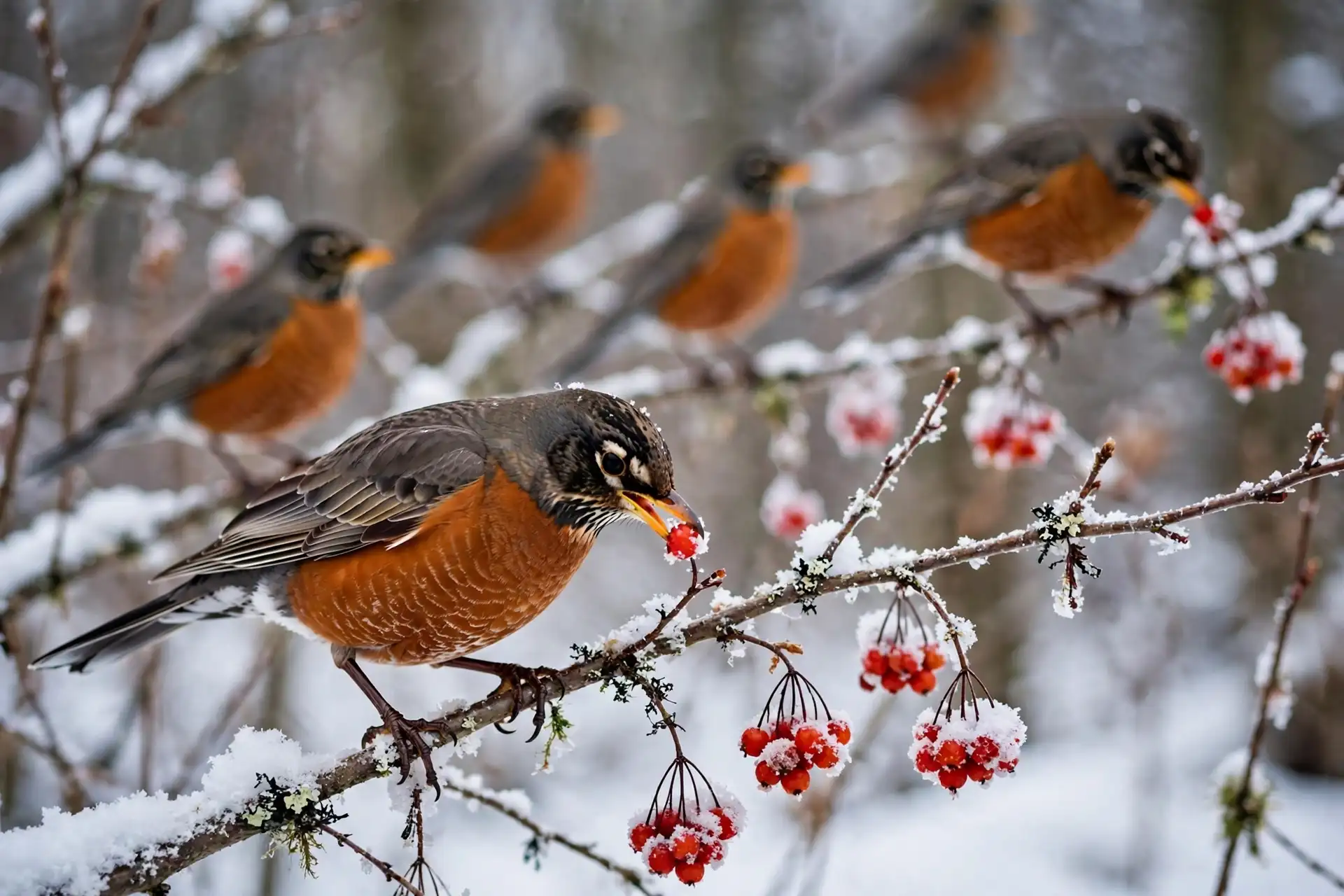
During winter, robins gather in large flocks and feed in fruiting trees, often in woods and parks rather than on lawns. At night, they gather in communal roosts, which can hold thousands of birds in sheltered woods or conifer stands. These roosts are noisy at dusk, when the birds arrive in waves and settle, and quiet in the dark. Learn more in our guide to do robins migrate.
The cold itself is rarely the problem. Robins can survive cold weather if they can find food and shelter. What tests them is ice and snow that cover the ground, frozen fruit, and a lack of open water. Our guide to how cold is too cold for birds explains the temperatures that matter, and our guide to the heated bird bath covers a simple way to offer open water in winter.
The first robins of spring are often birds that never left, or birds returning from a short move south. In the north, their return is a sign of the season, but in the south, robins are present all year and their song simply rises in volume as days lengthen. The best measure of spring is not a robin, but the song of many birds together.
Robins in Your Yard
Robins are very easy to attract to your garden, and they ask for very little. A short lawn, kept free of pesticides and with bare patches where worms are easy to find, is the biggest draw. A robin uses a lawn the way other birds use a feeder: as a place to hunt, not a place to perch. Keep the lawn short in spring, let leaves gather in a corner for insects, and the robins will do the rest.
Plant for fruit, and robins will follow. Native shrubs and trees that fruit in autumn and winter – serviceberry, dogwood, juniper, holly, chokecherry, and crabapple – are far better than a feeder. Plant them in a sunny spot with room to grow, and you will see robins in them from autumn to spring, along with waxwings and other fruit eaters.
Water matters all year. A bird bath with clean water, shallow at the edge and deep enough in the center for a robin to bathe in, will be used daily. Change the water often, clean the bath to prevent disease, and keep the bath unfrozen in winter with warm water or a heated bath. A robin that bathes in your garden will return to it again and again.
Keep cats indoors or supervised, especially in the nesting season. A single cat can destroy a robin nest in a morning, and outdoor cats kill millions of birds each year. If you have a cat, fit it with a bell, keep it indoors at dawn and dusk when birds are most active, and give the robins dense shrubs to nest in.
Common Confusions
The American robin is often confused with other birds.
European Robin
The European robin is a different bird entirely, a small Old World flycatcher with a red breast and a brown back, about the size of a sparrow. It is not a thrush, and it is not related to the American robin beyond the shared name.
Varied Thrush
The varied thrush is the closest lookalike in the west, and it often fools people. It has a dark breast band across an orange breast, a black head with an orange eyebrow stripe, and a back that is dark slate rather than gray. It looks like a robin wearing a band across its chest, and it is also a thrush, though less common and more secretive than a robin.
Eastern Towhee
The eastern towhee is another bird with a black head, a white belly, and rusty orange sides. It is smaller than a robin, with a longer tail and a heavier bill, and it scratches in leaf litter with both feet at once. The towhee’s song is a clear drink your tea, quite different from the robin’s many phrases.
Eastern Bluebird
The eastern bluebird is a robin’s smaller cousin, and the two are often confused in the east. The bluebird is smaller, with a blue back and wings, a rusty breast that is lighter than a robin’s, and a slimmer shape. The bluebird’s song is a soft warble, and it often sits on wires or low branches, looking out for insects before swooping down to catch them.
Spotted Juveniles
Spotted juveniles are the birds most often misidentified in summer. A juvenile robin’s heavily spotted breast can look like a thrush, a young starling, or even a young mockingbird at first glance. Look for the robin’s size, its upright stance, and the gray-brown back. The bill shape, longish and slightly downcurved, is the same as an adult’s, and the bird will show the robin’s run and pause behavior on the lawn.
Frequently Asked Questions
Are American robins a sign of spring?
Partially. Robins migrate back to their northern breeding grounds in spring, and their song is an early sign of the season, but many robins stay in the south over the winter. So seeing a robin in February does not prove spring has arrived.
Do robins migrate?
Some do and some do not. Robins are partial migrants. Northern birds move south for winter, southern birds stay put, and birds in between move as food and weather dictate.
What do robins eat?
In spring and summer, mostly earthworms, insects, and other invertebrates. In autumn and winter, mostly fruit, especially wild berries. Fruit accounts for perhaps 60 percent of the diet across the year. They rarely eat seed, but they will take fruit and mealworms from a platform feeder.
How can you tell a male robin from a female?
The male has a black head and a deep brick red breast. The female has a dark gray head and a paler, softer orange breast. In poor light, they can look the same.
How many eggs do robins lay?
Usually 4, sometimes 3 to 7. The eggs are pale blue, incubated by the female for 12 to 14 days. Young leave the nest about 14 to 16 days after hatching, and pairs raise 2 broods a season, sometimes 3.
Why did the robins disappear from my yard in winter?
They probably moved into the trees. Winter robins feed in flocks on fruiting trees and roost together at night, so they leave lawns alone. Look up into fruiting trees and listen for low cuck calls.
Conclusion
The American robin is a lovely bird to get to know. It is a thrush with a brick red breast and a black head, a singer whose clear phrases open the dawn chorus, and a hunter whose run and pause rhythm fills summer lawns. Its diet shifts from worms and insects in spring to fruit in winter, its nests are sturdy cups of grass and mud holding pale blue eggs, and its migration is partial, shaped by food and weather rather than a fixed calendar. In your yard, give it a short lawn without pesticides, fruiting shrubs, clean water, and a safe place to nest, and it will return year after year. Watch for the male’s black head and deep red breast, listen for the song at dawn, and look up into the fruiting trees in winter.