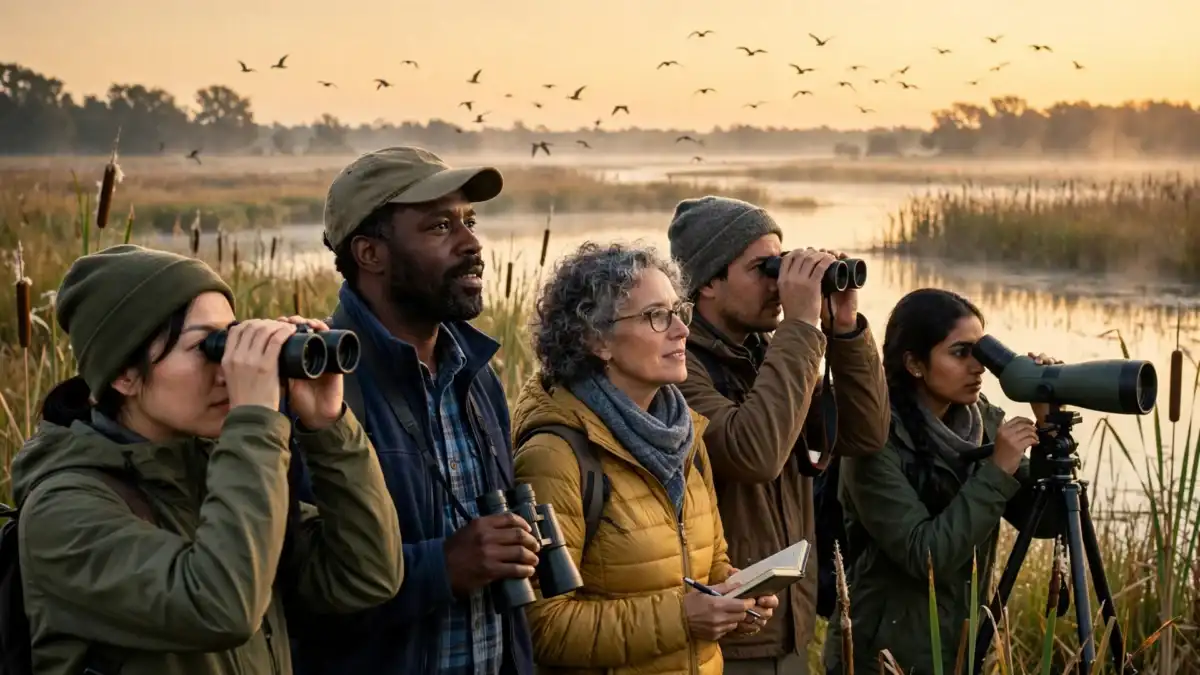
On Saturday, October 10, 2026, birdwatching did something it had never done in October before. More than one million people went out to look at birds on the same day, as part of eBird’s October Big Day.
They found 7,961 species between them, submitted well over 120,000 checklists, and set a new record for the most bird sound recordings ever collected in a single day.
This article pulls together the official October Big Day 2026 results: what happened, which records fell, which countries led the world, and how many birds were moving through the night sky while everyone counted.
One honest note before the numbers. eBird shared its first summary a few days after the event, and its live results dashboard keeps updating as late checklists are reviewed. Both sets of figures appear below, labelled clearly, so you can see the announcement numbers and the latest totals side by side.
The October Big Day 2026 Results at a Glance
Start with the headline figures. eBird’s post-event summary reported more than one million participants, about 51,000 eBirders submitting checklists, 7,935 species, and 2.4 million individual bird observations. The live dashboard, still being updated when checked on October 21, had climbed a little higher on the measures it tracks.
| Measure | eBird announcement | Latest dashboard total |
|---|---|---|
| Total participants (eBird and Merlin) | More than 1,000,000 | Not shown |
| eBirders who submitted checklists | 51,000 | 53,108 |
| Species recorded | 7,935 | 7,961 |
| Checklists submitted | Not stated | 124,135 |
| Individual observations | 2,400,000 | Not shown |
| Sound recordings | New single-day record | Exact count not published |
The two participant numbers confuse a lot of people, so they are worth separating. The million counts everyone who enjoyed birds through eBird or the Merlin Bird ID app during the day. The 53,108 eBirders are the smaller group who submitted complete checklists, the records scientists actually build research on. Both numbers matter, but they measure different things.
If you want the background on how the day works, our earlier guide to October Big Day 2026 and how to join the world’s biggest birding day covers the format in full.
How the Day Unfolded
October Big Day runs for 24 hours, from midnight to midnight local time, wherever you happen to be on the planet. There is no fee, no minimum time commitment, and no requirement to travel. A ten-minute watch from a balcony counts, provided the sightings go into eBird or Merlin.
The 2026 edition sat inside Global Bird Weekend, which ran from October 9 to 11, and shared its Saturday with the autumn edition of World Migratory Bird Day. Participants were asked to submit their checklists by October 13 so their birds would land in the official results.
And eBird encouraged complete checklists with counts rather than simple presence lists. A complete checklist tells scientists not just what you saw, but that you reported everything you could identify, which makes absence data useful too.
This year carried an extra push on sound. eBird challenged birders to upload recordings through the eBird app and Merlin’s Sound ID, and the response broke the record for the most bird sound recordings collected in a single day. eBird has confirmed the record without publishing the exact total, so this article does not invent one.
The Records That Fell, and One That Did Not
Judged on participation, this was comfortably the biggest October Big Day in the event’s history. The million-person barrier fell for the first time, checklists and observations both set October highs, and the sound recording record went as well.
| Measure | 2024 | 2025 | 2026 |
|---|---|---|---|
| Participants | About 750,000 | About 900,000 | More than 1,000,000 |
| eBirders | Not consistently reported | About 48,000 | 53,108 |
| Species | More than 7,800 | About 7,960 | 7,961 |
| Checklists | Close to 100,000 | 122,433 | 124,135 |
| Observations | Not reported here | 2.1 million | 2.4 million |
| Countries | 201 | 196 in early reporting | Exact count not published |
The species total needs a careful sentence. At 7,961, it sits almost exactly level with the final figures reported for 2025, which settled somewhere between 7,955 and 7,962 depending on the snapshot.
That is a tie in practical terms, not a new species record, and claiming one would be misleading. The growth this year was in people, not in species, which is arguably the healthier kind of growth for an event built on public participation.
The countries row needs the same honesty. eBird said before the event that birders could follow observations from more than 200 countries, but the results material available so far has not published an exact 2026 country total. Rather than repeat the expectation as a result, the table leaves it open.
Where the World Watched Birds
Look at the species leaderboard and a familiar pattern appears. The tropical countries of Latin America dominate, because a single day there can produce species counts that temperate countries cannot match.
Top Countries by Species
| Rank | Country | Species |
|---|---|---|
| 1 | Colombia | 1,474 |
| 2 | Peru | 1,326 |
| 3 | Brazil | 1,257 |
| 4 | Ecuador | 1,129 |
| 5 | Bolivia | 871 |
| 6 | Venezuela | 858 |
| 7 | Kenya | 807 |
| 8 | India | 781 |
| 9 | Argentina and Tanzania | 762 |
| 11 | Mexico | 753 |
| 12 | Costa Rica | 744 |
| 13 | United States | 700 |
Colombia’s 1,474 species is close to one in every five species found worldwide that day, from one country. Peru and Brazil both cleared 1,250, and Ecuador joined them above 1,100. Kenya was the strongest African country on 807, and India led Asia on 781.

Top Countries by Checklists
Rank the day by effort instead of diversity and the picture flips. The United States submitted 40,669 checklists, nearly a third of the world total. Colombia followed on 8,724, then Canada on 7,109, Venezuela on 6,520, Brazil on 6,322, Argentina on 4,764, Australia on 4,282, India on 4,046, Costa Rica on 3,862, and Peru on 3,516.
Venezuela deserves a closer look. National reporting put 630 observers in the field across 13 states, finding 51 endemic species. The state of Tachira led on species with 440, while Trujillo produced a remarkable 1,087 checklists. Venezuela finished fourth in the world for checklists, a striking result for a country whose birding community often works with limited resources.
Results by Continent
- North America: 1,650 species, 59,899 checklists, 30,903 eBirders
- South America: 2,901 species, 35,546 checklists, 8,515 eBirders
- Europe: 480 species, 10,944 checklists, 5,946 eBirders
- Asia: 1,929 species, 8,771 checklists, 4,088 eBirders
- Africa: 1,748 species, 3,772 checklists, 1,384 eBirders
- Australasia: 796 species, 4,956 checklists, 2,237 eBirders
The split tells a clean story. North America supplied the people and the checklists. South America supplied the diversity, logging 2,901 species with a quarter of North America’s observers. Latin America and the Caribbean together recorded 3,730 species, which underlines why the Neotropics sit at the centre of global bird conservation.
Stories From the Day
Totals flatten a day like this. The texture sits in the local reports, and a few of them show what a single Saturday can produce.
In western Kenya, one team working the Busia and Yala Swamp area logged 205 species. Their list included European and Blue-breasted Bee-eaters, seven Piapiacs, four Rock Pratincoles on the River Nzoia, and a duetting pair of Papyrus Gonoleks, a papyrus specialist that many visiting birders never hear, let alone see well.
They still ran out of daylight before reaching the Abyssinian Ground Hornbill site they had hoped to add. That is a Big Day in miniature: a huge list, and one bird left for next year.
Singapore, a city state you can cross in an hour, recorded 151 species island-wide. Bird Society of Singapore groups found Arctic Warblers at all six of their sites, plus Amur Paradise-Flycatchers, Yellow-rumped Flycatchers, Tiger Shrikes, and an Eastern Crowned Warbler. In Belize, guides at one lodge started along the Macal River at 4:30 in the morning and finished with 155 species across seven checklists.
Anguilla offers the other end of the scale. Volunteers there covered 10 sites through mixed weather and rain and recorded 57 species, including an American Flamingo that had relocated to the Road Salt Pond Important Bird Area. Fifty-seven species will never trouble Colombia, but on a small island, in the rain, it is real fieldwork, and the records feed the same database.
The live dashboard’s latest additions list reads like a world birding wish list: Horned Curassow in Bolivia, King Bird-of-Paradise in Papua, Banded Ground-Cuckoo in Ecuador, Graceful Pitta in Sumatra, Himalayan Snowcock in Ladakh, and South Georgia Pipit on South Georgia. No single sighting became a global headline this year, and no verified report of a first national record surfaced in the coverage. The day was about breadth, not one rarity.
How Many Birds Were in the Air That Night?
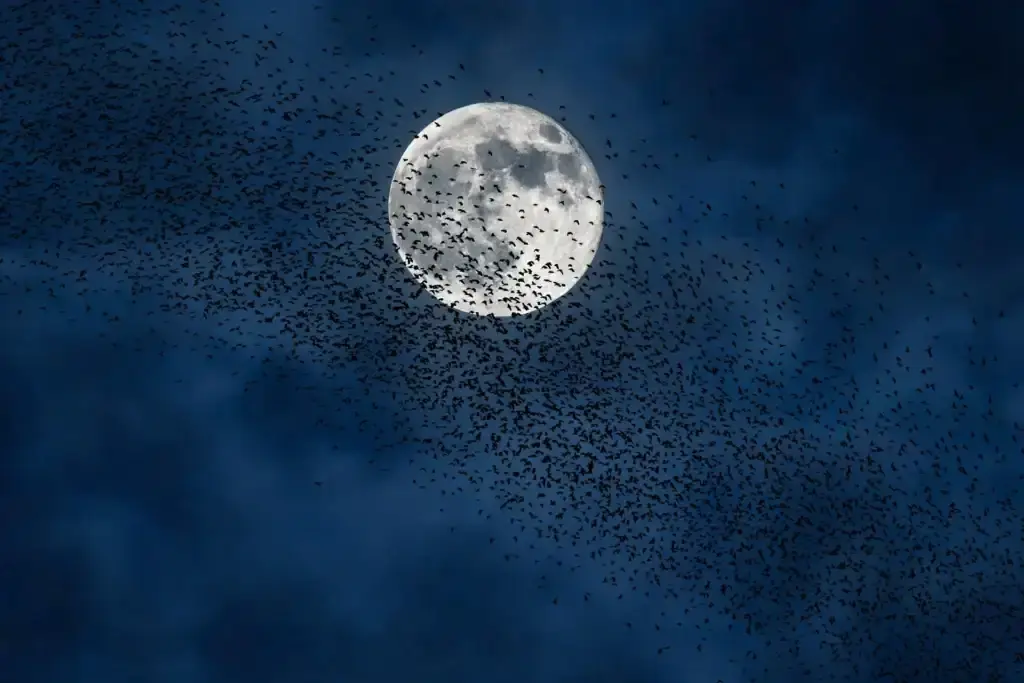
Checklists count the birds people saw. Radar counts the ones they could not. October Big Day falls near the peak of autumn migration in the Northern Hemisphere, and BirdCast, the migration forecasting project led by the Cornell Lab, measured what moved on the night of the event itself.
Over Mississippi alone, BirdCast estimated that 31,205,600 birds crossed the state during the night of October 10 to 11. At the peak, around 8:20pm Central Time, an estimated 57,935,900 birds were in flight over the state at once, travelling south-southeast at about 32 miles per hour at roughly 2,300 feet. Those figures are radar estimates for one state, not a national total, and no United States total for that night has been published.
Six nights later, the season produced its biggest spectacle. On October 16, behind a strong cold front, the number of birds in flight over the contiguous United States passed 1.0318 billion at 10:40pm Eastern Time. BirdCast described it as the fourth billion-bird night in its records, and the first, possibly the only, one of autumn 2026. Mississippi alone saw 149,294,800 birds cross that night.
Put the two datasets together and the Big Day picture sharpens. People counted thousands of species by day, while tens of millions of migrants, most of them never seen by anyone, poured south overhead the same night. If migration timing fascinates you, our guide to BirdCast and the live bird migration forecast explains how to read those radar maps, and What Birds Migrate in October covers the species on the move this month.
One Date, Two Celebrations: World Migratory Bird Day 2026
October Big Day always shares its autumn date with World Migratory Bird Day, and the 2026 theme could hardly have fitted better: “Every Bird Counts: Your Observations Matter!” The campaign, coordinated by the Convention on Migratory Species and partners, put community science at the centre of migratory bird conservation.
Its argument is simple. Migrants cross countries, continents, and oceans, and no professional survey network can watch all of that. Public observations fill the gaps, helping scientists track population changes and identify the sites that matter along each flyway.
The campaign named nine ambassador species, among them Cinnamon Teal, Merlin, Ruby-throated Hummingbird, Barn Swallow, the three oystercatchers, Abdim’s Stork, and the Spoon-billed Sandpiper.
That last bird carries the starkest number in this whole article. The Spoon-billed Sandpiper is Critically Endangered, with an estimated 350 to 550 individuals left in the world.
The Barn Swallow, a bird so familiar it is easy to overlook, has declined by 38 to 44 percent in North America since 1966, according to figures cited in the campaign coverage. Big Day data will not save either species on its own, but it helps show where they still occur, and where they have gone quiet.

Why One Day of Counting Matters
A fair question sits underneath all of this. Birds get counted every day of the year, so what does one coordinated Saturday add?
The answer is the snapshot. When thousands of observers use the same method on the same date, the result is a single-day picture of distribution and relative abundance across the whole planet. Repeated each year, those snapshots show range shifts, changing migration timing, and population trends that scattered records cannot reveal as cleanly.
eBird feeds this material into its Status and Trends products, which map where species are gaining and losing ground, and conservation groups use those maps to decide where protection money does the most good.
The database behind the day keeps reaching new scales. eBird passed 2 billion bird observations in June 2025, and 2026’s October total of 2.4 million observations in 24 hours beat the 2.1 million recorded in October 2025, then described as the most birds ever observed on a single October day. Community science at this size stops being a hobby statistic and becomes infrastructure.
October vs May: How the Bigger Sibling Compares
October Big Day, first held in 2018, is the autumn counterpart to Global Big Day, which began in 2015 and runs each May. The format is identical. Only the season changes, and the season changes the numbers.
| Measure | Global Big Day, May 2026 | October Big Day, October 2026 |
|---|---|---|
| Species | 8,023 | 7,961 |
| Countries | 203 | Exact count not published |
| Checklists | 197,640 | 124,135 |
| eBirders | More than 80,000 | 53,108 |
| Top country | Colombia, 1,566 species | Colombia, 1,474 species |
May 2026 was the first Global Big Day to pass 8,000 species, and Colombia topped it for the fifth straight year. Spring migration in the Northern Hemisphere, plus a decade of momentum, keeps May ahead on species, checklists, and eBirders. October’s claim is different. It is the younger event, it runs during autumn passage in the north and spring in the south, and this year it became the first October edition to draw a million people.
What Happens Next
The counting season does not end with Big Day. Project FeederWatch, the winter feeder survey run by the Cornell Lab and Birds Canada, opens its 40th season on November 1, 2026, and runs to April 30, 2027. It asks for the opposite style of birding: the same patch, watched regularly, through the whole winter. Our guide to Project FeederWatch 2026 and how to join walks through signup and count days.
After that, the calendar rolls to the Christmas Bird Count from mid-December to January 5, National Bird Day on January 5, the Great Backyard Bird Count in February, and Global Big Day again on May 8, 2027. Anyone who joined October Big Day for the first time now has a reason to keep a list running all winter.
October Big Day 2026 FAQs
When was October Big Day 2026?
It took place on Saturday, October 10, 2026, running for 24 hours from midnight to midnight local time in every time zone. The date coincided with the autumn World Migratory Bird Day and fell inside Global Bird Weekend, October 9 to 11.
How many people took part in October Big Day 2026?
More than one million people took part through eBird and Merlin combined, according to eBird’s post-event summary. Of those, the live results dashboard counts 53,108 eBirders who submitted checklists. The million was a stated goal before the event, and this was the first October Big Day to reach it.
How many species were recorded on October Big Day 2026?
The latest live dashboard total is 7,961 species. eBird’s announcement summary said 7,935 species, and the dashboard figure has risen slightly since as late checklists are reviewed. The total is broadly level with 2025, so it is not presented here as a species record.
Which country recorded the most species?
Colombia, with 1,474 species, followed by Peru on 1,326 and Brazil on 1,257. Ecuador was fourth on 1,129. The United States recorded 700 species but submitted far more checklists: 40,669.
Was October Big Day 2026 a record?
Yes, on participation. It set October highs for total participants, checklists, eBirders, and individual observations at 2.4 million, and it set a new single-day record for bird sound recordings. The species total essentially matched 2025 rather than beating it clearly.
How many countries took part in October Big Day 2026?
No exact 2026 country total has been published in the official results material available at the time of writing. eBird expected observations from more than 200 countries, and the confirmed totals for recent years were 201 countries in 2024 and 203 countries at Global Big Day in May 2026. This article will be updated if eBird publishes a final country count.
When is the next Big Day?
The next global event is Global Big Day on May 8, 2027. Before that, Project FeederWatch begins on November 1, 2026, the Christmas Bird Count runs from December 14, 2026 to January 5, 2027, and the Great Backyard Bird Count follows in February 2027.
Conclusion
October Big Day 2026 will be remembered for a number that has nothing to do with birds. One million people, on one Saturday, in one shared act of attention. Behind that headline sit 124,135 checklists, 53,108 eBirders, 7,961 species, and 2.4 million observations, from Colombia’s 1,474 species down to a wet 57 on Anguilla.
Add the radar’s view, tens of millions of migrants crossing a single state the same night, and the day becomes a fair measure of how much bird life moves through the world, noticed and unnoticed.
The October Big Day 2026 results show an event still growing where it counts most: in the number of people willing to stop, look up, and write down what they saw.