
Choosing binoculars for bird watching can feel surprisingly complicated. The numbers on the box 8×42, 10×42, 8×32 look simple, but they describe only part of the experience. The real question is not simply how much you can magnify a bird, but how easily you can find it, keep it in view, focus quickly, and see enough detail to identify it.
That is where the classic magnification vs. field-of-view debate begins.
Higher magnification can make a distant bird appear larger and reveal details that are difficult to see through lower-powered optics. But increasing magnification can also narrow your field of view and make hand movement more noticeable. For a birder trying to follow a warbler through dense branches, a bigger image is not necessarily a better image.
For many birders, 8x binoculars, particularly 8×42 models, remain an excellent all-purpose starting point. Cornell Lab’s testing describes 8×42 as a popular and versatile configuration, while Audubon’s binocular research similarly emphasizes the advantages of moderate magnification, brightness, and a generous field of view.
But that does not mean 10x binoculars are a poor choice. In open habitats, where birds are often far away, the extra magnification can be extremely useful.
So which should you choose?
The answer depends on where you bird, what you watch, how you use your binoculars, and which trade-offs you are willing to make.
8x vs. 10x Binoculars: What’s the Real Difference?
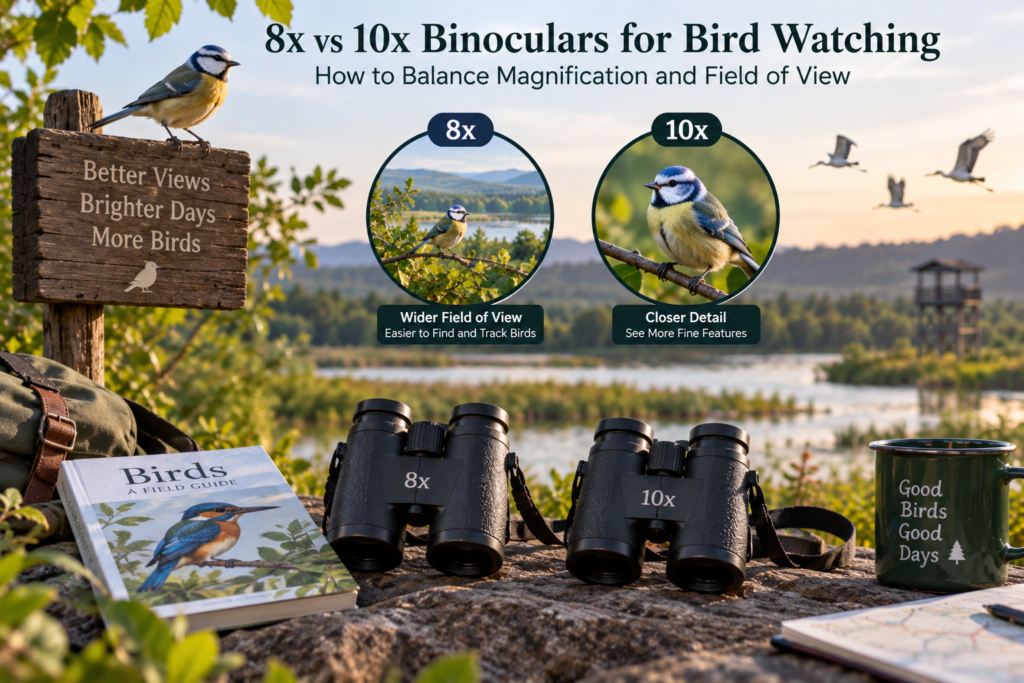
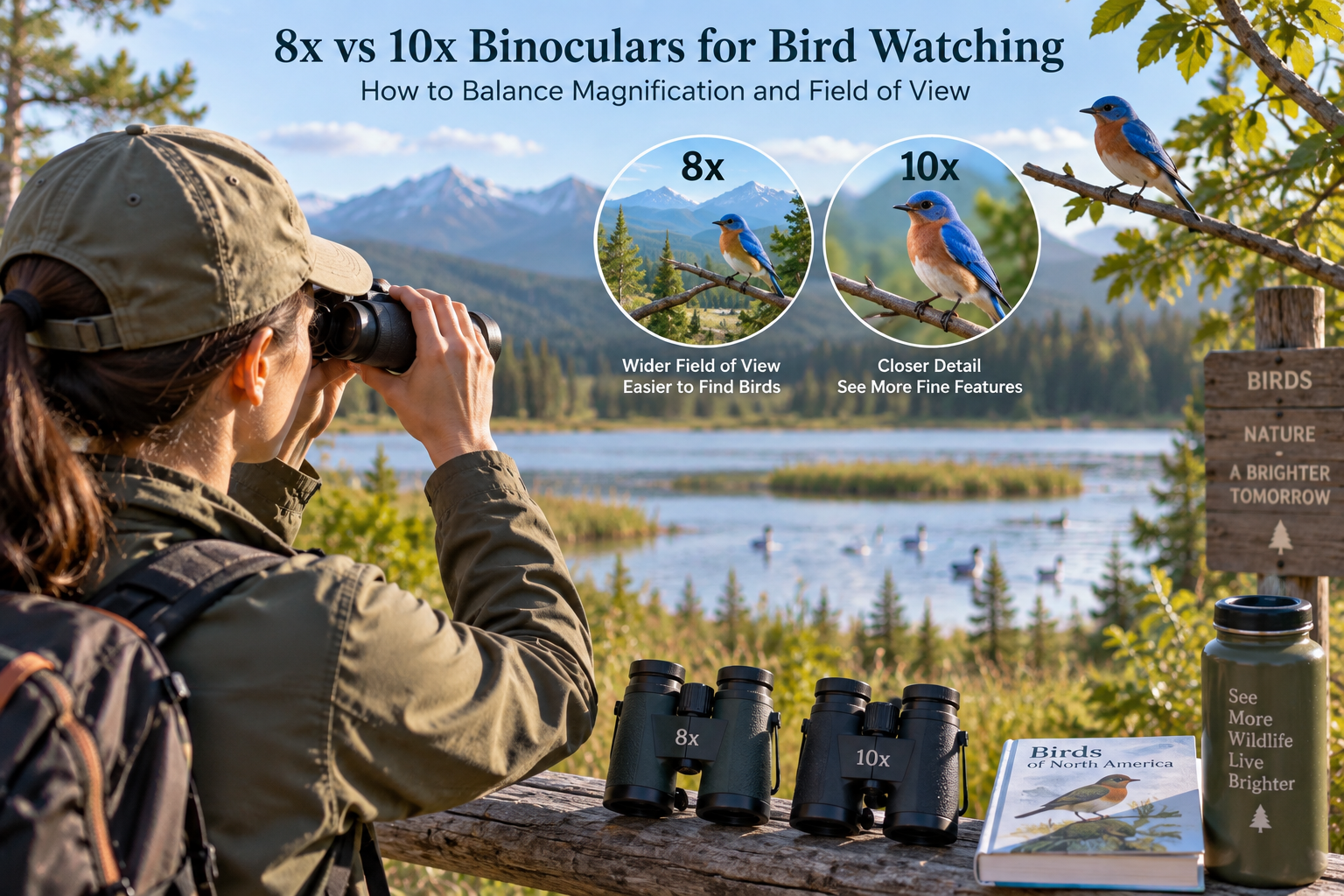
The first number in a binocular specification tells you the magnification. An 8x binocular makes the subject appear approximately 8 times larger than it would to the naked eye, while a 10x model provides 10x magnification.
That extra power sounds appealing, but magnification affects more than image size.
8x Binoculars
An 8x binocular generally gives you:
- A wider field of view
- Easier target acquisition
- Less noticeable hand shake
- A steadier image
- Comfortable tracking of birds in flight
- Strong performance for woodland and backyard birding
10x Binoculars
A 10x binocular generally gives you:
- More apparent detail on distant birds
- Greater reach for open-country birding
- Useful magnification for shorebirds and raptors
- A narrower field of view
- Greater sensitivity to hand movement
- Potentially more challenging target acquisition
Cornell’s binocular testing makes essentially this same practical distinction: 8x models are often a sweet spot for finding and following birds, while 10x can make sense when long-distance viewing is a major part of your birding.
The Simple Rule
If you frequently lose birds before you can get them into view, prioritize field of view and stability.
If you regularly watch distant birds across open landscapes, consider the additional reach of 10x.
Why Field of View Matters So Much for Bird Watching
Field of view is one of the most important—and most frequently overlooked—binocular specifications.
It describes how much of the scene you can see through the binoculars at a given distance. Manufacturers commonly express it as feet at 1,000 yards or as an angular measurement.
A wider field of view makes it easier to:
- Find a bird after someone points it out.
- Follow a bird as it moves.
- Keep flying birds inside the view.
- Scan vegetation efficiently.
- Reacquire a bird after it briefly disappears behind a branch.
Cornell’s explanation of field of view demonstrates why this specification matters so much in real-world birding. A field of view around 6.5 degrees corresponds to roughly 341 feet at 1,000 yards, while wider designs can exceed that considerably.
Why High Magnification Can Work Against You
Imagine spotting a warbler moving rapidly through a tree.
With a wider field of view, you can see more surrounding habitat through the binoculars. That gives you a better chance of keeping the bird inside the frame.
With a narrower field of view, the bird can disappear outside the image after only a small movement.
This is why more powerful does not automatically mean better for birding.
Audubon similarly notes that birders often favor 7x or 8x binoculars because their combination of brightness and field of view makes it easier to find and follow birds.
8×42 vs. 10×42: Which Is Better?
The 8×42 and 10×42 configurations are two of the most common choices for serious birders.
The objective lens is the same in both models—42mm—but the magnification changes.
| Feature | 8×42 | 10×42 |
|---|---|---|
| Magnification | 8x | 10x |
| Objective lens | 42mm | 42mm |
| Field of view | Generally wider | Generally narrower |
| Hand shake | Less noticeable | More noticeable |
| Target acquisition | Easier | More demanding |
| Distant detail | Good | Better |
| Woodland birding | Excellent | Good |
| Open-country birding | Excellent | Excellent |
| Beginner-friendly | Usually easier | Requires more technique |
The choice becomes particularly interesting because the objective lens remains 42mm while magnification changes.
That affects the exit pupil.
What Is Exit Pupil?
Exit pupil can be calculated by dividing objective lens diameter by magnification.
For an 8×42:
42 ÷ 8 = 5.25mm
For a 10×42:
42 ÷ 10 = 4.2mm
The larger exit pupil of the 8×42 can make it more forgiving in lower-light conditions, although real-world brightness depends on more than exit pupil alone. Optical quality, coatings, transmission, and your own eyes all matter.
This is one reason the 8×42 format has become such a popular all-purpose design. Cornell’s testing of more than two dozen affordable 8×42 binoculars describes the configuration as popular and versatile across many kinds of birdwatching.
8×32 vs. 8×42: Don’t Ignore Size and Weight
Magnification is only one part of the binocular equation.
The second number in a specification such as 8×42 refers to the objective lens diameter in millimeters.
That means:
- 8×42: 8x magnification + 42mm objective lens
- 8×32: 8x magnification + 32mm objective lens
- 10×42: 10x magnification + 42mm objective lens
A larger objective lens can provide advantages in low light, but it also adds size and weight.
For hikers, travelers, and birders who spend hours walking, that difference can become more important than a small improvement in optical performance.
Cornell’s comparison of full-size, compact, and pocket binoculars highlights this trade-off: full-size binoculars around 42mm tend to provide a bright, comfortable viewing experience, while compact models around 32mm reduce size and weight.
And modern 8×32 binoculars should not automatically be dismissed as too small. Cornell’s testing of affordable compact models found that some newer 8×32 designs can deliver impressive optical performance while saving weight and space.
Choose 8×32 If:
- You hike long distances.
- Weight matters to you.
- You travel frequently.
- You already carry a lot of camera or field equipment.
- Most of your birding happens in reasonable daylight.
Choose 8×42 If:
- You regularly bird at dawn or dusk.
- You spend considerable time in shaded habitats.
- You want an all-purpose setup.
- Weight is less important than brightness and comfort.
The Specifications That Matter Beyond Magnification
Once you have narrowed your choices to something like 8×32, 8×42, or 10×42, don’t stop at magnification and objective lens size.
Several other specifications can have a major effect on the viewing experience.
Field of View
Look for a field of view that makes it easy to locate and track birds.
A wide field is particularly valuable for:
- Warblers
- Flycatchers
- Swallows
- Woodpeckers moving between trees
- Birds in flight
- Small birds in mixed feeding flocks
Close Focus
Close focus tells you how close you can be to a subject while still achieving a sharp image.
This matters more than many beginners expect.
A short close-focus distance can be particularly useful for:
- Backyard birds
- Hummingbirds
- Butterflies
- Insects
- Birds feeding near trails
- Small woodland species
Cornell’s binocular resources specifically highlight close focus alongside field of view as an important part of choosing optics.
Eye Relief
Eye relief describes how far your eyes can be from the eyepieces while still seeing the complete image.
This becomes especially important if you wear glasses.
Instead of choosing binoculars solely from a specification sheet, try them with your glasses on and check whether you can see the entire field without black edges or tunnel vision.
Lens Coatings
Anti-reflective coatings improve light transmission and can contribute to brighter, higher-contrast images.
Fully multi-coated optics are generally preferable to basic single-coated designs, particularly if you regularly bird in challenging lighting.
ED Glass
Extra-low dispersion glass can help reduce chromatic aberration, which appears as colored fringes around high-contrast edges.
That can be noticeable when viewing a bird against a bright sky or trying to distinguish subtle plumage details.
ED glass is useful, but don’t treat it as the only indicator of optical quality. Overall optical design, coatings, alignment, ergonomics, and manufacturing quality all contribute to the final image.
Budget, Mid-Range, or Premium Binoculars?
You do not need to spend thousands of dollars to enjoy birding.
Modern binoculars cover a huge range of prices, and good options exist at several levels. Cornell’s testing emphasizes that even relatively affordable binoculars can provide bright, crisp images and useful fields of view.
Budget Binoculars
Good for:
- Beginners
- Backyard birding
- Occasional outings
- Learning basic bird identification
Prioritize:
- A comfortable grip
- Reliable focusing
- Decent field of view
- Weather resistance
- Good optical clarity
Mid-Range Binoculars
This is often where you start seeing meaningful improvements in:
- Optical clarity
- Color rendition
- Edge sharpness
- Coatings
- Weather sealing
- Mechanical quality
- Ergonomics
For someone who birds regularly, this can be a particularly attractive price-to-performance category.
Premium Binoculars
Premium optics can offer excellent:
- Resolution
- Contrast
- Color accuracy
- Low-light performance
- Edge-to-edge sharpness
- Build quality
- Ergonomics
However, the improvement becomes progressively more expensive.
The best binocular is therefore not necessarily the most expensive one. It is the one whose performance improvements matter for your birding conditions.
Which Binoculars Should You Choose for Your Birding Style?
There is no universal answer.
Instead, match your binoculars to the environments where you actually spend time.
Backyard Birder: Choose 8×42 or 8×32
If you mostly watch birds around feeders, gardens, balconies, or nearby trees, extreme magnification is rarely necessary.
Prioritize:
- Close focus
- Comfortable handling
- Wide field of view
- Good color rendition
An 8×42 gives you excellent versatility, while an 8×32 can be easier to carry and handle.
Forest Birder: Choose 8×32 or 8×42
Woodlands are challenging because birds can appear suddenly and disappear behind leaves.
A wide field of view and stable image can be more valuable than maximum magnification.
For long hikes, 8×32 is especially attractive because it reduces carrying weight. For darker forests and early-morning outings, 8×42 provides additional low-light flexibility.
Coastal Birder: Consider 10×42
Open coastlines create a different problem: distance.
Shorebirds, seabirds, and distant raptors can benefit from additional magnification.
A 10×42 can be a strong choice if you are comfortable holding it steadily.
Weather resistance is also important around:
- Salt spray
- Humidity
- Rain
- Wind
- Wet environments
Raptor Watcher: Consider 10×42
If your birding focuses on distant hawks, eagles, falcons, or other birds across open landscapes, 10x can provide useful additional reach.
Just remember that heat shimmer and atmospheric distortion can become limiting factors over long distances. More magnification cannot eliminate distortion caused by the air between you and the bird.
How to Find a Bird Through Binoculars Quickly
Even the best binoculars cannot compensate for poor technique.
One of the most useful habits for beginners is simple:
Find the bird with your naked eyes first. Then raise the binoculars without moving your head or changing your gaze.
This eye-first technique is much easier than lifting binoculars and searching randomly through the branches.
Try This Five-Step Method:
- Find the bird with your naked eye.
- Keep your eyes fixed on it.
- Raise the binoculars directly to your eyes.
- Use the center focus wheel to sharpen the image.
- Observe the bird’s shape, behavior, plumage, and habitat.
The technique becomes faster with practice.
And this matters because bird identification is not simply about color. Audubon recommends paying attention to structural features, size, shape, bill characteristics, plumage, and behavior when identifying birds.
How to Adjust the Diopter Correctly
A binocular can be perfectly good and still produce a poor image if the diopter is incorrectly adjusted.
The diopter compensates for differences between your eyes.
Quick Calibration Method
- Choose a stationary, detailed object at a moderate distance.
- Close or cover your right eye.
- Use the center focus wheel to sharpen the image for your left eye.
- Open your right eye and close your left.
- Use the diopter adjustment to sharpen the same target.
- Open both eyes and check the image.
- Remember the diopter position for future use.
Once calibrated, the center focus wheel should allow you to bring subjects into focus efficiently.
If you experience persistent double images or significant eye strain even after proper adjustment, the binoculars may have an alignment problem and should be professionally inspected.
How to Hold Binoculars More Steadily
Higher magnification makes good technique even more important.
For a stable handheld view:
- Hold the barrels comfortably rather than squeezing them.
- Keep your elbows close to your body.
- Support the binoculars naturally against your face.
- Use nearby objects such as trees, railings, or benches for additional support.
- Sit or kneel when the situation allows it.
- Consider a tripod or other stabilization system for specialized long-distance viewing.
The goal is not to eliminate every movement. It is to reduce enough movement that your eyes can interpret fine detail comfortably.
How to Clean and Maintain Birding Binoculars
Good optics deserve careful maintenance.
Dust and grit can scratch optical coatings if you immediately wipe them across the glass.
A simple routine is better.
Step 1: Remove Loose Dust
Use a suitable lens brush or air blower before touching the optical surface.
Step 2: Use Proper Lens-Cleaning Materials
A dedicated microfiber lens cloth is preferable to rough household materials.
Step 3: Protect the Objectives
Use lens caps when the binoculars are stored or transported.
Step 4: Keep the Body Dry
After birding in rain or high humidity, allow the binoculars to dry appropriately before long-term storage.
Audubon also recommends using appropriate materials for cleaning binocular lenses to avoid damaging their coatings.
When Binoculars Aren’t Enough: Should You Use a Spotting Scope?
Binoculars are ideal for mobile birding, but they have limits.
If you regularly study distant shorebirds, raptors, waterfowl, or other birds across large open spaces, a spotting scope can provide considerably more magnification.
The trade-off is portability.
A spotting scope typically requires:
- A tripod
- More setup time
- A stable observation position
- More space in your gear bag
That makes it less convenient for walking through forests but extremely useful for stationary observation.
For many birders, the ideal combination is not binoculars versus spotting scope.
It is:
Binoculars for finding and following birds + spotting scope for studying distant birds in detail.
What About Image-Stabilized Binoculars?
Image-stabilized binoculars can make higher magnification easier to use by reducing the effect of hand movement.
They can be particularly interesting for:
- Boat-based birding
- Pelagic trips
- Distant raptor observation
- Open-country viewing
However, they can be heavier, more complex, and dependent on batteries or electronic components.
For most woodland and general-purpose birding, conventional 8x binoculars remain a simple and practical solution.
The Biggest Birding Binocular Mistake: Chasing Magnification
It is tempting to assume that 12x or 15x binoculars must be better because they make distant birds appear larger.
But bird watching is not a contest to produce the largest possible image.
You need an image that is:
- Stable
- Bright
- Easy to find
- Easy to focus
- Wide enough to track movement
- Detailed enough for identification
A huge, shaky image that you cannot keep on the bird is not useful.
This is why moderate magnification continues to be so popular among birders.
Quick Decision Guide: Which Binocular Configuration Is Right for You?
| Your Birding Style | Recommended Starting Point | Why |
|---|---|---|
| Backyard birding | 8×42 | Versatile and bright |
| Woodland birding | 8×32 or 8×42 | Wide view and easy tracking |
| Long hiking trips | 8×32 | Lower weight |
| Coastal birding | 10×42 | Extra reach |
| Raptor watching | 10×42 | Useful for distant subjects |
| General-purpose birding | 8×42 | Strong all-around balance |
| Distant stationary observation | Binoculars + scope | Combines mobility and reach |
Treat this table as a starting point rather than a strict rule. Your eyesight, hand stability, face shape, preferred habitat, and comfort can all change which binoculars feel best.
A Practical Birding Binocular Checklist
Before buying, run through this checklist.
Optical Performance
- Is the image sharp?
- Are colors natural?
- Is contrast good?
- Is chromatic aberration controlled?
- Is the field of view wide enough?
Ergonomics
- Does the binocular feel comfortable?
- Can you reach the focus wheel easily?
- Is it too heavy for your typical outing?
- Can you hold it steadily?
- Does the hinge accommodate your interpupillary distance?
Eyeglasses
- Is the eye relief adequate?
- Can you see the complete field while wearing glasses?
- Are the eyecups easy to adjust?
Field Conditions
- Is it waterproof?
- Is it fogproof?
- Is it nitrogen or otherwise appropriately purged/sealed?
- Can it withstand your typical weather?
Birding Requirements
- Is the close-focus distance suitable?
- Is 8x enough for your normal viewing distance?
- Would 10x genuinely benefit your habitat?
- Do you need compact rather than full-size binoculars?
FAQ: Birding Binoculars and Magnification
Is 8x or 10x better for bird watching?
Neither is universally better. 8x is generally easier to stabilize and offers a wider field of view, making it particularly useful for woodland and general birding. 10x provides more apparent reach, which can be valuable for distant birds in open habitats. Cornell recommends considering 10x when long-distance viewing is a major part of your birding.
Are 8×42 binoculars good for bird watching?
Yes. 8×42 is one of the most versatile configurations for birding and is a strong starting point for many users. Cornell describes 8×42 as a popular, versatile choice, while Audubon’s binocular testing has also focused heavily on 8×42 and similarly sized models.
Are 10×42 binoculars too powerful for beginners?
Not necessarily. They can work very well for beginners who primarily watch distant birds in open environments. The challenge is that higher magnification makes hand movement more noticeable and can make it harder to locate fast-moving birds.
Is a wider field of view better for bird watching?
Usually, yes—especially when locating and following moving birds. Field of view is particularly valuable for woodland birding and birds in flight.
Are 8×32 binoculars good enough?
Absolutely. Modern compact binoculars can offer impressive performance while being lighter and easier to carry than full-size 8×42 models. Cornell’s testing of compact binoculars found several models capable of strong real-world performance.
Do expensive binoculars make bird identification easier?
Better optics can help, particularly in difficult light and at long distances, but price alone does not guarantee better birding results. Fit, field of view, focus speed, stability, and your familiarity with the binoculars all matter.
The Bottom Line: Magnification Isn’t Everything
The best binoculars for bird watching are not necessarily the ones with the highest magnification.
For many birders, 8×42 remains an excellent all-purpose starting point because it combines useful magnification, a generous field of view, a bright image, and manageable handheld stability. Cornell’s reviews reinforce the versatility of the configuration, while Audubon likewise emphasizes the importance of brightness and field of view for finding and following birds.
But 10×42 has a legitimate place.
If you spend most of your time watching shorebirds across mudflats, raptors over open country, or seabirds at a distance, the additional magnification may be worth the narrower field of view and increased sensitivity to movement.
Likewise, an 8×32 can be the smarter choice if you hike long distances and want to reduce the weight around your neck.
Ultimately, the right binocular is the one that helps you find the bird quickly, keep it in view, focus comfortably, and see enough detail to identify it.
Don’t buy binoculars simply because the number on the box is bigger.
Buy them for the birds you actually watch.