Have you ever seen cardinals and thought, ” Why are cardinals red? If this question comes to mind, here is a detailed answer. Few sights lift a grey winter day like a male northern cardinal against fresh snow: a flame-red bird on a white branch, singing in February as if spring were a personal decision. The cardinal is one of North America’s most recognizable birds, and its color is the whole reason.
But that famous red is not painted on at birth. It is built, feather by feather, out of the bird’s food. A cardinal is literally what it eats, and the story of how dinner becomes crimson involves diet, hormones, honest advertising, and one of the strangest colour mutants in the bird world.
The Short Answer
Cardinals are red because of carotenoid pigments in their diet. They cannot manufacture red pigment from nothing; they extract yellow and orange carotenoids from seeds, berries, and fruit, then convert them into red pigments that are deposited in growing feathers.
Males are brilliant red because testosterone boosts the conversion and females choose the brightest mates. A cardinal eating a poor diet grows duller feathers. The red you see is a billboard built from breakfast.
Carotenoids: Eating Your Way to Red
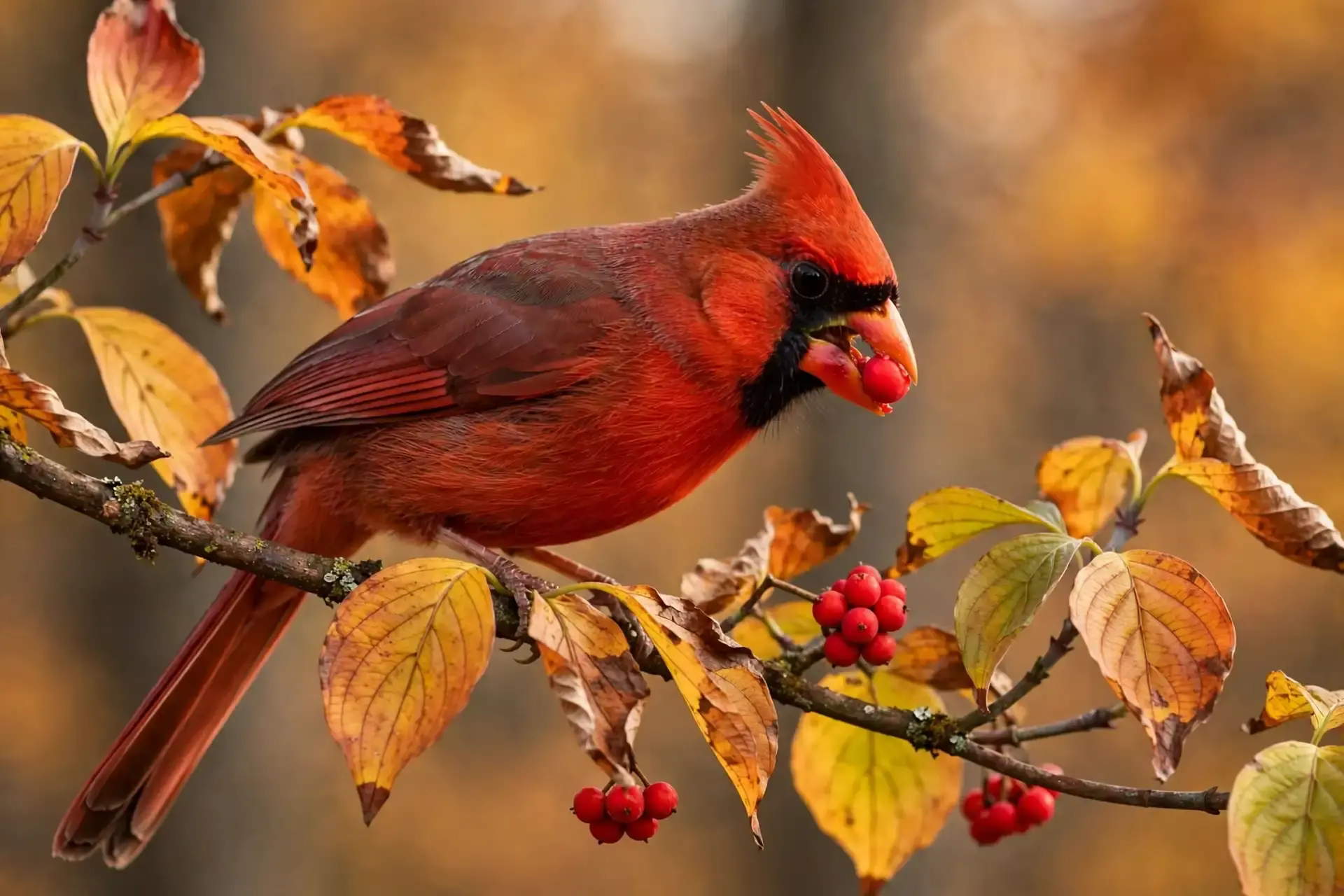
Carotenoids are the same family of pigments that make carrots orange and flamingos pink. Plants produce them, animals borrow them. Cardinals gather carotenoids from a long menu of natural foods: sunflower and safflower seeds, dogwood and sumac berries, wild grapes, mulberries, hackberries, and the fruits of various native shrubs.
The raw pigments they ingest are mostly yellow and orange. Inside the bird’s body, enzymes convert these into red ketocarotenoids, which the bloodstream then carries to feather follicles while new feathers are growing.
This conversion step is the key to the whole system. It is metabolically expensive, which means only a bird in genuinely good condition can afford to produce the deepest red.
A sick, parasitised, or malnourished cardinal simply cannot run the chemistry at full power, and its feathers come out duller. The colour is therefore not decoration.
It is a receipt, proof of the bird’s foraging success and health over the past weeks. If you want the deeper story of how diet shapes the birds at your feeders, our guide to attracting cardinals to your yard covers the foods that matter most.
Why Males Are Red and Females Are Not
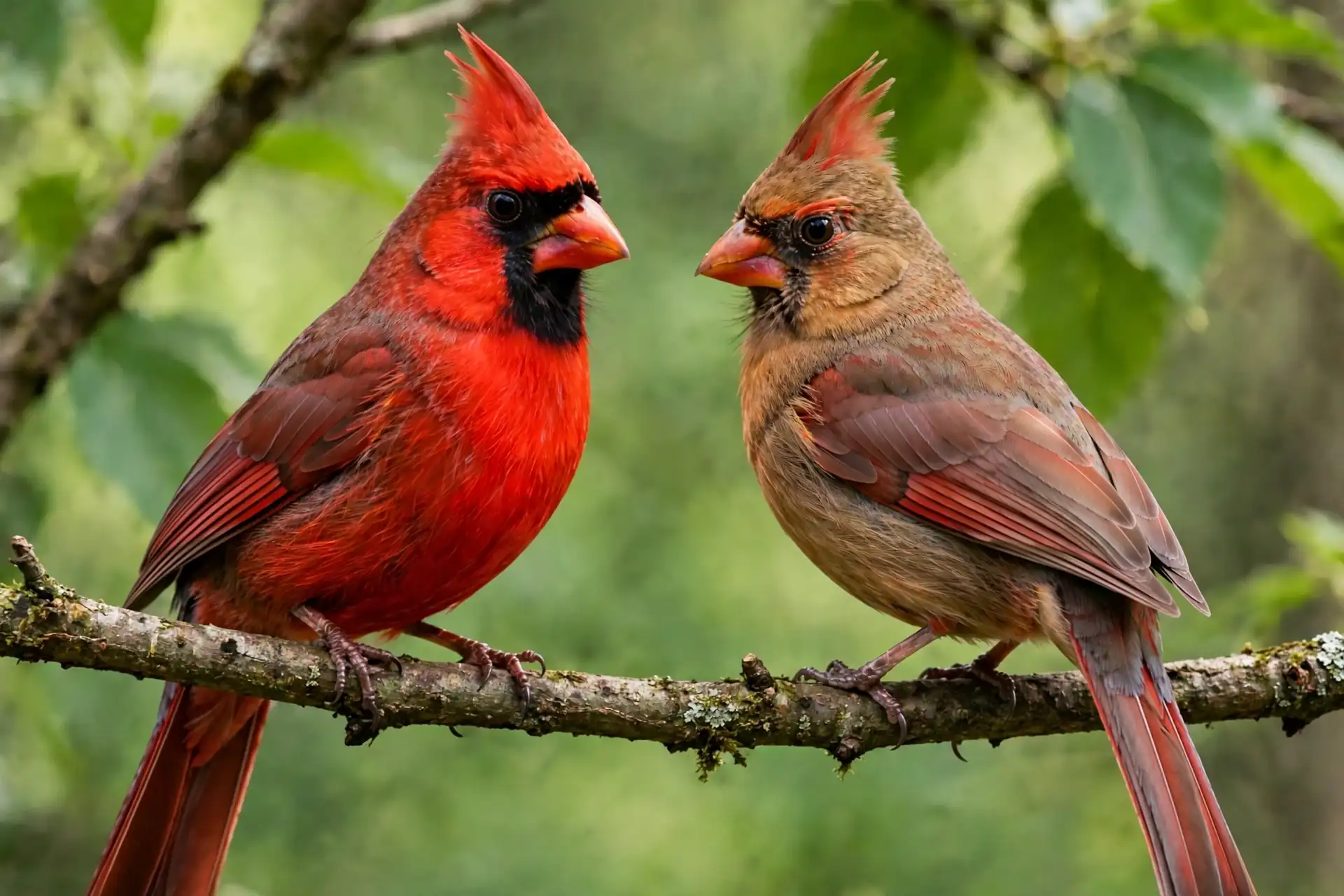
The difference between a male and female northern cardinal is one of the most striking cases of sexual dimorphism in North American birds. Males wear the full crimson suit with a black mask. Females are warm brown with red tinges on the wings, tail, and crest, like an ember version of the male’s flame. The full comparison is worth seeing side by side in our male vs female cardinal identification guide.
The split comes down to hormones and mating strategy. Testosterone in males ramps up carotenoid conversion and deposition, flooding the growing feathers with red pigment. Females produce far less of the hormone signal, so their feathers take up only a fraction of the pigment. Evolutionarily, the arrangement makes sense.
The male’s job in courtship is to be seen and judged, so selection has pushed his colour to the maximum. The female’s job includes sitting on an open-cup nest for nearly two weeks, and a flame-red bird on a nest would be a beacon for every predator in the neighbourhood. Her camouflage is not a lack of beauty. It is survival strategy.
Female cardinals are choosy, and they use the male’s colour as information. In courtship, males perform a touching ritual: the male picks up a seed and places it directly in the female’s beak, beak to beak, sometimes repeatedly.
Researchers who have studied this mate-feeding behaviour find that females prefer males with brighter, more saturated red plumage, and brighter males tend to hold better territories and feed their mates more reliably during nesting. The red is a promise, and the females are reading it carefully.
Brighter Red Means a Healthier Bird
Biologists call the cardinal’s plumage an honest signal, and honesty is enforced by chemistry. Because producing red feathers costs real metabolic resources, a male cannot fake being healthier than he is.
Studies of northern cardinals have found that males with brighter red plumage tend to have better body condition, stronger immune responses, and greater reproductive success. Females paired with bright males often start nesting earlier and raise more young, partly because a bright male is usually a better provider.
Parasites are the great enemy of a bright coat. Feather mites and internal parasites drain the resources a bird would otherwise spend on pigment conversion.
A male riddled with parasites grows washed-out feathers no matter how many berries he eats, and females notice. This is why the signal stays honest across generations: cheaters are exposed every molt, and dull males simply get fewer chances to pass on their genes. The cardinal’s red is one of nature’s most reliable advertisements, verified annually.
The Strange Case of the Yellow Cardinal
Every few years, the birding world buzzes about a yellow cardinal. These are real birds, not hoaxes: brilliant yellow where a cardinal should be red, like a living highlighter. The most famous recent case was a bird nicknamed Sunny, photographed in Alabama in 2018, which drew national attention.
Yellow cardinals are the result of a rare genetic mutation called xanthochroism that disrupts the final step of pigment conversion.
Remember that cardinals eat yellow carotenoids and convert them to red. In a yellow cardinal, the conversion machinery is broken. The bird deposits the raw yellow pigments directly into its feathers instead of the finished red product.
The result is a cardinal in the wrong colourway: same shape, same crest, same song, entirely different paint job. These birds are extraordinarily rare, which tells you how tightly controlled the normal conversion pathway is. When the machinery works, and it almost always does, every feather comes out red.
Albino and leucistic cardinals occur too, but those involve melanin, the dark pigment, rather than carotenoids. A white cardinal with pink eyes is dealing with a completely different genetic pathway than a yellow one. The bird world has more ways to go wrong with colour than most people imagine.
What Cardinals Eat to Stay Red
A cardinal’s menu is the foundation of its colour. In the wild, the most important carotenoid sources shift with the seasons: fresh berries and fruits in late summer and fall, when new feathers are actually growing, matter more than anything the bird eats in deep winter. Dogwood berries, sumac clusters, wild grapes, mulberries, and hackberries are all rich sources. Seeds carry carotenoids too, especially oil-rich ones.
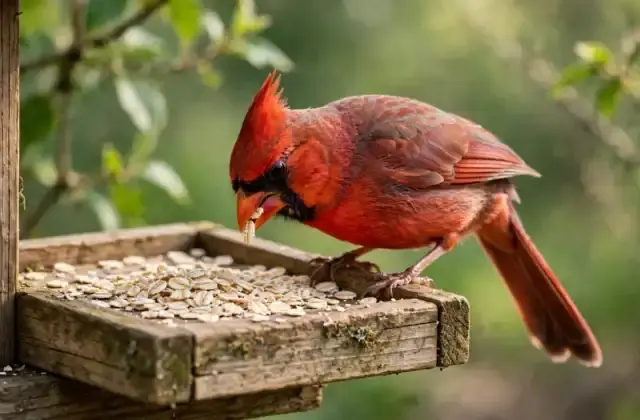
At backyard feeders, the foods that best support rich colour are the ones cardinals already prefer. Black oil sunflower seeds and safflower seeds are the top picks, with striped sunflower and peanut pieces close behind.
Cornell Lab’s Northern Cardinal species guide confirms their strong preference for sunflower and safflower over filler grains. Cardinals are not particularly fond of millet or milo, the cheap fillers in many seed mixes, so a feeder full of filler does little for either the birds or their colour.
Fresh water matters as well, since hydrated birds process nutrients more efficiently, and a heated birdbath in winter keeps a cardinal visiting your yard through the coldest months, when that red plumage shows to its best advantage against the snow.
Do Cardinals Fade in Winter?
It is a reasonable question, because so many birds change with the seasons. Goldfinches molt from bright yellow to dull olive. But cardinals do not fade in winter. They molt once a year, in late summer, and the fresh feathers they grow then carry them through the entire year. A cardinal in January is wearing feathers grown in August and September, coloured by the berries and seeds of late summer.
If anything, cardinals look their best in winter. The feathers are still relatively fresh, and the contrast of red against snow or grey branches is at its most dramatic.
By late spring, sun and wear have dulled the plumage slightly, and the bird looks a little shopworn until the next molt. Females follow the same cycle in their subtler palette. There is no winter-specific colour change, no seasonal wardrobe swap, just one good molt and a long, slow fade until the next one.
Red Pigment vs Blue Structure: A Quick Contrast
Here is a twist worth knowing: not all bird colour works the way the cardinal’s does. The cardinal’s red is pigment based, built from chemicals in food. But the blue of a blue jay contains no blue pigment at all.
Jay feathers get their colour from microscopic structures that scatter light, a phenomenon called structural colouration. Crush a blue jay feather and the blue vanishes, because you have destroyed the structure. Crush a cardinal feather and the red remains, because the pigment is still there.
This is why diet affects the two birds so differently. A cardinal on a poor diet grows dull feathers. A blue jay on a poor diet stays just as blue, because its colour was never about food chemistry. Two common backyard birds, two completely different ways of being colourful. Nature rarely settles for one solution when two will do.
How to Help Your Cardinals Keep Their Colour
You cannot paint a cardinal, but you can stock its pantry. The single most effective step is planting native berry producers: dogwood, serviceberry, elderberry, winterberry, and sumac all feed cardinals during the critical late-summer molt window. A yard that offers these is doing more for cardinal colour than any feeder can.
- Feed the right seeds: black oil sunflower and safflower as staples, peanut pieces as a supplement. Skip mixes heavy on millet and milo.
- Offer water year-round: a heated birdbath in winter keeps cardinals hydrated and visiting.
- Plant for the molt: native berries ripening in August and September feed the feather-growing season directly.
- Provide cover: dense shrubs near feeders give cardinals the safe staging areas they prefer. They are cautious birds that dislike long open flights to a feeder.
- Skip the pesticides: insects supplement the cardinal diet in breeding season, and poisoned insects poison the birds.

Cardinals do not migrate, so the birds you help in August are the same birds glowing in your yard in January. That year-round residency is part of what makes them special, and you can read about their winter strategy in our guide to whether cardinals migrate. Range maps and year-round sightings on eBird’s Northern Cardinal page show just how faithfully they stay put. A well-fed resident cardinal is a neighbourhood fixture, and its colour is the visible proof that your yard is doing its job.
FAQs
Are female cardinals red too?
Only partly. Females are warm brown with red accents on the crest, wings, and tail. They produce less of the hormonal signal that drives full red pigment deposition, which keeps them camouflaged while nesting. A fully red female would be a striking sight and an easy target for predators.
Can a cardinal change colour?
Not within a single feather. Once a feather is grown, its colour is fixed. A cardinal’s overall colour can only change at the annual late-summer molt, when old feathers are replaced. Diet during the molt window determines the new plumage, which is why late-summer nutrition matters most.
Why are some cardinals brighter red than others?
Diet quality, health, age, and genetics all play a role. Older, experienced males that hold good territories and eat well tend to be brightest. Parasites, illness, or a poor berry season can all dull a bird. Females use these differences to judge mate quality, so brightness carries real reproductive consequences.
What is a yellow cardinal?
A rare genetic mutant affected by xanthochroism, a condition that blocks the conversion of yellow dietary carotenoids into red pigments. The bird deposits unconverted yellow pigment in its feathers instead. Yellow cardinals are healthy and behave normally; they are simply wearing the raw ingredients instead of the finished product.
Do cardinals get their red from eating berries?
Partly. Berries are an important carotenoid source, especially during the late-summer molt, but seeds, fruits, and even some insects contribute. The full menu matters more than any single food. A varied natural diet plus quality feeder seeds produces the richest colour.
Conclusion
The cardinal’s red is not a coat of paint but a life story written in feathers: the berries of August, the health of the bird, the hormones of courtship, and the judgment of a watching female, all compressed into a single colour.
Every bright male on a winter branch is advertising a summer of successful foraging and a body strong enough to afford the chemistry. Plant the berries, fill the feeder with the right seeds, keep the water open, and the cardinals will do the rest. Their colour is their report card, and a well-kept yard earns top marks.