 Skip to content

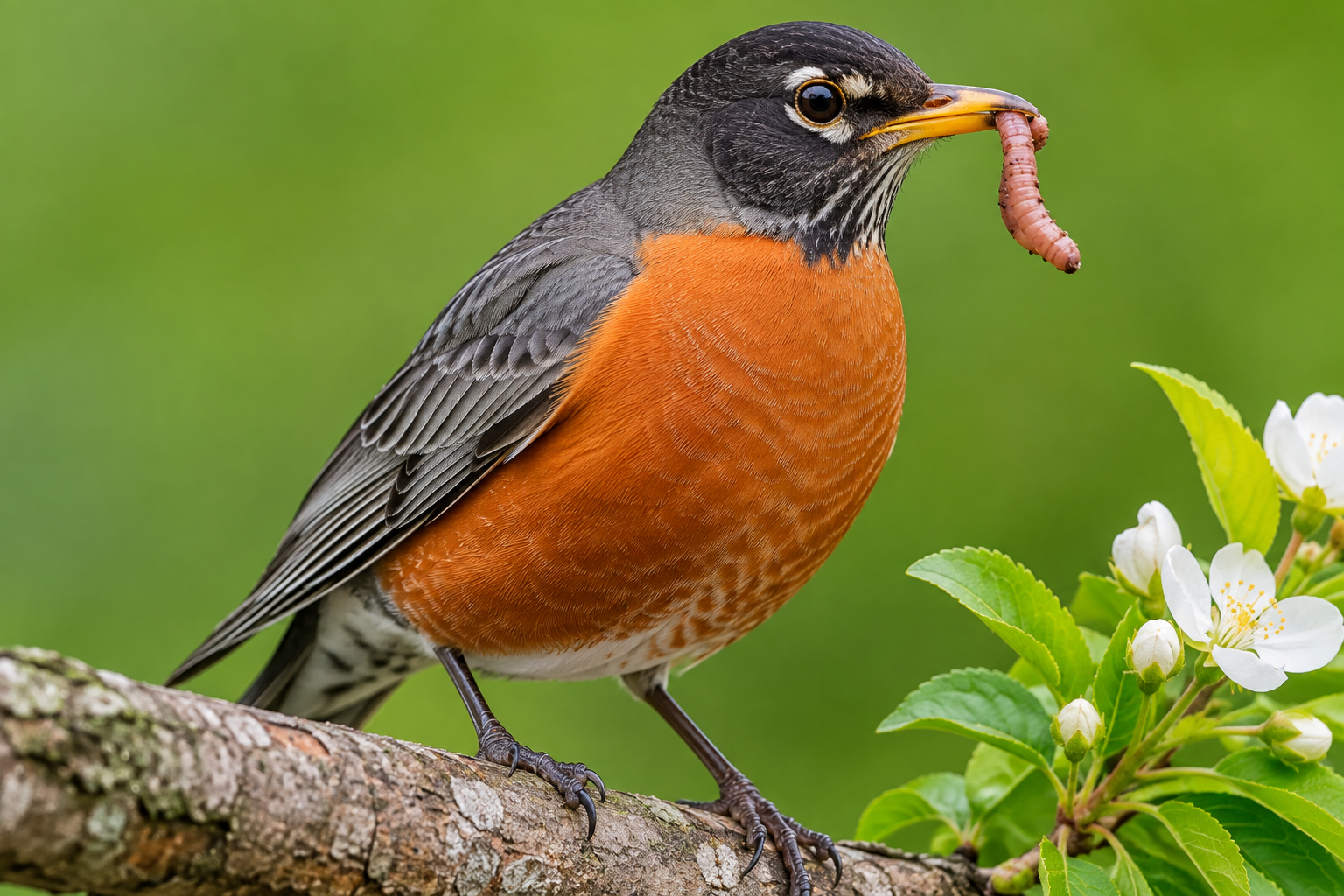
A gray morning in early spring, a thawing lawn, and a plump bird standing bolt upright with its head tilted toward the grass that scene plays out in yards across the continent every year, and the bird at the center of it is almost always an American robin. The reddish-orange breast gives it away from a block away. So does the posture: chest out, tail down, the erect stance typical of a thrush.
The American robin belongs to the family Turdidae, known as the true thrushes, which puts it in the company of bluebirds and the wood thrush rather than the small European robin that shares its name and orange front. Different family, different continent, different bird entirely.
This guide walks through how to identify an American robin in the field and covers habitat, migration, diet, song, nesting, life cycle, predators, and practical steps for attracting robins to your yard.
How to Identify an American Robin

Use this sequence when a likely robin is in front of you and you want a confirmed identification rather than a guess.
- Position yourself at a window or a spot roughly twenty paces from the bird, with the sun behind you. Backlighting washes out breast color, which is the whole game here.
- Check the breast first. Look for a solid reddish-orange wash across the chest and belly, fading to white under the tail. If the breast is streaked or spotted instead, you likely have a juvenile or a different thrush.
- Note the posture. Confirm an upright, chest-forward stance with the head held high. Robins stand tall; sparrows and starlings crouch.
- Watch the head and back. Look for a dark gray-to-black head contrasting with a gray-brown back, plus broken white eye-arcs and a yellow bill.
- Observe one full foraging cycle. Wait for the run, the abrupt stop, the head cock, the jab. That sequence confirms a robin more reliably than color alone.
- Listen for the song — a rolling, caroling series of clear phrases delivered in bursts.
- Log the sighting with date, location, and behavior. A photo or recording settles any doubt later.
What Is an American Robin?
The American robin is a thrush, classified as Turdus migratorius within the family Turdidae. The genus Turdus covers the large, ground-foraging thrushes found across much of the world — the Eurasian blackbird is a close relative, and the family resemblance shows in the body shape, the hopping-and-running gait, and the fluting song.
The name ‘robin’ is a historical accident. English colonists arriving in North America saw a bird with an orange-red front and reached for the familiar name from home. The European robin they were thinking of is a small, flycatcher-like bird in a different family, barely bigger than a wren. The two look nothing alike side by side, but the color association stuck and never came loose.
Familiarity is what makes this bird worth knowing well. The American robin nests in city parks, suburban hedges, orchards, and forest clearings, which means most people on the continent have one within walking distance for at least part of the year. It is the bird people learn first, the one that teaches beginners what “thrush” means in practice, and the yardstick against which other backyard birds get measured.
What Does an American Robin Look Like?
Start with size and shape. The American robin is a medium-sized songbird noticeably larger than a house sparrow, slightly bulkier than a starling — with a rounded belly, a long tail, and long legs built for walking on open ground. The bill is straight, slender, and yellow, sometimes with a dark tip.
The plumage reads as high contrast. A dark gray or blackish head, a gray-brown back and wings, and that famous brick-orange breast and belly. The throat is white with black streaking, the lower belly and undertail are white, and broken white crescents above and below the eye give the bird a slightly startled expression.
On the question of American robin male vs. female: males run darker and more saturated, with a blacker head that contrasts sharply against the gray back and a deeper orange breast. Females are paler and softer throughout, with a head tone closer to the back. The difference is real but subtle, and lighting can erase it judge birds side by side when you can.
Juveniles throw people off constantly. Young robins wear a heavily spotted breast over a pale buff background, with pale speckling on the back. The spots are a thrush trademark and they fade as the bird matures.
Quick identification checklist: upright stance, yellow bill, dark head, orange breast, white eye-arcs, white undertail, long legs, ground foraging.
Where Do American Robins Live?
American robin habitat is best described as “edges.” These birds want open ground to forage on and elevated cover to nest and perch in, and anywhere those two things meet, robins show up.
The breeding range covers most of North America, from the tree line in the far north down through the continent, with populations reaching into the mountains of Mexico. Robins occupy deciduous and mixed woodlands, forest clearings, tundra scrub, pine plantations, orchards, and agricultural hedgerows.
They also took to human development with unusual enthusiasm. Mowed lawns mimic the short-grass openings that robins already favor, irrigation keeps the soil soft, and ornamental fruit trees provide winter food. City parks, golf courses, cemeteries, campus quads, and ordinary backyards all support robins, often at higher densities than nearby wild habitat.
Where to look: scan the open lawn first, then the shrub line behind it, then the mid-height branches of any fruiting tree. In winter, skip the lawn entirely and check holly, crabapple, juniper, and sumac.
Do American Robins Migrate?
Yes — but not all of them, and not in the way most people assume. American robin migration is partial and highly flexible. birds breeding in the far north withdraw southward as insects disappear, while birds in milder middle latitudes may stay put year-round if food holds out.
Spring movement follows thawing ground northward. As soil softens and earthworms become reachable, robins push north in a loose wave, males usually arriving ahead of females to stake out territory. That timing is why the bird became a spring emblem: its return coincides with the ground becoming workable again.
In fall, robins shift from territorial pairs to roaming flocks. They abandon lawns, move into woodlands and fruiting thickets, and travel wherever berry crops are heaviest, sometimes covering long distances in short bursts.
Winter sightings surprise people every year. A flock of robins stripping a crabapple in January does not mean the birds failed to migrate or that spring is early. It means the fruit supply is good, which is the only variable most wintering robins are tracking.
What Do American Robins Eat?
Ask what do American robins eat and the honest answer is: two completely different menus, depending on the month.
In the warm months, the american robin diet leans heavily on invertebrates. Earthworms are the headline item, but robins also take beetle grubs, caterpillars, cutworms, grasshoppers, spiders, termites, and snails. Soft-bodied larvae are prime nestling food because they are easy to swallow and rich in protein.
From late summer through winter, fruit takes over. Robins eat chokecherry, serviceberry, hawthorn, dogwood, sumac, juniper berries, holly, crabapple, mulberry, and whatever ornamental fruit a neighborhood happens to offer. Fermented fruit late in the season can leave birds visibly unsteady.
Foraging technique differs by menu. On the ground, robins hunt visually, running a short distance and freezing to scan. In fruiting trees, they perch, reach, and pluck, often hovering briefly at the outer branches where the berries hang.
The seasonal switch is the practical takeaway: lawn worms in spring and summer, berries in fall and winter. and winter.
Why Do Robins Pull Worms From Lawns?
Watch closely and the pattern is unmistakable: run a few steps, stop dead, cock the head sideways, then stab. That head tilt is not listening in the way people often describe it. Robins hunt primarily by sight, angling one eye toward the grass to spot a worm’s movement, soil disturbance, or the tip of a burrow.
Moist soil changes everything. After rain or watering, worms move closer to the surface and the ground gives way easily to a probing bill, which is why lawns fill with robins right after a shower and empty during a dry spell.
One correction worth making: robins are not worm specialists. Worms are simply the most visible, most abundant, easiest prey on a short-cut lawn in spring. The same bird will ignore worms entirely once fruit ripens.
American Robin Behavior
Robins spend far more time on the ground than most songbirds, walking and running rather than hopping continuously, which is a useful identification cue on its own.
During breeding season, males defend territory aggressively. They sing from high perches, chase intruding males, and occasionally attack their own reflection in windows, hubcaps, and car mirrors — a behavior that frustrates homeowners every spring.
Outside the breeding season the social structure flips. Robins gather in flocks that forage together by day and gather into communal night roosts, sometimes numbering in the thousands, tucked into dense trees or reed beds.
Bathing is a reliable spectacle. Robins splash hard in shallow water, soaking themselves thoroughly, then retreat to a branch to shake, ruffle, and preen every feather back into place. A birdbath will pull them in even when nothing else will.
American Robin Song and Calls
The american robin song is a string of clear, whistled phrases, rising and falling, delivered in short bursts with brief pauses between them. Birders transcribe it as cheerily, cheer up, cheer up, cheerily — mnemonic shorthand that actually helps once you have heard the real thing.
Robins sing early. They are frequently the first voice in the dawn chorus and often the last at dusk, and males sing most persistently through the breeding season.
The american robin call inventory is separate from the song and worth learning. A sharp, repeated tut tut tut signals mild alarm. A high, thin seee warns of a hawk overhead. A loud, laughing chatter accompanies chases and flushes.
Listening tip: learn the alarm calls first. They are simpler, more frequent, and they tell you a robin is nearby before you see one.
American Robin Nesting and Breeding
Robins nest almost anywhere with a stable horizontal surface. Tree forks and dense shrubs are the natural choice, but porch light fixtures, gutter corners, window ledges, drainpipes, and equipment left in an open shed all get used regularly.
The female builds. She assembles an outer cup of coarse grass, twigs, and plant stems, then plasters the interior with mud carried in her bill, shaping the cup by pressing her body against it and turning. A soft lining of fine grass finishes the job. The mud shell is the signature — no other common backyard nest is built that way.
American robin eggs are the famous ones: unmarked, pale blue-green, smooth, and glossy enough that the color has a paint name. The female incubates while the male defends the area and brings food.
Nestlings hatch naked, blind, and helpless. Both parents feed them constantly on worms and soft larvae, and both haul away fecal sacs to keep the nest clean. Multiple broods in a single season are common where the weather allows.
American Robin Life Cycle
The sequence runs egg, nestling, fledgling, juvenile, adult — and each stage looks and behaves so differently that people often mistake them for separate species.
Nestlings develop fast, going from bare skin to pinfeathers to a full spotted juvenile plumage in a compressed window. When they leave the nest they cannot fly well, and this is the most dangerous stretch of a robin’s life. Fledglings spend days on the ground and in low cover, flapping clumsily, calling constantly, and relying on the male parent for food while the female often starts a new nest.
A grounded, hopping, spotted young robin with short tail feathers is almost never abandoned. The parents are watching from nearby. Independence follows gradually, and flight strength, foraging skill, and adult plumage all arrive over the weeks after fledging.
How Long Do American Robins Live?
Two different numbers get conflated here. The maximum recorded american robin lifespan is far longer than what a typical bird achieves, because mortality in the first year is brutal. Most robins that hatch do not survive to breed. Those that clear that first year stand a considerably better chance.
Risks stack up from both directions: predation, severe weather, disease, and starvation on the natural side; window strikes, vehicle collisions, pesticide exposure, and outdoor cats on the human side.
American Robin Predators and Threats
Eggs and nestlings face the heaviest pressure — from snakes, squirrels, chipmunks, crows, jays, grackles, and raccoons raiding nests. Adults are taken by hawks and falcons in daylight and by owls at night. Scavengers such as vultures clean up what predators leave behind rather than hunting robins themselves.
Human-related hazards do serious damage. Lawn chemicals move up the food chain through worms. Glass kills birds that see reflected sky. Free-roaming cats take enormous numbers of fledglings during the ground-hopping phase.
Homeowners can fix most of this cheaply: apply exterior window screens or patterned decals to problem glass, keep cats indoors during nesting season, skip broad-spectrum insecticides, and leave dense shrubs unpruned until young birds have moved on.
How to Attract American Robins to Your Yard
Robins ignore seed feeders, so the usual approach does not work. Target food, water, and cover instead.
Keep part of the lawn short and chemical-free — robins need open, workable ground to hunt on. Water it during dry spells to keep worms within reach of a probing bill.
Plant native fruiting species: serviceberry, dogwood, chokecherry, elderberry, winterberry, sumac, and juniper. These carry robins through fall and winter, which is when your yard actually stands out.
Add a shallow birdbath with rough footing and clean it often. Moving or dripping water works even better.
Drop the insecticides entirely. Poisoned worms and grubs are worse than no worms at all.
For nesting, leave dense shrubs and low tree forks intact, or mount an open-fronted nesting shelf under an eave.
American Robin vs European Robin
The american robin vs european robin question comes down to family. The American robin is a thrush in Turdidae, built like a blackbird and native to North America. The European robin is a small Old World flycatcher, closer in size to a chickadee, found across Europe and parts of Asia and North Africa.
They share an orange front and a name, nothing more. Colonists applied a familiar name to an unfamiliar bird based on color alone, and centuries later the confusion persists in Christmas cards, greeting card art, and trivia arguments on both sides of the Atlantic.
American Robin vs Similar Birds
Within North America, robins get confused with spotted thrushes such as the wood thrush and hermit thrush, with varied thrush in the West, with Eastern towhee, and occasionally with an orange-fronted bird with red head and black wings glimpsed at distance.
Judge four things: breast pattern — solid orange versus spotted; head color and any breast band; bill color; and foraging style. Robins run and freeze on open lawns; forest thrushes stay in shade and flick their wings. When plumage is ambiguous, AI bird identification tools can confirm from a photo or a recorded song.
10 Interesting American Robin Facts
- Robins hunt worms by sight, not by sound.
- The nest cup is reinforced with mud the female shapes herself.
- Egg color is distinctive enough to have named a shade of blue.
- Juveniles wear spotted breasts, a thrush family trait.
- Winter flocks roost communally in huge numbers.
- Fermented berries can leave robins visibly intoxicated.
- Males often attack their own reflection during breeding season.
- Robins raise multiple broods in a single season.
- They are among the first singers in the dawn chorus.
- Their diet flips from animal to fruit as the year turns.
Frequently Asked Questions About American Robins
- Do robins mean spring has arrived? Not necessarily. Many robins winter well north of where people expect them, so a January sighting reflects available fruit rather than early spring.
- Should I move a baby robin I found on the ground? No. Grounded fledglings are normal and their parents are nearby. Keep pets away and leave it alone.
- Will robins use a birdhouse? No. They need an open platform or shelf, not an enclosed box with an entry hole.
- Why is a robin attacking my window? A territorial male is fighting his reflection. Break up the reflection from the outside and it stops.
- Do robins reuse old nests? Usually not. They typically build fresh, though they may reuse the same site.
- What should I put out to feed robins? Mealworms, chopped fruit, or raisins — not birdseed.
Final Takeaway
The American robin earns its reputation as the neighbor bird: a large thrush with an orange breast and an upright stance, comfortable on lawns and in woodland edges, feeding on invertebrates in warm months and fruit the rest of the year, and singing before almost anything else at dawn.
Knowing all that changes what a walk across the yard feels like. Watch one bird through a full run-stop-jab cycle, learn its alarm call, find its mud-lined nest, and the most ordinary bird on the block stops being ordinary.






[…] If you want to hear why do birds sing in fall for yourself, the American robin is the best teacher. Robins sing a soft, sweet version of their spring carol, often from high perches at dawn and dusk. They are defending winter feeding territories rich in berries and fruit. Learn more in our guide to identifying and caring for American robins. […]