Introduction
The blue jay does not sneak into your garden. They are very loud and are often seen with their crest raised. They make a loud noise to let all the birds in your garden know they are there. While some love their loudness and bright blue color, others would like them to be more polite when feeding from the feeder. Overall, the blue jay is one of the most well known and misunderstood birds in North America.
The blue jay is a large songbird from the crow family, a bird with an amazing memory, voice, and social nature. They plant oak forests by accident, mimic the call of a hawk, and can communicate how they feel to their family by raising or lowering their crest. This guide will explain what blue jays are, how to identify them, what they eat, how they store acorns, and why they behave in certain ways.
Quick Answer
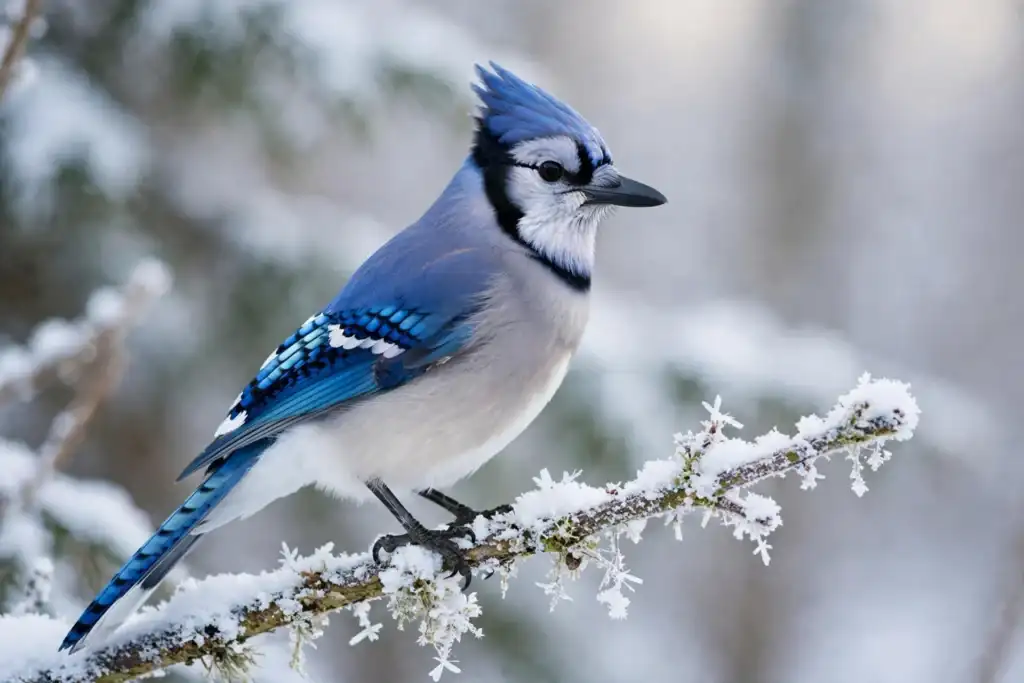
Blue jay: This large, noisy songbird (Cyanocitta cristata) belongsto the crow family. It has a perky blue crest, blue wings and tail, a white face and belly, and a black necklace around its throat. It lives in woodland and urban areas throughout eastern and central North America. Its diet includes acorns, nuts, seeds, fruit, and insects. It stores thousands of acorns each autumn. They can mimic the call of hawks and live in tight family groups.
Blue jay call: Loud, variable, and often shrill. Their most well-known call is a clear ‘jay’ call, but they also make soft whistles, clicks, and chattering calls, and mimic hawk calls extremely well.
Blue jay colour: The blue is not a pigment. It comes from light scattering inside the feather, so a blue jay feather crushed to dust looks brown.
What Is a Blue Jay
The blue jay is a bird belonging to the Corvidae family (Cyanocittacristata), the crow family. This family link explains a lot about the bird: crows, ravens, magpies, and jays share large brains, long memories, and complex social lives, and the blue jay fits that pattern.
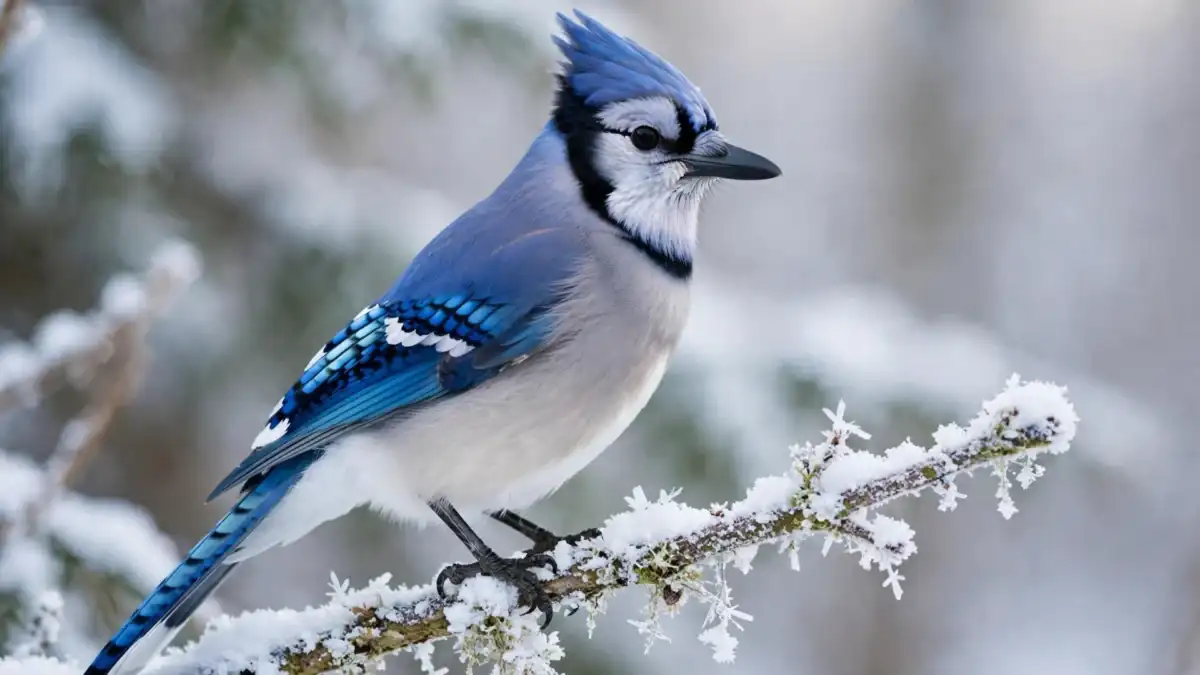
This large songbird has an upright crest and bright blue wings and tail. It has a white face and belly and a black necklace around the throat and sides of the head. The back is blue-gray with bold black barring on the wings and tail with white spots. This is an easy bird to identify when seen and difficult to forget once heard.
Blue jays can be found in all sorts of woodland habitats, but particularly around oak trees. They are also more common near woodland edges than in dense woodland. This means they are often seen in suburban areas, parks, and gardens with a good amount of trees. Having a few oaks, a feeding station, and shelter makes a great habitat for blue jays.
Four subspecies are recognised, differing slightly in size and shade of blue.
How to Identify a Blue Jay
The blue jay has several identifying features. The first identifying feature is the crest. The crest is a pointed feathered tuft on top of the head that the blue jay will raise when it is alert or excited. When it is relaxed, it will lower its crest. This feature is not found on any other common blue bird in the eastern United States.
Next, look at the face. The blue jay has a white face, with a black necklace around the throat and a black stripe across the eye that connects to the necklace. The bill is strong and black, and the underparts are white to pale gray. The wings and tail are bright blue with black bars.
It has a long blue tail with white tips and black barring. It often flicks its tail. The blue wings and white wing bars are prominent in flight. It has slow wingbeats and flies in a steady rowing motion.
Male, Female, and Juvenile
The sexes appear similar. There is no reliable color variation between the sexes that can be used to differentiate them in the field. The best way to tell them apart is by looking at their behavior at the nest. Juveniles look like a duller version of the adults, with a grayer crest and more muted patterning. Their plumage becomes more defined as they mature.
| Feature | Adult male | Adult female | Juvenile |
|---|---|---|---|
| Crest | Perky blue crest, raised when alert | Same as male | Duller, greyer crest |
| Plumage | Bright blue, white, black necklace | Same as male | Duller blue, less crisp marks |
| Bill | Strong black bill | Same as male | Dark bill, softer look |
| How to tell | Behaviour at the nest | Behaviour at the nest | Duller colours, often with parents |
For a full step by step comparison of the sexes, see our guide Male vs Female Blue Jay Identification.
Blue Jay vs American Crow
Blue jays and crows are cousins in the Corvidae family, and people sometimes confuse them at a distance. The differences are clear once you know what to check.
| Feature | Blue Jay | American Crow |
|---|---|---|
| Size | Large songbird, smaller than a crow | Larger, heavier, all black |
| Colour | Blue, white, grey, black | All black, including bill and legs |
| Crest | Perky crest on the head | No crest |
| Bill | Strong black bill, medium length | Heavy black bill, longer |
| Call | Varied, sharp jay notes, hawk mimicry | Harsh, familiar caw, caw |
| Flight | Steady rowing wingbeats, blue wings clear | Slow, steady wingbeats, broad wings |
| Behaviour | Noisy at feeders, caches acorns | Walks on the ground, works in flocks |
The blue jay is smaller, blue, and has a crest. The crow is larger, black, and does not have a crest. If it is blue, then it cannot be a crow.
Calls and Mimicry
Blue jays have a variety of different calls and an extensive vocabulary. The most well known is the loud and shrill jay-jay call, which can be heard throughout a garden and is how the bird got its name. This is often the first indication you may have that there is a jay nearby.
They also make soft whistling, clicking, and rattling sounds. Loud sounds are used to warn other birds of the presence of a hawk, whereas softer sounds are used to keep the family group together while feeding.
Blue jays are great mimics. They mimic the calls of Red-tailed Hawks and Red-shouldered Hawks to a very high standard. This can cause confusion with other birds and people. It can also put smaller birds off feeding at your feeder. Blue jays in captivity have been known to mimic human speech and cat meows.
The crest is another way of communicating. When it is up, they are either alarmed or excited. When it is down, they are relaxed. Using this in conjunction with their call will give you a better understanding of how they are feeling.
Intelligence and Social Life
Blue jays are a highly intelligent species with complex social structures and strong family ties. This is typical for corvids and can be seen in their everyday lives. They are able to learn where to find food, remember where they have hidden it, identify regular visitors to their feeding station, and work out how to reach food that is hard to get at.
Family groups are very tight-knit. Often young jays will remain with their parents for several months. Members of the family will feed each other, warn each other, and mob predators. If a jay finds a hawk, it will call loudly until others come to join in and mob the hawk until it goes away.
What Blue Jays Eat
Blue jays have a varied diet, changing throughout the year. Approximately 22 percent of their diet consists of insects, and the rest of their diet is made up of acorns, nuts, fruits, and grains. During spring and summer, insects are most important as they provide food for the growing chicks. During autumn and winter, they rely on acorns and nuts.
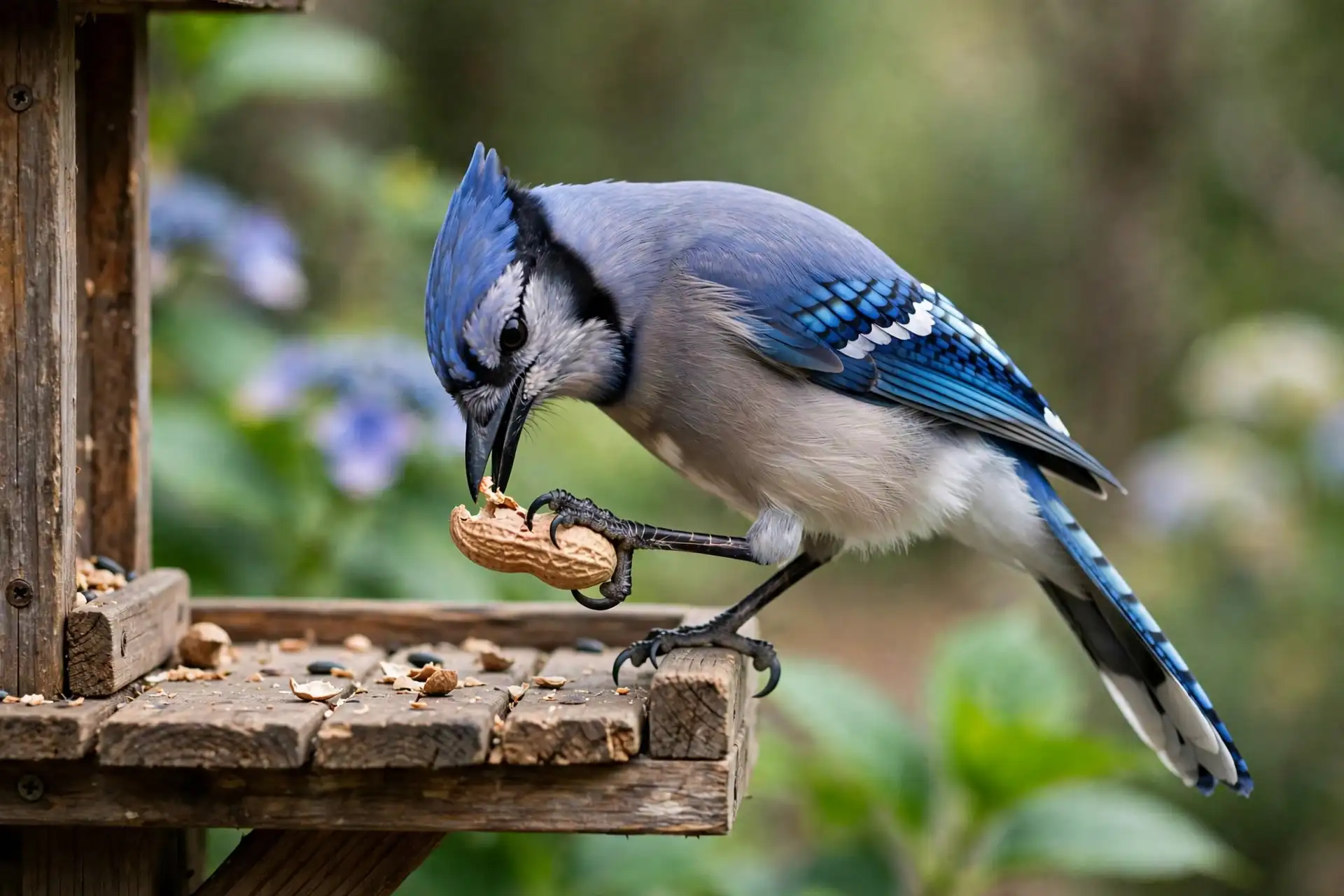
They collect insects from leaves and branches, eat nuts and seeds from trees and the ground, and also come to feeders to eat peanuts, sunflower seeds, and suet. They hold food in their feet while they peck it open.
Blue jays are often given a bad reputation for eating eggs and nestlings. However, a large-scale study found that only about 1 percent of blue jays had evidence of eggs or birds in their stomachs. Nest raiding behavior is present, but it only makes up a small part of their diet, not the main event.
At feeders, peanuts in the shell are a favourite. Offer peanuts, black oil sunflower seed, and suet, and keep the feeder clean and the food fresh.
Caching and Oak Forests

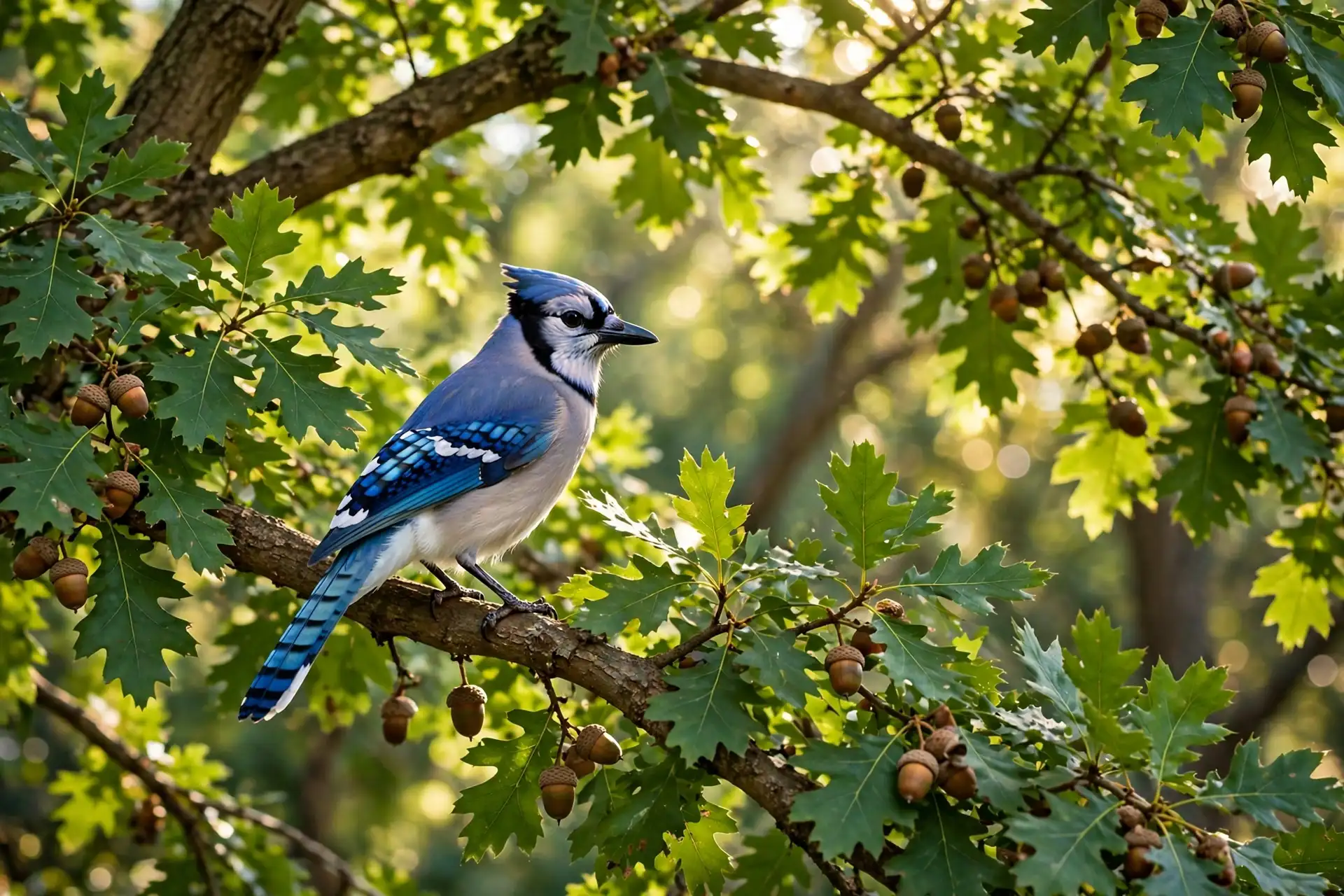
Caching is the blue jay habit that shapes whole forests. Blue jays have a throat and upper esophagus pouch called the gular pouch. They can store between 2 and 3 acorns in their gular pouch. They can also store one in their mouth and one at the tip of their bill. This means that they can carry 5 acorns at a time.
Six radio-tagged blue jays were tracked. Each bird caches between 3,000 and 5,000 acorns in one autumn. The acorns are buried underground, under leaf litter, and in soft soil. Many of these are remembered by the bird. However, acorns that are forgotten will grow into oak trees.
Forgetting helped the spread of oak forests after the last glacial period. Oaks are heavy seeded, so their acorns don’t travel far. Blue jays dispersed these acorns by carrying and burying them and leaving enough acorns to begin new oak stands. This could have resulted in an oak forest growing in an area where there were previously no oaks.
Caching is not random. Jays choose acorns that are sound and heavy, and they hide them in places they can find again.
Nesting and Family Life
The nest is built in a fork of a deciduous or coniferous tree, about 10 to 20 feet above the ground. The nest is made of twigs, grass, and mud, lined with soft materials. Both parents help to build the nest. They often nest in garden trees and are very vocal when defending their nest.
The female lays a clutch of 2 to 7 eggs, usually 4 or 5. The eggs are pale blue or green, speckled with brown. Both parents share incubating duties. The female does most of the sitting, while the male feeds the female. The eggs take around 17 days to hatch.
The chicks hatch blind and naked, and feed on insects provided by both parents. They grow quickly, and leave the nest after around 17 to 21 days. They remain with their parents for several weeks after this to learn where to find food and how to cache it.
Range and Habitat
Blue jays are found throughout eastern and central North America. They range from southern Canada to Florida and the Gulf Coast, and west to the east side of the Rockies. They are year-round residents throughout most of their range and one of the most common birds in eastern forests and suburbs.
They can be found in a variety of forests, but are more common around oak trees. They also like to live on the edges of forests, which means they can often be found in parks, gardens, campuses, and yards with trees. A suburban area with oaks, pines, and feeders can have more jays than an area of deep forest.
Migration in Brief
Blue jays are partially migratory. Many remain in the same area all year round but some will migrate south in autumn, often forming loose flocks during the day. Migration is irregular and depends on the acorn crop and weather conditions. If there is a good acorn crop, more will remain resident, whereas if there is a poor crop, more will migrate.
For the full picture, including when they move and how far, see our guide Do Blue Jays Migrate?.
Attracting Blue Jays in Brief
Blue jays will visit your yard if you provide them with food, water, shelter, and a place to cache. They will enjoy feeding on peanuts in the shell, black oil sunflower seed, and suet. A platform feeder or ground feeding area is ideal, as blue jays are large birds and like to have plenty of space to stand on.
Water helps, and so does cover. For the full guide, including feeder types and placement, see our guide How to Attract Blue Jays to Your Yard.
Anting and Other Odd Behaviours
Blue jays practice anting. This involves them taking an ant, usually a live one, and rubbing it across their feathers. The ant produces formic acid, which the bird spreads over their feathers. Although it is not yet entirely clear why they do this, it may help rid their feathers of parasites, or they simply enjoy it. Either way, it shows how much time they spend looking after their feathers.
Another odd habit is the way jays handle food. A jay will weigh a peanut in its bill, drop it, pick up another, and choose the heaviest.
Population and Conservation
Blue jay populations have decreased over the years. Between 1966 and 2014, there was a decrease in blue jay populations of about 29 percent, according to the North American Breeding Bird Survey. This is quite a significant decrease in population, despite them being fairly common and easily seen.
It is estimated that there are around 17 million individuals in the world breeding population (Partners in Flight, 2020). It is also listed as Least Concern on the IUCN Red List, due to having a large population and a wide range. However, this does not mean it is not still susceptible to decline. The blue jay is a reminder that common does not mean safe forever.
Habitat change is also an issue. Blue jays require oak woodland and woodland edge habitats. Both habitats are under threat from development and loss of oak due to disease and pests.
Common Mistakes About Blue Jays
- Mistake 1: Calling blue jays bullies and nothing else. While they can be quite noisy at feeders, blue jays also plant oaks, alert other birds to hawks, and are caring parents. The bully label misses most of the bird.
- Mistake 2: Thinking blue feathers are blue pigment. Blue is structural coloration due to scattering of light. There is no blue pigment in the blue jay feather. The only true pigment in the feather is brown melanin. If you crush the feather, it will appear brown.
- Mistake 3: Thinking all blue jays migrate. Many are permanent residents. They will migrate depending on acorn availability and weather conditions. The blue jay you see in your yard in the winter may be a permanent resident.
- Mistake 4: Thinking jays mainly eat eggs and nestlings. While they do prey on nests, an extensive study showed only about 1 percent of jays had evidence of eggs or birds in their stomachs. Jays mainly eat acorns, nuts, fruit, grain, and insects.
- Mistake 5: Thinking males and females look different. They look alike to us, and the sexes are best told apart by behaviour at the nest.
Frequently Asked Questions
- What is the scientific name of the blue jay: Cyanocitta cristata, in the crow family, Corvidae.
- Are male and female blue jays different: To our eyes, no. Males and females look alike, with the same crest, necklace, and blue plumage. Behaviour at the nest is the reliable difference.
- Why are blue jays blue: The blue is structural, not pigment. Light scatters inside the feather and returns blue to the eye. The only true pigment is brown melanin.
- Do blue jays migrate: They are partial migrants. Many stay all year, and others move south in autumn, depending on acorn crops and weather. For the full picture, see the migration guide linked above.
- What do blue jays eat: Acorns, nuts, fruits, grains, and insects. About 22 percent of the diet is insects over the year. At feeders they favour peanuts, black oil sunflower seed, and suet.
- Why do blue jays mimic hawks: They copy Red-tailed and Red-shouldered Hawk calls, and the mimicry can scare smaller birds away from a feeder. It may also warn other birds of a real hawk nearby.
- How many acorns can a blue jay carry: Up to 5 at a time, with 2 to 3 in the gular pouch, one in the mouth, and one in the tip of the bill.
- How many acorns does a blue jay cache: In one study, six radio-tagged birds each cached 3,000 to 5,000 acorns in a single autumn.
- Are blue jays intelligent: Yes. They cache food and remember hiding places, learn feeder routines, recognise people, and live in tight family groups with complex calls.
Conclusion
A blue jay is much more than just a noisy blue bird that visits your feeders. They are an intelligent member of the crow family. Their intelligence shows through their ability to plant new oak forests by caching acorns and forgetting where some of them are. They are also very vocal, and give warnings to other birds about hawks. They can also mimic hawk calls. Finally, they care for their young in tight family units.
If you know the characteristic features of the bird, then it is easy to identify them. The perky crest, black necklace, blue wings with black bars, and noisy jay call will all help. If you know their behavior, then they become more difficult to ignore. The acorn in the gular pouch, the peanut weighed in the bill, and the crest raised in alarm are the signs of a bird that is thinking.
Keep peanuts and sunflower seed out, keep an oak if you have one, and watch the jays for a few minutes. The noise is the first thing you notice. The intelligence is the thing that stays with you.
Sources
- Cornell Lab of Ornithology, All About Birds, Blue Jay life history and identification.
- BirdsBuzz, Do Blue Jays Migrate?
- BirdsBuzz, How to Attract Blue Jays to Your Yard
- BirdsBuzz, Male vs Female Blue Jay Identification