

Introduction
Woodpeckers are one of the easiest and most frustrating birds to identify. Is it a downy or hairy? Is that red a red-bellied or red-headed woodpecker? Once you know how to identify them by their size, bill shape and a few constant field marks, you will be able to quickly identify most woodpeckers.
This guide will help you identify the six most commonly seen woodpeckers in North America. You’ll learn about their family characteristics, size, bill shape, field marks, how they use their drumming and calls, and where to look for each bird. Woodpeckers are built for that life, with a chisel-like bill, stiff tail feathers and feet that grip a vertical trunk.

Quick Answer
There are over 200 woodpecker species worldwide. Approximately 20 plus species of woodpecker can be found in North America. The six most common woodpeckers seen in backyards are the downy, hairy, pileated, red-bellied, red-headed and northern flicker.
Downy woodpecker: The smallest in North America, about 6 inches long, with a short thorn-like bill. Hairy woodpecker: Looks almost identical to the downy but is about twice the size, with a long chisel-like bill. Pileated woodpecker: The largest in North America, 16 to 19 inches long, black with a flaming red crest. Red-bellied woodpecker: Barred black and white back, red on the nape, and a pale belly with only a small reddish patch. Red-headed woodpecker: The only North American woodpecker with an entirely red head and neck. Northern flicker: A ground-feeding woodpecker with a brown barred back, spotted breast, and black chest band.
What Makes a Woodpecker
Woodpeckers belong to the Picidae family, a group of birds built for life on tree trunks. Every member of the family shares the same toolkit, and that toolkit is what lets a woodpecker hammer, climb, and feed where other birds cannot.
The bill is the first tool. It is straight, strong, and chisel-like, made for chipping bark and drilling into wood.
Tool two: The tail. Woodpeckers have stiff tail feathers which press against the tree bark to provide support for their body. This helps them to lean back and hammer without falling over.
Third tool: The feet. Woodpeckers have zygodactyl feet (two toes facing backwards and two forwards). This gives a strong grip to allow them to cling onto vertical trunks. The feet also work well on branches.
The fourth tool is the tongue. The woodpecker has a long sticky tongue that can extend far beyond its bill to help it reach insects deep in cracks and tunnels. This is one of the most unusual features of the bird world and allows the woodpecker to eat where the nuthatch or chickadee would be unable to.
How to Identify a Woodpecker
Start with size, then bill, then pattern. Size alone separates the pileated from the rest, and it separates the downy from the hairy once you have a reference point.
If the bill is short in comparison to the head then it will be a downy. If it is about the same length then it will be a hairy. If it is long and heavy and the bird is large and black then it will be a pileated.
Check the pattern on the back. If there is a white stripe down the back they are downy or hairy. If there is a black and white barred back they are red-bellied or red-headed. If there is a brown barred back with spots underneath they are northern flicker.
Look at how the bird moves. Most woodpeckers climb trunks and branches in short bursts. The northern flicker is an exception to this, because it often feeds on the ground, walking and probing for ants.
The Six Common Backyard Species
| Species | Scientific Name | Length | Bill | Key Marks |
|---|---|---|---|---|
| Downy Woodpecker | Dryobates pubescens | About 6 inches | Short, thorn-like, shorter than head | White back stripe, black spots on white outer tail feathers |
| Hairy Woodpecker | Dryobates villosus | About 9 to 10 inches | Long, chisel-like, about head length | White back stripe, no black spots on white outer tail feathers |
| Pileated Woodpecker | Dryocopus pileatus | 16 to 19 inches | Long and heavy | Black body, white neck stripes, flaming red crest |
| Red-bellied Woodpecker | Melanerpes carolinus | About the size of a hairy | Medium, straight | Barred black and white back, red nape, pale belly |
| Red-headed Woodpecker | Melanerpes erythrocephalus | About 9 inches | Medium, pointed | Entirely red head and neck, white underparts, large white wing patches |
| Northern Flicker | Colaptes auratus | About 11 to 12 inches | Slightly curved, pointed | Brown barred back, spotted breast, black chest band |
Use the table as a starting point, then read the species accounts below for the details that confirm an identification.
Downy Woodpecker
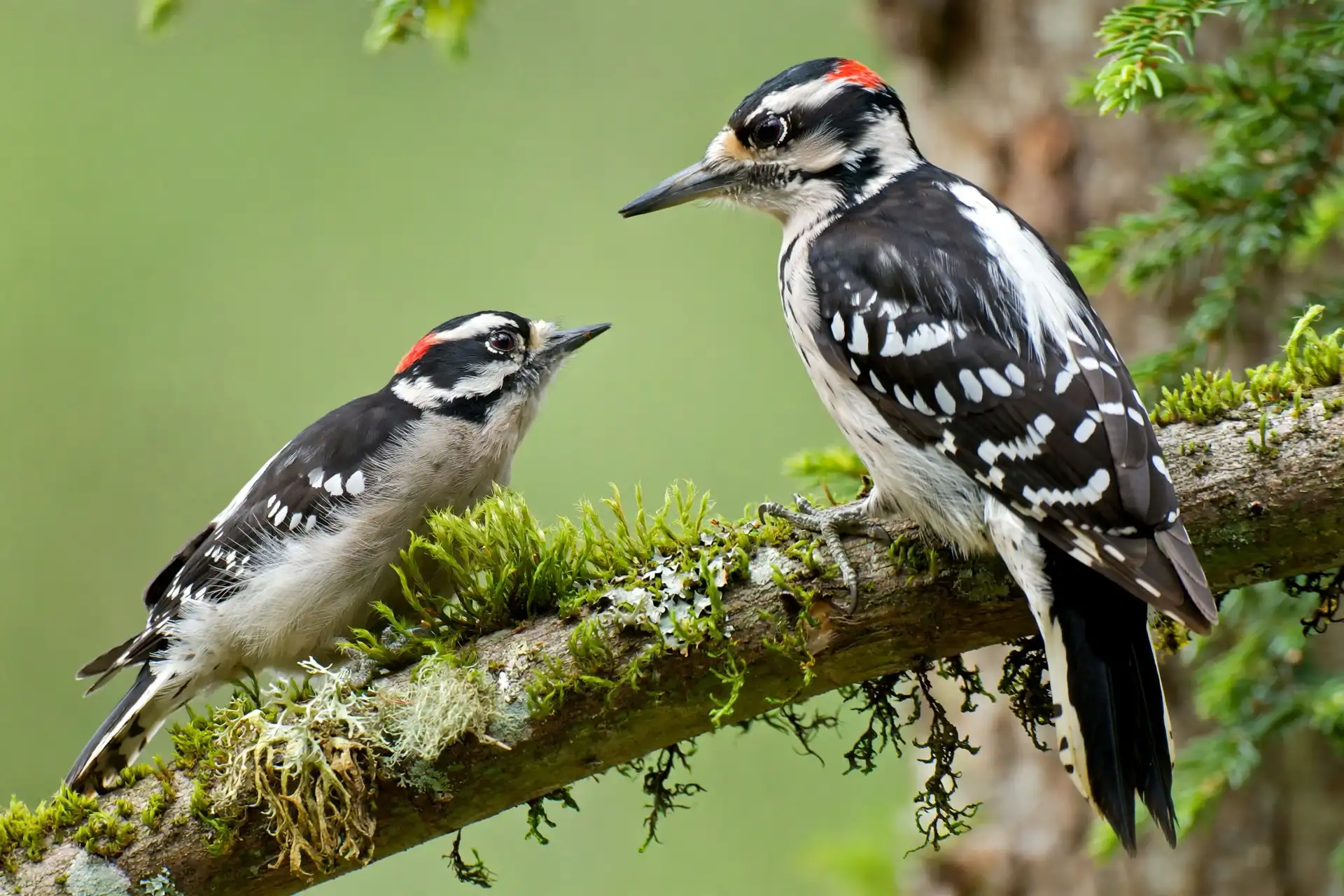
The downy woodpecker, Dryobates pubescens, is the smallest woodpecker in North America. It is about 6 inches long and weighs about 0.95 oz, which is less than an ounce. This small woodpecker is very neat, with black and white feathers and a white stripe down its back.
The bill is the key mark. It is short and thorn-like, clearly shorter than the length of the head. That short bill separates the downy from the hairy at a glance, once you know to look for it.
The male has a small red spot on the nape. The female is unmarked. Both sexes have black spots on the outer tail feathers, which are white; this feature is absent in the hairy woodpecker.
Downy woodpeckers use smaller branches and stems, and they visit feeders often.
Hairy Woodpecker
The hairy woodpecker, Dryobates villosus, has a very similar appearance to the downy woodpecker. However, differences can be clearly seen between the two species; the hairy woodpecker is larger and has a longer bill.
The hairy is around 9 to 10 inches long and weighs around 2.3 oz, making it roughly twice the size of the downy. The hairy is larger and heavier than the downy, with a longer body and more pronounced presence on the trunk.
The bill is long and chisel-shaped, and is about the same length as the head. This is the best identification feature. If the bill appears to be the same length as the head then it is a hairy.
The white outer tail feathers are unmarked with black spots, unlike the downy. The male has a red patch on the back of its head, like the male downy.
Hairy woodpeckers spend more time on large trunks, while downy woodpeckers work smaller branches.
Downy vs Hairy: The Quick Check
This is the comparison most people will want. Look at the bill first, then the body size. If the bird has a short bill and a small body, then it is a downy. If it has a long bill and a larger body, then it is a hairy.
The tail spots help too. Black spots on the white outer tail feathers point to downy. Clean white outer tail feathers point to hairy.
See our guide Downy vs Hairy Woodpecker: How to Tell Them Apart for a full step-by-step comparison. It covers the field marks in the order to check them in the field.
Pileated Woodpecker
The pileated woodpecker, Dryocopus pileatus, is the largest woodpecker in North America. It can be 16 to 19 inches long and is almost as large as a crow. Once you have seen this bird well, it is impossible to confuse it with any other woodpecker.
The body is black with prominent white stripes along the neck. The head has a flaming red crest extending backwards from the bill, creating a dramatic, wild appearance.
Male and female differ in two small marks. The male has a red moustache, called a malar stripe, and the red crest reaches all the way to the bill. The female has a black moustache and a gray forehead, and her crest does not reach the bill.
Pileated woodpeckers live in large forests with big dead trees, and they leave big rectangular holes in trunks when they feed.
Red-bellied Woodpecker
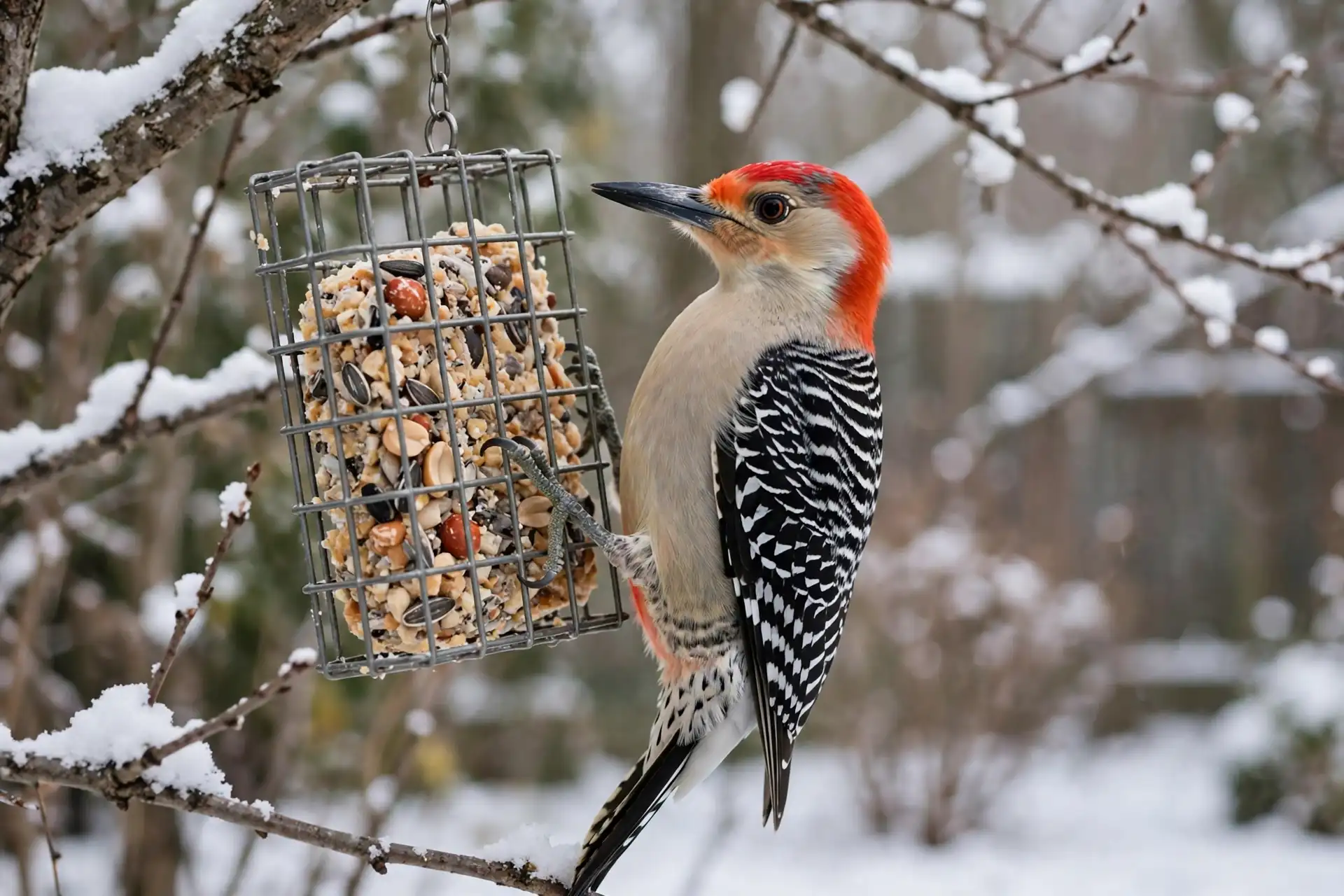
The name of the red-bellied woodpecker, Melanerpes carolinus, is one of the most misleading names in birding. Its belly is pale, with only a small amount of red that can be difficult to see, and many birders never notice it at all.
The back is also distinctive. There are barred black and white stripes running the length of the back and wings. There is red on the nape, and this is the mark to watch.
The male has red from the nape right to the tip of the bill. The female’s red is confined to the nape. The crown is pale. This is a definite and easily recognizable difference when at the feeder.
The red-bellied woodpecker is about the same size as a hairy woodpecker. It is very common in the eastern United States and can be found in woodlands, parks, and backyards. It visits suet feeders often.
It is often mistaken for the red-headed woodpecker, which has a fully red head and a black back with white wing patches.
Red-headed Woodpecker
The red-headed woodpecker, Melanerpes erythrocephalus, is the only woodpecker in North America that has a fully red head and neck. As such, it is the simplest woodpecker to identify in the field.
The head and neck are bright red, underparts are white, and back is black with large white wing patches that flash in flight. This is a very distinctive and striking bird. No other woodpecker looks like this.
Male and female look alike, which is unusual for woodpeckers. Both sexes show the same red head, white belly, and black and white wings.
Red-headed woodpeckers catch insects in the air, storing their acorns in crevices in trees. They can be found in open woods, groves, and parks. For full identification information, see the Red-headed Woodpecker identification guide.
Northern Flicker
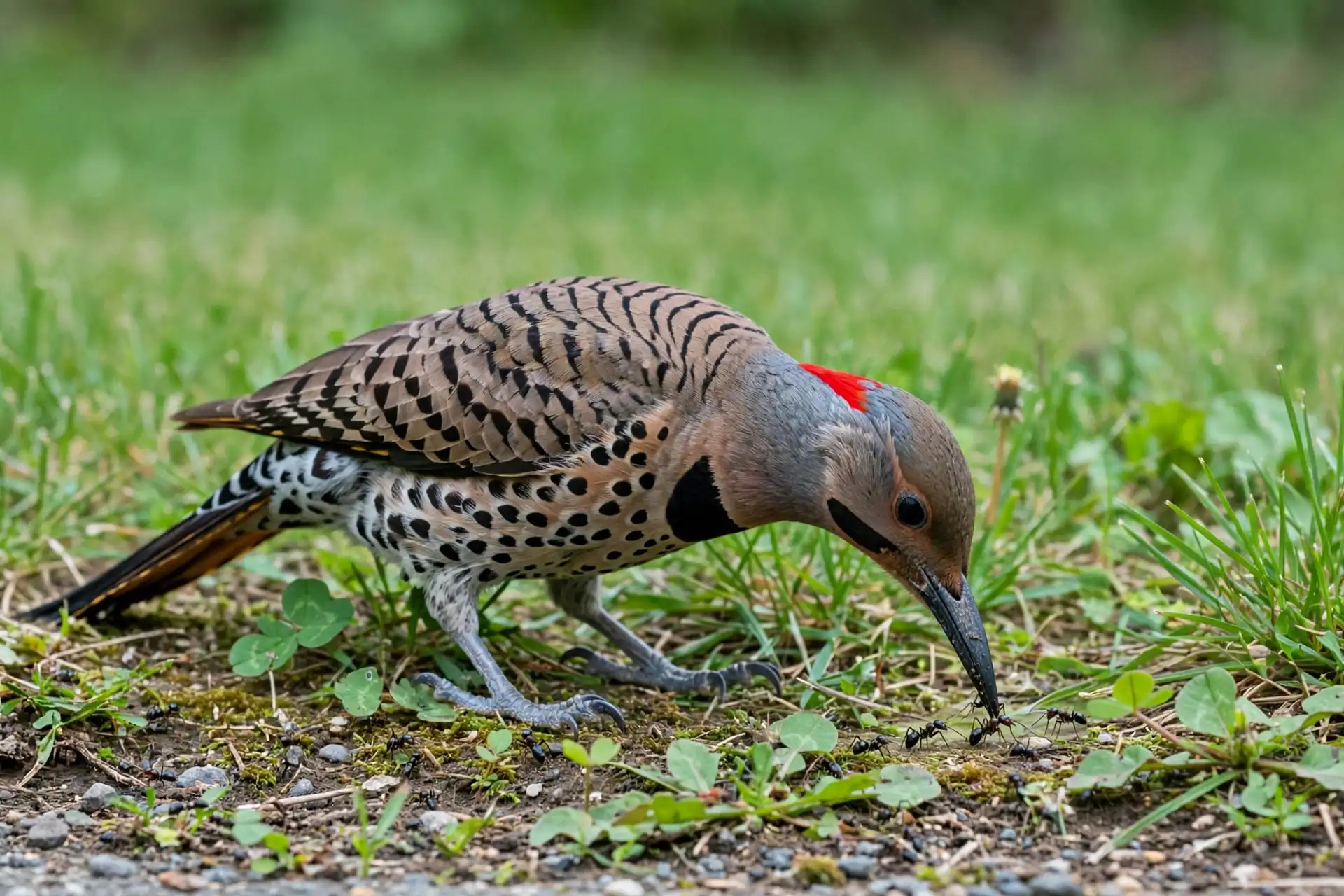
The northern flicker, Colaptes auratus, is an exception to the rule. It forages on the ground, walking around on lawns and probing the soil for ants, its primary food.
The back is brown and barred, the breast is spotted, and a black band crosses the chest. In the east, the yellow-shafted form shows yellow under the wings and tail, a flash of color that is easy to see in flight.
The bill is slightly curved and pointed. The flicker uses it to probe into soil rather than hammer into wood. Like other woodpeckers, the flicker drums and nests in cavities, but its feeding style sets it apart.
Look for flickers on lawns and in open woods, especially when ants are active.
Drumming and Calls
Woodpeckers drum to communicate. They drum by hammering their bills in a fast burst against a hollow branch, a dead trunk, or even a metal gutter. This sound can be heard from far away and informs other woodpeckers of their location and that the territory is taken.
Each species has a different rate of drumming. Downy woodpeckers drum quickly in short bursts. Hairy woodpeckers drum more slowly. Pileated woodpeckers drum slowly in long, irregular bursts which sound strong and wild.
They also have distinctive calls. The pileated has a raucous laughter like a jungle bird. The northern flicker has a loud, clear, rising and falling call. The downy has a high, thin call. The hairy has a sharper, higher pitched and louder version of the same call.
For a wider look at how woodpeckers live and communicate, take a look at this guide to woodpeckers in the Washington DC area, which covers the common species, their calls, and their habits.
Nesting and Cavities
Woodpeckers nest in holes that they make by pecking, usually in dead trees or dead limbs. The pair works together to chip out a hole using their bills, and the nest chamber sits inside the trunk.
Cavity nesting is hard work, and it is one of the reasons woodpeckers need dead trees. Removing dead trees takes away both food and homes.
Old woodpecker cavities matter after the woodpecker leaves. Owls, ducks, bluebirds, and many other birds use old woodpecker holes for nesting, because they cannot dig their own.
Do not approach a nest to get a closer look. Watch from a distance with binoculars, and give the birds space while they raise their young.
What Woodpeckers Eat
Their diet consists of insects, larvae and small animals found in bark and wood, as well as fruits, nuts, seeds and sap. Their diet varies depending on the season and what is available on the trees.
Insects and larvae are the most important foods in spring and summer. Woodpeckers probe bark, drill into dead wood, and catch insects in the air. In autumn and winter, fruit, nuts, and seeds are more important. Suet is an important food source at feeders.
The northern flicker is the exception, because it eats ants from the ground. The red-headed woodpecker is another exception, because it stores acorns and catches insects on the wing.
Do Woodpeckers Migrate
Most woodpecker species in North America are non-migratory and remain in the same area during the winter. A few species will migrate south in some years due to a lack of food, but most woodpeckers do not migrate like warblers and hawks.
The same downy, hairy, red-bellied, and pileated woodpeckers you see in summer are usually still there in January.
For the full answer, including which species move and when, see Do Woodpeckers Migrate?
Woodpeckers at Feeders
The best food to give woodpeckers is suet, and it is a key winter food. Hanging a feeder filled with suet on a branch or pole will attract downy, hairy, red-bellied, and pileated woodpeckers. They will often give you great views from close up.
Feed suet from a cage feeder. It should be kept fresh and dry. In warm weather, suet can melt and go rancid, so feed mainly in the colder months, and clean the feeder regularly.
Black oil sunflower seed also brings woodpeckers in, and so do peanuts and peanut butter mixes.
For the full attracting guide, including feeder types and placement, see How to Attract Woodpeckers to Your Yard.
Common Mistakes When Identifying Woodpeckers
- Mistake 1: Calling every small black and white woodpecker a downy. Check the bill first. A long bill on a larger bird means hairy, not downy.
- Mistake 2: Expecting a red belly on a red-bellied woodpecker. The belly patch is small and often hidden. Look at the barred back and the red on the nape instead.
- Mistake 3: Confusion between red-headed and red-bellied woodpeckers. The red-headed has a fully red head, and a black back with white wing patches. The red-bellied has a barred back and only the head is red.
- Mistake 4: Forgetting the northern flicker. A brown, spotted bird on the ground is often a flicker, and many people miss it because they only look up at trunks.
- Mistake 5: Using color alone in poor light. Use size, bill shape, and back pattern as well as color, because light can hide red and wash out barring.
- Mistake 6: Ignoring females. In several species, the female looks different from the male, especially in the red on the head. Learn both sexes.
Frequently Asked Questions
What is the most common woodpecker in North America: The downy woodpecker, the smallest species and a regular feeder visitor across the continent.
How do you tell a downy from a hairy woodpecker: Check the bill and the size. The downy has a short bill that measures less than the length of its head, and is about 6 inches long. The hairy has a long bill that measures about the same as the length of its head, and is about 9 to 10 inches long. The downy also has black spots on its white outer tail feathers, and the hairy does not.
What is the largest woodpecker in North America: The pileated woodpecker, 16 to 19 inches long, nearly the size of a crow, black with a flaming red crest.
Why do woodpeckers drum: Drumming is used to communicate. It is used to mark territory and attract a mate. It can be heard further away than a call. It is not used for feeding, and is slower and less regular.
Do woodpeckers eat suet: Yes, suet is a key winter food for woodpeckers, and it brings downy, hairy, red-bellied, and pileated woodpeckers to feeders.
Do woodpeckers migrate: Most North American woodpeckers are year round residents. A few species move south in some years when food is scarce, but most stay put through winter.
Which woodpecker has a fully red head: The red-headed woodpecker, the only North American woodpecker with an entirely red head and neck, with white underparts and large white wing patches.
Why do woodpeckers peck at houses: Woodpeckers drum on houses to make noise, and they may also probe for insects or excavate a cavity. The drumming is usually about communication, not feeding.
Conclusion
Woodpeckers reward a careful look at size, bill, and pattern. The downy is small with a short bill. The hairy is bigger with a long bill. The pileated is very large with a black body and a red crest. The red-bellied has a barred back and its nape is red. The red-headed has a completely red head. The northern flicker has a spotted breast and a black band across the chest and feeds on the ground.
If you can recognize these six species, you will be able to identify most of the woodpeckers you will see in your yard or woodland in North America. By providing suet outside in the winter and leaving dead trees standing where it is safe to do so, you will hear some drumming in the spring. That careful look, and that careful listen, is what turns a quick flash on a trunk into a confident woodpecker sighting.
For a friendly overview of woodpecker habits and identification, see this woodpecker guide from Dave’s Garden.
Sources
- Cornell Lab of Ornithology, All About Birds, woodpecker species guides.
- Dave’s Garden, woodpecker identification and habits guide.
- Kingfisher of the Anacostia Watershed, woodpecker guide.