
Baltimore Oriole: The Short Answer
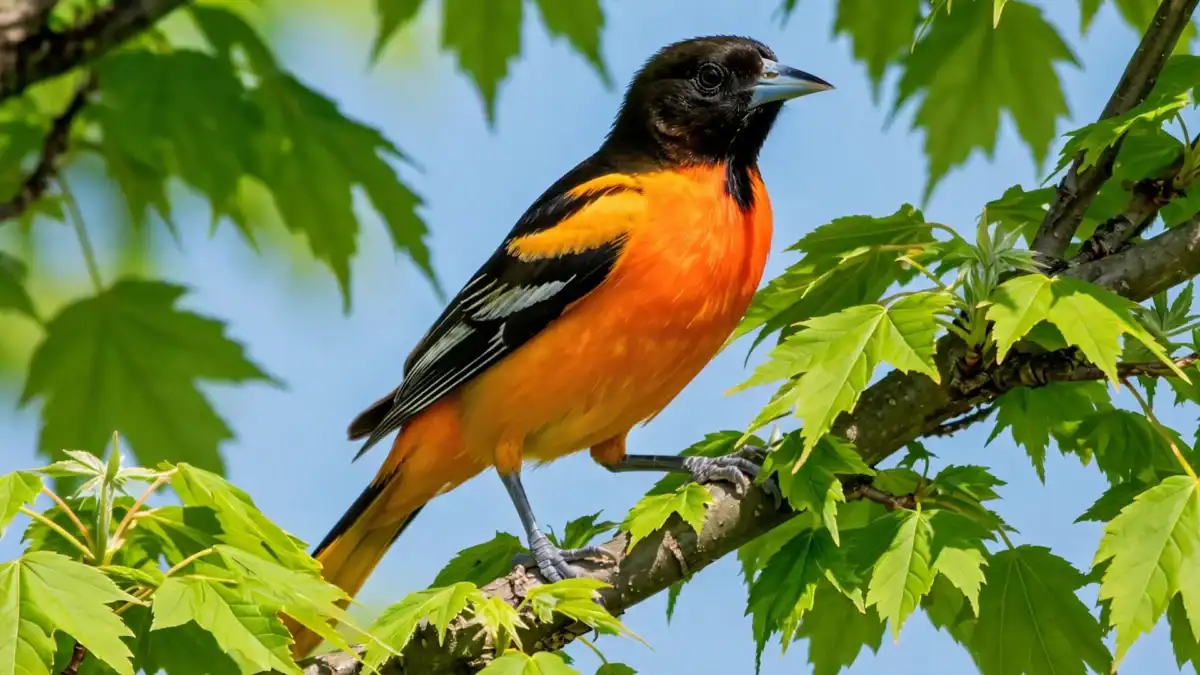
The Baltimore oriole is a medium sized eastern songbird, Icterus galbula. The adult male is flame orange and black, the song is a rich whistle, and the nest is a deep hanging pouch woven by the female. It breeds in open leafy woodland across eastern North America, spends winter in Mexico and Central America, and in late spring it visits backyards for orange halves, grape jelly and nectar.
How to Identify an Adult Male Baltimore Oriole
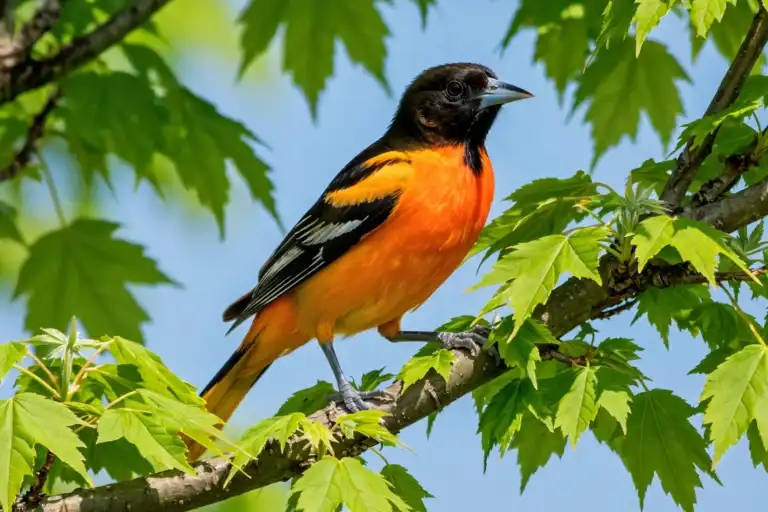
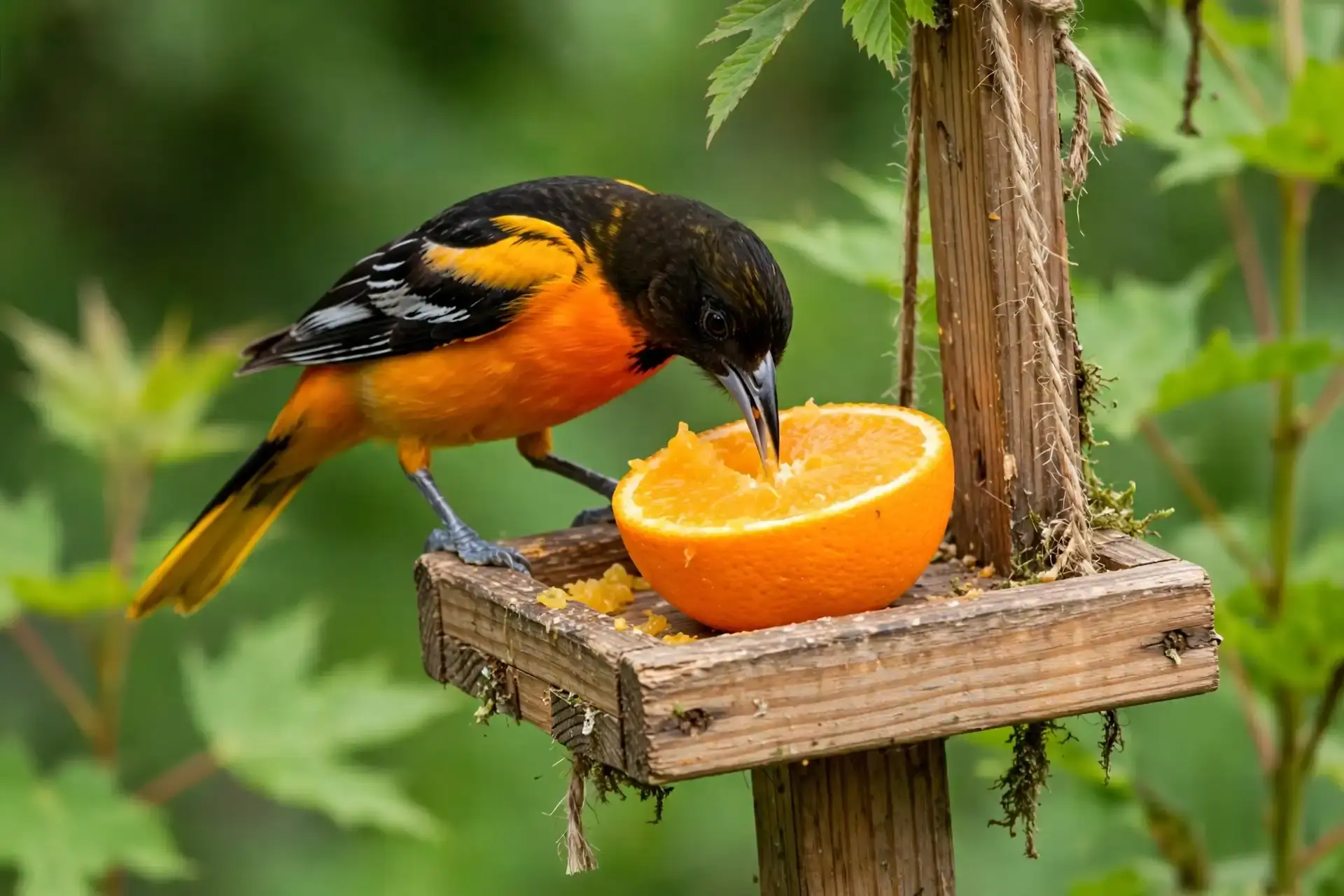
An adult male is one of the easiest birds to identify in eastern North America. No other common songbird in its range puts flame orange together with a solid black head, back, wings and tail. The orange covers the underparts, the shoulder patch and the rump. The wings carry clear white bars, and they stand out even when the bird is moving through leaves. The bill is straight, pointed and dark.
A Baltimore oriole measures 17 to 22 cm long, with a wingspan of 23 to 32 cm, and weighs about 33.8 g, with a range of 22.3 to 42 g. That makes it a little smaller than an American robin, slimmer in build, with a fairly long tail and long legs. Males sing from the tops of elms, maples, cottonwoods, willows and apple trees. Often the first sign is a flash of orange moving between branches. The National Wildlife Federation describes the adult male as brilliant orange below with a black head and wings, and that matches what most readers see in May.
Young males can cause confusion, because at first they do not look like adult males. A male in its first year looks much more like a female, with duller yellow orange underparts and brownish tones above. Males take until the fall of their second year to reach full adult plumage, so a dull orange oriole in spring is not always a female. Shape, bill, white wing bars and song are better guides than colour alone.
How to Identify a Female and Young Baltimore Oriole
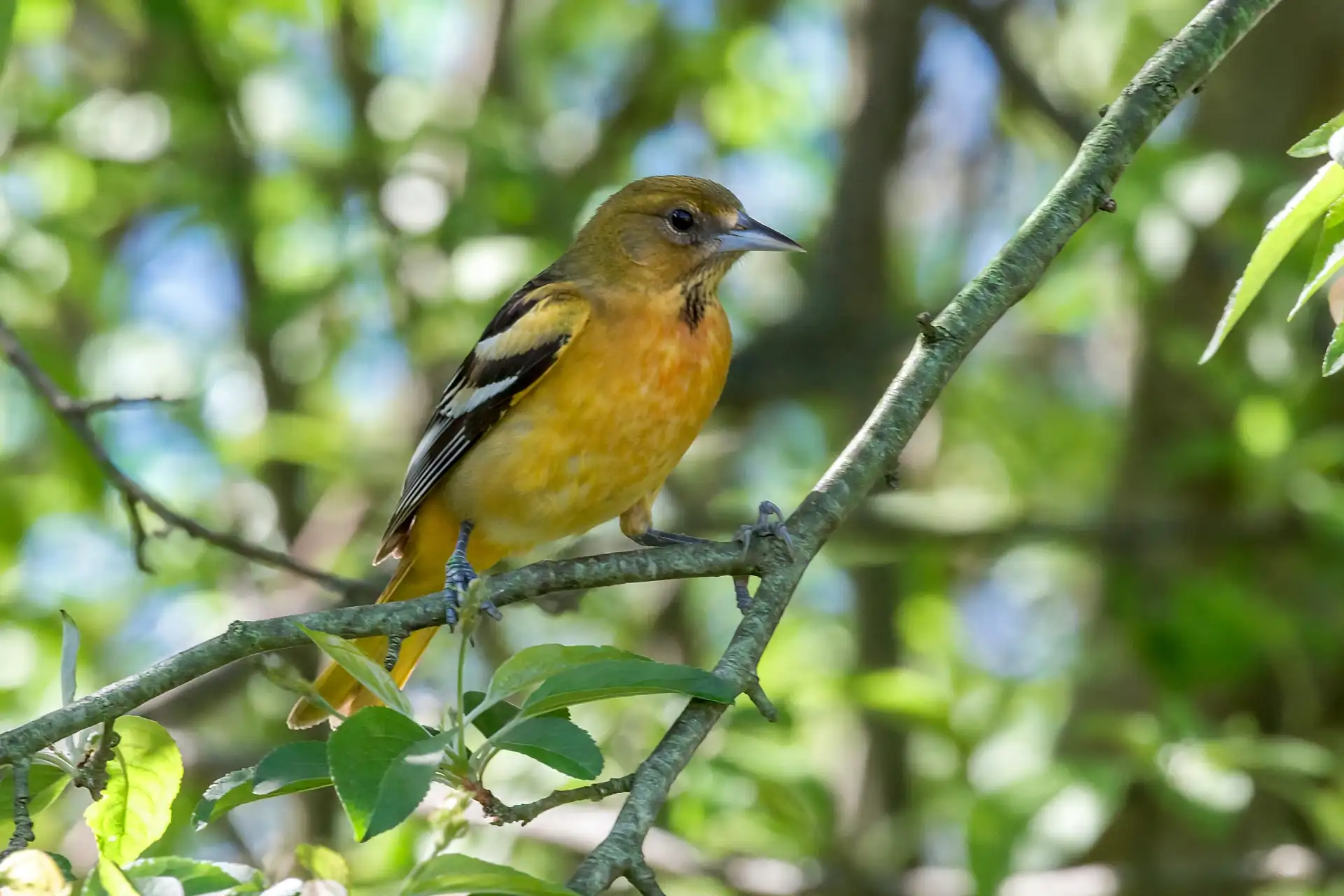
A female is much softer in colour than the male, and that softness is the main reason she is missed. Her upperparts are yellow brown, with darker wings, and her breast and belly are dull orange yellow. She has two white wing bars, like the male, and a pointed bill, but she has no black hood and no black back. Some adult females show traces of black on the head, which can suggest the hood of a male, but the overall impression is still pale and warm, not bold and black. In good light, the yellow brown back, the dull orange wash below and the white wing bars together give a clear identification.
Juvenile Baltimore orioles look similar to the female, with yellow brown upperparts and dull orange yellow underparts. At first they are less neat in plumage, and their colours can look washed out, but the same basic pattern is there. A young bird may stay near the nest tree for a short time after leaving the nest, begging with a soft call and following a parent for food.
The female is often the bird seen first at a feeder, because she may come down to orange halves or grape jelly while the male is still singing high in a tree. To separate her from a female orchard oriole, look at size, colour and bill, since the orchard oriole is smaller, more greenish yellow, and has a shorter, more curved bill. To separate her from a female scarlet tanager, look at the wing bars, since the tanager has no white wing bars and a shorter, thicker bill.
The Hanging Pouch Nest of the Baltimore Oriole
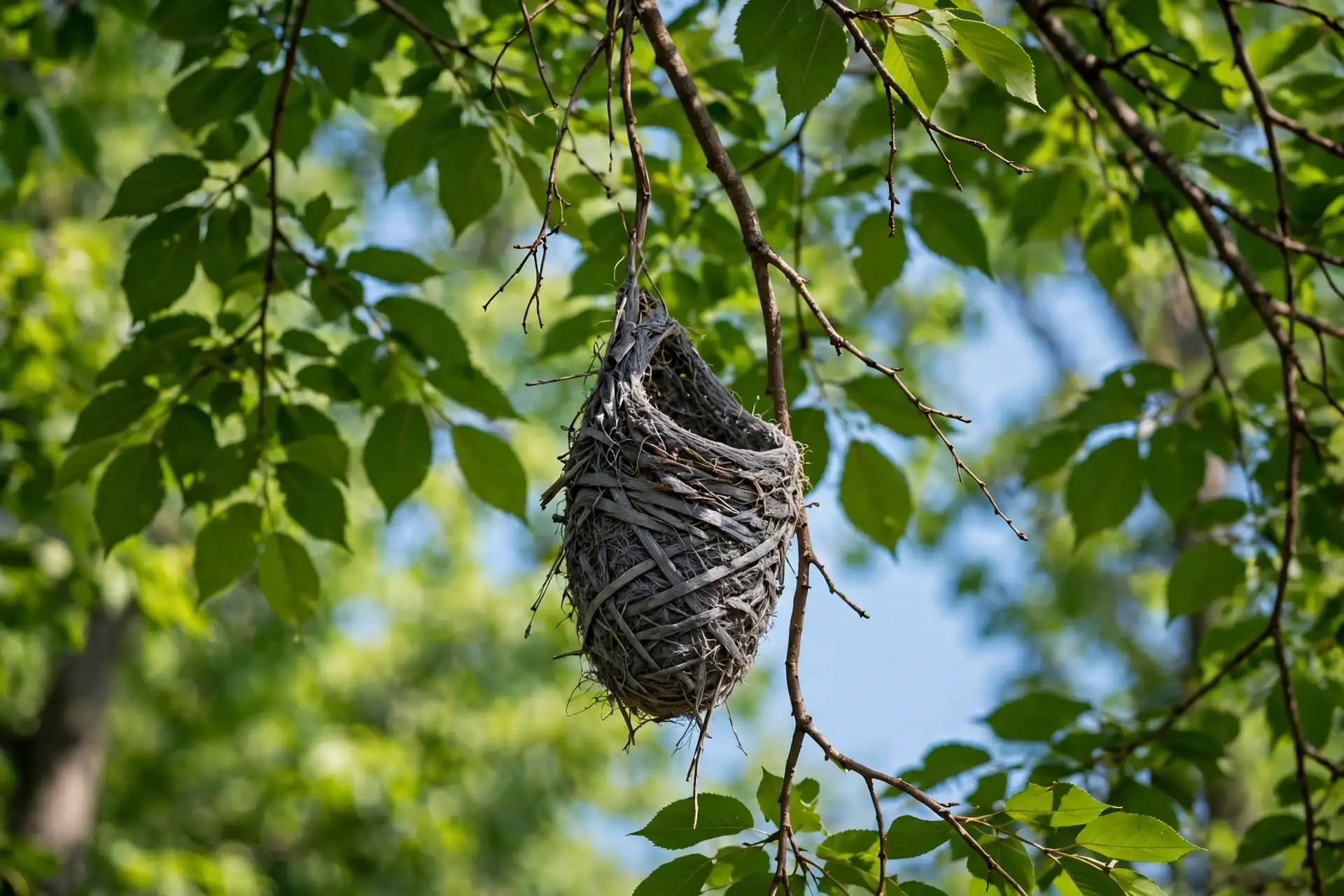
The nest is one of the most remarkable nests in North America. It is often the best clue that orioles are breeding nearby, even when the birds themselves are hard to see. The female weaves a deep hanging pouch nest, tied by its rim to a slender drooping branch, usually 20 to 30 feet up in a tall tree. The pouch is made of plant fibres, bark strips, grass and hair, woven together into a strong grey sock shape that hangs down from the branch and sways gently in the wind. From below it can look like a small grey bag. In winter, after the leaves have fallen, old nests are often easy to spot in bare trees.
The female does the weaving. She starts by anchoring fibres to the branch, then builds the sides down and around until the pouch is deep enough to hold the eggs safely. The nest is usually placed at the end of a small branch, where it is hard for a climbing predator to reach, and where the leaves above give shade and cover. Favourite nest trees include maples, sycamores, birches, apples, black cherry, oaks and elms. The male does not build the nest, although he may sing nearby while the female works. Once the nest is finished, the female lays eggs inside the deep pouch, and both parents bring food to the young after they hatch.
If a hanging pouch nest is found in winter, it is almost certainly an old Baltimore oriole nest, because few other birds in eastern North America build a nest of this shape. It is best to leave the old nest where it is, because it may be used as a roost by other birds in cold weather. A hanging nest that is still in use should never be touched or approached closely, because disturbance can cause the parents to leave the nest.
Feeding a Baltimore Oriole at Home
A Baltimore oriole eats mostly insects in summer, including caterpillars, beetles, aphids and grasshoppers, picking them from leaves high in trees. It also eats fruit and nectar, especially in fall, when insects are less common and fruit is ripe. Preferred fruit trees and shrubs include serviceberry, apple, mulberry, cherry, blueberry and blackberry.
The classic way to attract a Baltimore oriole to a yard is to put out orange halves, grape jelly and an oriole nectar feeder, best put out in late April or May and kept clean. Orange halves can be fixed to a small wooden feeder, a nail on a post, or a hanging feeder made for orioles, with the cut side up so the bird can reach the flesh. Grape jelly can be put in a small cup or dish on the same feeder, and it should be replaced often so it does not spoil or attract wasps. An oriole nectar feeder is similar to a hummingbird feeder, but with larger ports, and it should be filled with plain sugar water and cleaned every few days.
Whole grapes are a different food from grape jelly, and the BirdsBuzz guide on can birds eat grapes explains how to serve grapes safely.
Timing and cleanliness matter. In Maryland, orioles return in March through April, and in much of the east they arrive in late April and early May. If the feeder is put out a few days before the first orioles are expected, and it is kept full and clean, a passing oriole is more likely to stop and feed. Orange halves should be replaced every two to three days, or sooner in hot weather, and grape jelly should be replaced at the same time. Native fruit and nectar plants help even more than a feeder, because they give orioles food through the whole season. For more detail, see the BirdsBuzz guide on how to attract orioles to your yard.
Song and Calls: Heard Before Seen
The song is rich and clear, made of short phrases of piping whistles that rise and fall in a musical pattern. It is often described as a series of clear, flute like notes, given from high in a leafy tree. The male sings most in spring, when he is setting up a territory and trying to attract a mate, and he may sing from the same tree for several minutes at a time.
Most people hear a Baltimore oriole before they see it, because the bird sings from the top of a tall tree where the leaves hide it from view. A good way to find the bird is to stand still, listen for a few phrases, and then look slowly through the top of the tree where the sound is loudest. A flash of orange or a black head moving between leaves is often the first sight, and the bird may then fly to another tree and sing again.
As well as the song, the Baltimore oriole has a low whistled hewli call, given by both males and females, and a dry chatter when the bird is agitated. The song can be confused with the song of a robin, but it is richer and more whistled than a robin song, and it is given in shorter phrases with more pauses. For how birds learn their songs, see the guide to bird songs.
Range, Habitat and Migration
The Baltimore oriole breeds in eastern North America, from the Canadian Prairies and eastern Montana east through southern Ontario, southern Quebec and New Brunswick, and south through the eastern United States to central Mississippi, Alabama and northern Georgia. It is a bird of open deciduous woodland, forest edge, parks, orchards and suburban yards with tall trees, and it does not generally live in deep forest.
The species is a Neotropical migrant, which means it breeds in North America and winters in the tropics. In fall it migrates south to winter mainly from southern Mexico through Central America into northern South America, and in the Caribbean. It leaves the breeding grounds in late summer and early fall, and it returns in spring, with the first birds reaching Maryland in March through April and much of the east in late April and early May. A small number stay through winter along the southeastern United States coast and in Florida, often at feeders, where fruit and nectar remain available. Those winter birds are the exception, not the rule, and most orioles are far to the south in winter.
The bird was named for the colours of Lord Baltimore’s coat of arms, which match the flame orange and black of the adult male. It is the state bird of Maryland, and the namesake of the Baltimore Orioles baseball team. Habitat is the key to finding a Baltimore oriole, because the bird needs tall trees for song, nesting and feeding. Elms were a favourite nesting tree, and cottonwoods, maples, willows and apple trees are used widely. The Maryland Department of Natural Resources notes that orioles are grouped with Neotropical migrants, and the BirdsBuzz list of state birds notes that the Baltimore oriole is the state bird of Maryland.
Baltimore Oriole Versus Bullocks Oriole
The Baltimore oriole has a western counterpart, the Bullocks oriole, and the two species are often confused where their ranges meet. The Bullocks oriole lives in the western United States, particularly in the Great Basin and parts of the Rocky Mountains, while the Baltimore oriole lives in the east. On the Great Plains their ranges overlap, and the two species form fertile hybrids there. Because they hybridise freely where they meet, the two were once considered one species, under the name northern oriole, but they are now treated as separate species again, with clear differences in plumage and range.
An adult male Bullocks oriole is also orange and black, but the pattern is different. The Bullocks male has an orange face with a black line through the eye and a black throat, while the Baltimore male has a solid black head. The Bullocks male also has a large white patch on the wing, and the black on the back is more limited. A female Bullocks oriole is paler and more grey yellow than a female Baltimore oriole, with a pale belly and less orange below. In the overlap zone on the Great Plains, hybrids can show a mix of marks, and it is best to note the exact marks seen and the location, rather than to force a identification.
For most readers, the key point is simple: east of the Great Plains, a black headed orange oriole is a Baltimore oriole, and west of the Great Plains, an orange faced oriole with a black eye line is a Bullocks oriole.
Conservation: Common but Declining
The Baltimore oriole is listed as Least Concern, and it is still widespread and common, with roughly 12 million birds. That number is large, and it means the species is not endangered, and it is not at immediate risk of disappearing. It can be found across a wide area of eastern North America in summer, and it is a familiar bird in parks, suburbs and orchards. For that reason, it is not a bird that needs special protection, and it is not a bird that should cause alarm when it is seen in a yard.
The long term trend, however, is less reassuring. The Breeding Bird Survey shows long term declines, steepest in the northern and eastern parts of the range, where numbers fell by more than 1.5 percent a year. A decline of more than 1.5 percent a year may sound small, but over 20 or 30 years it adds up to a large loss. Keeping tall trees, planting native fruit trees and shrubs, and avoiding broad pesticide use in a yard are all practical ways to help orioles.
Frequently Asked Questions About the Baltimore Oriole
What does a Baltimore oriole look like?
An adult male has flame orange underparts, shoulder patch and rump, with a black head, back, wings and tail and white wing bars. An adult female is yellow brown above and dull orange yellow below, with two white wing bars and no black hood. The bird measures 17 to 22 cm long, with a wingspan of 23 to 32 cm, and weighs about 33.8 g.
When do Baltimore orioles return in spring?
Baltimore orioles return to Maryland in March through April, and to much of the eastern United States in late April and early May. Males usually arrive first, set up territories and start singing, and females arrive a few days later. A small number winter along the southeastern United States coast and in Florida at feeders, but most winter in Mexico and Central America.
What do Baltimore orioles eat?
Baltimore orioles eat mostly insects in summer, especially caterpillars, beetles, aphids and grasshoppers, and fruit and nectar in fall. At a feeder they take orange halves, grape jelly and nectar. In the wild they eat fruit from serviceberry, mulberry, cherry, blueberry and blackberry.
Where do Baltimore orioles build their nests?
The female weaves a deep hanging pouch nest of plant fibres, bark strips, grass and hair, tied by its rim to a slender drooping branch, usually 20 to 30 feet up in a tall tree. Favourite nest trees include maples, sycamores, birches, apples, black cherry, oaks and elms. The male does not build the nest, although he may sing nearby while the female works.
How can I attract a Baltimore oriole to my yard?
Put out orange halves, grape jelly and an oriole nectar feeder in late April or May, in a quiet place near a tall tree, and keep all three clean and full. Plant native fruit trees and shrubs, such as serviceberry, mulberry and cherry, and keep tall trees for singing and nesting.