 Skip to content

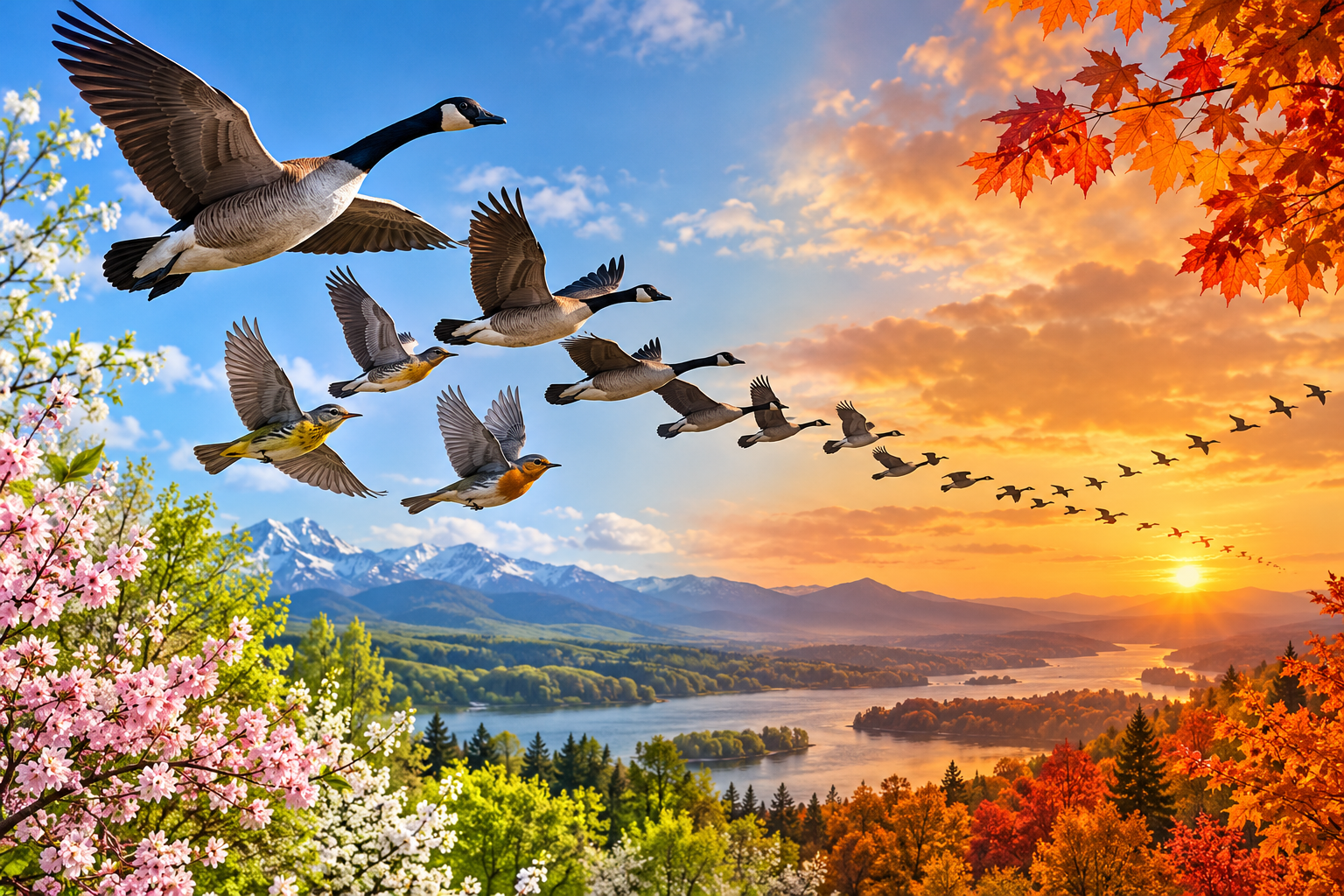
“Where did all the warblers go?” This question arises every August, usually from someone standing at a feeder that was crowded a week earlier.
In the Northern Hemisphere, most migratory birds move north in spring to breed and south in fall to escape shrinking food supplies. Spring migration generally builds from late winter through late spring, peaking in the middle months.
Fall migration starts earlier than most people expect. Some shorebirds are already heading south while summer still feels new, and it stretches into early winter for the last waterfowl.
Not every bird leaves. Cardinals, chickadees, jays, and many woodpeckers hold territory year-round. Others are partial migrants: part of the population moves, part stays put, and the split can vary by region and by year.
This guide lays out bird migration patterns by season, by month, and by bird group, so you can figure out what’s moving through your yard and when to watch for it.
When Do Birds Migrate? Quick Answer

When do birds migrate? Twice a year for most species: north in spring toward breeding grounds, south in fall toward wintering grounds. The exact timing varies based on latitude, species, and weather.
| Season | Typical window | What’s moving |
|---|---|---|
| Spring (northbound) | Late February through early June | Waterfowl and blackbirds first, then sparrows, then warblers, flycatchers, and hummingbirds |
| Summer | Late June through July | Breeding, nesting, and the first southbound shorebirds |
| Fall (southbound) | July through December | Shorebirds first, then songbirds, then raptors, then waterfowl |
| Year-round | All months | Resident species that never leave, plus short-distance wanderers |
Three main factors set the schedule. Day length is the clock: lengthening days in late winter push birds into breeding condition and restlessness, shortening days do the reverse. Food supply is the reason: insects, nectar, seeds, and open water all follow a seasonal curve, and birds follow the curve.
Weather is the trigger for any given night a following tailwind behind a passing front launches huge numbers of birds at once, while headwinds and storms keep them grounded.
So the season answers when, but the weather answers tonight.
Spring Bird Migration: When Do Birds Migrate North?

Spring bird migration doesn’t start on a single date. It moves up the continent like a slow tide, and where you live determines when it reaches you.
- By latitude. Along the Gulf Coast and the southern tier of states, the first movement shows up in late February red-winged blackbirds claiming marsh territory, ducks trading north, early swallows over water. Mid-latitude states see the surge build through April. northern tier, the Great Lakes, New England, and southern Canada get their heaviest days in May. Far northern breeding grounds may not thaw enough to support arrivals until late May or early June.
- Peak months. For most of the Lower 48, the peak runs from mid-April into late May. That’s when the neotropical migrants arrive — warblers, vireos, tanagers, orioles, thrushes, and flycatchers — and when a single morning of good conditions can drop dozens of species into a patch of woods that was empty the day before.
- The tail end. Late-arriving species keep coming after the visible rush fades. Flycatchers, cuckoos, and nightjars often show up last, sometimes into the second week of June, because they wait for insect populations to be fully established.
- What starts it. Lengthening daylight is the primary trigger; it drives hormonal changes that prompt birds to fatten up and grow restless. From there, the pace is set by conditions on the ground:
- Insect emergence and leaf-out, which move north with warming temperatures
- Ice-out on lakes and rivers, which opens habitat for waterfowl
- Southerly tailwinds behind a warm front, which carry birds farther for less energy
Males of many species travel ahead of females to claim territory, which is why the first arrivals often look like the brightest ones.
Fall Bird Migration: When Do Birds Migrate South?

Fall bird migration starts while it still feels like summer. The first southbound movements begin in July, when shorebirds that bred in the Arctic yellowlegs, sandpipers, plovers reverse course almost immediately after their short nesting season ends.
Non-breeding adults and those that failed to breed move even earlier. If you see a flock of sandpipers on a mudflat in mid-July, you are already watching migration.
Peak months. August through October carries the bulk of it, and the order is fairly consistent:
- August: Shorebirds continue, early warblers and flycatchers start slipping south, hummingbirds begin moving.
- September: The heaviest songbird nights of the year across much of the continent, plus the main raptor flights.
- October: Sparrows, kinglets, thrushes, late raptors, and the front edge of waterfowl.
Why there’s no single end date. Autumn bird migration ends at different times for different birds and different places. Long-distance insect-eaters need to clear out before cold weather kills their food supply. Seed-eaters and hardy species can afford to linger.
Waterfowl move only as far as they must, pushed south in waves by freezing water — which means November and December still produce migration in northern states, and a mild winter can stall birds well north of their usual range.
What drives the southward push. Shortening days set the internal timetable again, but the immediate cues are practical: declining insect numbers, cooling nights, and the north winds that follow a cold front. Those front-driven nights are when radar lights up with departing birds.
Fall migration is also slower and messier than spring. There’s no breeding deadline to meet, the population includes inexperienced young birds making the trip for the first time, and many species pause to molt along the way. Expect a longer, lower, more drawn-out flow rather than spring’s compressed rush.
What Time of Day Do Birds Migrate?
Most songbirds migrate at night. Darkness offers cooler, calmer air that reduces overheating and water loss during sustained flight, fewer hunting hawks and falcons, and a stable atmosphere with less turbulence. Night flight also leaves the daylight hours free for the other critical task: refueling.
This explains why migration mornings occur as they do. Birds that flew overnight descend near dawn, land wherever they happen to be, and spend the first hours after sunrise feeding hard. Get to a park at first light during peak season and you’re seeing the previous night’s flight.
Not everyone travels in the dark. Hawks, eagles, vultures, swallows, swifts, nighthawks, cranes, pelicans, and many waterfowl move by day. Raptors in particular depend on daylight because they ride thermals — columns of warm air rising off sun-heated ground. Thermals don’t form until the ground warms, so hawk flights build through mid-morning and peak in early afternoon, then fade as the air cools.
Practical viewing:
- For songbirds, go out at dawn and work edges, water, and any patch of trees that stands out in an open landscape.
- For raptors, go mid-morning to mid-afternoon and find a ridge, a lakeshore, or a coastline that concentrates the flight.
- After a night of favorable winds, check your local spots early. The best mornings often follow a passing front.
Also, listen. Many night migrants give short flight calls overhead, and on a big night you can hear them from a backyard.
Why Do Birds Migrate?
Why do birds migrate, when the journey costs so much energy and kills so many of the birds that attempt it? Because staying put costs more. Migration involves trading high short-term risk for access to resources unavailable year-round in one place.
- Food availability. This is the core driver. Flying insects, nectar, fruit, and aquatic invertebrates collapse in northern winters. A warbler that eats caterpillars cannot survive a January in Minnesota no matter how mild the weather is, because the caterpillars are gone. Moving south follows the food, and moving north in spring exploits an explosion of insects that southern habitats can’t match.
- Breeding requirements. Northern summers offer enormous prey density, abundant nesting space, and lower competition than crowded tropical habitats. That combination supports larger clutches and faster chick growth. Many species can raise more young in a short northern season than they could in a long tropical one.
- Daylight advantages. Long northern days give parents more hours to hunt and feed nestlings. Near the Arctic, near-continuous light in June means feeding can continue almost around the clock, which speeds development and shortens the window when chicks are most vulnerable.
- Weather and temperature. Cold itself is survivable for a well-fed bird; food scarcity and ice are not. Freezing shuts off water for ducks and geese, buries seeds under snow, and raises the energy needed just to stay warm. Birds move far enough south to find open water and accessible food, and no farther than necessary.
- Predation and disease pressure. Shifting ranges seasonally also reduces exposure to local predators and parasites that build up when a population stays in one place.
How Birds Know When to Migrate
Birds run on an internal annual calendar. Even held in constant conditions with unlimited food, many migratory species become restless at the time of year they would normally travel — hopping, fluttering, and orienting in their migratory direction at night. That built-in rhythm gives them a rough schedule that doesn’t depend on the weather outside.
The rhythm gets synchronized by photoperiod: the length of the day. Day length is the one environmental signal that’s identical every year on a given date, which makes it a reliable clock. Changing photoperiod drives hormonal shifts that prompt birds to pack on fat, lighten their digestive organs, and enter migratory condition. This is why the broad timing of migration stays fairly consistent from year to year even when the weather doesn’t.
Environmental cues then fine-tune the departure. Temperature, food abundance, body condition, and — most immediately — wind direction determine which night a bird actually leaves. A bird ready to go will wait days for a favorable tailwind rather than fight a headwind.
For navigation, birds use several overlapping systems. They read the position of the sun by day, star patterns by night, and the Earth’s magnetic field as a compass and approximate map.
Experienced adults also rely on remembered landmarks coastlines, mountain ranges, river valleys to correct their course. Young birds on their first fall trip often navigate on inherited direction and duration alone, which explains why first-year birds show up in unexpected places more often than adults do.
Bird Migration by Month
Use this as a general framework, then adjust for where you live. The same month means different things in Texas and in Manitoba.
| Month | What’s happening |
|---|---|
| January | Quiet. Wintering flocks, some waterfowl shifting with ice cover |
| February | First stirrings in the South: blackbirds, ducks, early raptors |
| March | Waterfowl, sparrows, phoebes, and swallows push north; heavy movement in southern states |
| April | The main surge across mid-latitudes; early warblers, thrushes, hummingbirds |
| May | Peak in the North; warblers, vireos, tanagers, orioles, shorebirds heading to the Arctic |
| June | Late arrivals — flycatchers, cuckoos, nightjars. Breeding underway |
| July | Breeding winds down; first southbound shorebirds appear |
| August | Shorebirds continue; early songbirds and hummingbirds move south |
| September | Peak songbird nights; major hawk flights |
| October | Sparrows, kinglets, late raptors, first waterfowl waves |
| November | Waterfowl, cranes, and hardy late migrants; winter finches may appear |
| December | Final southward pushes with freeze-up; wintering flocks settle |
Regional notes. Coastal areas often see migration concentrated along shorelines, where birds avoid crossing open water. Mountain ranges and river valleys funnel movement into narrow corridors.
In the desert Southwest, riparian strips hold almost everything. Gulf Coast sites can produce spectacular spring “fallouts” when birds crossing the Gulf hit bad weather and drop en masse into the first trees they reach.
Timing also shifts with elevation. High-country sites run weeks behind valley floors in spring and weeks ahead in fall, so a mountain town may lose its hummingbirds while the lowlands still have them.
Which Birds Migrate?
Songbirds. The largest and most varied group of night migrants. Warblers, vireos, thrushes, tanagers, orioles, buntings, sparrows, and flycatchers all move, though distances differ enormously. Some sparrows shift only a few states south.
Some warblers cross the Gulf of Mexico in a single flight and winter in Central or South America. Learning the common birds species and names in your area makes migration far easier to track, because you’ll notice when a new one appears.
Waterfowl. Ducks, geese, and swans are weather-driven migrants. They move only as far south as open water requires, which makes their timing the most variable of any group. Snow geese and tundra swans travel long distances on predictable routes; mallards may barely move at all in a mild winter.
Raptors. Broad-winged hawks, sharp-shinned hawks, ospreys, kestrels, and many others migrate by day on thermals and updrafts. Because thermals don’t form over large water bodies, raptors concentrate along shorelines, ridgelines, and narrow land bridges, producing the famous hawk-watch spectacles of September and October.
Shorebirds. The long-distance specialists. Many breed in the Arctic and winter in South America, with a compressed breeding season and an early southbound departure. They depend on a small number of rich stopover sites where they can double their body weight in a couple of weeks.
Hummingbirds. Tiny, solitary migrants that travel by day. Ruby-throated hummingbirds cross the Gulf of Mexico nonstop; rufous hummingbirds run a long loop up the Pacific coast and back down through the mountains. Leave feeders up in fall — they don’t keep birds from leaving.
Where Do Migrating Birds Travel?
Migration isn’t spread evenly across the map. Birds follow flyways — broad corridors shaped by geography, prevailing winds, and the location of food and water. Coastlines, river systems, mountain ranges, and the edges of large lakes all guide movement, and birds concentrate where those features narrow.
North America is usually divided into four flyways:
- Atlantic Flyway — the East Coast, from the Maritimes and eastern Canada south along the shoreline to Florida and the Caribbean.
- Mississippi Flyway — the Mississippi River corridor, a broad, obstacle-free route from the boreal forest and prairie potholes down to the Gulf Coast.
- Central Flyway — the Great Plains east of the Rockies, running from the Canadian prairies through Texas.
- Pacific Flyway — the West Coast and intermountain valleys, from Alaska down to Mexico and beyond.
These boundaries overlap heavily. Individual birds cross between them, and many species use one route north and a different one south.
Stopover sites matter as much as the routes. A migrating bird spends most of its journey on the ground, refueling. Coastal marshes, mudflats, sandbars, riparian woodlands, and isolated woodlots in farmland serve as filling stations.
And losing one can force birds to fly farther on less fuel. That’s why a small city park or a strip of trees along a creek can hold remarkable numbers during peak season in an open landscape, it may be the only cover for miles.
How Long Does Bird Migration Take?
Duration varies from a few days to a few months, and the distance covered matters less than the strategy used.
Several variables set the pace: total distance, the size of the bird, whether it feeds along the way, how many stopovers it needs, and how cooperative the winds are. A bird that must rebuild fat reserves every few days will spend far more time on the ground than in the air.
Spring migration is generally faster than fall. Breeding creates a deadline — arrive too late and the best territories are gone — so birds push harder, use tailwinds aggressively, and make shorter stops. Fall has no such pressure, so the same species may drift south over weeks, feeding heavily, molting, and moving only on favorable nights.
Some journeys are astonishingly compressed. Certain shorebirds and songbirds fly nonstop over open water or desert for days at a time, burning stored fat and even shrinking organs they won’t need in flight. Those birds arrive depleted and need extended recovery time at the other end.
Others take the opposite approach, hopping short distances with long refueling stops. Both strategies work; they just distribute the cost differently.
When Is the Best Time to See Migrating Birds?
Spring offers the best viewing quality. Spring migration birds are in bright breeding plumage, they’re singing, and the movement is concentrated into a few intense weeks. Mid-April through May is the window across most of the country. Go at dawn.
Fall offers more birds and more time. The population includes the summer’s young, and the season stretches for months. The trade-off is duller plumage, less song, and harder identification. September and October are the core, with hawk watches peaking on clear days after a cold front.
Local conditions decide the day. Check the wind. In spring, southerly winds overnight mean arrivals. In fall, northerly winds behind a front mean departures — and a big morning after. Rain or fog that grounds a flight in progress can produce a concentration of birds in a small area.
Tools. Live bird migration forecast maps built from weather radar show how many birds moved the previous night and predict the next one. Regional rare bird alerts and sightings feeds tell you what’s already down. A local birding group’s reports are often the fastest signal that something is happening near you.
What Can You Do to Help Migrating Birds?
Provide food and cover. Plant native trees, shrubs, and flowers — native plants support the insects that migrants actually eat. Keep feeders clean and stocked during peak weeks, and leave leaf litter and seed heads in place rather than clearing everything in fall.
Offer water. A shallow, clean birdbath with moving water attracts migrants that would otherwise pass over your yard. Refresh it often and scrub it weekly.
Prevent window collisions. Glass is one of the largest hazards birds face in developed areas. Apply exterior patterns — dots, stripes, or tape — spaced closely enough that birds don’t try to fly between them. Screens and external shades work too. Move feeders either very close to the glass or well away from it.
Turn off the lights. Night-migrating birds are disoriented by artificial light, especially in low cloud. Switch off unnecessary outdoor and upper-floor lights overnight during spring and fall, close blinds, and shield any fixture that has to stay on so it points down.
Keep cats indoors. Exhausted migrants feeding on the ground are especially vulnerable.
FAQs for Featured Snippets + PAA
What months do birds migrate?
Bird migration occurs during different periods depending on the species and location. In North America, spring migration generally begins in late February or March and continues through early June, with April and May often seeing the greatest movement. Fall migration can begin as early as July and commonly continues through November or December, with August through October bringing peak activity. The exact timing varies with species, latitude, weather, and available food.
Do birds migrate twice a year?
Yes, most migratory bird species make two major migrations each year. They typically travel north in spring to reach breeding grounds and then head south in fall to spend the winter where food and weather conditions are more favorable. Some species use different routes during spring and fall, while others make shorter seasonal movements when weather or food availability changes.
When is bird migration season?
There are two main bird migration seasons: spring and fall. Spring migration is the northbound journey toward breeding grounds, while fall migration is the southbound journey toward wintering areas. Migration does not happen on the same schedule for every bird, so the season can begin earlier or end later depending on the species, region, and weather conditions.
Do all birds migrate?
No, not all birds migrate. Many species remain in the same general area throughout the year, including birds such as chickadees, cardinals, jays, nuthatches, and many woodpeckers. Some species are partial migrants, meaning certain individuals migrate while others remain in their breeding areas. Migration behavior often varies according to food availability, climate, age, and geographic location.
Why do some birds migrate and others don’t?
Migration is influenced by several factors, especially food availability, weather, breeding needs, and seasonal changes. Birds that depend heavily on insects, nectar, or other seasonal foods may need to travel when those resources become scarce. Species that can find seeds, berries, nuts, or other dependable foods throughout the year may be able to remain in the same area instead.
Do birds migrate at night or during the day?
Many birds migrate at night, particularly small songbirds that travel long distances. Night migration can help them avoid some predators and take advantage of cooler, calmer conditions. Other birds, including hawks, eagles, cranes, swallows, and many waterfowl, commonly migrate during the day. Large soaring birds often depend on rising warm air, called thermals, to conserve energy while flying.
How do birds navigate during migration?
Birds use several navigation methods to find their way during migration. Depending on the species, they can use the position of the sun, stars, Earth’s magnetic field, visual landmarks, and memories of familiar landscapes. Young birds may rely more heavily on inherited directional cues, while experienced adults can improve their navigation by using knowledge gained from previous migrations.
How fast do birds migrate?
Migration speed varies widely between species and depends on flight ability, distance, weather, wind conditions, and the availability of stopover sites. Many birds take advantage of favorable tailwinds and may wait for suitable weather instead of flying directly into strong headwinds. Because of these changing conditions, a bird’s speed can vary considerably from one migration period or flight to another.
How high do birds fly when migrating?
Migration altitude varies depending on the species, terrain, weather, and wind conditions. Many nocturnal migrants fly at relatively low to moderate altitudes, often within a few thousand feet of the ground. Birds crossing mountains may fly much higher, while other species adjust their altitude to find favorable winds that make long-distance travel more efficient.
Do birds fly nonstop during migration?
Some birds can fly nonstop for extremely long distances, particularly certain shorebirds and other long-distance migrants crossing oceans or large areas of land. These birds build substantial fat reserves before departure and use that stored energy during continuous flights. However, most migratory species travel in stages, stopping regularly at important wetlands, forests, fields, and coastal habitats to rest and refuel.
Why do birds fly in a V formation?
Large birds such as geese, cranes, and some other waterfowl may fly in a V formation because it can reduce the energy needed for flight. Birds behind the leader can benefit from air movement created by the bird ahead, helping them maintain lift more efficiently. Birds may also take turns in the lead position, allowing the group to share the physical effort of flying at the front.
Should I take my hummingbird feeder down in fall?
No, there is generally no need to remove a hummingbird feeder simply because fall migration has started. Leaving a clean, well-maintained feeder available can provide an important food source for migrating hummingbirds, including late migrants that still need to build energy reserves. A feeder does not normally prevent hummingbirds from migrating because their movement is influenced by factors such as seasonal cues, daylight length, weather, and natural food availability.
Where do birds go in winter?
Winter destinations vary greatly by species. Some birds travel only a few hundred miles to reach areas with better food and milder weather, while long-distance migrants may travel to Mexico, Central America, the Caribbean, or South America. Other species do not migrate at all and remain in the same region throughout winter. The distance a bird travels depends largely on its species, habitat, food sources, and breeding range.
Do birds return to the same place every year?
Many migratory birds return to the same general breeding or wintering areas year after year. Some species show remarkable site fidelity and may return to the same territory or nesting area, although the exact behavior differs between species and individuals. Younger birds may take several migrations to establish consistent routes and destinations.
What is a migration fallout?
A migration fallout happens when large numbers of migrating birds are forced to stop unexpectedly because of difficult weather conditions. It can occur when strong winds, storms, rain, or other unfavorable conditions interrupt migration, particularly after birds cross large bodies of water.
Conclusion – Give the Reader a Simple Mental Model
Remember one key idea: birds follow food. North in spring for the insect boom and long daylight, south in fall as that food disappears. Everything else — the species, the routes, the exact dates — is variation on that single theme.
The variables that shift your local timing are latitude, elevation, habitat, species, and the weather on any given night. Two towns a hundred miles apart can have peak days a week apart.
- Identify your latitude’s rough peak weeks — mid-spring and early fall for most of the country.
- Check the overnight wind direction before you plan a morning out.
- Visit the same nearby patch repeatedly so you notice what’s new.
- Go at dawn for songbirds and midday for raptors.
- Turn off outdoor lights and treat your windows during both seasons.





[…] What they cannot handle is an empty pantry. If you want the full timing story, our guide to the spring and fall migration seasons breaks down when each wave […]