
Have you ever wondered why birds fly in a V? If so, you might also wonder why they fly like that. So here is a solid and detailed answer to help you understand this energy-saving trick.
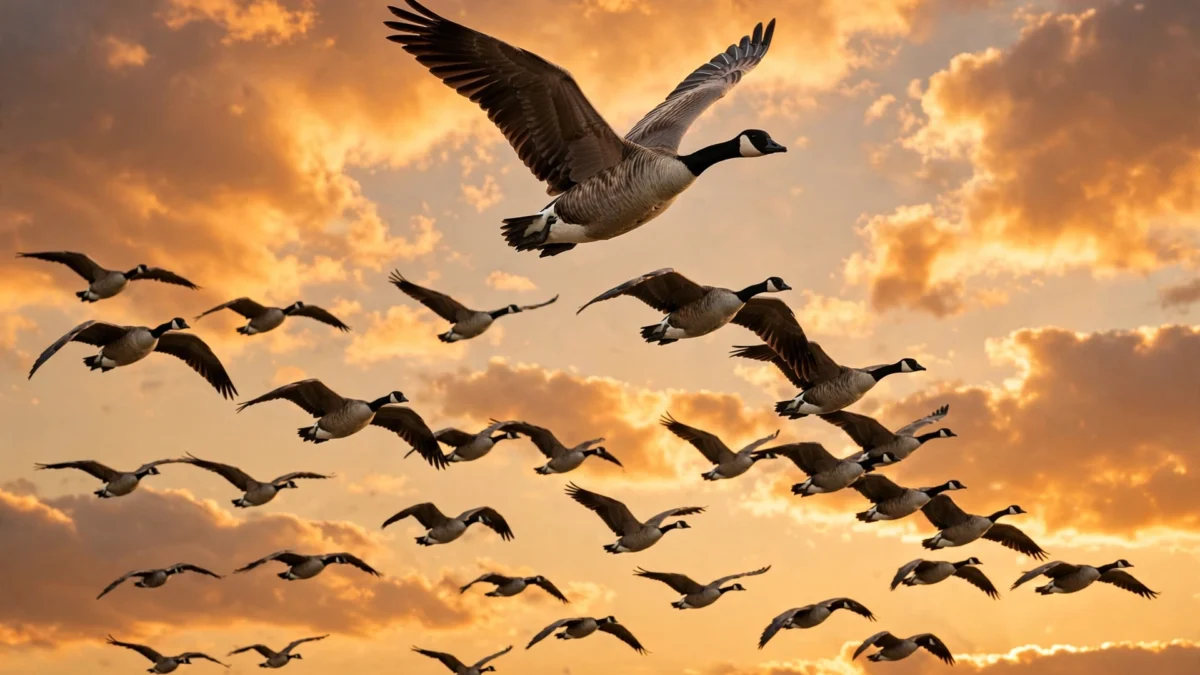
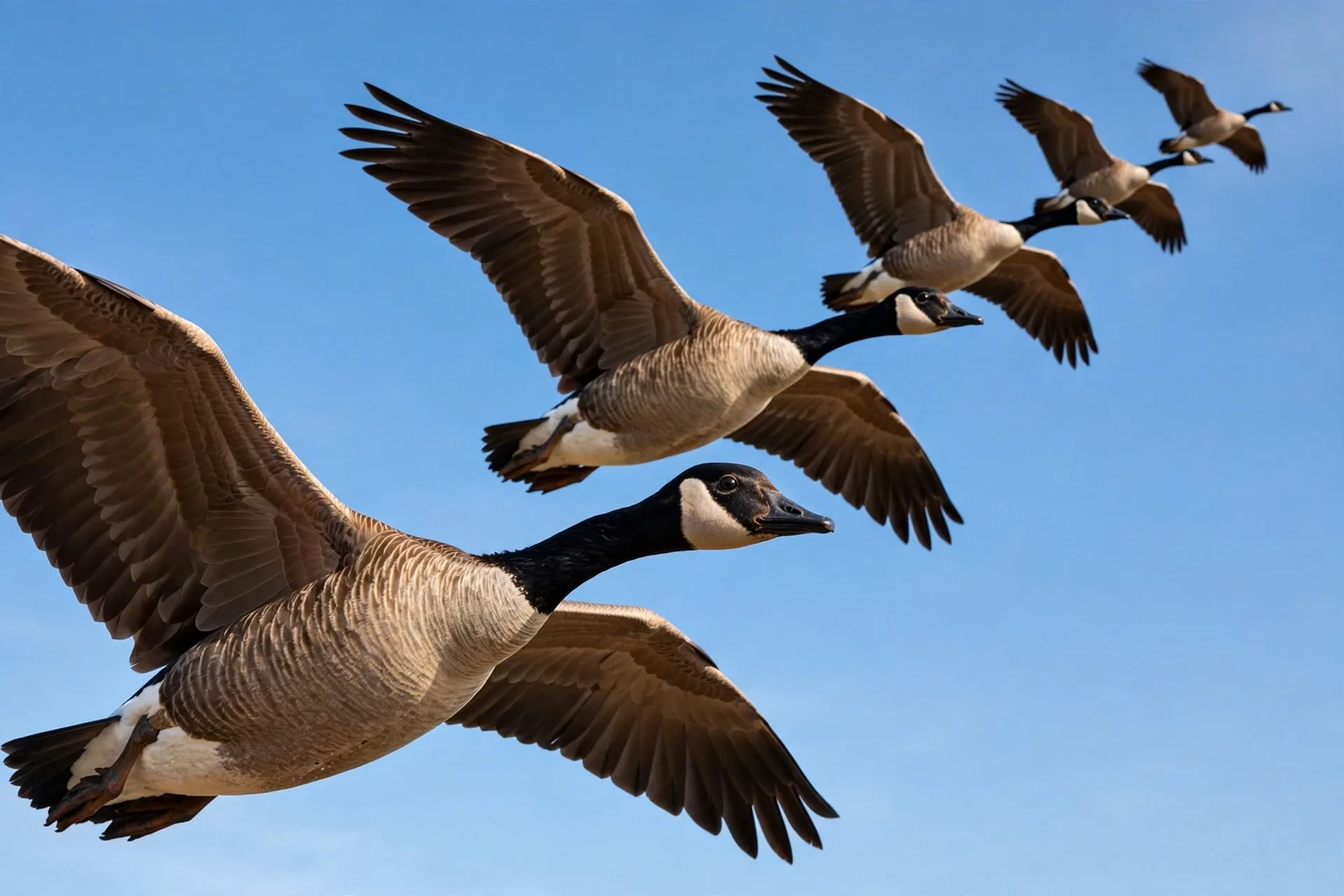
On a crisp October evening, you hear them before you see them. A chorus of honks rolls across the sky, and then the flock appears: a long, ragged V of Canada geese, wingtips beating in near-perfect rhythm, sliding south against a copper sunset.
It is one of the most recognizable shapes in nature, and for centuries people assumed it was about leadership, with one wise bird guiding the rest. The real answer is far more interesting. The V is not about leadership at all. It is about physics.
Each bird in the formation is surfing an invisible wave of rising air created by the bird ahead of it, and that free lift can dramatically cut the cost of flight. Here is how the trick works, how much energy it really saves, and why only certain birds can pull it off.
The Short Answer
Birds fly in a V formation to save energy. Every flapping wing creates a small pocket of rising air just behind and to the side of the wingtip, called upwash. A bird that positions itself in that pocket gets free lift, so it flaps less and tires more slowly.
The V shape is simply the geometry that lets every bird in the flock catch the upwash of the bird ahead. The leader gets no help and works hardest, which is why flocks rotate the front position on long journeys.
Riding an Invisible Wave: How Upwash Works
To understand the V, you have to picture what a wing does to the air. As a bird pushes down on its downstroke, air curls around the wingtip from the high-pressure zone beneath the wing toward the low-pressure zone above it. That curling air forms a spinning vortex trailing behind each wingtip.
Directly behind the bird, the vortex pushes air downward. That zone, called downwash, is terrible air to fly in. But just outboard of each wingtip, the same spinning motion pushes air upward. That rising zone is the upwash, and it is the entire secret of formation flight.
A bird flying slightly behind and to the side of another bird places its inner wing inside that rising air. The upwash pushes up on the wing, doing part of the lifting work for free. Less lift to generate means fewer wingbeats, and fewer wingbeats mean less energy burned over a journey of hundreds or thousands of miles.
Finding the Sweet Spot
The upwash zone is small and precise. In a landmark 2014 study published in Nature, researchers fitted a flock of northern bald ibises with tiny GPS loggers and accelerometers and tracked every wingbeat. They found the birds positioned themselves about one meter behind and one meter to the side of the bird ahead, exactly where models predicted the upwash would be strongest.
Even more remarkably, the ibises timed their wingbeats to the bird in front of them. They flapped in phase when it helped them catch the rising air and shifted out of phase to avoid the sinking downwash.
This is not a rough approximation. It is precision flying, adjusted beat by beat, and the birds appear to sense the best position through the feel of the air on their feathers as well as by sight.
Why the Shape Is a V and Not a Line
Each bird produces upwash on both sides, behind the left wingtip and behind the right wingtip. Two lines of birds can therefore form, one trailing each wing of the leader. Those two lines angle outward because the useful upwash sits slightly outside each wingtip, not directly behind the bird.
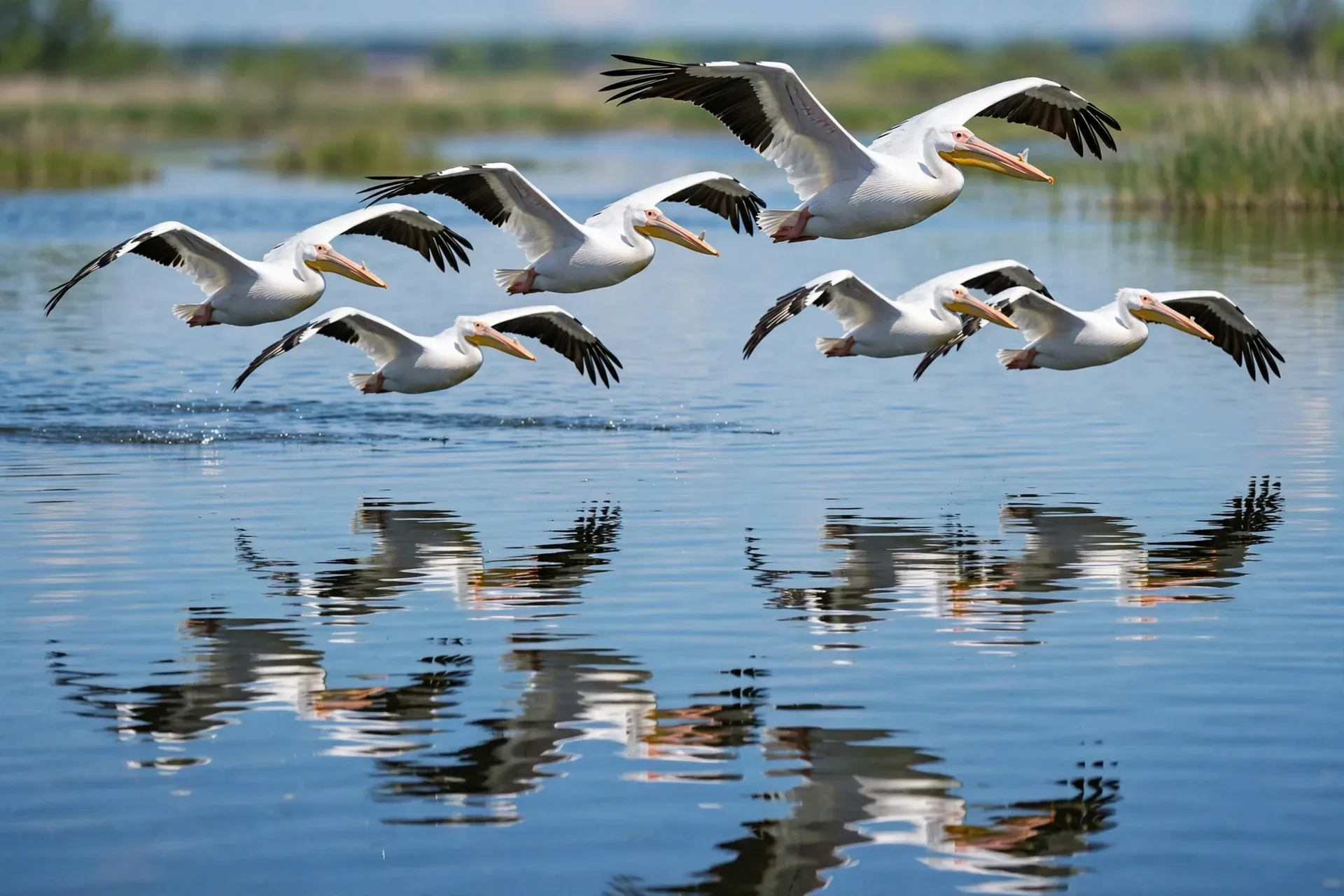
The result is the classic chevron. Pelicans and cormorants sometimes fly in a single echelon, one straight diagonal line, which is the same trick using only one side of the leader’s wake.
How Much Energy Does the V Really Save?
The savings are real and they have been measured in living birds, not just in equations.
In 2001, researchers studying great white pelicans published results in Nature showing that pelicans flying in formation had lower heart rates and flapped their wings less frequently than pelicans flying alone. The birds in the back of the formation worked noticeably less hard than the bird at the front, exactly as the upwash theory predicts.
The ibis study found similar benefits from the precise positioning and flap phasing. And the theoretical foundation goes back even further: a 1970 paper by Lissaman and Shollenberger calculated that a flock of 25 birds in an optimal V could extend its flying range by about 71 percent compared with the same birds flying solo. Real flocks rarely hit the theoretical optimum, but even a fraction of that gain is the difference between completing a migration and falling short of it.
- Measured savings: Field studies consistently show reduced heart rate and wingbeat frequency for birds in formation, with estimates of energy savings in the range of 20 to 30 percent for birds in the best positions.
- Theoretical maximum: The 1970 aerodynamic model suggested up to a 71 percent range extension for a 25-bird V in perfect formation.
- Who benefits most: Every bird except the leader. The front bird gets no upwash and pays full price, which is why the lead position is shared.
Do Young Birds Have to Learn the V?
Evidence suggests they do. The ibis researchers noticed that juvenile birds held less precise positions than experienced adults, and their wingbeat timing was sloppier.
Over successive migrations, the young birds tightened up, sliding into the sweet spot more reliably and phasing their flaps more accurately. Formation flight appears to be a skill refined through practice, not a pure instinct switched on at birth.
That learning curve is another reason family groups, like goose parents flying with that year’s goslings, stick together: the veterans literally show the youngsters where the good air is.
The Leader Works Hardest: Why Flocks Take Turns
The bird at the tip of the V flies in clean, undisturbed air. That sounds pleasant, but it is the most expensive seat in the formation because there is no upwash to ride.
Watch a skein of geese for long enough and you will often see the formation ripple as the lead bird drops back and another bird slides forward to take its place.
This rotation shares the hardest work across the flock. It is a cooperative system, and it only works because every bird takes a turn paying the cost. Young or weak birds tend to hold positions deeper in the V, where the savings are greatest and the flying is easiest.
There is a persistent myth that one dominant bird leads the whole migration. In reality, leadership in a V is a shift, not a title. The flock is a team running a relay at 40 miles per hour, thousands of feet in the air.
Why Only Big Birds Fly in Vs
If the V is such a good trick, why do you never see sparrows or robins flying in formation? The answer comes down to wing size and flight style.
The upwash behind a wingtip is proportional to the wing that makes it. Large birds with long, broad wings, like geese, swans, cranes, and pelicans, generate strong, well-organized vortices that a following bird can actually use.
Small songbirds generate weak, messy wakes that dissipate quickly, and their flapping flight is too erratic to hold a precise position in them.
Small birds have their own solutions. Starlings gather in huge murmurations for protection, and many songbirds migrate at night in loose, scattered streams where the cooler, calmer air does the efficiency work instead. The V is a big-bird technology, tuned for heavy bodies and long, flapping wings.
V-Flyers vs Non-V-Flyers
| Group | Typical Formation | Why |
|---|---|---|
| Geese and swans | Classic V or long lines | Heavy bodies, long wings, very long migrations; upwash savings are large. |
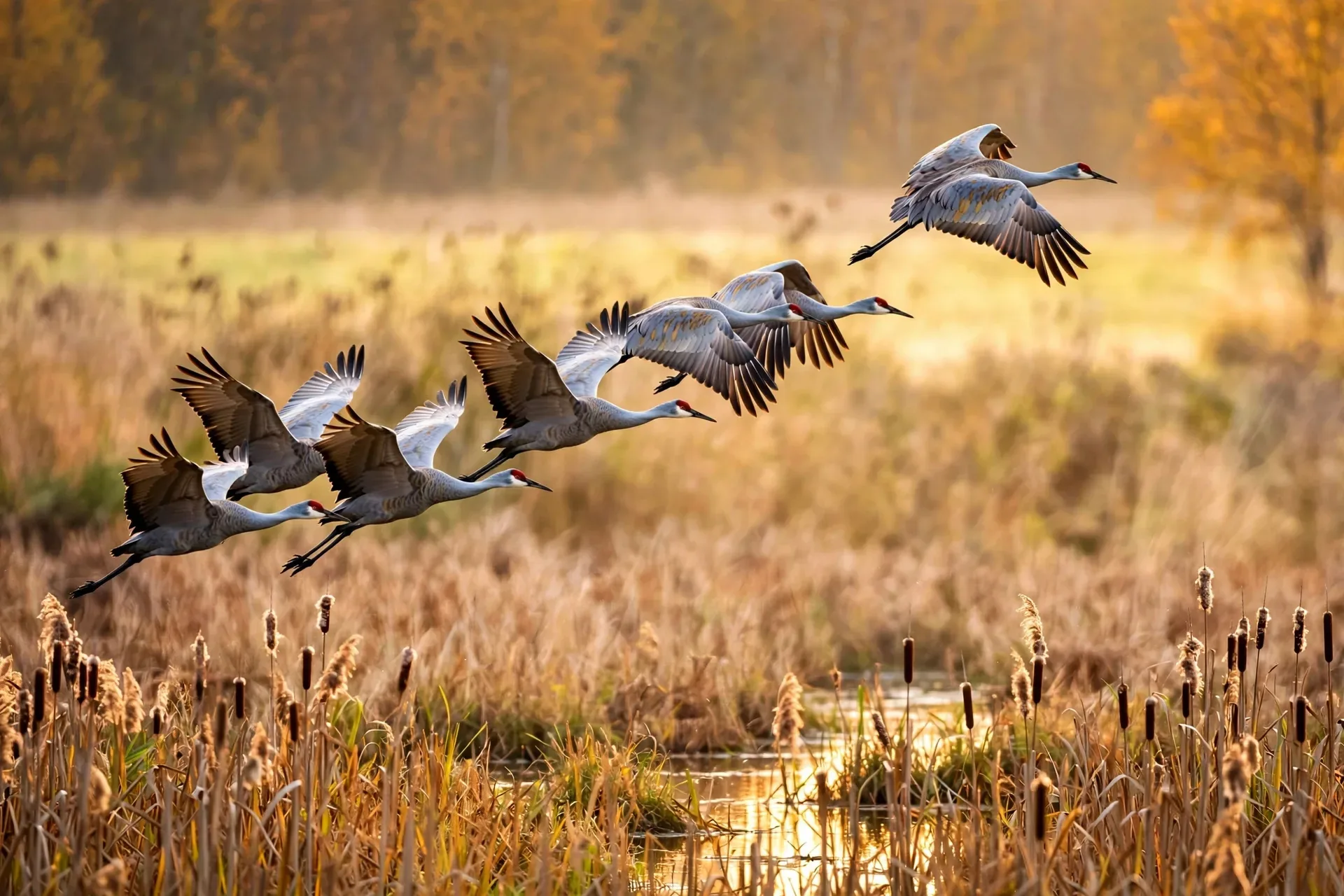
| Cranes | V or echelon lines | Large soaring and flapping fliers on continental migrations. |
| Pelicans and cormorants | V, line, or echelon | Heavy waterbirds; formation flight measurably lowers heart rate. |
| Ducks | Loose Vs and strings | Smaller wings than geese, so formations are ragged but still useful. |
| Songbirds (warblers, thrushes) | Loose scattered flocks | Wakes too weak and flight too erratic for precise formation. |
| Shorebirds | Dense swirling flocks | Tight clusters confuse predators; aerodynamics are secondary. |
| Raptors | Solo or loose kettles | Soar on thermals instead; flapping in formation would waste energy. |
The Honking Question: Why Do Geese Honk in Flight?
If you have ever watched geese pass overhead, you know the V comes with a soundtrack. The honking is constant, and its exact purpose is still debated, but researchers have solid theories.
The leading idea is coordination. Honking may help the flock stay together and keep its rhythm, with birds calling to maintain spacing and signal position changes.
Some researchers suggest it functions as encouragement, keeping the group motivated on exhausting flights. What seems clear is that the calls are social: lone geese are quiet, and the chorus swells when the flock is maneuvering, landing, or changing leaders.
So the next time a skein passes over your yard this fall, listen for the pattern. The honks cluster around the moments when the formation is working hardest, which is exactly when a team needs to talk.
How to Watch V Formations This Fall
Late October is prime time. The great southbound push of waterfowl is underway, and Vs cross the sky daily in many regions. A few tips make the watching better:
- Listen first: You will usually hear geese and cranes long before you see them. Step outside at dawn and dusk and just listen.
- Check the shape: Notice whether one arm of the V is longer. Flocks rarely form a perfect symmetrical V; the arms shift as birds jockey for the best upwash.
- Watch the leader change: With binoculars, you can sometimes catch the ripple that runs through the flock when the lead bird drops back.
- Note the species: Canada geese are the classic, but sandhill cranes fly in Vs too, and their rattling bugle calls are unmistakable.
- Track the timing: Most Vs move in the morning and late afternoon. Midday thermals belong to the hawks.
If migration timing fascinates you, our guide to how birds navigate migration covers the five senses and signals they steer by, and how long bird migration takes puts these journeys in perspective, from days to record-breaking nonstop flights. For the bigger picture of why they go at all, see why birds migrate.
V Formation FAQ
Do birds always fly in a perfect V?
No. Real formations are ragged, shifting, and asymmetrical. Birds constantly adjust position to stay in the upwash as winds change and neighbors move. The textbook-perfect V is the ideal; the sky version is a living, wobbling approximation of it.
Why is one side of the V often longer than the other?
There is no deep mystery here. Flocks rarely split evenly, wind favors one side, and birds join or leave the arms as the flock travels. An uneven V is the normal state, not a sign that something is wrong.
Do small birds ever fly in formation?
Not in true Vs. Small songbirds fly in loose flocks where the aerodynamic benefit of formation would be tiny. Their wakes are too weak and their flight too bouncy for precision positioning to pay off. They save energy in other ways, such as migrating at night through cool, calm air.
Could airplanes use the V formation trick?
They already study it. Military aircraft have long flown in formation partly for the same aerodynamic reason, and researchers have tested automated formation flight for airliners to cut fuel burn. The physics does not care whether the wing has feathers.
The Takeaway
The V formation is one of those rare natural phenomena that looks like art and works like engineering. Every bird behind the leader is stealing a little lift from the air the bird ahead disturbed, and across a migration of a thousand miles, those stolen sips of lift add up to survival. The leader pays full price, the flock shares the cost, and the whole system runs on nothing but air and teamwork.
So when the geese go over this week, honking into the autumn dusk, you are not just watching birds fly south. You are watching a precision aerodynamic maneuver, refined over millions of years, executed by animals that cannot read a physics textbook but can feel exactly where the good air is. That is worth stepping outside for.