
Why Do Turkeys Gobble? The Meaning Behind the Call
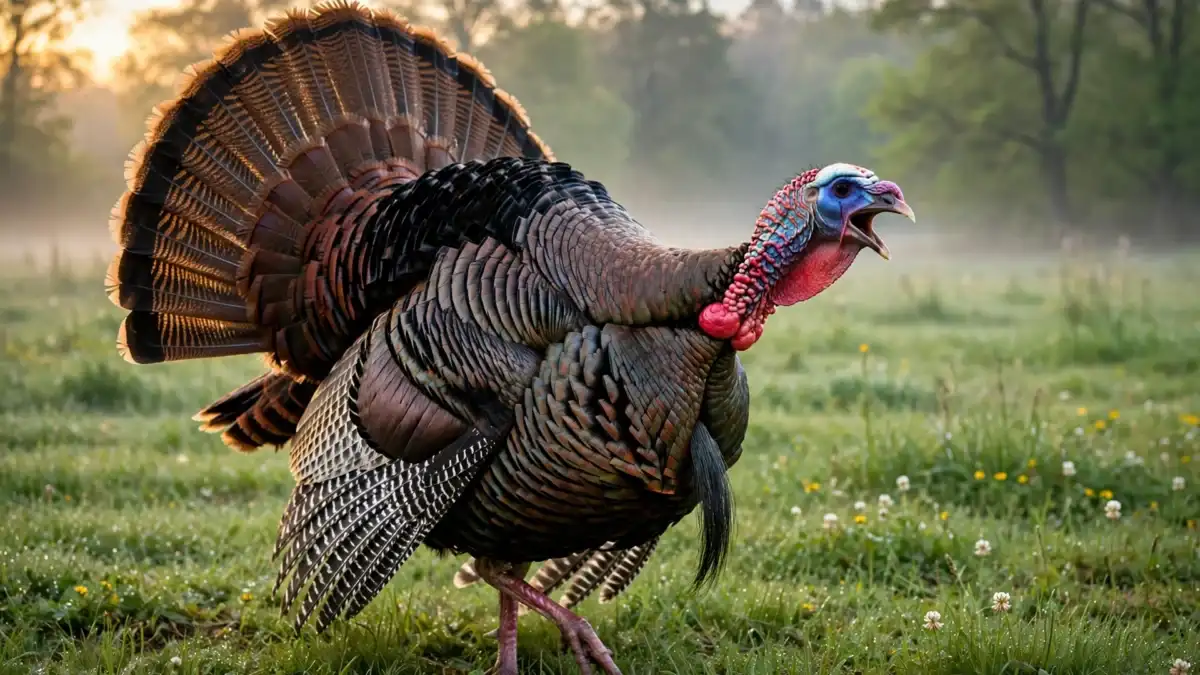
If you have ever been startled awake by a thunderous gobble rolling across a spring meadow at dawn, you have heard one of the loudest and most recognisable calls in North American birdlife. The short answer to why turkeys gobble is courtship.
The gobble is a male turkey’s mating advertisement, broadcast at high volume to attract hens and warn off rival males. Only adult males (toms) gobble; hens never do under normal circumstances.
But the gobble carries more information than a simple come-hither, and turkeys also gobble in situations that have nothing to do with romance. This guide breaks down every meaning behind the call, when gobbling peaks, and what the rest of the turkey’s surprisingly rich vocabulary is actually saying.
What Exactly Is a Gobble?
A gobble is a loud, rapid, descending series of notes produced by a male turkey, often rendered as gobble-obble-obble. It erupts in less than two seconds and can be heard across long distances. On a calm morning, experienced listeners can pick out a gobble from up to a mile away, though wind, terrain, and tree cover shorten that range considerably.
Sound production happens at the syrinx, the vocal organ birds carry at the base of the trachea. The male turkey’s syrinx is larger and more developed than the female’s, which is part of why only toms can produce the full gobble.
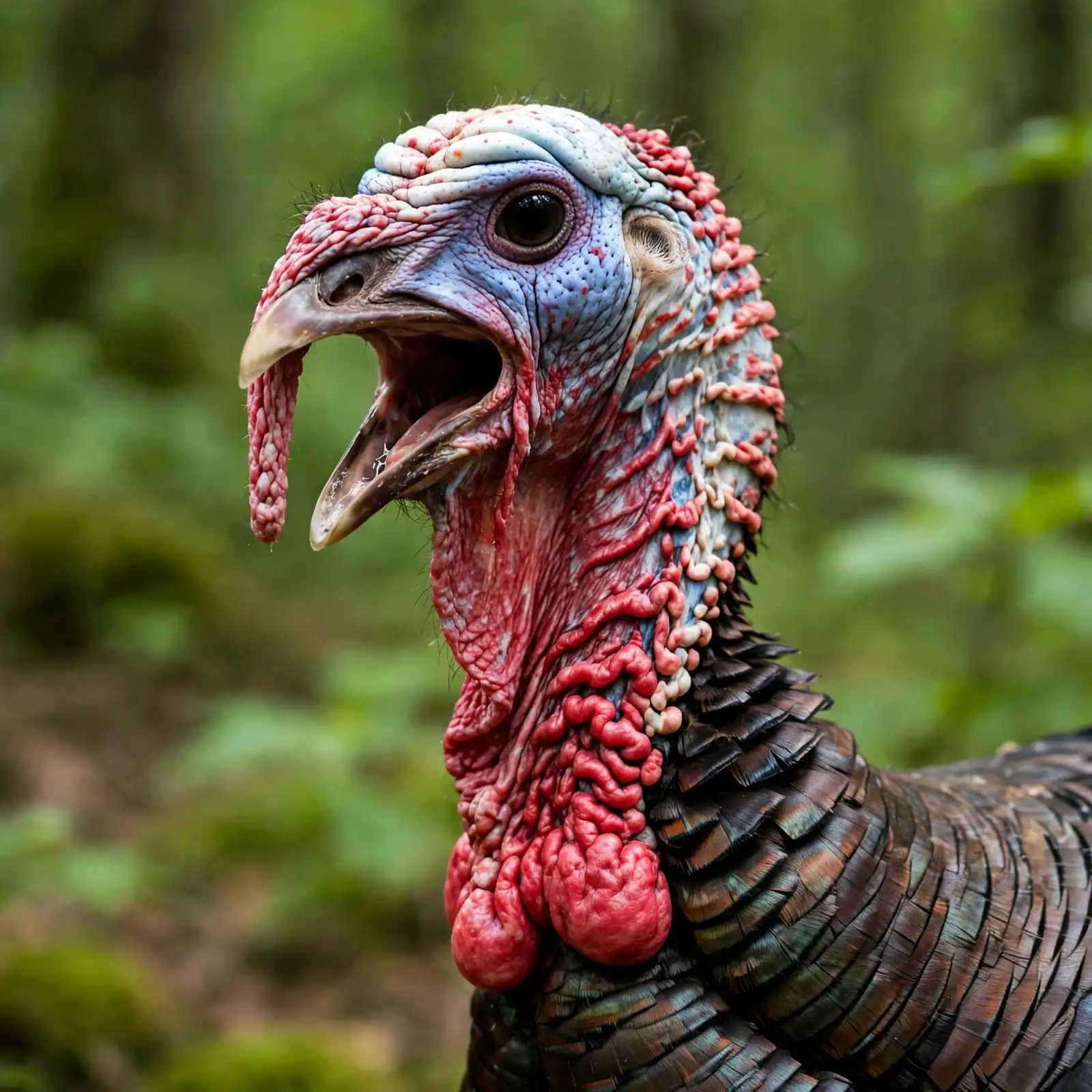
During the call, a gobbling tom typically stretches its neck forward, and the whole display often arrives bundled with strutting: tail fanned, wing feathers dragging, body puffed, and the head flushing from pale blue to vivid red and white as blood rushes through the skin.
The gobble often comes wrapped with two companion sounds. Before the gobble, a strutting tom makes a low spitting noise; after it, a deep drumming thrum rolls out. Hunters and biologists describe the full sequence as spit, drum, gobble, and the drumming alone can carry surprising distances.
Taken together, this is the wild turkey’s loudest and most complete courtship advertisement. You can hear real recordings and compare regional variations on the Cornell Lab’s All About Birds Wild Turkey sounds page.
Who Gobbles and Who Doesn’t
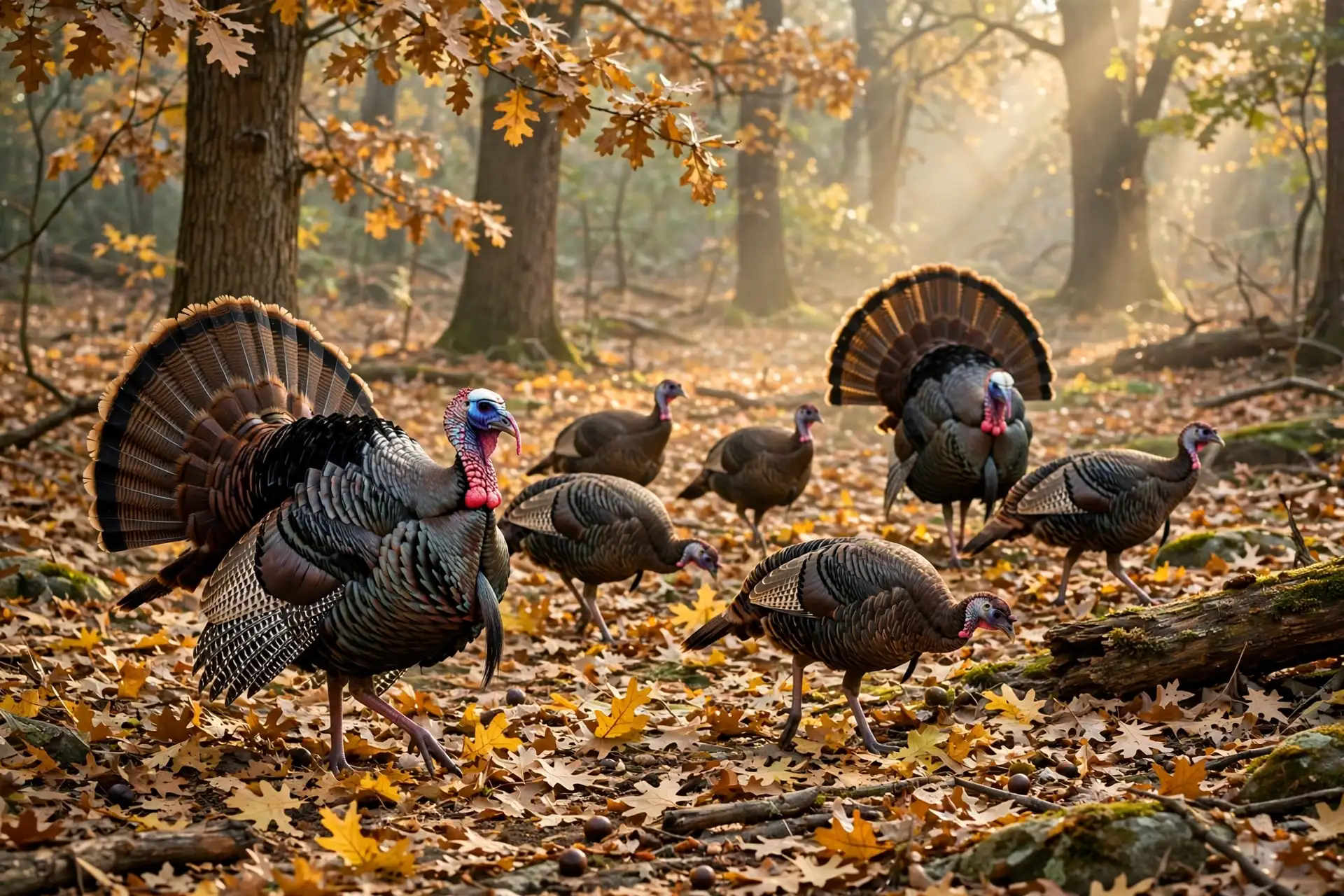
Gobbling is strictly a male behaviour. Adult toms gobble. Yearling males (jakes) gobble too, though their calls sound thinner and shorter, more like a rough yelp-gobble hybrid that breaks partway through. Hens do not gobble under normal circumstances. Reports of gobbling hens exist but are vanishingly rare and usually involve bearded hens with unusual hormonal profiles. For practical purposes, if you hear a gobble, a male turkey made it.
This matters because the turkey’s sound world is much bigger than the gobble. Hens run the social conversation with an entire vocabulary of calls, and toms use several calls besides the gobble. The table below shows who says what.
| Call | Made by | What it means |
|---|---|---|
| Gobble | Toms only | Mating advertisement, territorial claim, assembly call |
| Yelp | Both, mostly hens | Basic contact call, the backbone of turkey conversation |
| Cluck | Both | Short-range attention or location note |
| Putt | Both | Sharp alarm when something looks wrong |
| Purr | Both | Contentment while feeding, keeps the flock calm |
| Cut | Mostly hens | Agitated, excited yelping, often a breeding-season call |
| Cackle | Both | Loud series made when flying down from the roost |
| Kee-kee | Young birds | Lost or separated young calling for the flock |
| Spit and drum | Toms only | Strutting display sounds that frame the gobble |
So the gobble is the headline act, but it is one instrument in a full band. A turkey hunter can carry a dozen different calls in a vest and still not match what a real flock produces on an ordinary morning. If you want the full picture of the bird beyond its voice, our wild turkey facts guide covers habitat, diet, behaviour, and the adaptations that make this bird so distinctive.
The Four Meanings Behind a Gobble
A gobble is not a one-word sentence. Biologists and experienced observers recognise at least four overlapping functions, and a single gobble can serve more than one at once.
1. Mating advertisement
This is the primary job of the gobble. In spring, a tom gobbles to announce himself to hens across the landscape. Breeding season is short and competition is intense, so volume and persistence matter. The toms that gobble most often and most boldly tend to hold the best display grounds, and hens visit those grounds to choose mates. In this sense, the gobble works exactly like a songbird’s dawn chorus: it says here I am, I am healthy, come and inspect me.
2. Territorial warning to other males
The gobble also tells rival toms to keep their distance. When two males hear each other gobbling from adjacent ridges, they are mapping each other’s positions and settling boundaries without a fight. Gobbling duels between toms can run back and forth for many minutes. Occasionally they escalate into real fights, with the birds leaping and striking with their spurs, but the vocal contest usually resolves things first.
3. Assembly and location
Turkeys roost in trees overnight and scatter to feed by day. The gobble helps reassemble the social group, particularly in the morning when birds are flying down from different roost trees. A hen’s yelp can pull a tom across a field; a tom’s gobble can pull wandering hens and jakes toward the display ground. It is a contact call scaled up to the size of the landscape.
4. The shock gobble
This is the oddest meaning and the one most people notice first. A tom will sometimes gobble in direct response to a sudden loud noise: thunder, a slamming car door, a crow’s caw, a woodpecker’s drumming, even a train whistle.
The call appears to be an involuntary startle response wired into the breeding-season brain, and dawn is full of triggers because owls hoot through the early hours when gobblers are primed to answer. Hunters have exploited this reflex for generations with locator calls, owl hoots and crow caws designed to make a tom reveal its position without any hen sounds at all.
When Turkeys Gobble Most
Gobbling follows a strict seasonal and daily calendar. The peak runs through the spring breeding season, roughly March through May in most of the turkey’s range, with timing shifting earlier in the South and later in the North. This is when a tom may gobble dozens of times in a single morning.
Within a day, the heaviest gobbling happens at dawn. Toms gobble from the roost before first light, go quiet briefly while they fly down, then gobble hard again on the ground as they move toward display areas. A second, smaller peak comes in the late afternoon and evening as birds head back toward roost trees.
Outside the breeding season, gobbling drops off sharply. Through summer, fall, and winter, turkeys communicate mostly with yelps, clucks, and purrs, and the woods go quiet. Hearing a gobble in November is a genuine novelty, which is one reason the sound feels so tied to spring. If a tom does gobble in autumn, it is usually a brief response to a startling noise rather than sustained breeding behaviour.
Weather shapes the daily pattern too. Toms gobble most on calm, clear mornings. Heavy wind, rain, and cold snaps suppress gobbling because the sound does not carry and the birds stay hunkered. A still, mild morning after a storm front passes is the classic recipe for a loud dawn chorus of gobbles.
What a Gobble Tells Other Turkeys
The gobble carries information beyond I am here. Researchers who study turkey vocalisations note that the rate, volume, and persistence of gobbling reflect a tom’s condition and status. A dominant, healthy male gobbles more often, answers challenges faster, and holds the centre of the display ground. Subordinate jakes gobble less and may go silent when a dominant bird is sounding off nearby.
Hens appear to use this information when choosing where to feed and, ultimately, which males to approach. A tom that gobbles boldly from an open strutting zone advertises both his health and his territory quality.
The system is honest because faking it is costly: gobbling is loud enough to attract predators as well as hens, so a male that gobbles constantly is demonstrating that he can afford the risk. Predators such as coyotes and bobcats absolutely key in on gobbling toms in spring.
Distance matters too. Because a gobble carries so far, a single tom can advertise to hens spread across a wide area without moving. This long-range function is unusual among the calls in the turkey’s repertoire, most of which are quiet, short-range social sounds. The gobble is the broadcast tower; the yelps and purrs are the group chat.
Why the Name Causes Confusion
The turkey’s name has nothing to do with its call, which confuses many newcomers. The bird was named after the country Turkey because early European traders confused it with the guineafowl, which reached Europe through Turkish trade routes. Taxonomists later placed it in its own genus, Meleagris, as detailed in the wild turkey’s species account.
The confusion runs the other way too. The turkey vulture carries the word turkey in its name because its bald red head reminded early settlers of a male turkey, but it is a completely different bird, a scavenging raptor rather than a game bird. If the naming puzzles you, our turkey vulture versus hawk guide untangles the lookalikes.
Why Hunters Listen for Gobbles
The spring turkey hunt is built around the gobble. Hunters slip into the woods before dawn, listen for the first roost gobbles to pinpoint a tom’s position, then set up nearby and use hen calls, yelps, clucks, purrs, and cuts, to lure him into range after fly-down. The entire strategy depends on the tom’s urge to answer: a gobbler that goes silent is far harder to hunt than one that gobbles at every call.
The shock gobble gets its own chapter in hunting tradition. Locator calls, typically owl hoots at dawn and crow calls later in the morning, exist for one purpose: to make a tom gobble reflexively and give away its location. An experienced hunter reads the answers like a map.
A quick, aggressive gobble suggests a fired-up dominant bird. A faint, distant gobble means a long walk or a reposition. Silence means the bird may have hens already or has simply shut down for the day.
This hunting culture has produced one of the richest folk vocabularies in birding. Hunters distinguish gobbles by mood and context, from the roost gobble to the fighting purr-gobble of two toms squaring off, and the terminology fills whole books.
You do not need to hunt to enjoy this, though. Simply sitting quietly in turkey country on an April morning and listening to the ridges trade gobbles is one of the great free wildlife experiences in North America.
It is also a sound that nearly vanished: from fewer than a quarter of a million birds in the early 1900s, wild turkeys have recovered to nearly 7 million today through trap-and-relocate programmes led by agencies and the National Wild Turkey Federation.
What to Do If You Hear Gobbling
If gobbling erupts near your home, your campsite, or your hiking trail, a few simple steps turn the moment into a real observation.
- Freeze first: Movement spooks turkeys faster than noise, so stop and let the birds settle before you reach for binoculars.
- Locate the roost: In spring, repeated dawn gobbles from the same direction usually mark a favoured roost tree, worth revisiting on later mornings.
- Watch the strut zone: Mid-morning gobbling often comes from an open display area, a field edge or logging road, where you may catch the full tail-fan strut.
- Stay downwind and quiet: Turkeys see extraordinarily well and hear well too, so keep a respectful distance and let the show come to you.
- Note the date: A gobble in March means breeding behaviour, while a November gobble is almost certainly a startle response, and your notes become a personal phenology record.
Never try to approach a gobbling tom closely in spring. A bird focused on courtship can behave unpredictably, and crowding wildlife for a photo stresses the animal and ruins the observation for everyone else. Patience beats proximity every time.
Can female turkeys gobble?
Effectively no. Gobbling is a male-only call under normal circumstances, produced by the larger, more developed male syrinx. The rare published reports of gobbling hens involve unusual individuals, and biologists treat them as extreme exceptions. If you hear a gobble, it came from a tom.
How far away can a gobble be heard?
On a calm, still morning, a gobble can carry up to a mile, which is why hunters listen from ridgetops before dawn. Wind, rain, dense timber, and rolling terrain cut that distance sharply. The companion spitting and drumming sounds of the strut carry far less distance than the gobble itself.
Do domestic turkeys gobble?
Yes. Domestic toms gobble just as wild ones do, since the call is inherited from their wild ancestors. Farm and backyard toms may gobble at feeding time, at visitors, or at any loud noise, and they are often more trigger-happy with shock gobbles than wary wild birds.
Why do turkeys gobble at thunder and loud noises?
This is the shock gobble, an involuntary startle response most common during the spring breeding season when the male’s system is primed for vocal display. Thunder, crow calls, owl hoots, slamming doors, and train whistles can all set it off. Outside the breeding season the reflex largely disappears.
Do turkeys gobble in winter?
Rarely. Once breeding ends, toms go nearly silent and the flock communicates with quieter yelps, clucks, and purrs. A winter gobble is almost always a brief shock response to a startling sound rather than the sustained dawn gobbling of spring.
What time of day do turkeys gobble most?
Dawn is the peak, with toms gobbling from the roost before first light and again on the ground after fly-down. Late afternoon brings a smaller secondary peak as birds return toward roost areas. Midday gobbling is uncommon except during the height of the breeding season.
A Call That Means Business
The gobble is courtship, territory, roll call, and startle reflex packed into two seconds of sound. It is the loudest statement a turkey makes and the one most tied to the bird’s identity, which is why a single gobble at dawn can define a whole spring morning. Listen for it from March through May, respect the bird’s space, and you will hear one of North America’s great wild performances exactly as it has sounded for thousands of years.