
Do Bluebirds Migrate? Where Eastern Bluebirds Go in Winter
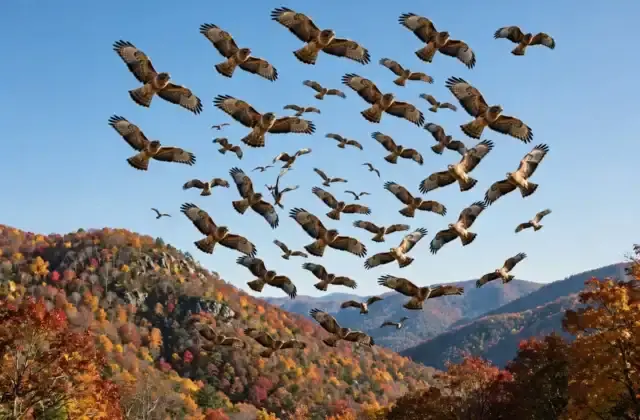
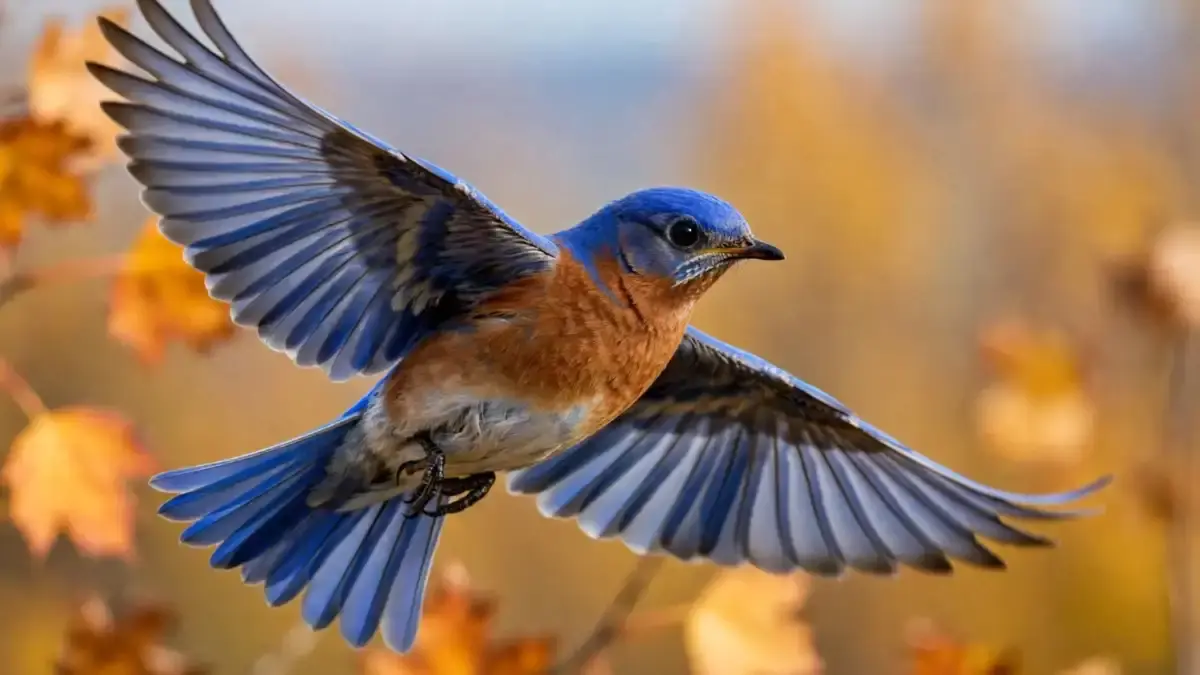
Yes, but only some of them. Eastern Bluebirds are partial migrants: birds that breed in the northern part of the range fly south for winter, while birds in the South stay put all year. Right now, in late October, the northern birds are on the move, gathering into chattering flocks and drifting south toward the Gulf states. If your bluebirds vanished from the nest boxes this month, they probably did not die or abandon you. They are migrating, and there is a good chance they will be back in February. Here is exactly which bluebirds migrate, where they go, when they travel, and how to support the ones passing through your yard.
The Short Answer: Partial Migration
Most songbirds fall into neat boxes: migrants leave, residents stay. Bluebirds refuse the neat box. The Eastern Bluebird’s range stretches from southern Canada to the Gulf Coast and into northeastern Mexico, and migration behaviour changes across that range. Northern populations are genuinely migratory. Southern populations are year-round residents. In the broad middle band, some individuals migrate and others do not, even within the same local population.
This flexible strategy is called partial migration, and it is one of the bluebird’s smartest adaptations. When winter is mild and berries are plentiful, staying put avoids the risks and energy costs of travel. When winter turns harsh, moving south guarantees food. Individual birds appear to adjust their strategy to conditions, which is why bluebird numbers in any given northern winter vary so much from year to year. A mild December can leave bluebirds scattered across Pennsylvania; a brutal one pushes the same birds toward the Carolinas.
The other two North American bluebirds follow similar logic. Mountain Bluebirds breed across the high country of the West and migrate to lower elevations and southern latitudes for winter, with many moving only as far as conditions require. Western Bluebirds are partial migrants across the Pacific states. But this article focuses on the Eastern Bluebird, the species most backyard birders in the East and Midwest are watching right now.
Which Bluebirds Migrate and Which Stay
Your latitude decides most of the story. The table below gives the general pattern, though individual birds always reserve the right to surprise you.
| Breeding region | Migration behaviour | Typical winter location |
|---|---|---|
| Southern Canada, New England, Great Lakes, northern Midwest | Mostly migratory | Southeastern US, Gulf Coast |
| Mid-Atlantic, central Midwest, southern New England | Partial, varies by winter severity | Local area or a few hundred kilometres south |
| Southeast, Texas, Gulf Coast | Resident | Same area year-round |
| Northeastern Mexico | Resident | Same area year-round |
Climate trends are slowly redrawing this map. With winters warming, Christmas Bird Count data and eBird reports show bluebirds wintering farther north than they did a generation ago. Researchers call this short-stopping: birds halting their migration earlier because conditions allow it. If you live in the mid-Atlantic and your bluebirds stayed all winter for the first time recently, you are watching this shift in real time. It is a genuine, documented change, not just a lucky year.
The Cornell Lab’s Eastern Bluebird range map shows the breeding, year-round, and wintering zones clearly, and it is worth a look to see exactly where your yard falls.
Where Northern Bluebirds Go
Migrating Eastern Bluebirds do not undertake the marathon flights of warblers or hummingbirds. They are short to medium-distance migrants, typically moving a few hundred kilometres to perhaps a thousand or more, settling across the southeastern United States. Winter concentrations build in the Carolinas, Georgia, Alabama, Mississippi, Louisiana, Texas, and Florida, with some birds reaching northeastern Mexico.
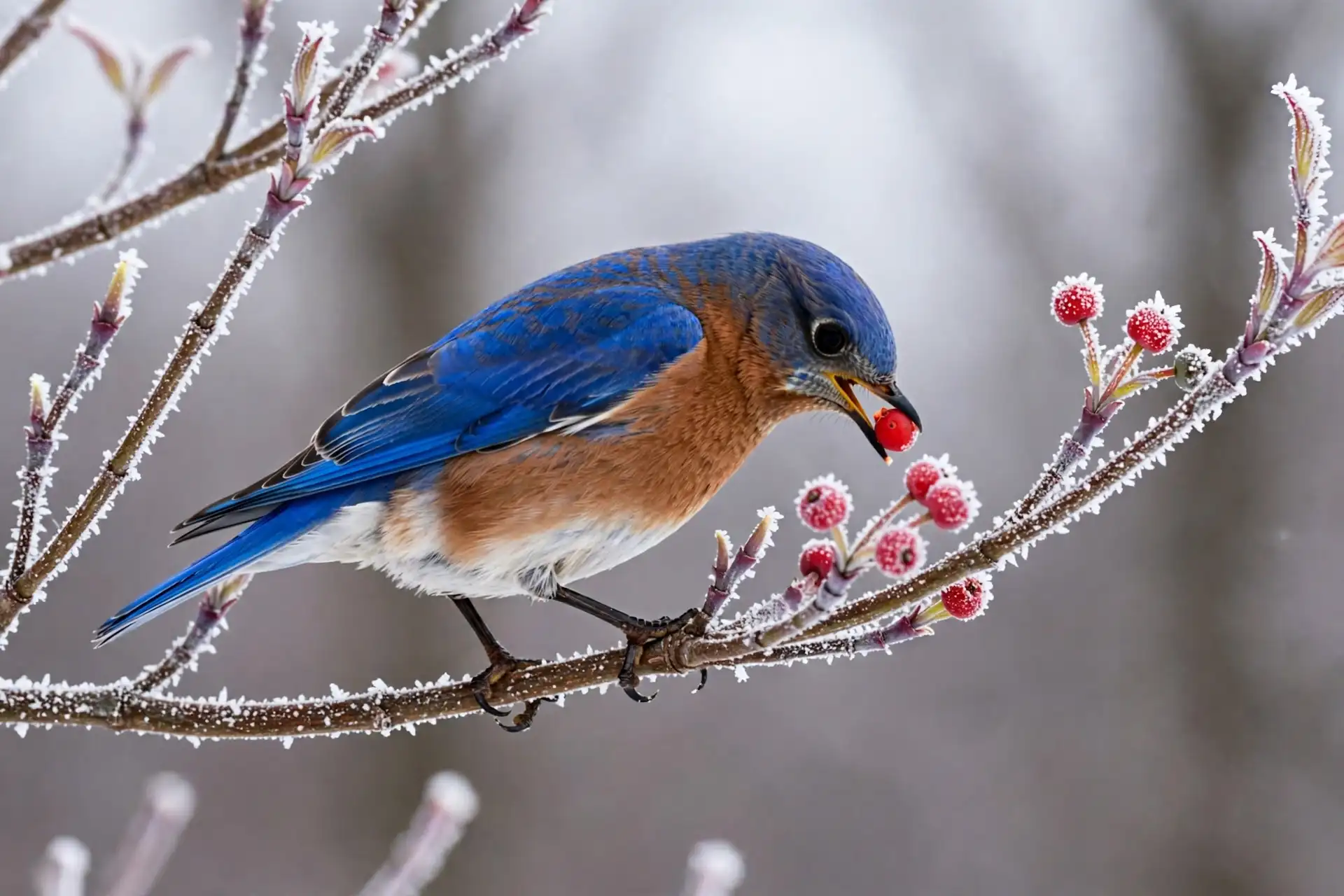
Within the winter range, bluebirds seek open country with scattered trees, the same habitat recipe they prefer for breeding: pastures, orchards, parkland, golf courses, and open pine woods. The critical winter resource is fruit. While breeding-season bluebirds are insect hunters, winter birds pivot to berries, and the wintering grounds that hold the most bluebirds are the ones with the heaviest berry crops: dogwood, holly, sumac, hackberry, juniper, and wild grape.
Unlike many songbirds that funnel into narrow migration corridors, bluebirds move on a broad front. They drift south in loose streams rather than concentrated flyways, which is why there is no single famous bluebird migration hotspot to visit. Your best chance of seeing migrants is simply to watch open habitat in October and November for small flocks of bluebirds moving through, calling their soft chattering contact notes as they go. Our roundup of birds migrating in October puts bluebirds in context with the other species on the move right now.
When They Leave and When They Return
Bluebird migration runs on a relaxed schedule compared with the frantic September rush of warblers. The timetable below covers the Eastern Bluebird’s typical movements.
| Period | What happens |
|---|---|
| Late August to September | Family groups break up; young birds disperse; loose flocks begin forming in the North |
| October | Peak southward movement from northern breeding areas; migrants pass through the mid-latitudes |
| November | Stragglers depart; wintering flocks settle into southern territories |
| December to January | Wintering period; flocks roam berry-rich habitat, roost communally |
| February | First northbound movement; males begin prospecting in the South and mid-latitudes |
| March to April | Main return to northern breeding grounds; males claim nest boxes and cavities |
One detail matters for nest-box landlords: the males return first and start house-hunting immediately. A male may claim your box in late February or March, weeks before nesting begins. If your boxes were productive last summer, clean them in late winter and have them ready early. The earliest arrivals get first pick, and a box that is clean and available in February beats a perfect box that goes up in April. For the full year-round playbook, see our guide on how to attract bluebirds to your yard.
How Bluebirds Migrate: Daytime Drifters
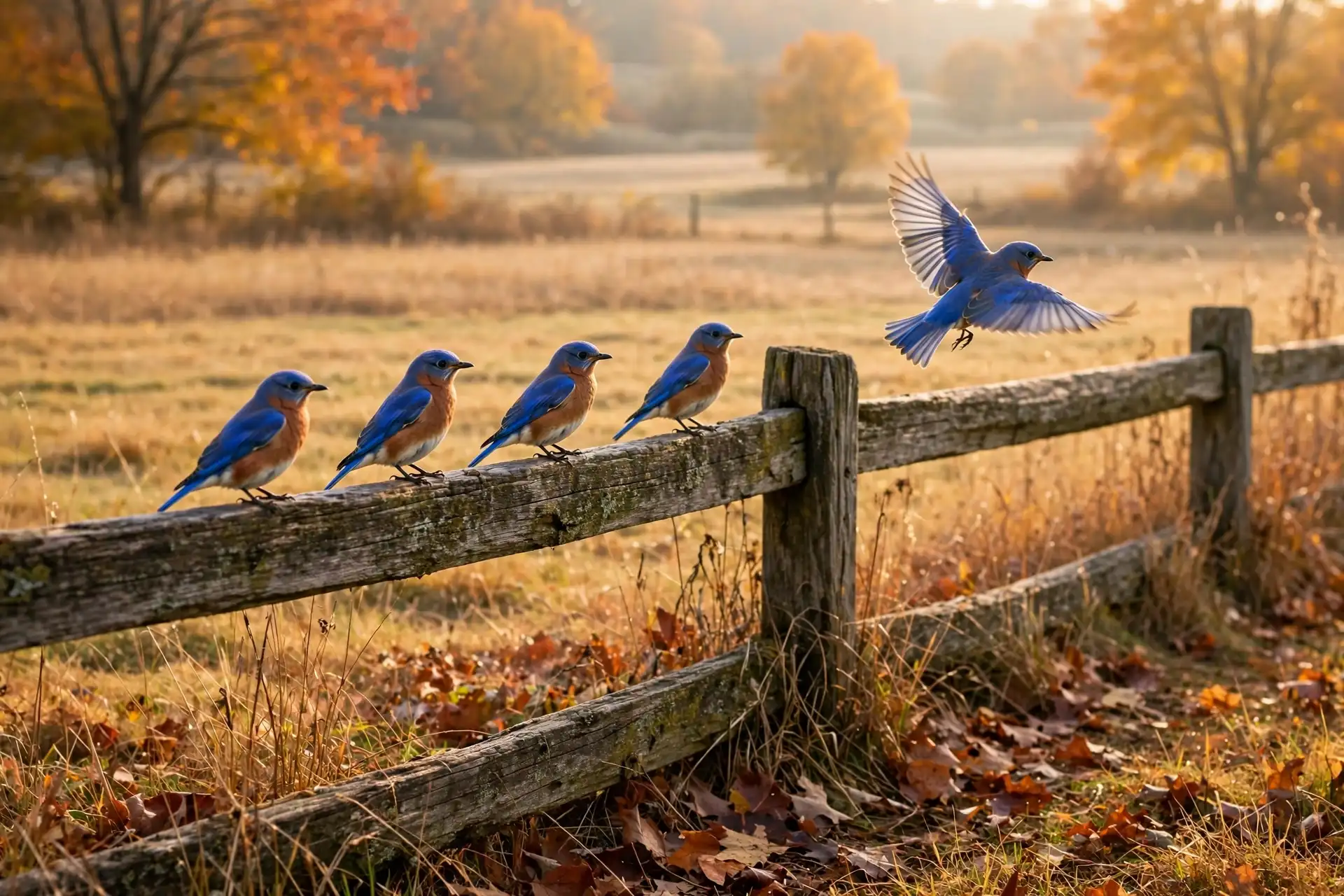
Here is where bluebirds break the songbird rulebook. Most migrating songbirds travel at night and rest by day. Bluebirds migrate primarily during the day, flying in small loose flocks and stopping frequently to perch and feed. It is less a journey than a slow southward drift with lunch breaks.
This daytime strategy shapes everything about their migration. They do not need to gorge and fly nonstop; they forage as they go, picking insects and late berries along the route. They travel low, moving from perch to perch across open country, and their flight has the familiar bluebird bounce: a few quick wingbeats, a glide, a few more beats. A flock on the move looks relaxed, almost casual, with birds calling back and forth to stay in contact.
Flock size stays modest. Wintering and migrating groups typically number a half dozen to a couple of dozen birds, often extended family groups plus hangers-on. These are the chattering flocks you see in October, working across a field edge or orchard. Listen for the soft, rolling chur-wi contact calls. A silent flock of bluebirds in fall is usually a flock at rest; a vocal one is often a flock on the move.
The daytime habit also means bluebirds are far less vulnerable to the hazards that kill nocturnal migrants. They do not collide with lit-up skyscrapers at 2 a.m., and they are not disoriented by city lights. Their migration risks are the ordinary daytime ones: hawks, especially Cooper’s and Sharp-shinned Hawks working the same field edges, and the simple attrition of weather and scarce food.
What They Do All Winter
Winter transforms bluebird society. The territorial breeding pairs dissolve into social flocks that roam the wintering grounds together, and the birds’ daily routine reorganises around two priorities: finding fruit and staying warm.
The diet shift is dramatic. A breeding bluebird is an insect specialist, dropping from perches to snatch beetles, grasshoppers, and caterpillars. A wintering bluebird is a frugivore, moving through the landscape in search of berry crops. Sumac clusters, dogwood berries, holly, juniper berries, and hackberry fruits fuel the winter flock. Insects are not abandoned entirely; on warm winter days the birds still hawk insects, but fruit carries them through the cold stretches.
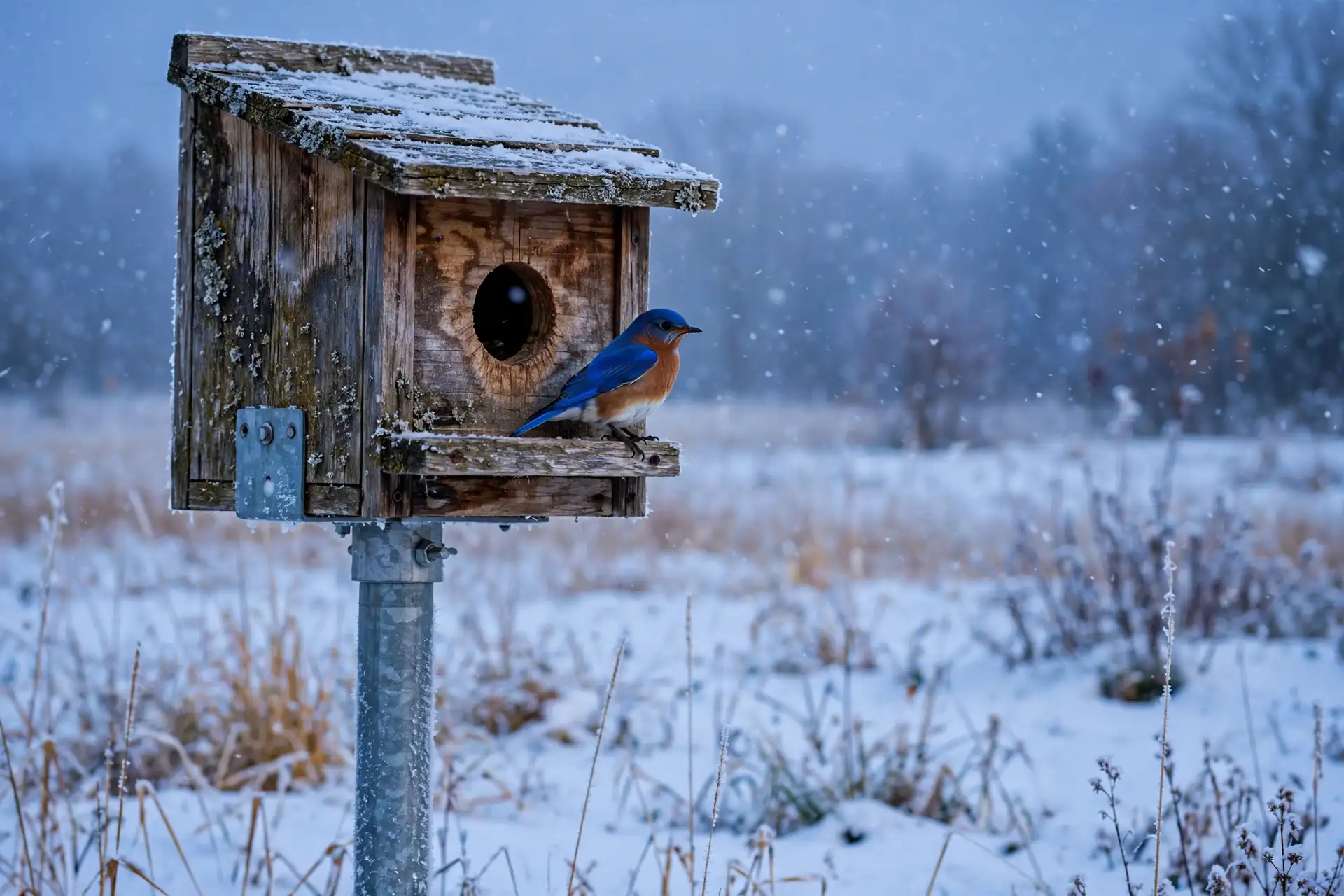
Staying warm brings the most charming winter behaviour: communal roosting. On cold nights, bluebirds pack themselves into tree cavities and nest boxes, sometimes several birds to a box, huddling for shared warmth. This is why experienced bluebird landlords leave their boxes up all winter instead of taking them down. A box that raised three broods in summer becomes a life-saving shelter in January. Face the entrance away from prevailing winter winds, and resist the urge to clean the box until late winter; the old nest material adds insulation.
For the broader picture of how birds handle the cold season, our guide on where birds go in winter covers the full menu of strategies, from migration to torpor to toughing it out.
Will Bluebirds Visit Feeders in Winter?
Bluebirds are not seed eaters, so a standard tube feeder full of sunflower seed will not interest them. But wintering bluebirds absolutely visit feeders stocked with the right foods. Mealworms are the classic offering: live or dried, presented in a small dish or a bluebird-specific feeder with entry holes sized to exclude starlings. Suit cakes, peanut butter mixtures, and berry-flavoured suet dough also draw them, as do raisins and currants soaked to soften them.
Placement matters as much as food. Bluebirds are open-country birds that feel exposed at a feeder tucked deep in the woods. Set the feeder near the edge of an open area, within quick flight of a perch such as a fence post or small tree. They like to stage, scan, and swoop in, the same hunting rhythm they use in summer. A heated birdbath nearby is a powerful bonus; in freezing weather, open water draws bluebirds as reliably as food does.
Be patient if migrants pass through without stopping. A flock moving south in October may pause for an hour, strip a dogwood, and move on. That is migration working as intended, not a rejection of your hospitality. The birds that settle for winter, or the ones that short-stop in your area during a mild year, are the ones that will learn your feeder.
How to Help Migrating and Wintering Bluebirds
Whether your bluebirds are leaving, passing through, or staying, these steps make your yard more valuable to them.
- Plant native berry producers: Dogwood, winterberry holly, sumac, serviceberry, and juniper feed wintering flocks for months; plant for a sequence of ripening times.
- Leave nest boxes up all winter: Clean them in late winter, not fall; winter roosting birds use the old nests for insulation and shelter.
- Offer mealworms and suet: A dish of mealworms or a suet feeder near open ground gives migrants and winter residents high-energy food.
- Provide open water: A heated birdbath in freezing weather attracts bluebirds and dozens of other species.
- Keep some perches: Fence posts, dead snags, and small trees at field edges are hunting perches; resist the urge to tidy every last one away.
- Skip the pesticides: Fall insect populations feed migrating birds; a sprayed yard is a food desert for a flock trying to fuel up.
- Report your sightings: Logging bluebirds on eBird or your local birding list helps researchers track the short-stopping shift in real time.
The North American Bluebird Society offers region-specific guidance on box design, predator guards, and monitoring programmes if you want to go deeper than a single box.
Do bluebirds migrate south for winter?
Northern populations do; southern populations do not. Eastern Bluebirds are partial migrants, so the answer depends on where the bird breeds. Birds from Canada, New England, and the Great Lakes fly south to the southeastern US, while birds in the Southeast and Texas stay year-round.
Where do bluebirds go in winter?
To the southeastern United States and northeastern Mexico: the Carolinas, Georgia, Alabama, Mississippi, Louisiana, Texas, and Florida hold the largest winter concentrations. They settle in open country with scattered trees and heavy berry crops.
Do bluebirds stay in winter up north?
Increasingly, yes. Warming winters have pushed the wintering range northward, and bluebirds now regularly overwinter in the mid-Atlantic and parts of the Midwest where they were once strictly summer birds. A harsh winter can still push them south, which is why numbers fluctuate year to year.
Do bluebirds migrate at night?
No, unlike most songbirds. Bluebirds migrate during the day in small flocks, flying low from perch to perch and foraging as they travel. Their migration is a slow southward drift rather than a nonstop night flight.
Should I take down bluebird houses in winter?
Leave them up. Wintering bluebirds roost communally in cavities and nest boxes, packing several birds into one box for shared warmth on cold nights. Clean the boxes in late winter before the males return to prospect in February and March.
Will bluebirds return to the same nest box?
Often, yes. Bluebirds show strong site fidelity, and males returning in late winter frequently reclaim boxes they used the previous year. Clean, available boxes in February get claimed first, so early preparation pays off.
The Birds That Choose
The bluebird’s answer to winter is not a rigid programme but a decision, remade each year by each bird: stay or go. That flexibility has carried the species through centuries of changing winters, and it is carrying them through this one too. Watch the October flocks, keep the boxes up, plant the berries, and you will be ready whether your bluebirds are saying goodbye until February or simply settling in for the season.