

Introduction
Pigeons are one of the most common birds to be found on city ledges. But most people just ignore them. Pigeons and doves can be found everywhere. Rooftops, parks, feeders and country roads. They are peaceful and have a gentle call. They also have a unique head-bobbing walk. There are many different species of pigeons and doves in North America. From the city rock pigeon to the mountain forest band-tailed pigeon. This guide will tell you about the ones you are most likely to see. Rock pigeon, mourning dove, Eurasian collared-dove, white-winged dove and band-tailed pigeons. You’ll learn about their size, field marks, calls, habitat and diet. The next time you see a pigeon you’ll know their actual name. Each species has its own unique look and call. From the gray rock pigeon to the slim mourning dove.

What Is a Pigeon
Pigeons and doves are members of the Columbidae family. There are a large number of species (around 350) within this family. All species have similar physical features including a stout body, a small head, a relatively short neck, and a slender bill. Their diet consists mostly of seeds, fruits, and other plant matter. They also have a distinctive head-bobbing walk that marks them at a glance.
The family is large, with about 350 species, and the North American members are a small part of it. Within this guide we will be looking at five species in full detail. These are the rock pigeon, mourning dove, Eurasian collared-dove, white-winged dove and band-tailed pigeon.
Dove vs Pigeon
The terms dove and pigeon are interchangeable. There is no scientific basis to determine which species belong to each category. They are common names and will often be used based on tradition. A mourning dove and a rock pigeon are both members of Columbidae, and the difference between the two names tells you nothing about how the birds are related.
Most people will use the common names based on size and feel. The smaller, slimmer, gentler birds will often be referred to as doves. However, the larger, plumper, city birds will often be referred to as pigeons. This is not a rule and will often not hold true. Despite the rock pigeon and mourning dove having true common names they both belong to the same family and have the same body plan.
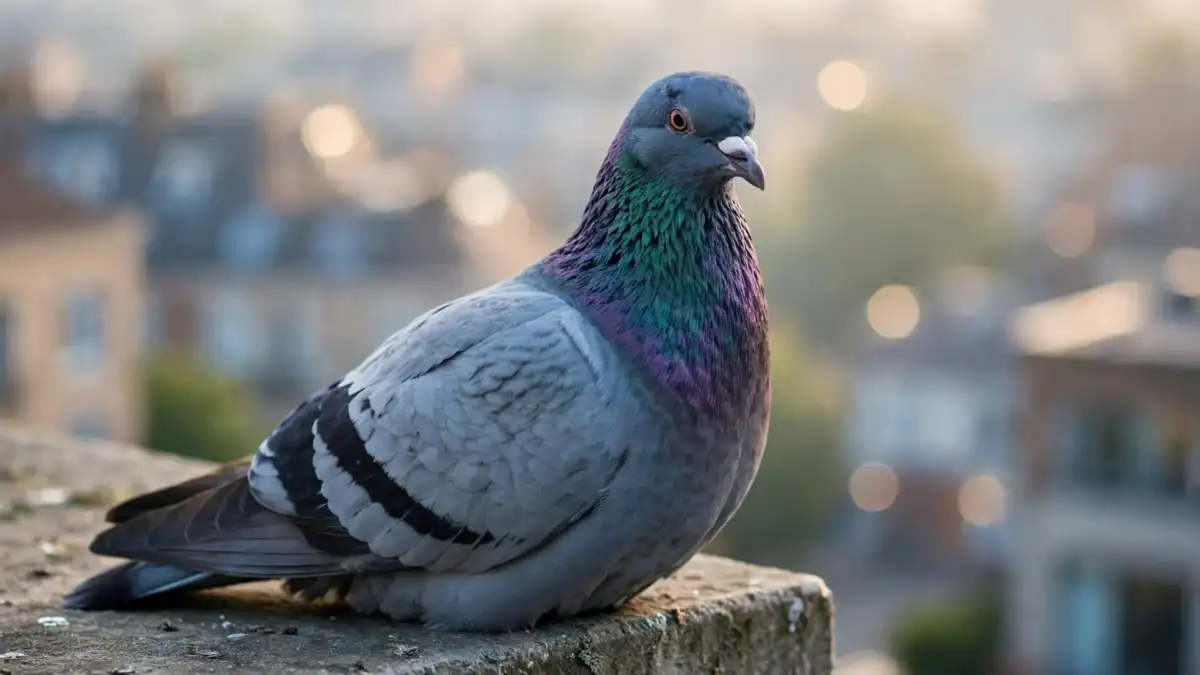
The best way to refer to a bird is by using its field marks, not by its common name. A gray bird with two dark wingbars and an iridescent neck is a rock pigeon. A slender buffy-brown bird with black wing spots and a long pointed tail is a mourning dove. The names matter less than the marks, and the marks are easy to learn once you know them.
Rock Pigeon
The rock pigeon (Columba livia) is one of the best known pigeons to North Americans. Rock pigeons are 11 to 14 inches long, weigh between 9 to 13 ounces, and have a wingspan of 26 to 29 inches. They are stocky, blue-gray birds with two dark wingbars and a neck that is iridescent green and purple. Rock pigeons have a rounded tail and a small, slender bill.
Rock pigeons are the most widespread introduced pigeon in North America. The species was introduced from Europe in the early 1600s and feral pigeons spread around the continent. Now they can be seen in cities and towns throughout North America. They are often found around ledges, rooftops, bridges and parks. They are the gray pigeon most people picture when they hear the word pigeon.
They were officially called Rock Dove until 2003 when the name was changed to Rock Pigeon by the American Ornithologists’ Union. Rock pigeons are an introduced species and are therefore not protected under the Migratory Bird Treaty Act.
Mourning Dove
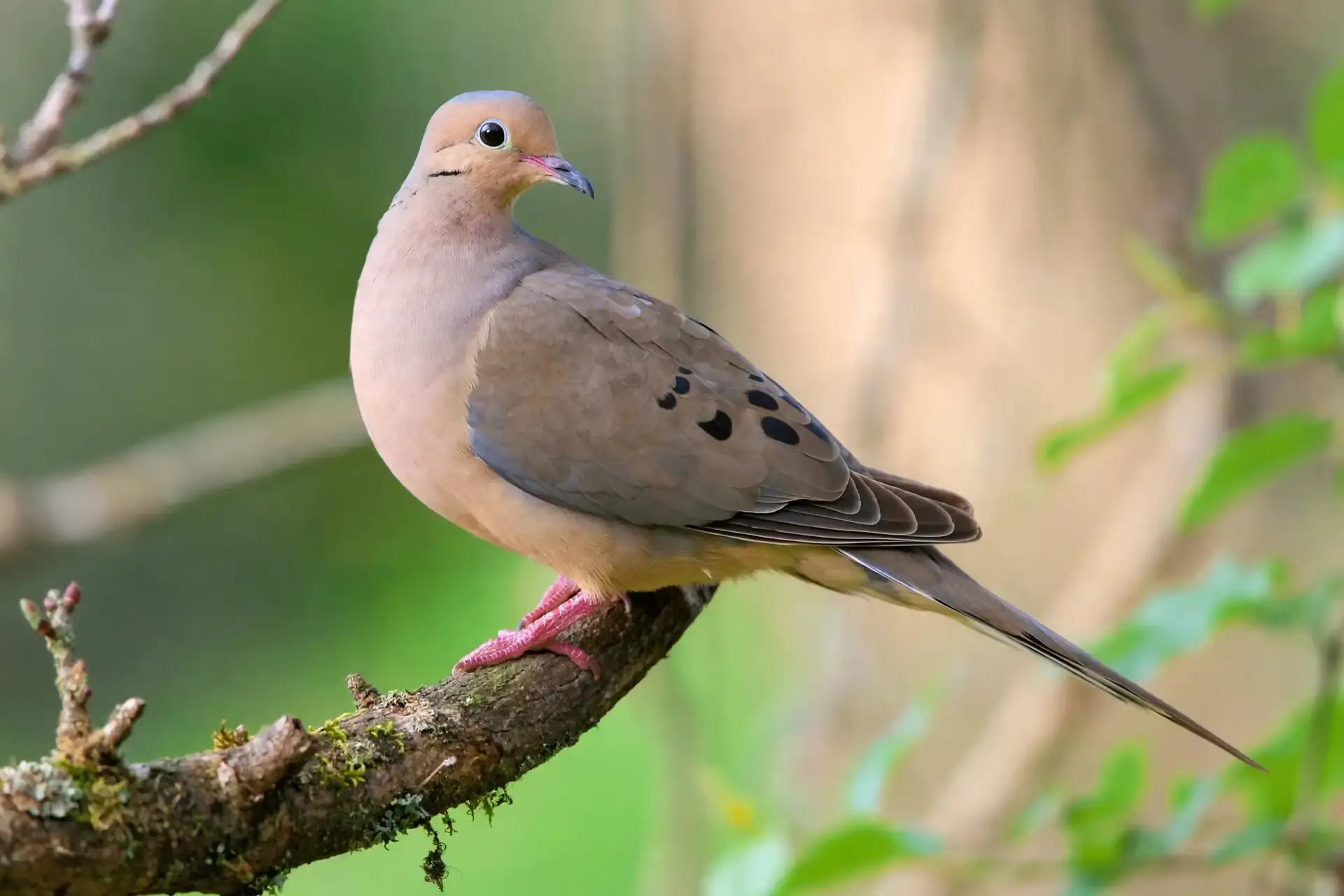
The mourning dove (Zenaida macroura) is the most widespread native dove to be found across North America. You can find them across the United States, southern Canada, Mexico and parts of Central America. They range between 9 to 13 inches in length, 3 to 6 ounces in weight and have a wingspan of 17 to 18 inches.
Mourning doves are slender with buffy-brown to grayish plumage. They have black spots on their wings and a long pointed graduated tail with white tips that have black borders. They look very delicate compared to rock pigeons, and they are! Rock pigeons typically weigh around two and a half times a mourning dove.
The mourning dove’s call is a mournful three-part coo: “coo-OO, coo-COO, coo-COO”. It is a soft, low sound, often heard at dawn and dusk in backyards and open country. Many people mistake it for an owl, but the gentle coo belongs to the dove. For the full story of this bird, see our guide to the mourning dove.
Eurasian Collared-Dove
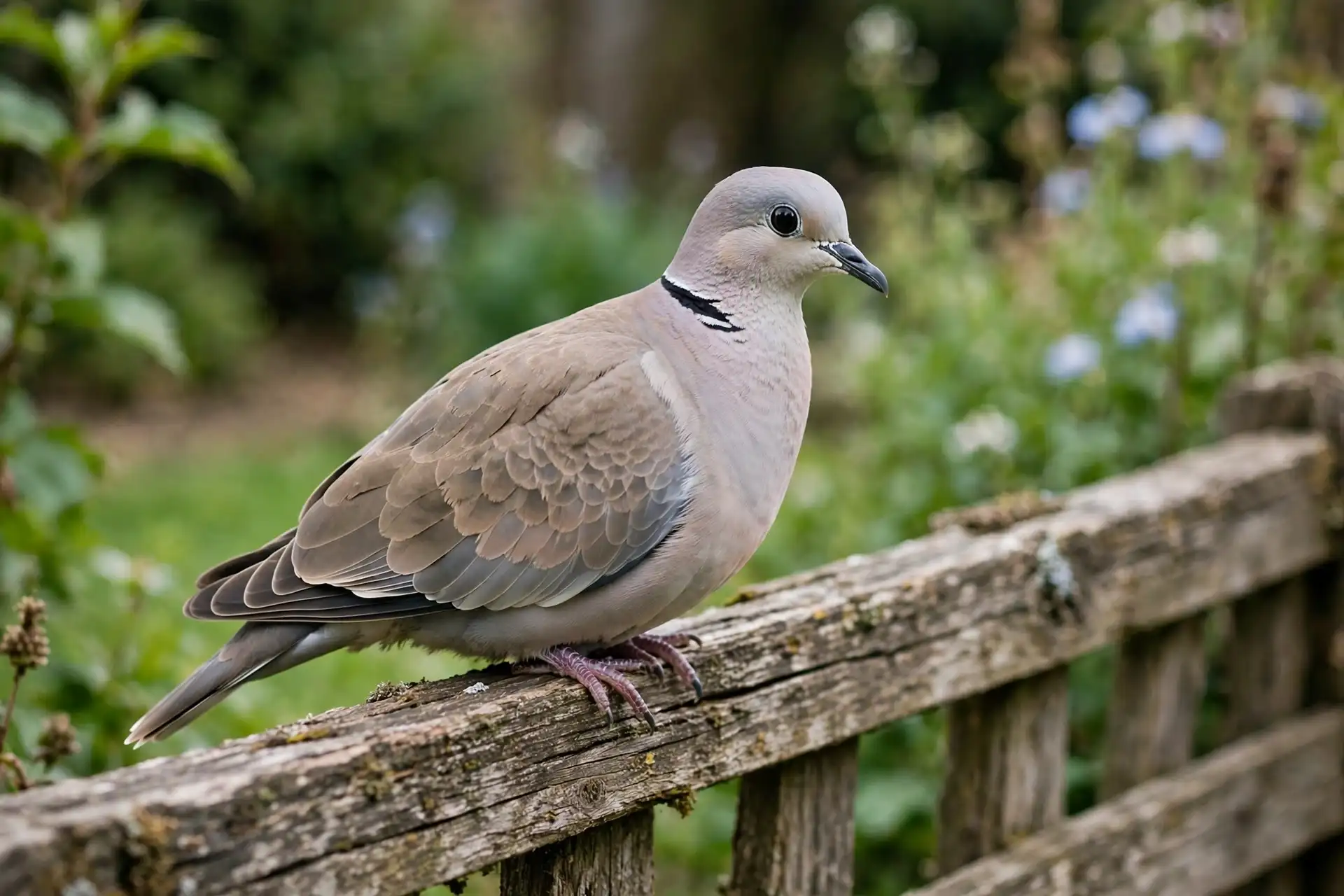
The Eurasian collared-dove has one clear mark that makes it easy to name. It is 11.4 to 12.2 inches long, with a narrow black half-collar on the hindneck edged with white. The collar is visible all year, and it is the mark to look for first.
The collared-dove is a stout-bodied bird with a small head, a relatively short neck, and a slender bill, like every member of its family. Its black collar makes it easy to separate from both the rock pigeon and the mourning dove, once you know to look at the back of the neck.
Collared-doves feed mainly on seeds, fruits, and other plant matter, like the rest of the family, and they share the same head-bobbing walk. Watch for the black half-collar first, and the rest of the identification follows.
White-Winged Dove
The white wing stripe of the white-winged dove is distinctive. It can easily be seen when the bird is flying and is the main feature to look for. No other dove in this guide has a white stripe, making it easy to identify.
The white-winged dove has a heavy body, small head and short neck, with a slender bill like all doves. They mainly eat seeds, fruit and other plant matter. Like all doves the white-winged dove has a head-bobbing walk. The white stripe can easily be seen on the wing while flying and can be identified before they land.
Watch the wings in flight, and check for the stripe before you look at anything else. A dove with a white wing stripe is a white-winged dove.
Band-Tailed Pigeon
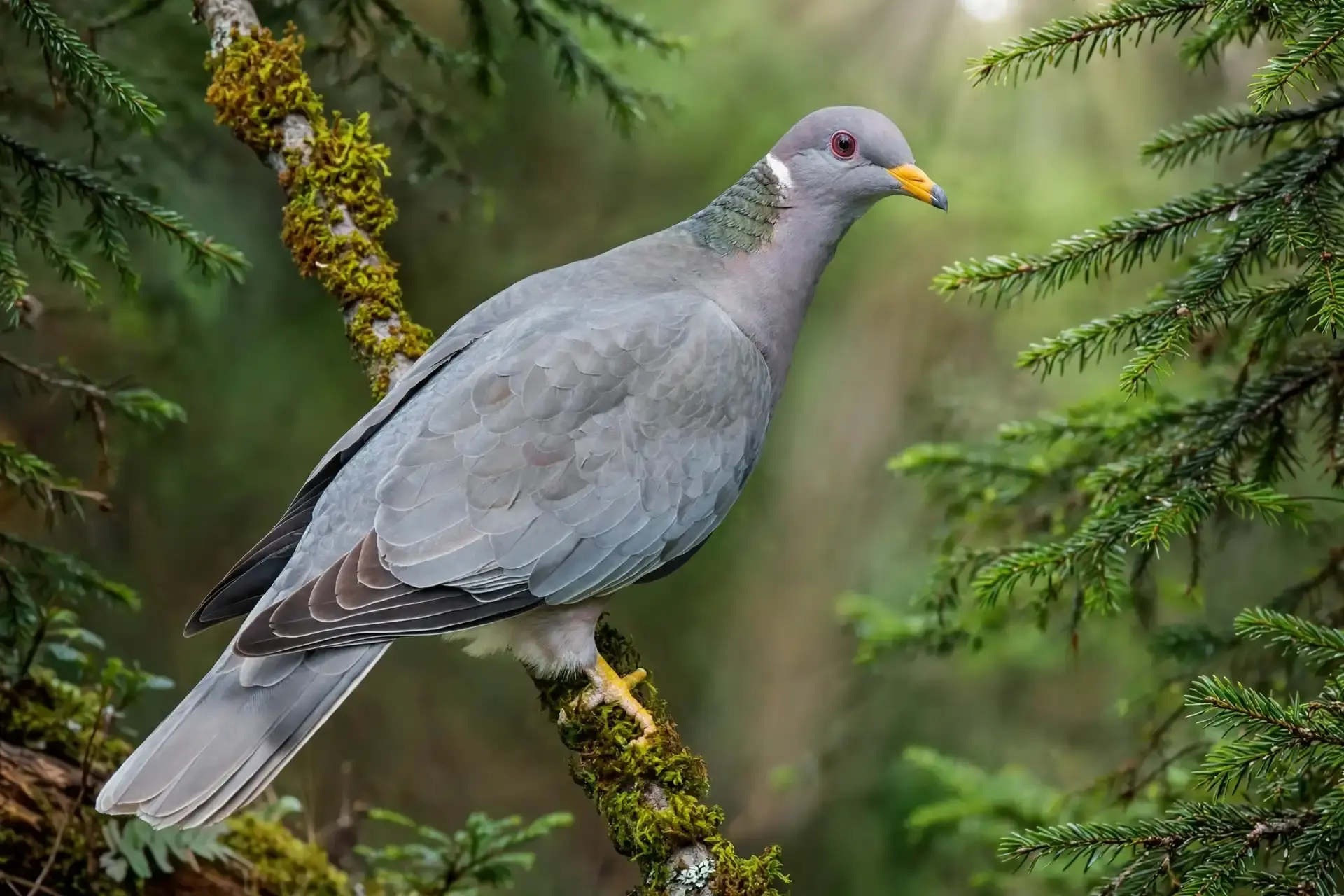
The largest pigeon in this guide is 13 to 15.7 inches long, larger than a rock pigeon. The band-tailed pigeon has a white crescent on the back of its neck and a pale band across the tail. These are the two marks to look for, and they are clear on a bird seen well.
The band-tailed pigeon is a stout-bodied bird with a small head, a short neck and a slender bill, like every member of its family. Band-tailed pigeons feed mainly on seeds, fruits and other plant matter. They also have the same head-bobbing walk as their relatives. This pigeon can easily be identified by its large size compared to other species. The band-tailed pigeon is longer than the rock pigeon, mourning dove and collared-dove, measuring between 13 to 15.7 inches.
The white crescent on the back of the neck is the mark to check first. The pale band across the tail is the second mark, and together they name the bird.
Pigeon Calls
Every pigeon and dove has its own voice, and calls are a real identification tool. The rock pigeon gives a repetitive “coo-ROO-coo”, a low, rolling sound heard on rooftops and ledges. The mourning dove gives its mournful three-part coo, “coo-OO, coo-COO, coo-COO”, a soft sound that carries across a quiet yard.
Once you learn them it can help you identify the birds. You might only get a clue from the calls if there are no birds in sight, for example on a quiet morning. Start by learning the three-part coo of the mourning dove, then move on to the rolling “coo-ROO-coo” of the rock pigeon.
The Head-Bobbing Walk
Pigeons have a distinctive walking style. They bob their head forward and back with every step. While this may look strange it is one of the easiest ways to identify them. All members of the family do this including the rock pigeon on the sidewalk and the band-tailed pigeon on the forest floor.
This makes them easy to spot from a distance, even before you see the plumage. If you can see a bird bobbing its head with each step, moving in short thrusts across the ground, then it will be a pigeon or a dove.
What Pigeons Eat
Pigeons and doves mainly eat seeds, fruits, and other plant matter. They have slender bills which are great for picking up small seeds and fruit. They spend many hours a day feeding on the ground. Their main food source is seeds, but they also eat fruit and other plant matter.
Rock pigeons, mourning doves, collared-doves, white-winged doves, and band-tailed pigeons all feed the same way, on seeds, fruits, and other plant matter, wherever they live.
Nesting
Pigeons build simple nests. A pair gathers sticks and twigs and lays them in a loose platform, and the nest looks careless, but it works.
City Life
The rock pigeon is the ultimate urban bird. It was introduced from Europe in the early 1600s and has been living among humans ever since. It is the most widespread introduced pigeon in North America, and it lives in cities and towns across the continent, on ledges, rooftops, bridges, and parks.
Rock pigeons are social birds. They flock to feed, roost in groups on ledges and fly around the city in flocks. They can be heard cooing in parks and plazas in the mornings. Their head-bobbing walk is a familiar sight on every sidewalk. The city provides plenty of ledges for them to roost on and open spaces to feed, so they have made the city their home.
Mourning doves live in cities too. Together, the species in this guide divide the settled landscape between them, each in its own corner.
Pigeon vs Dove Identification
It is actually easier to tell a pigeon from a dove since there really is not a divide between them. They are all pigeons and doves within this family. The main difference is based on the field marks. First, the rock pigeon is plump and heavy, whereas the mourning dove is very slim and light. The rock pigeon weighs about two and a half times the weight of a mourning dove.
Colour is the second clue. A rock pigeon is blue-gray with two dark wingbars and an iridescent neck. A mourning dove is buffy-brown to grayish with black wing spots. A collared-dove carries a narrow black half-collar on the hindneck edged with white. A band-tailed pigeon shows a white crescent on the back of the neck and a pale band across the tail.
Lastly, the neck. The rock pigeon has an iridescent neck, the collared-dove has a black half-collar and the band-tailed pigeon has a white crescent. They name the bird at a glance. By looking at the size, color and neck you can tell what it is. For the full side-by-side comparison, see our guide to mourning dove vs pigeon differences.
Migration
This depends on the species of pigeon you are looking at as some will stay close to home all year and others will move with the seasons. Rock pigeons are city birds and will remain within their cities and towns throughout the year.
If you want to find out exactly which pigeons migrate, when and how far they travel then we have a whole guide on this. For the full timing and routes, see our guide on do pigeons migrate. That guide covers the seasonal movement of the family in detail, and it is the place to check before you plan a trip to see a migrant dove.
Pigeon Species Comparison Table
| Species | Size | Field marks | Habitat |
|---|---|---|---|
| Rock pigeon | 11 to 14 inches | Blue-gray, two dark wingbars, iridescent neck, rounded tail | Cities and towns |
| Mourning dove | 9 to 13 inches | Buffy-brown to grayish, black wing spots, long pointed tail | Throughout the United States, southern Canada, and Mexico |
| Eurasian collared-dove | 11.4 to 12.2 inches | Narrow black half-collar on hindneck edged with white | Varies |
| White-winged dove | Medium | White wing stripe, the key mark in flight | Varies |
| Band-tailed pigeon | 13 to 15.7 inches | White crescent on back of neck, pale band across tail | Conifer forest |
How to Watch Pigeons
Pigeons are easy to watch due to their size, tameness and abundance. A few habits will make your sightings better.
- Go early. Early morning is best, as pigeons feed in the morning and will be resting on ledges and wires during the middle of the day.
- Listen first. Listen out for the three-part coo of the mourning dove and the rolling coo of the rock pigeon, which often tell you a bird is near before you see it.
- Watch the walk. The head-bobbing walk marks a pigeon at a glance, even at a distance.
- Check the wings in flight. Look out for the white wing stripe of the white-winged dove and two dark wingbars of the rock pigeon, which show best in the air.
- Look at the neck. Look out for the iridescent neck of the rock pigeon, black half-collar of the collared-dove and white crescent of the band-tailed pigeon, which are all neck marks.
- Note the size. Look out for the size: the rock pigeon is about two and a half times the weight of a mourning dove, and the difference shows at a glance.
- Bring binoculars. A pair of binoculars will help, as small marks like black wing spots and tail bands are hard to judge with the naked eye at 100 yards.
Frequently Asked Questions
What is the difference between a pigeon and a dove?
There is no scientific difference between the two. Dove and pigeon are just folk names for birds from the same family, Columbidae. There is no rule that decides which members are called doves. A mourning dove and a rock pigeon are both pigeons and doves in the biological sense.
What is the most common pigeon in North America?
The rock pigeon is the most widespread introduced pigeon in North America. It lives in cities and towns across the continent, and it is the gray bird with two dark wingbars and an iridescent neck that most people picture when they hear the word pigeon.
Are mourning doves and pigeons the same bird?
No, but they are close relatives in the family Columbidae. The mourning dove is smaller and slimmer, between 9 to 13 inches long and 3 to 6 ounces, while the rock pigeon is plumper and heavier, between 11 to 14 inches long and 9 to 13 ounces. On average, the rock pigeon weighs about two and a half times a mourning dove.
What does a mourning dove sound like?
The mourning dove gives a mournful three-part coo: “coo-OO, coo-COO, coo-COO”. It is a soft, low sound, often heard at dawn and dusk. Many people mistake it for an owl, but the gentle coo belongs to the dove.
Do pigeons migrate?
This depends on the type of pigeon. Some stay close to home all year, whereas others will move with the seasons. The rock pigeon stays in its cities and towns through every season. If you want to know the exact times and migration routes, see our guide on do pigeons migrate.
Where do pigeons nest?
Pigeons build simple nests of sticks and twigs, laid in a loose platform. The nest looks careless, but it works.
What do pigeons eat?
Pigeons and doves feed mainly on seeds, fruits, and other plant matter. Their slender bills pick up small seeds and fruit, and they spend hours each day feeding on the ground. Seeds are the core of the diet, and fruit and other plant matter fill in the rest.
Are rock pigeons protected?
No. As a non-native species, the rock pigeon is not protected under the Migratory Bird Treaty Act. It came from Europe in the early 1600s, and it is the most widespread introduced pigeon in North America.
Conclusion
Pigeons and doves are easy to miss and easy to fall in love with once you know them. The rock pigeon dominates urban areas, the mourning dove can be heard cooing in your backyard, the collared-dove can be spotted by its black half-collar in suburban areas, the white-winged dove has a white stripe that can be seen when flying, and the band-tailed pigeon lives in mountainous forests. All these birds have different sizes, field marks and lifestyles. They all live in every corner of North America. Start by learning about the rock pigeon then add in the mourning dove, collared-dove and band-tailed pigeon one by one. If you’re unsure about any of their field marks refer back to the table above. Get your binoculars out and listen for the coo at dawn, and watch the head-bobbing walk. They will be there, on the ledge or the branch, waiting for their next seed! This guide has everything you need to identify them.
Sources
https://avibirds.com/types-of-doves-and-pigeons/
https://betterwithbirds.com/blogs/bird-identification/dove-vs-pigeon
https://bigbird.alibaba.com/question/are-mourning-doves-and-pigeons-the-same-bird
https://birdshow.blog/pigeon-vs-mourning-dove-spot-difference