
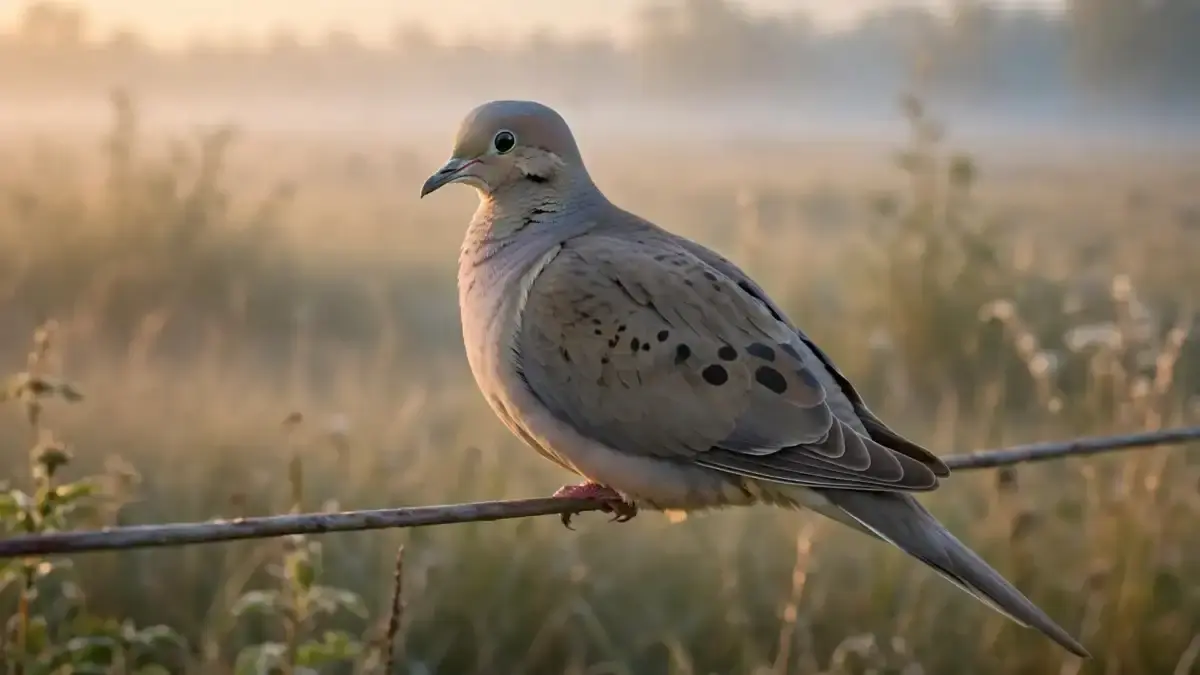
If you have ever walked through the peaceful yard just after sunrise, the gentle coo of the mourning dove can be heard. The mourning dove is a slender and gentle bird found throughout much of North America. You can see them in backyards, parks, farms, and open fields. You can easily identify this bird by its long, tapered tail. You often see them perched on wires or feeding on the ground.
How to Identify a Mourning Dove
Mourning dove. The first thing to note in these birds is their general appearance. They have a slender and elegant body. Their heads are small, with a short beak and a long, pointed tail that appears large compared with the rest of the body. Their colors are soft and muted, helping them camouflage well in open areas. These birds are also known by the scientific name Zenaida macroura.
Size and general appearance
A mourning dove is similar in size to a Robin, but appears much more slender. They can range between 9-13 inches from beak to tail and have a wingspan of around 17-18 inches. They weigh around 3-6 ounces, making them quite light for their size. Their small head sits atop a rounded body with short legs.
This gives them a squat appearance when perched on wires or branches. The most important feature to look for is their long, pointed tail. No other common North American dove has a tail as long and pointed as a mourning dove. When flying, their tail fans out slightly, showing their white-tipped feathers.
Colours and markings
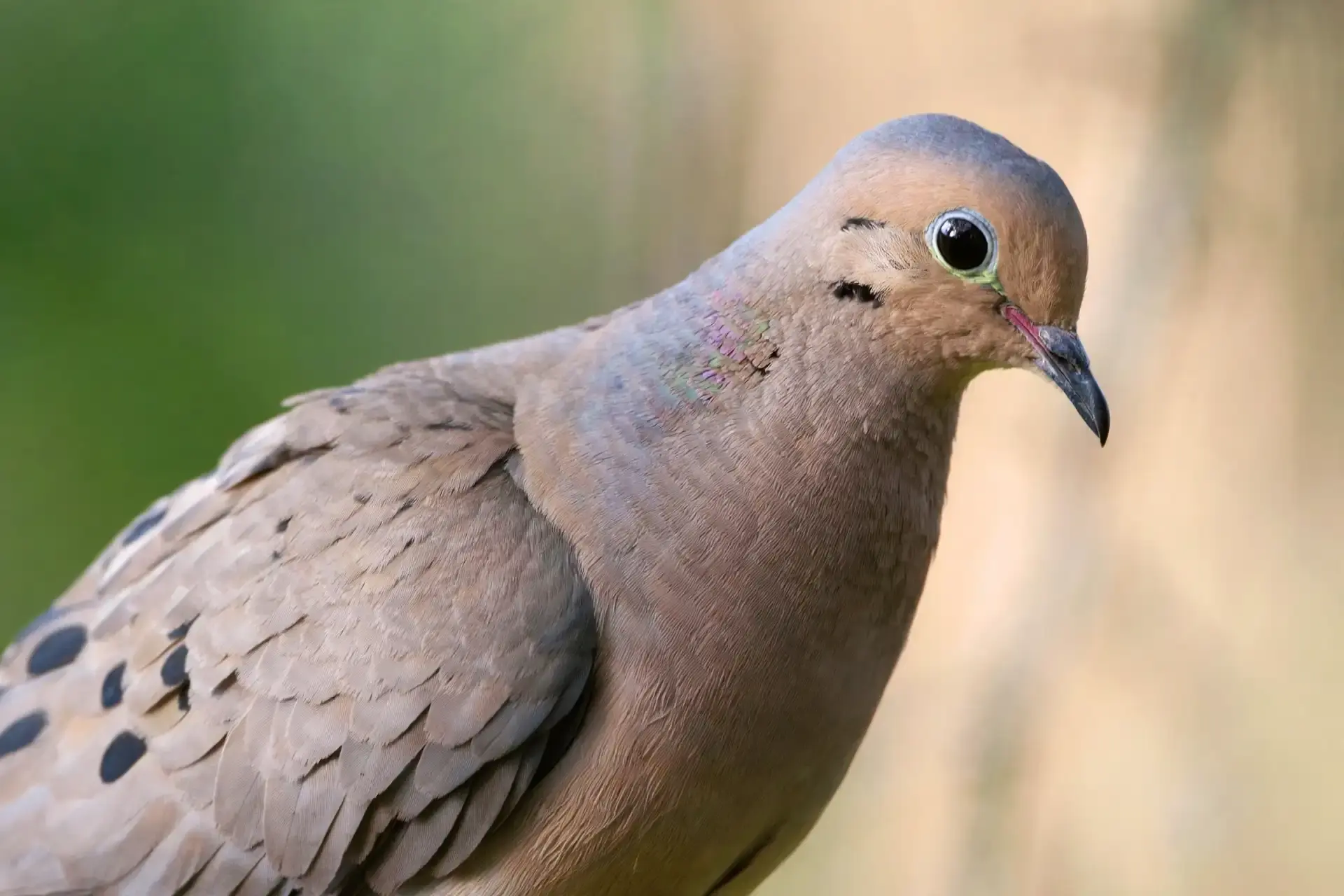
The colours are very soft. Their backs are a pale grey/brown color. Their breast and belly are a soft peachy color. Large black spots can be seen on their wings. There is also a small black spot on their cheeks. Their neck has a patch of iridescent feathers which shimmer pink and green in bright light. Their legs are pink.
Males are easy to identify because they are much brighter in good light. They often have a bluish-grey crown and rosy breast. From a distance, they appear to be a pale brown-grey dove with dark spotting on their wings.
In Flight
The mourning dove flies swiftly through the air. It has strong, direct wing strokes. The tail has large white tips on the outer feathers. It has a loud whistling noise. You can hear this clearly when the dove takes off nearby.
Juveniles
The juvenile plumage is quite distinct. The feather edges are pale, giving a scaly effect. Sometimes these birds can be confused with an Inca dove or common ground dove due to their scaly appearance (Audubon). However, they still have a long-tailed shape, so it is clear they are a mourning dove before their adult plumage has developed.
Male vs Female Mourning Doves
Identifying between male and female Mourning Doves can be difficult as they look very similar. Males are typically slightly bigger, with a pink tinge on their chests, blue-grey crown, and iridescent neck patch. Females are typically more muted in color, with plain brown feathers and less color on the crown and breast.
Males tend to do most of the cooing advertising from their favorite perch spots. They will also defend these areas from other males. Both members of the pair will also groom each other, gently nipping around the neck area. Take a look at this article to find out more about why birds preen each other.
- Male: Pink chest, Blue-grey crown, more colorful neck, slightly larger.
- Female: More muted, Plain brown feathers, less color on crown.
- Both: Long pointed tail, Black spots on wings, Small head.
What Mourning Doves Eat
Seeds make up the main part of a mourning dove’s diet. They eat approximately 99% seeds, including cultivated grains, wild grasses, weeds, herbs, and ragweed. (Cornell Lab of Ornithology). They will sometimes eat berries and occasionally snails but rarely eat insects.
They will eat around 12-20% of their body weight per day. This is a large amount for a bird this size, which is why they spend so much time eating. This equates to approximately 71 calories.
Ground Feeding
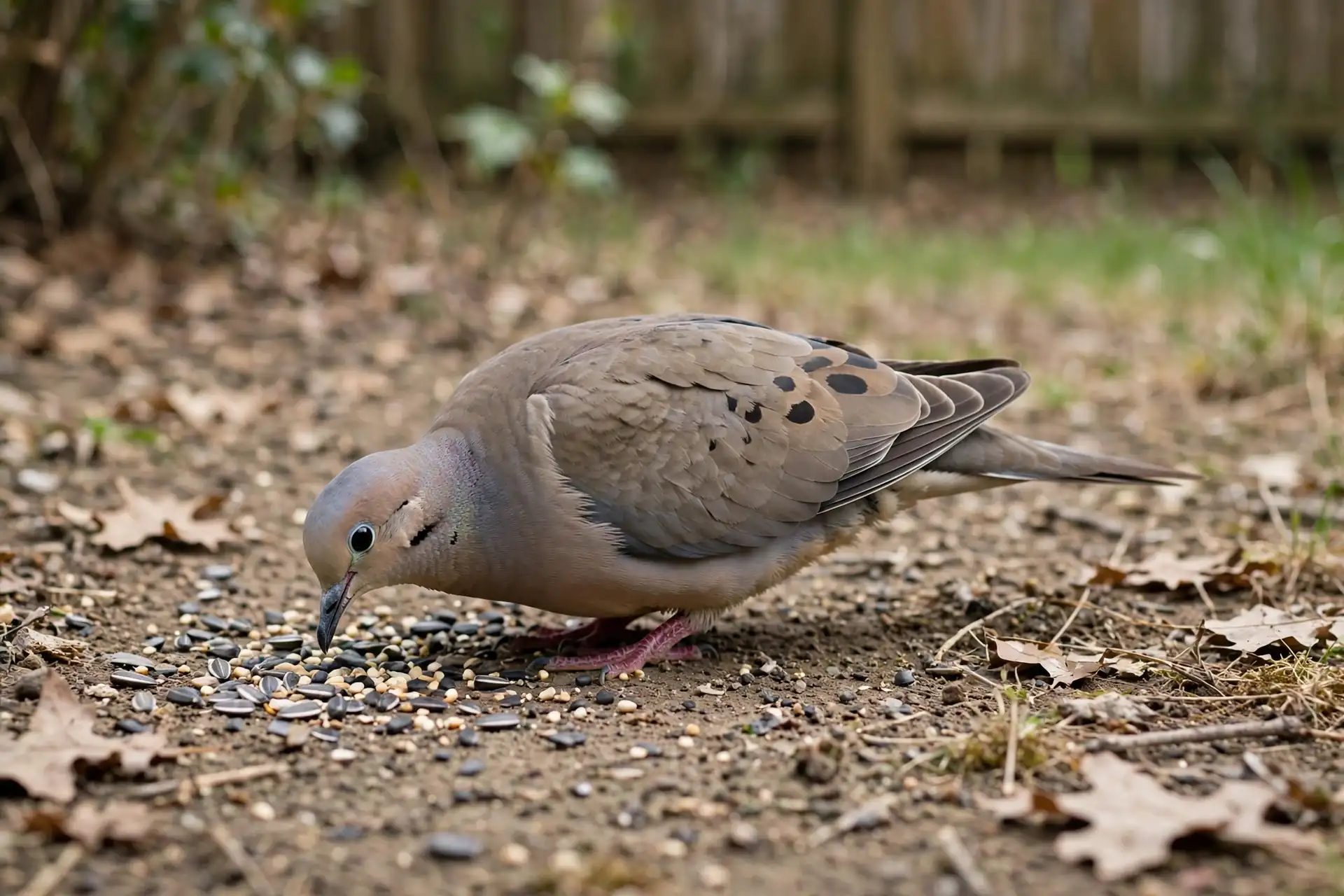
Mourning doves feed on the ground and prefer to feed in open areas. They usually feed in small groups. They peck at seeds or flick through the ground litter with their beaks but do not scratch like sparrows and towhees. They swallow seeds whole and store them in the crop (an outgrowth of the esophagus) before flying off to a secure perch to digest their food.
Best feeding areas include areas of open ground, weedy field margins, farmyards, and under your feeders in your garden. They also eat grit from open ground to help grind up seeds in their gizzards.
At the Feeder
Unlike the more finch-like sticklers, mourning doves are attracted to feeding stations offering seeds on the ground or those that have a large flat feeding area, such as a platform feeder. White millet is very attractive, but they also eat cracked corn, safflower, and oil sunflower seed. A tray attached to a tube feeder can be useful, as they will feed from the flat tray and eat any spilled seed.
Where Mourning Doves Live
Habitat
Mourning doves prefer open areas with sparse vegetation and woodland edges. You can see them feeding in grassy areas, farmland, gardens, and roadside areas, but you can also find them in suburban, parkland, farming, and desert areas. However, they will usually avoid thick forested areas.
Many doves will roost together during the winter months in woodlots. They often perch on telephone cables, fences, and dead branches. In many parts of the country it is common to see a line of doves along telephone cables.
Range
The range of the mourning dove covers southern Canada to central Mexico. They are resident throughout much of the United States; however, northern birds migrate south in autumn. Most of the range is occupied by birds that remain during the winter, so it is common to see them at your feeders in January.
Nesting and Raising Young
The Nest
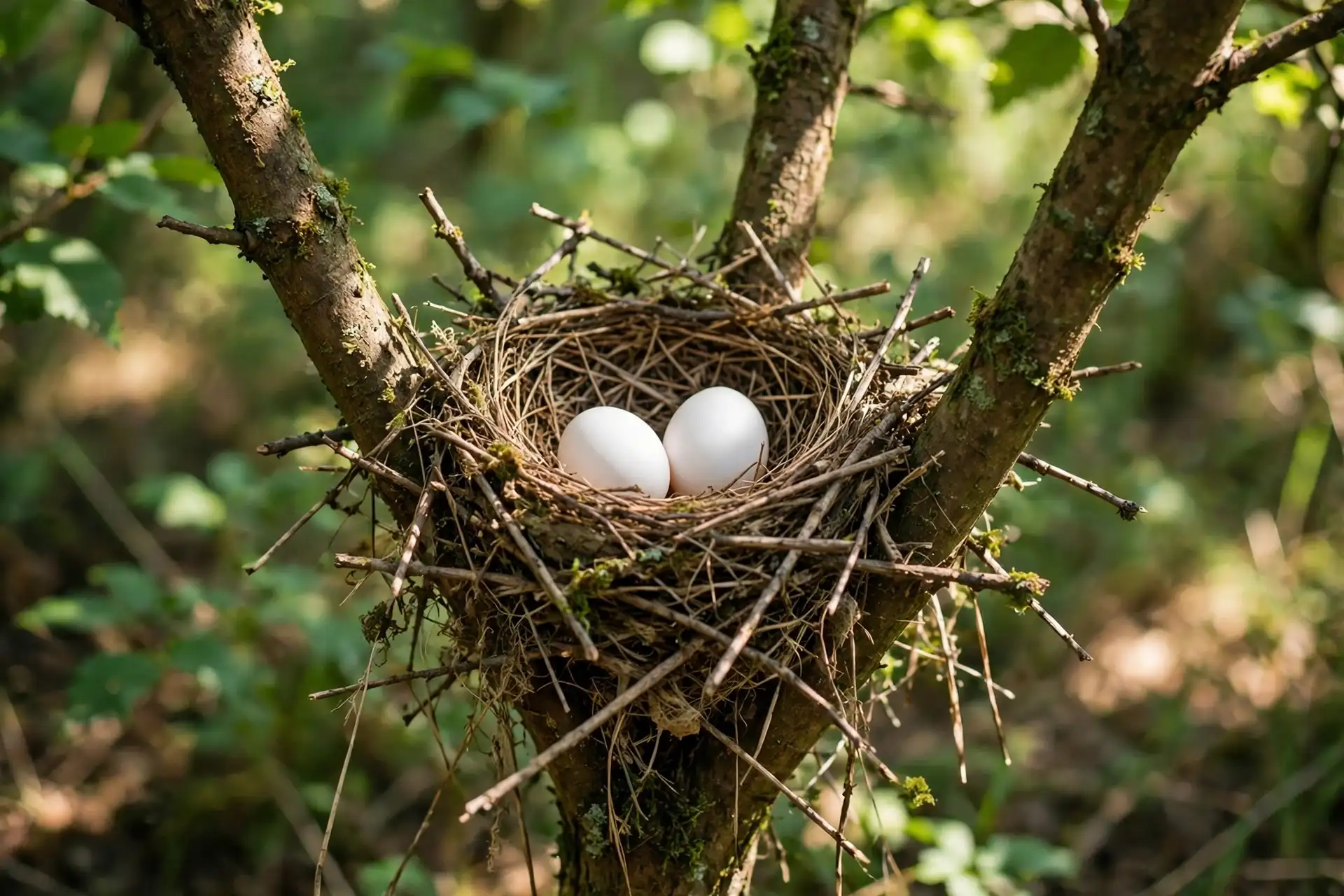
The nest is well known for being very fragile. The nest is made from pine needles, sticks, and grass stems. There is no lining and there is very little insulation for the young. It takes between 2-4 days to build. The male brings sticks to the female who then weaves them together to make a platform approximately 8 inches in diameter.
Nests are typically found in dense foliage on an evergreen tree, orchard tree, mesquite, cottonwood or vine. Doves will sometimes nest on the ground, especially in Western areas. They are not fussy about nesting close to humans. They will often nest in gutters, eaves, and old equipment. Sometimes mourning doves will reuse their own nests or nests of other species.
Eggs and Incubation
The dove will lay almost always just 2 eggs. The eggs are white and measure between 1.0-1.2 inches. The incubation period is approximately 14 days. Both parents take part in incubating the eggs with males usually sitting on the nest during the day and females during the night. The young will hatch blind and with very little cream coloured down. They rely on adults to keep them warm.
Crop Milk and Fledging
Both parents feed squabs on a protein-rich, fatty secretion called crop milk, produced by the crop lining. After the first few days, they gradually move onto a diet of regurgitated seeds. The young will leave the nest at 12-15 days old.
Pairs can raise between one and six broods. In the warmer southern regions, pairs can raise up to six broods per year, more than any other native bird (Audubon). Because predation and hunting put immense pressure on adults, constant breeding is vital.
Migration
This species is partly migratory. Those breeding in northern USA and Canada will migrate south in autumn. Those in the southern USA and Mexico are resident. Migrating is mainly done during the day in flocks. Wintering birds will often form feeding flocks in open country.
As this is such a widespread species there will be differences in migration times depending on where you are. Feeders in the north may become empty in autumn but become busy again in spring, whilst those in the south will have doves throughout the year. The cold does not cause them to leave; rather, food availability and daylight hours do.
Mourning Dove Sounds
The mourning dove gets its name from the soft, sad call they make, which can be written as coo-ah coo coo coo. Males will often give this during the breeding season, from their favourite perch. They use this as an advertisement call. They will also give a shorter, quieter version as a nest call within pairs.
The wing whistle is a completely different type of call. This is made by the wings. You can hear it most when the bird takes off or lands. According to Cornell, this call can be described as a high-pitched whistle or whinny. Often, the first thing you will hear is a dove that has taken off from a nearby feeding area.
This knowledge helps to identify them without using binoculars. You can hear the coo across a yard or field. Whereas the whistle lets you know there is a bird flying.
Mourning Dove vs Eurasian Collared-Dove
An invasive species that has spread throughout North America in recent decades, the Eurasian collared-dove can be found in many of the same areas as the mourning dove. While they are similar they can be easily distinguished by a few characteristics.
| Feature | Mourning Dove | Eurasian Collared-Dove |
|---|---|---|
| Size | 9 to 13 inches, slender | 11 to 12 inches, stockier |
| Tail | Long and pointed, white edges | Squared, dark base with broad white tip |
| Neck | No collar, iridescent patch | Narrow black half-collar on the nape |
| Wings | Large black spots | Plain, no spots |
| Call | Mournful coo-ah, coo, coo, coo | Rhythmic three-note coo-COO-coo |
The easiest way to tell them apart is to look at the black half collar. If there is a neat black crescent on the back of their neck, then it is a collared-dove. If the tail is long and pointed with white edges and the wings are spotted with black then it is a mourning dove. If you are trying to tell them apart from pigeons then this guide will help you out.
Attracting Mourning Doves to Your Yard
Mourning doves are very easy to attract. Spread some white millet on the ground or on a platform feeder. Leave an area of bare earth so that they have somewhere to feed. Provide some thick shrubs or evergreens so they can nest. If you know a pair want to use a ready-made nest site then provide a nesting cone well in advance of the breeding season, as suggested by Cornell.
As ground feeding birds they are easy prey for cats, so keeping your cats inside will help. Provide a shallow bird bath or water source at ground level so they can have a drink. They will need to drink regularly so having somewhere to visit in the mornings and evenings is a bonus.
Population and Conservation
The global breeding population of this species is estimated to be around 150 million. The species is listed as Least Concern by Audubon and is still one of the most abundant birds on the continent. The fall population is higher due to including the current year’s young.
However, when looking at the long term trend for this species, it has declined by around 0.4% per year between 1966 and 2019 (North American Breeding Bird Survey). This is a cumulative decrease of around 20%. While this is due to habitat changes and hunting pressures, the species have actually benefitted from the open and stable habitats created by humans.
Mourning Doves are the most popular game bird on the continent. Over 20 million can be hunted each year (Cornell). Due to game managers using dove numbers to set hunting limits this species remains abundant.
Frequently Asked Questions
Are mourning doves and pigeons the same bird?
No. Mourning doves and pigeons are in the same family Columbidae, but are different species. Rock pigeons are bigger, stocky birds with a fan-like tail and varied plumage. Whereas mourning doves are slimmer, smaller birds with a long slender tail.
Do mourning doves mate for life?
Mourning doves are monogamous birds. Some pairs remain together during the breeding season and into the winter months. However, although there is a strong pair bond this cannot be said to be truly lifelong as a new pair will be formed if one member of the pair dies.
Do mourning doves reuse their nests?
Sometimes. Cornell points out that mourning doves will often reuse nests that they or another species have made; however, they will also make several attempts at building a delicate nest platform. A nest that appears too small to hold any eggs is typical of this species.
Why do mourning dove wings whistle?
Whistle is made by the wings. The air flows over the wing feathers, creating a high-pitched whistle. You can hear this most when the bird is taking off or landing. This is a normal noise the bird makes when flying. It often indicates when a dove has been flushed from the ground.
Are mourning doves protected?
This species is listed as Least Concern by the IUCN. It is widely distributed and common. They are hunted as a game bird within controlled seasons and quotas. Numbers are monitored by game managers. In a yard, providing ground feeding, nesting cover and keeping cats in will provide the best protection.
Conclusion
The Mourning Dove is also rewarding to observe. Look for the distinctive long, pointed tail with white tips, listen for the sad cooing call and whistling wings in flight, and watch for feeding on the ground in open areas. This will help you distinguish collared doves from pigeons.
You can be confident that the dove you see on a wire at dawn is a Mourning Dove because they are one of the most successful birds on the continent. They live very close to humans and thrive in open areas between forests and fields.