
The anhinga bird (Anhinga anhinga) is one of North America’s most misunderstood waterbirds a specialized, ancient-looking predator shaped by millions of years of evolutionary pressure into something genuinely unlike anything else.
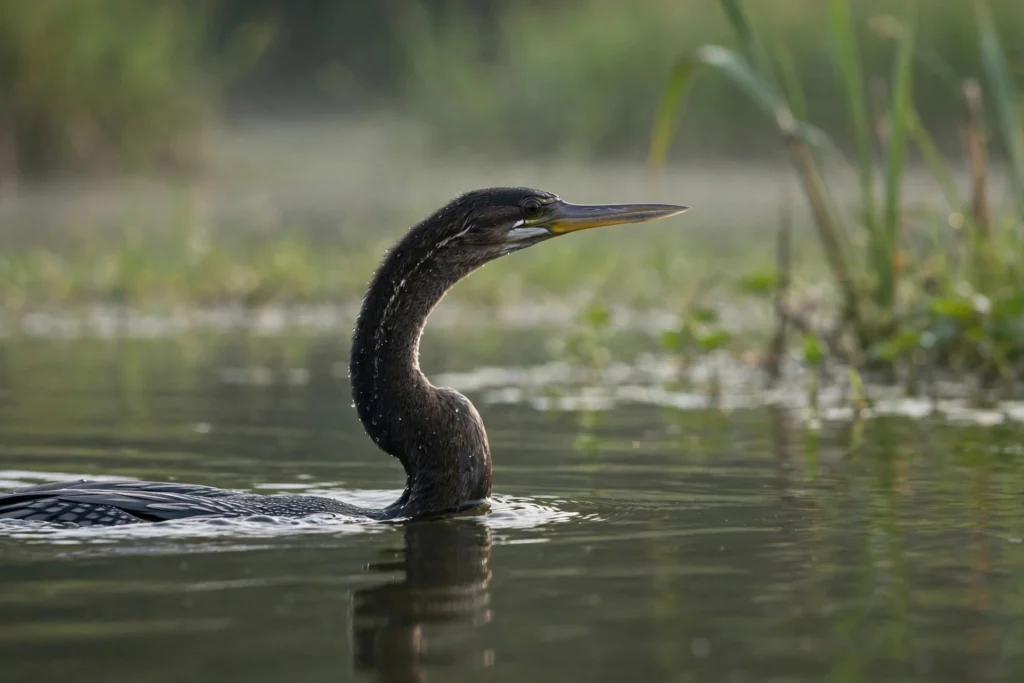
Its most famous nickname, the “Snakebird,” comes from a striking swimming behavior: the anhinga submerges its body completely, leaving only its long, S-curved neck above the surface. To anyone watching from a distance, it looks exactly like a water snake gliding through a Florida marsh.
And if you’re wondering where anhingas live, the answer spans freshwater lakes, swamps, and slow-moving rivers across the southeastern United States, with anhingas in Florida being especially common year-round.
The darker nickname, “Devil Bird,” says more about human discomfort than avian biology. That eerie silhouette wings spread wide to dry after a dive, body motionless reads as ominous. But it’s simply a functional adaptation: unlike ducks, anhingas lack waterproofing oils, so they must air-dry their feathers after every swim.
And that apparent weakness is actually a design advantage. Wettable feathers reduce buoyancy, letting the anhinga sink and hunt efficiently underwater. It’s not sinister. It’s elegant engineering.
Before exploring that biology further, it helps to clear up the most persistent field mistake birders make confusing the anhinga with the cormorant.
Anhinga vs. Cormorant: The Head-to-Head Identification Guide
The anhinga and cormorant are frequently confused, but a few sharp physical details separate them instantly once you know what to look for.
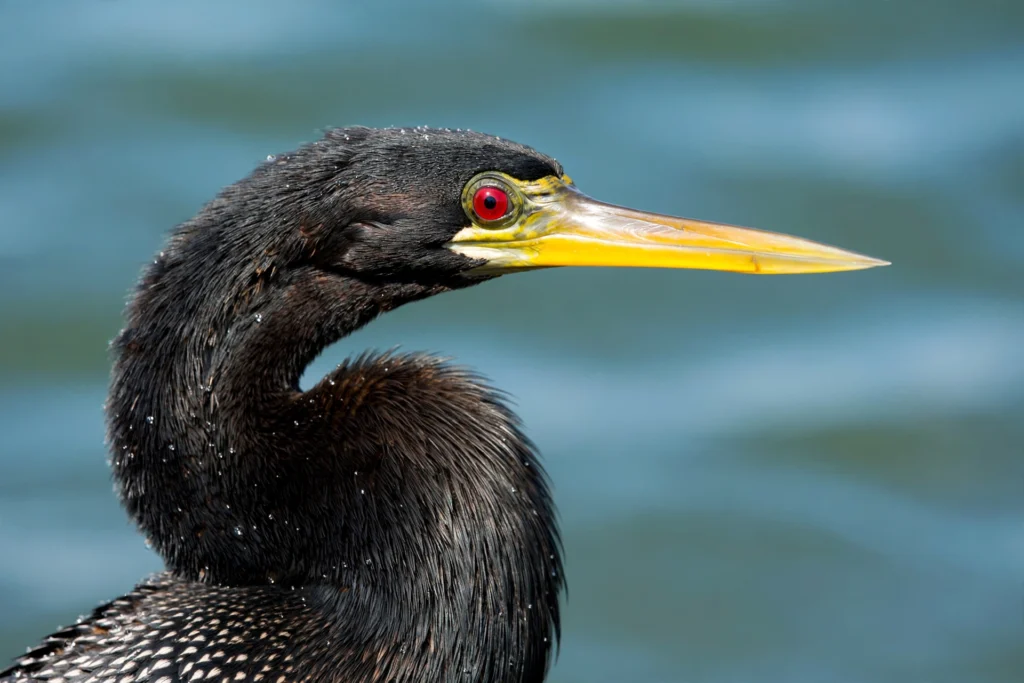
The bill is the fastest tell. An anhinga carries a straight, dagger-like bill built for spearing fish with a rapid, javelin-thrust motion. Cormorants, by contrast, have a hooked tip that curves downward, suited for gripping rather than stabbing. If you’re asking yourself what an anhinga looks like, start there.
The tail is equally diagnostic. Sometimes called a darter bird in other parts of the world, the anhinga fans out a long, rounded tail that resembles a turkey’s display, earning it the nickname “water turkey.” Cormorant tails are shorter and far less dramatic.
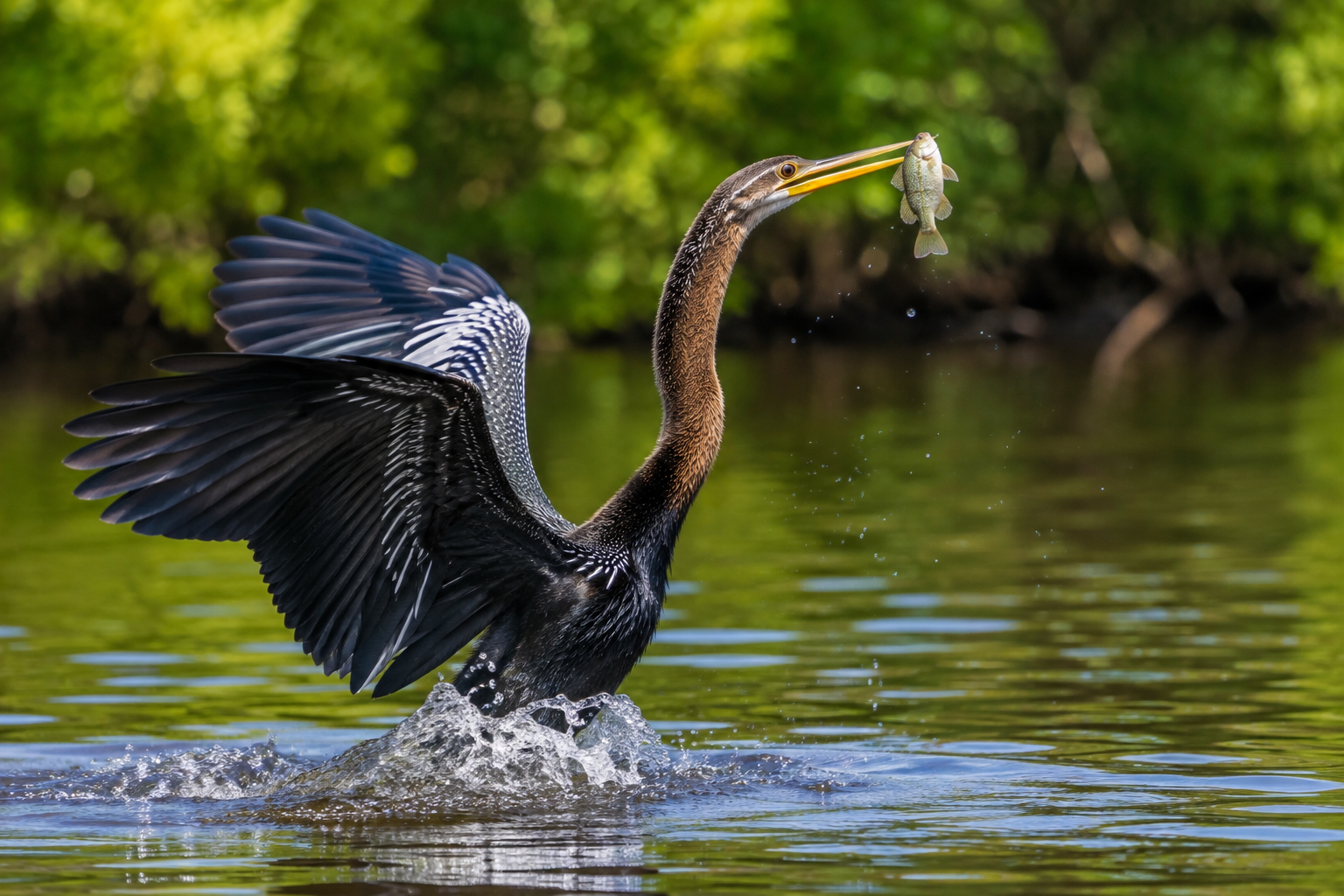
Wing patches clinch the ID on adult males. Glossy black plumage is broken by distinctive silver-white streaks and spots across the wings markings cormorants simply don’t carry.
And then there’s the neck. The anhinga’s S-shaped cervical vertebrae aren’t just unusual they’re functional architecture, coiling and releasing like a spring to drive the bill through water at striking speed. That anatomy, more than anything else, hints at just how specialized this bird truly is a detail the next section’s physical profile explores in full.
Anatomical Features and Physical Markers
The anhinga bird is a distinctively large waterbird, measuring 29.5 to 37.4 inches in length with a wingspan stretching nearly 43 inches — closer in scale to a heron than the ducks many people expect.
Sexual dimorphism is immediately obvious in the field. Males display glossy black-and-dark-green plumage with white spots along the wings. Females and juveniles swap that drama for buff-colored heads and necks, making them look almost like a different species entirely. The anhinga snake bird nickname comes from that long, sinuous neck an S-shaped structure that snaps forward like a spear when striking prey.
The name “anhinga” itself carries surprising weight. It traces back to the Tupi people of Brazil, roughly translating to “evil spirit” or “devil bird” a name presumably earned by the bird’s eerie silhouette rising from dark water with wings spread wide. Within its anhinga range across the southeastern United States, that ghostly appearance is a common sight along slow-moving rivers and cypress swamps.
Those physical markers size, dimorphism, neck shape are only part of what makes this bird remarkable. How it actually moves through water and air tells an even more interesting story.
Behavioral Distinctions in the Field
The anhinga bird moves through its environment in ways that immediately separate it from cormorants in the air, on a perch, aneneath the water’s surface.
Flight style is one of the clearest tells. Anhingas regularly soar on thermal currents, circling high like hawks rather than powering forward with the steady, rhythmic wingbeats cormorants favor. Spot a large waterbird gliding effortlessly overhead near a cypress swamp, and it’s almost certainly an anhinga.
Perching behavior follows a similar pattern. Both species spread their wings to dry, but the anhinga including the anhinga female, whose brown-buff neck distinguishes her from the male tends to favor freshwater habitats like flooded timber and cypress stands. The anhinga Everglades population is a textbook example: birds perched motionless in low branches, wings fully extended, are a signature sight there.
Diving mechanics reveal perhaps the most fascinating distinction. Unlike cormorants, the anhinga exploits neutral buoyancy its waterlogged feathers reduce its tendency to float, allowing it to sink slowly and lurk just below the surface rather than actively plunging. This stealthy underwater glide sets up what happens next, which is where the anhinga’s hunting strategy gets truly remarkable.
The Evolution of Aquatic Hunting: How Anhingas Master the Water
The anhinga bird has solved a hunting problem that most waterbirds never face: how to pursue fish effectively when your feathers absorb water instead of repelling it.
The oil deficit. Unlike ducks or herons, the anhinga has a greatly reduced uropygial gland the oil-producing gland that most birds use to waterproof their feathers. The result is plumage that soaks through on contact with water. Counterintuitively, this is a feature, not a flaw. Waterlogged feathers reduce buoyancy, letting the anhinga sink and maneuver beneath the surface with far less effort than a sealed, air-trapped coat would allow.
The spear vs. the grab. Where cormorants and herons grasp fish between their mandibles, the anhinga strikes with a specialized thrust darting its head forward using a coiled, spring-loaded neck mechanism to impale prey. You’ll rarely see this in casual anhinga images, but the technique is unmistakable once you recognize it. After surfacing, the bird flips the fish airborne, catches it headfirst, and swallowsit whole.
The thermoregulation trade-off is where that wet-feather advantage turns costly. After every dive, the anhinga must return to a perch and spread its wings that iconic silhouette you often see when watching an anhinga in flight transition to a lakeside branch. Without waterproofing, solar drying is non-negotiable. In colder climates, this creates a real physiological risk.
This is precisely why year-round residency concentrates in warm zones like Florida and coastal South Carolina — environments warm enough to make the drying period survivable. How long the anhinga can actually stay submerged before that wet plumage becomes a liability is worth examining closely.
Underwater Endurance and Diving Mechanics
The anhinga bird typically stays submerged for 1–2 minutes per dive short enough to seem modest, but long enough to execute a precise, slow-motion ambush that faster-swimming birds can’t replicate.
What makes those dives effective isn’t raw breath-holding capacity. It’s the physiology behind the descent. Because anhinga feathers lack the waterproofing oils that insulate most waterbirds, the bird becomes less buoyant as water saturates its plumage letting it sink and glide with minimal effort. That reduced buoyancy translates directly into stealthy, low-resistance stalking beneath the surface.
There’s a real tradeoff, though. Wet plumage in colder water poses a genuine risk of hypothermia, limiting where and when anhingas can forage. You won’t typically encounter them thriving in northern latitudes during winter — the energy cost of rewarming simply becomes too high.
That signature wing-spread pose on a sunny perch isn’t just behavioral; it’sa form of thermal management. And while the anhinga bird call a rattling, guttural croak signals social activity above water, below the surface this bird operates in near-total silence, relying entirely on stealth.
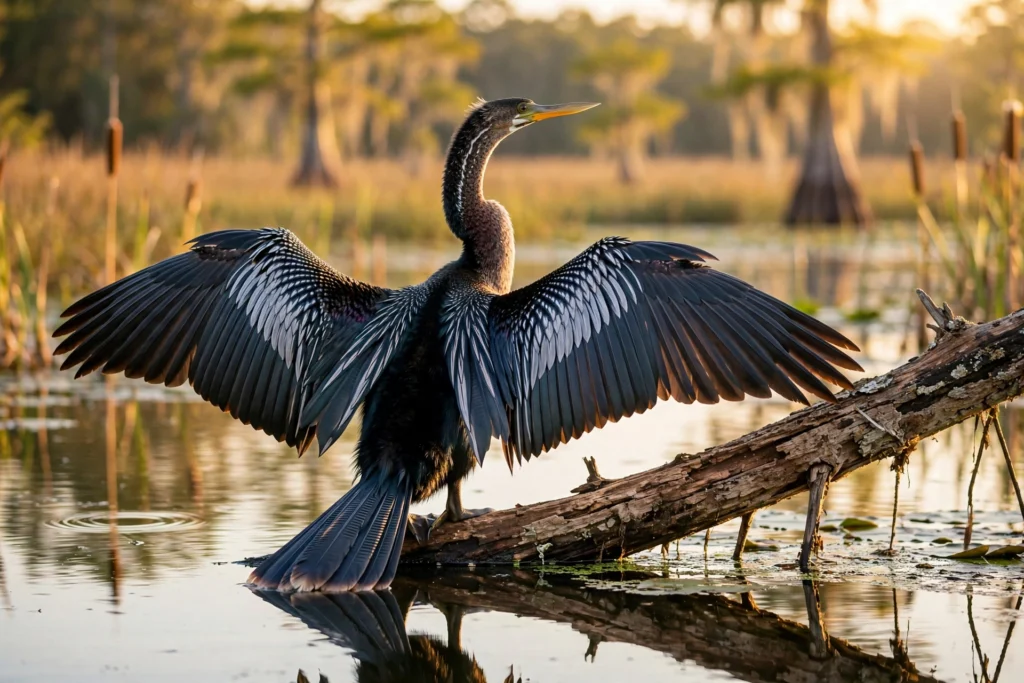
That contrast between vocal expressiveness and underwater stillness makes the anhinga’s hunting strategy all the more striking and sets the stage for understanding exactly what it’s hunting for.
Diet and Foraging Strategy
The anhinga bird is a selective, opportunistic predator built to hunt specific prey in specific places, and ruthlessly efficient at both.
Primary prey consists mostly of small fish, though anhingas will also take crustaceans and, when opportunity presents itself, small reptiles or amphibians. Anhinga habitat matters here: they strongly prefer shallow, slow-moving freshwater cypress swamps, marshy lake edges, sluggish streams — over open saltwater. That calm, clear water is exactly what makes precise underwater stalking possible.
What happens after the strike is surprisingly theatrical. The anhinga surfaces with prey impaled on its bill, then performs what’s often called the “toss and swallow” maneuver flicking its head sharply to launch the fish into the air, catching it headfirst for a smooth swallow. Those serrated bill edges help grip slippery prey, but they’re useless for chewing, so repositioning is everything.
And while you might spot an anhinga bird swimming low through still water like a slow-moving periscope, the real hunting unfolds beneath the surface patient, deliberate, and strangely graceful for something so prehistoric-looking.
Spiritual Symbolism and Cultural Misconceptions
The anhinga bird has spent centuries collecting unfair labels “evil spirit,” “water turkey,” and “bad omen” none of which survive contact with basic biology.
Debunking the ‘Evil Spirit’ Myth. The anhinga’s dramatic silhouette wings outstretched, neck curved, standing motionless at the water’s edge reads as ominous to an untrained eye. That stillness, though, is purely functional: thermoregulation and feather drying, not ritual posturing. Biology, not mysticism, explains every behavior that once spooked early observers.
Spiritual meaning, when people genuinely seek it, tends toward themes of patience, depth, and transition — a bird that moves fluidly between air, land, and water, occupying no single element completely. That resonates with many who spot it.
The “Water Turkey” misnomer is more morphological than mystical. The broad, fan-shaped anhinga tail feathers, banded in pale tips, genuinely resemble a turkey’s display tail. Combined with considerable anhinga size — roughly 35 inches from bill to tail the silhouette on a branch can briefly fool even experienced birders.
Conservation reality cuts through all the folklore: anhingas are sensitive indicators of wetland health. Where water quality degrades, populations quietly disappear making them far more valuable than their overlooked reputation suggests. That complex identity, straddling myth and ecological importance, is exactly what early naturalists found so compelling when they first documented the species.
Cultural History and Etymology
The anhinga bird has accumulated more nicknames than almost any other North American waterbird and each one tells you something true about the animal.
Early documentation dates to 1774, when naturalist William Bartram observed and described the species during his travels through the American South, capturing details about its hunting posture and striking silhouette that remain accurate today. Those early anhinga bird facts established a scientific baseline that modern ornithology has barely had to revise.
Regional nicknames reflect real biology. “Snakebird” references its habit of swimming with only the long, S-curved neck visible above water. “Darter,” the term used globally, describes its explosive, spear-like strike at prey. “Water Turkey” nods to its broad, fanned tail, which fans out during the signature wing-drying pose that so many people now search for after spotting it roadside or perched along a canal.
That curiosity is accelerating. Anhinga bird images shared across Reddit and Quora have driven a measurable spike in identification searches, with users posting photos of the wing-spreading posture and asking what they’re looking at often mistaking it for a cormorant.
Social media has effectively turned casual observers into engaged, if occasionally confused, naturalists. That identification challenge, it turns out, is worth addressing directly which is exactly where we’re headed next.
Limitations and Considerations for Birdwatchers
Spotting an anhinga bird in the wild is genuinely rewarding but it comes with real challenges that catch even experienced birders off guard.
Low-profile swimming is the first obstacle. Anhingas ride extremely low in the water, sometimes with only their long neck visible above the surface. Without binoculars, that silhouette reads as a snake or a floating branch — not a bird at all.
Their quiet, deliberate hunting style (diving for the same anhinga diet of fish, amphibians, and aquatic invertebrates they’ve always specialized in) keeps them submerged for extended periods, making patience non-negotiable.
Geographic limitations matter too. Anhingas are fundamentally a warm-climate species, concentrated in southeastern wetlands, Florida, and Gulf Coast states. Sightings become rare north of the Carolinas, and casual summer wanderers occasionally reach Illinois or further north but these are exceptions, not reliable destinations for a dedicated birding trip.
Wing-drying posture is the most common trigger for misidentification. Not every spread-winged bird is an anhinga. Double-crested cormorants adopt nearly identical poses, and that distinction becomes the next important skill to develop — which is exactly where a comparison of the two species becomes useful.
Finally,identifying juvenile and femaleanhingasy benefitsgreatly from a professional field guide. Females and immatures display tawny-buff heads and necks that differ sharply from adult males, and rare color variations can confuse even seasoned observers.
Comparison: Anhinga vs. Double-crested Cormorant
The anhinga bird and the double-crested cormorant are so frequently confused that knowing four key differences will save you from misidentifying either one in the field.
Bill shape is the fastest tell. The anhinga often called the snakebird has a long, straight, dagger-like bill it uses to spear fish. The cormorant’s bill hooks downward at the tip, built for gripping rather than stabbing. Tail length separates them at a glance too: the anhinga fans a long, almost turkey-like tail; the cormorant’s is short and stiff.
Habitat preference narrows things further. Anhingas favor freshwater swamps, lakes, and slow rivers especially across the southeastern U.S. Cormorants tolerate saltwater coasts and open bays comfortably. And in flight, the difference is striking: anhingas soar on thermals with wings fully outstretched (particularly visible on males in anhinga breeding plumage), while cormorants fly in direct, labored lines with steady, rapid wingbeats.
Once you’ve locked in these four markers, identifying each bird becomes almost instinctive which sets you up perfectly for the quick-reference field tips coming next.
Key Takeaways: Identifying the Anhinga
A few sharp field markers are all you need to confidently identify the anhinga bird and avoid the most common misidentification mistakes.
After covering the anhinga vs cormorant comparison in detail, it’s worth distilling everything into a practical checklist. When you’re scanning the water’s edge, these are the features that matter most:
- Dagger-like bill and long, fan-shaped tail: The two most reliable structural differences from a cormorant at any distance
- Silver-white wing patches on males: Iridescent streaks visible even in low light, serving as a primary field marker
- Wings spread wide on a perch: Their feathers aren’t waterproof, so sunning behavior is diagnostic, not incidental
- Sinuous “S-curve” neck movement: The source of the “Devil Bird” nickname, which describes hunting mechanics, not aggression
The anhinga’s wingspan, roughly 42 to 45 inches, also helps. It’s noticeably broader relative to body length than you might expect, making a soaring anhinga look almost prehistoric against an open sky.
These markers, taken together, make confident identification achievable even for newer birders. For deeper context on where to find documented sightings, migration data, and ongoing research, the next section points you toward the most reliable resources available.
Where to Look Next
The anhinga bird, also called the “water turkey,” rewards patient researchers who go beyond field guides and dig into living databases. Consult regional ornithology platforms like Cornell Lab’s eBird for real-time migration maps and sighting clusters.
Federal wetland conservation reports track habitat pressures that directly affect where anhingas breed and overwinter. And if questions like “what do anhingas eat” send you deeper, university-led avian research labs publish behavioral studies that go well beyond what any field guide covers. Follow the data the bird will follow.