
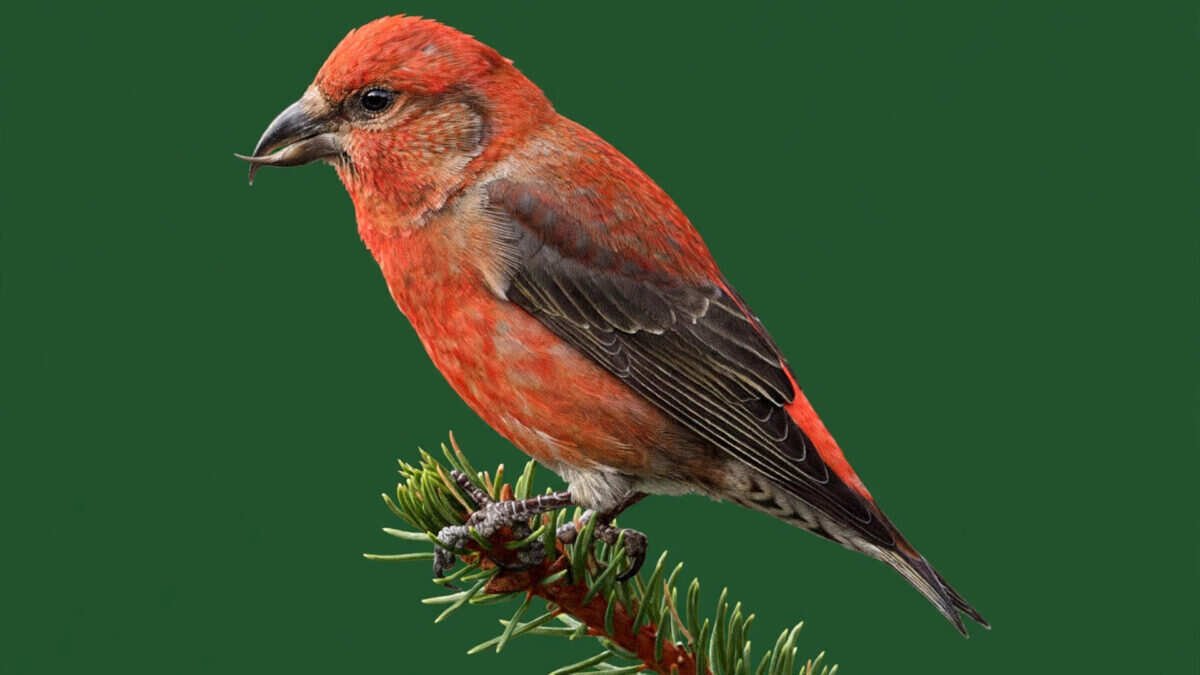
The 2026 red crossbill irruption is happening right now and this could be the best chance many birdwatchers get in years to see this elusive bird that usually lives in northern coniferous forests.
The Winter Finch Forecast 2026-27 update, published about 18 October 2026, carries a clear irruption alert for Type 2 Red Crossbills moving west to east across North America. Numbers have been above average at Hawk Ridge and Whitefish Point since August, and the movement is expected to keep building as winter sets in.
If you’ve never seen a crossbill before, now’s the time to give it a go! You don’t need a remote wilderness trip, a rare bird alert app running all day, or years of field experience. All you need to do is know what they look like, which trees to check, and how to record their flight call on your phone.
That recording matters more than a photograph for this species, because call type is how experts separate one crossbill population from another. This guide explains the alert in plain language, shows you where to look, and walks you through identification, recording, and reporting, step by step.
Red Crossbill Irruption 2026: What Is Happening Right Now
An irruption is not the same as a normal migration. Most migratory birds migrate on a fairly predictable schedule, to similar wintering areas each year. Irruptive birds move when food runs out. If the cone crop is poor in one area, but good in another, thousands of birds can move hundreds or even thousands of miles to find seed. Some winters there will be very few birds in a certain area. Other winters bring flocks where none were expected.
This winter belongs in the second category for Type 2 Red Crossbills. The forecast update describes a significant irruption of Type 2 birds moving west to east, following a good to great eastern white pine crop and a moderate spruce crop in interior sections of southeastern Canada toward the Great Lakes and the northeastern states.
The same update notes that after two fairly widespread large ponderosa pine cone crops in the central region, that crop has now busted, along with limber, whitebark, and most pinyon pines. Type 2 birds have therefore irrupted into the Plains states, and the movement is expected to continue and expand across the central country, from east of the Rockies to the Mississippi.
The early signs were already visible before autumn. Hawk Ridge and Whitefish Point, two well-watched migration sites, both reported larger-than-normal numbers of Red Crossbills since August. That matters because these sites sit on major flight paths around the western Great Lakes. When counts rise there early in the season, it often signals a broad movement rather than a small local wandering.
Type 2 should dominate more in the western Great Lakes at the start of winter, while Type 12 dominates in the northeastern United States, and a more even mix of Types 2 and 12 is possible in Algonquin Provincial Park.
As winter progresses, more Type 2 birds are expected to make their way into the northeastern United States. If numbers keep building, the forecast also raises the possibility of a late winter movement down the coast to Long Island, Cape May, Delaware, and points south, especially Type 12, as cone crops are depleted. That late movement is not guaranteed. The sensible approach is to watch early, watch often, and treat every crossbill flock as worth recording, even if it looks like a group you have already seen.
Why Type 2 Crossbills Are Moving West to East
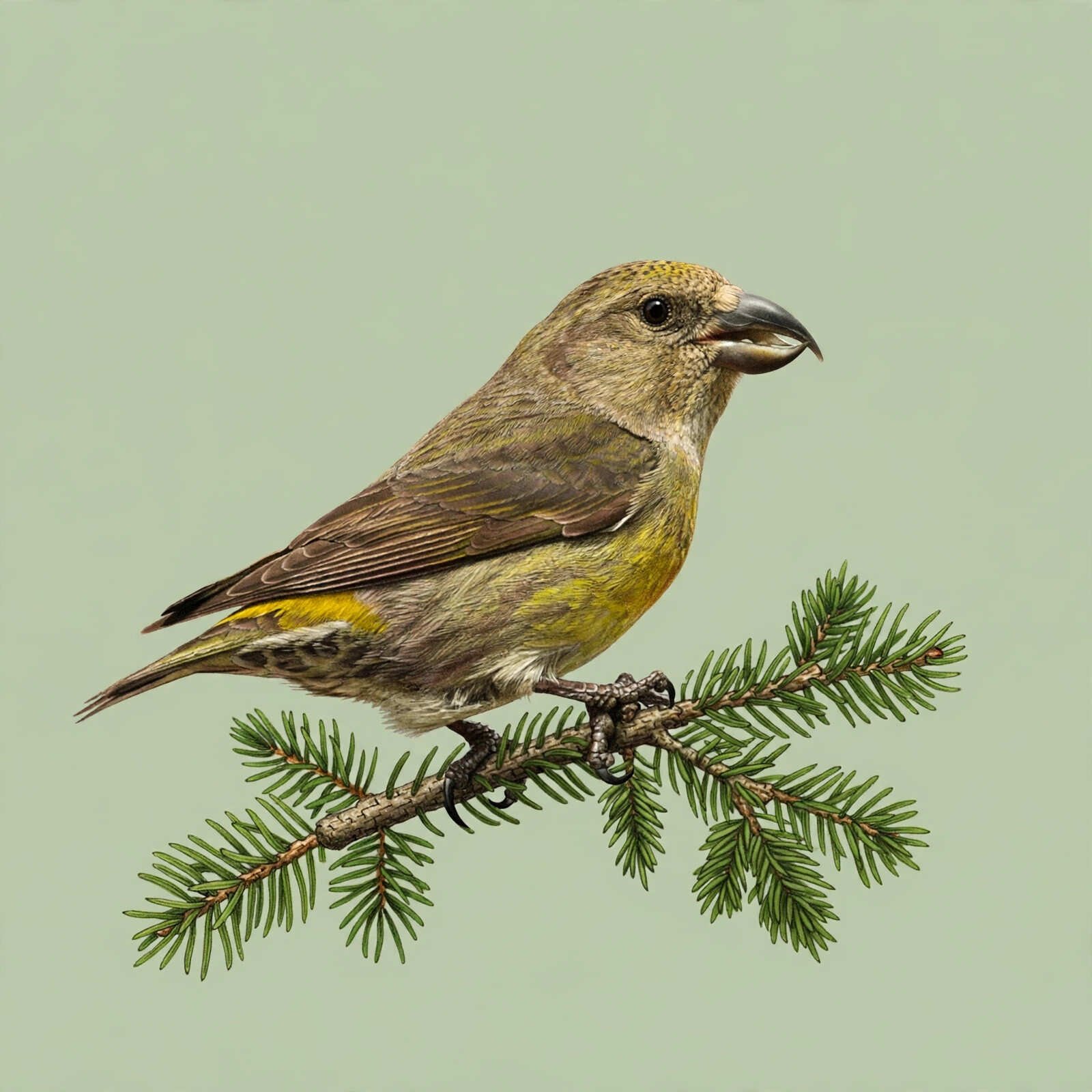
Red Crossbills are specialists with specialized bills. The tips of the bills cross over each other. The bills are inserted into the scales of a closed conifer cone. The bill will open from the side and the tongue will be used to lift the seed out. Different sizes of bills are used for different cones.
A large, heavy bill can pry open a tough ponderosa pine cone, while a smaller, finer bill suits hemlock or spruce. Over time, crossbill populations have become linked to particular cone types, and researchers describe them as call types, numbered from Type 1 to Type 12 in North America, because their flight calls differ even when the birds look almost identical.
Type 2 is the ponderosa pine specialist. It has a relatively large bill and a distinctive flight call. In a normal year, Type 2 birds stay close to ponderosa pine forests in the West, where they can find enough seed through winter. When the western pine crop fails, as it has this year, staying put means going hungry. The birds do what crossbills have always done. They move.
The direction of the move makes sense once you know where the food is. Eastern white pine had a good to great crop this year, and spruce in interior southeastern Canada toward the Great Lakes and the Northeast was moderate. Birds moving east found trees still holding seed, whereas birds that stayed west, or moved only a short distance, found empty cones. That food map, more than any calendar date, is driving the irruption.
How to Identify a Red Crossbill
Start with shape and behavior before you worry about call type. A Red Crossbill is a chunky, medium sized finch, larger than a goldfinch and heavier in the chest than a Purple Finch. It has a short, notched tail, a large head, and a bill that looks odd even at a distance. In flight, crossbills often undulate, rising and falling in a loose, bounding pattern, and they usually travel in small, chattering flocks rather than alone.
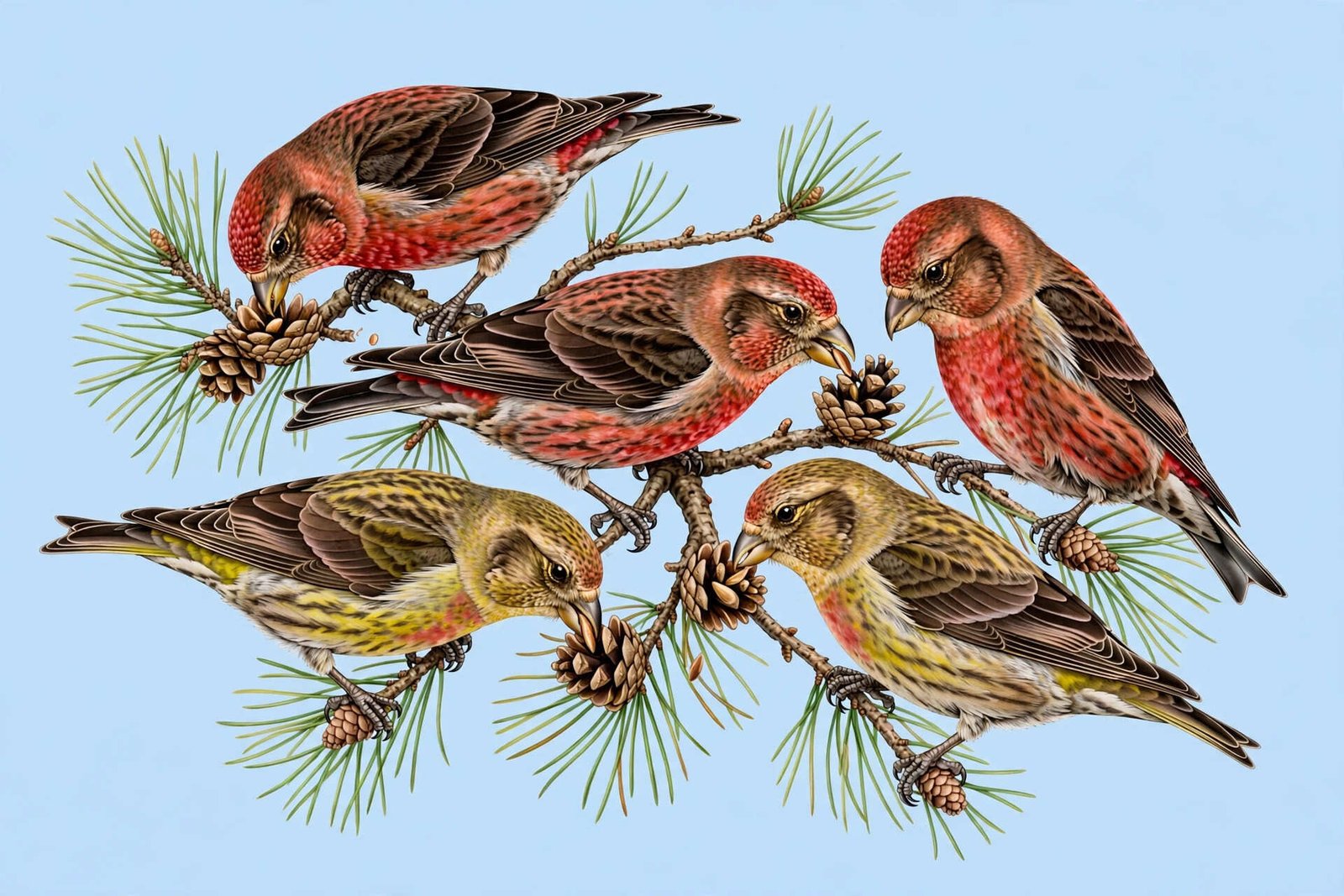
Adult males are the easiest to spot. They are brick red to orange red over most of the body, with darker wings and a darker tail. The exact shade varies. Some males look almost scarlet, while others look dusty orange, especially younger males or males in worn plumage.
Adult females are olive yellow to greenish yellow, similar in build to the male but with the same crossed bill. Juveniles are streaked brown and can look confusingly like a large, streaky finch until you see the bill or hear the call. However, the crossed bill tips are the clincher in all plumages. When seen at a distance, they can be identified by their shape, color, and call.
What to listen for
Crossbills are very vocal birds. Often a flock will make itself known before you see it, with a hard, metallic flight call given in flight and from perched birds. The calls sound like a sharp “jip jip” or “kip kip” to many listeners, but the fine differences between types are subtle and cannot be learned reliably from a written description alone. That is why recording matters so much. Your phone can capture what your ear cannot yet separate, and experts can identify the type from the recording later.
Crossbills you might confuse them with
The most likely bird to be confused with a Red Crossbill is the White-winged Crossbill, a smaller, slimmer crossbill with two bold white wing bars. Male White-winged Crossbills are a brighter, more rose pink red than Red Crossbills, and females are yellower with the same white wing bars.
In this forecast, White-winged Crossbills have moved west, where large winter cone crops run from Alaska through western Manitoba and southward, so eastern birdwatchers are less likely to meet them this winter. Still, check the wings. If you see two clean white bars, you are probably looking at a White-winged Crossbill, not a Red Crossbill.
In poor light you might confuse a Pine Siskin or a Purple Finch. These two birds are both smaller and more slender than crossbills, with different bills. A Pine Siskin has a thin, pointed bill, heavy streaking, and a yellow flash in the wing. A Purple Finch has a short, conical bill, not a crossed one, and a different, more musical song. If the bill does not cross, it is not a crossbill, however red the bird looks.
Comparison table: Feature / Red Crossbill / White-winged Crossbill / Purple Finch. Bill: Crossed at the tips, fairly large / Crossed at the tips, smaller and finer / Short and conical, never crossed. Wing bars: None or faint / Two bold white bars / None or faint.
Adult male colour: Brick red to orange red / Bright rose pink red / Raspberry red on head and breast. Typical flock: Small to large, often noisy / Small to large, often noisy / Singles, pairs, or small groups. Key sound: Hard metallic flight call / Dry, trilled flight call / Rich, warbling song.
Where to Look This Winter
Think trees first, then places. Red Crossbills head for the cone trees. Eastern white pine is the key tree this winter, with spruce also important in the interior Northeast and Great Lakes region.
A mature stand of white pines with a heavy cone crop is worth more than a long walk through mixed woodland with few cones. Look up into the crowns. Crossbills often feed high, and they can be easy to miss if you only scan eye level. The BirdsBuzz guide explains these movements.
Good places to start include conifer plantations, cemetery pines, golf course edges, lakeshore pine stands, and state park campgrounds where mature pines are planted in rows. Migration watch sites are also productive, because crossbills pass over ridges and points where other migrants concentrate.
Hawk Ridge near Duluth, Minnesota, and Whitefish Point in Michigan are the two sites named in the forecast for early large numbers, and they remain good sites to target through the winter for birds still moving through the Great Lakes region. In the Northeast, look at pine stands from Algonquin Provincial Park east to the Maritimes, and south through New York and New England.
How to Record a Crossbill on Your Phone
You do not need a parabola, a shotgun microphone, or an expensive recorder to make a useful crossbill recording. A smartphone held steady, with the microphone pointed toward the birds, will be sufficient for type identification in most cases.
The Finch Research Network notes that experts have listened to tens of thousands of smartphone recordings submitted this way and can identify them to type.
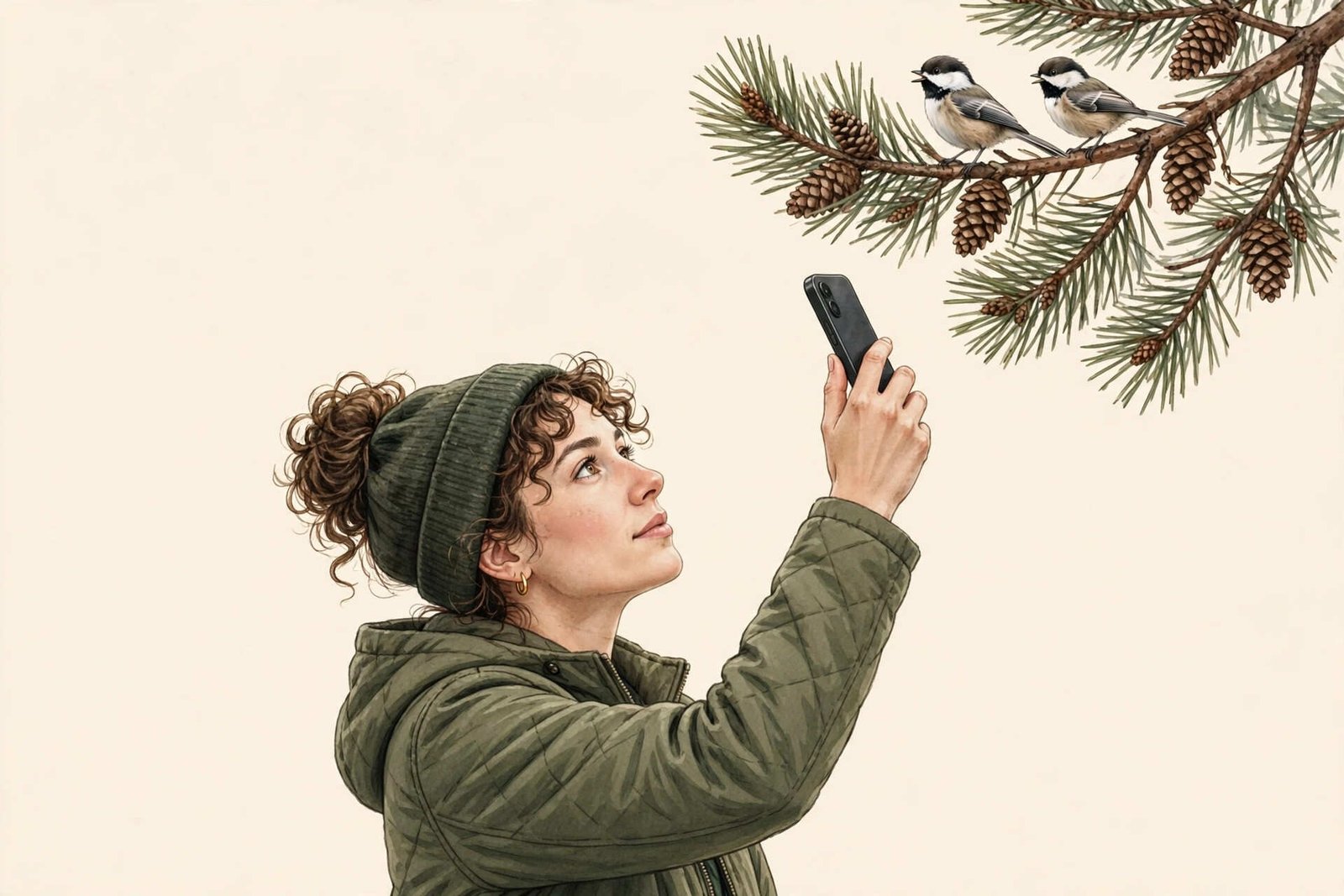
- If possible, open your voice recorder app before the birds arrive, so you are not fumbling with settings while the flock is calling.
- Point the bottom of the phone, where the microphone usually sits, toward the birds. Keep your hand still, and don’t cover the microphone with your fingers.
- Record for at least 20 to 30 seconds if the birds keep calling. A single call is rarely enough. A run of flight calls gives the identifier a pattern to work with.
- Stay quiet while recording. Whispered commentary, footsteps on gravel, and wind noise can mask the calls. If you need to note the location, do it after you stop recording.
- Note the date, time, location, number of birds, and the tree species if you know it. A recording without a location is far less useful for science.
- Save the file with a clear name, such as the date and place, so you can find it later when you upload it.
You have two good routes once you have a recording. Upload it with an eBird checklist for that location, which will deposit it in the Macaulay Library, or send it to the Finch Research Network for identification. The forecast names Matt Young at the Finch Research Network as a contact for type identification by email, and eBird checklists are the standard way to share both the sighting and the sound with the wider birding community. Either route turns a fleeting encounter into a lasting record.
Will Red Crossbills Visit Your Feeder?
Sometimes, but do not count on it. Crossbills are cone specialists, and a feeder is a poor substitute for a pine full of seed. When natural cone crops are good, as they are in parts of the East this winter, crossbills may stay in the trees and ignore feeders entirely. When a local cone crop runs out, or when a flock passes through an area with few mature pines, birds may drop into a yard for sunflower seed.
To give them a reason to stop, provide black oil sunflower seed in a platform or hopper feeder. Keep the feeding area clean and obvious from the surrounding trees. Crossbills will readily use feeders, but often only for a short time.
They may feed for a few minutes, call loudly, and move on. Keep your phone handy near the feeder during an irruption winter, and keep the feeder stocked, because a flock that finds an empty feeder will not wait around.
See what to feed birds in winter for general winter feeding advice, including which seeds suit which species. The same principles apply here: fresh seed, clean feeders, and fresh water matter more than any single special mix. A heated birdbath can also help, because crossbills, like all winter birds, need water when natural sources freeze.
How to Report Your Sighting and Help the Science
Reporting during an irruption matters more than in a normal winter, as the whole point is that birds are in unexpected places. A single record from a county with no previous crossbill records can change the map. An attached recording can confirm the call type and help researchers track which populations are moving and where they settle.
Frequently Asked Questions
What is a red crossbill irruption?
An irruption is a large, irregular movement of birds driven by food supply rather than by a fixed migration timetable. When cone crops fail in one region and succeed in another, crossbills move to where the seed is. Some winters bring very few birds to a given area, while irruption winters bring many, often to places where they are rarely seen.
What does Type 2 mean?
Type 2 is a call type of Red Crossbill, linked mainly to ponderosa pine. Red Crossbills look very similar across types, so researchers separate them by their flight calls. Type 2 has a relatively large bill suited to ponderosa pine cones. Recording the flight call is the usual way to confirm which type you saw.
Are Red Crossbills rare?
They are not uncommon worldwide, but can be patchy. In some areas they may be absent for years but appear in flocks during an irruption winter. This is normal for a cone specialist, and it does not mean the species is in trouble in a particular winter, and it does not mean that just because you see a red finch it is a crossbill.
Can I identify a crossbill type by sight alone?
Usually not with confidence. The bill size and shape will give some indication, as will the location and tree species, but the types can look similar. A sound recording is the standard for identifying the type. If you cannot record, note the bill size, the tree, and the call as best you can, and describe what you heard in your report.
When is the best time to look for crossbills this winter?
Now is the time to start, and keep looking through winter into early spring. The forecast expects Type 2 birds to dominate in the western Great Lakes early in winter, with more birds reaching the Northeast as winter progresses. A late winter coastal movement is possible if numbers build and cone crops run low. Check pine stands after cold fronts and on calm mornings.
Do crossbills stay all winter once they arrive?
Some do stay, if the cone crop holds. Others move on when the food runs out, sometimes after only a few days. Crossbills can also nest very early, even in late winter, if food is plentiful, which is one reason a flock may settle in an unexpected place. Do not assume a flock you saw in November will still be there in February.
Conclusion
There really is an opportunity this winter, not just a news headline. Type 2 Red Crossbills move west to east, the eastern white pine crop gives them a reason to stop, and early counts at Hawk Ridge and Whitefish Point show the movement is already real. You do not need perfect equipment or expert ears to take part. Learn the shape, learn the habitat, carry your phone, and record what you hear.
Check the pines near you this week, especially mature white pines with a heavy cone crop. Listen before you look. Record before the flock leaves. Report what you find, and attach the recording, so the next forecast can be sharper than this one.
If you are lucky, you will get a good look at a brick-red male working a cone overhead, its bill crossed at the tips, doing exactly what that odd bill evolved to do. If you are patient, the reward is larger: a winter list with a bird that many birdwatchers wait years to see.
To see another irruptive finch this winter, check out the BirdsBuzz Evening Grosbeak irruption guide. Grosbeaks move for similar food reasons, and a winter that brings crossbills often brings other northern finches with them.
Sources for the forecast details in this article include the Winter Finch Forecast 2026-2027 update from the Finch Research Network, the full Winter Finch Forecast 2026-2027, and Audubon magazine’s winter finch preview.