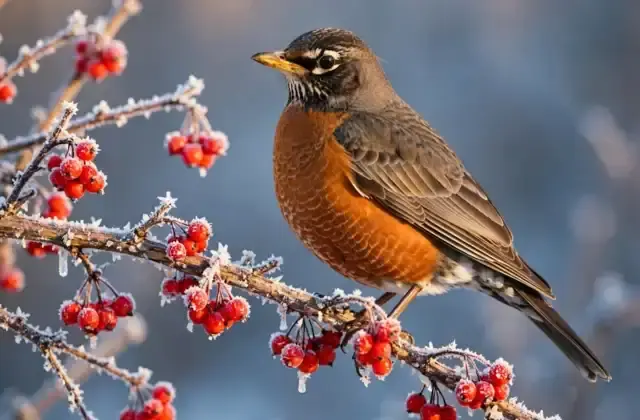

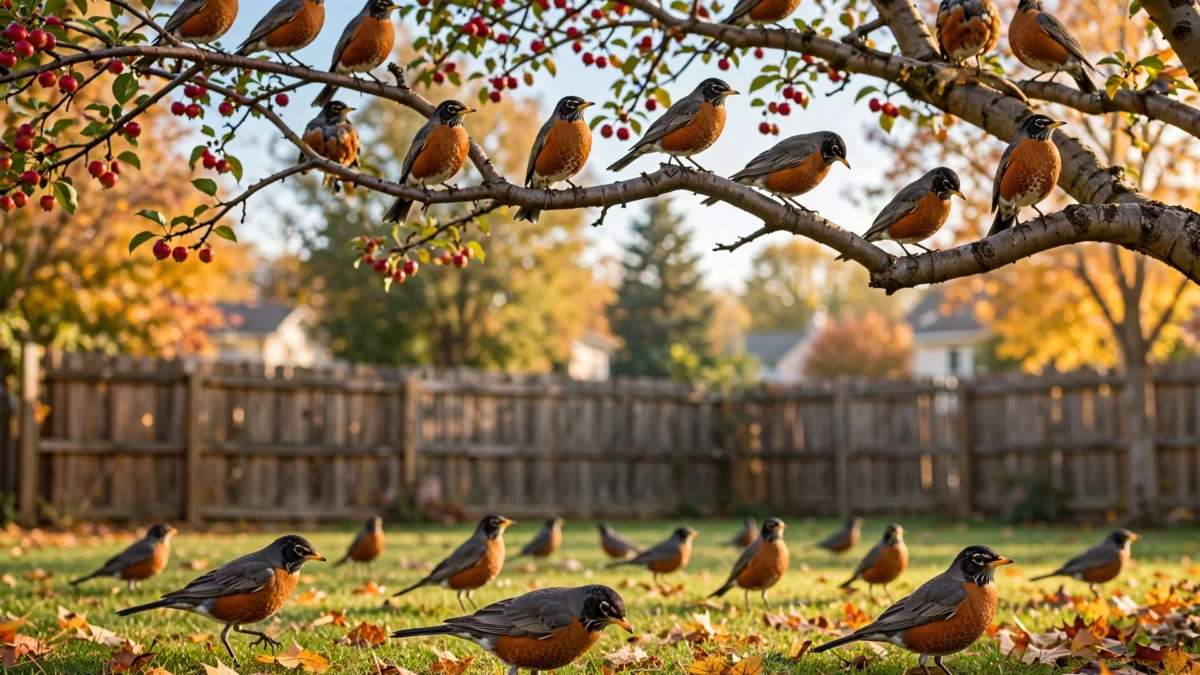
You step outside on a crisp October morning and stop counting at forty. Robins everywhere. They hop across the lawn in waves, cluster in the crabapple tree, then lift off together in a rustle of wings, circle once, and land again as if nothing happened.
The same yard that hosted a single territorial pair in June now looks like a robin convention. So why are there so many robins in my yard, and is anything wrong? Nothing is wrong. In fact, you are watching one of the most dramatic seasonal personality changes in North American birdlife.
The American robin you know as a solitary lawn-hopping worm hunter transforms every autumn into a social, fruit-chasing flock bird.
Fall rewrites the robin’s entire lifestyle, and your yard happens to sit right in the middle of it. This guide explains the science behind the crowd, what the flock does all day, how big these gatherings can get, and what it means for your garden.
The Robin Has Two Completely Different Lives
To understand the fall crowd, you have to forget the spring bird. From March through July, the American robin is a classic territorial breeder.
Males arrive early, claim a patch of lawn and shrubbery, and defend it with ringing song and the occasional chase. Pairs raise two or sometimes three broods, and each family keeps mostly to itself. That is the robin most people picture.
Then summer ends, the young grow independent, and the script flips. Hormones shift, territorial urges fade, and the same birds that chased intruders off the lawn in May now welcome dozens of companions.
Flocking is not a mood change. It is a survival strategy, timed to the exact season when the robin’s food supply changes underneath it. The solitary hunter becomes a crowd bird because fall rewards cooperation, or at least tolerance, far more than it rewards solitude.
Berries Are the Real Reason They Came
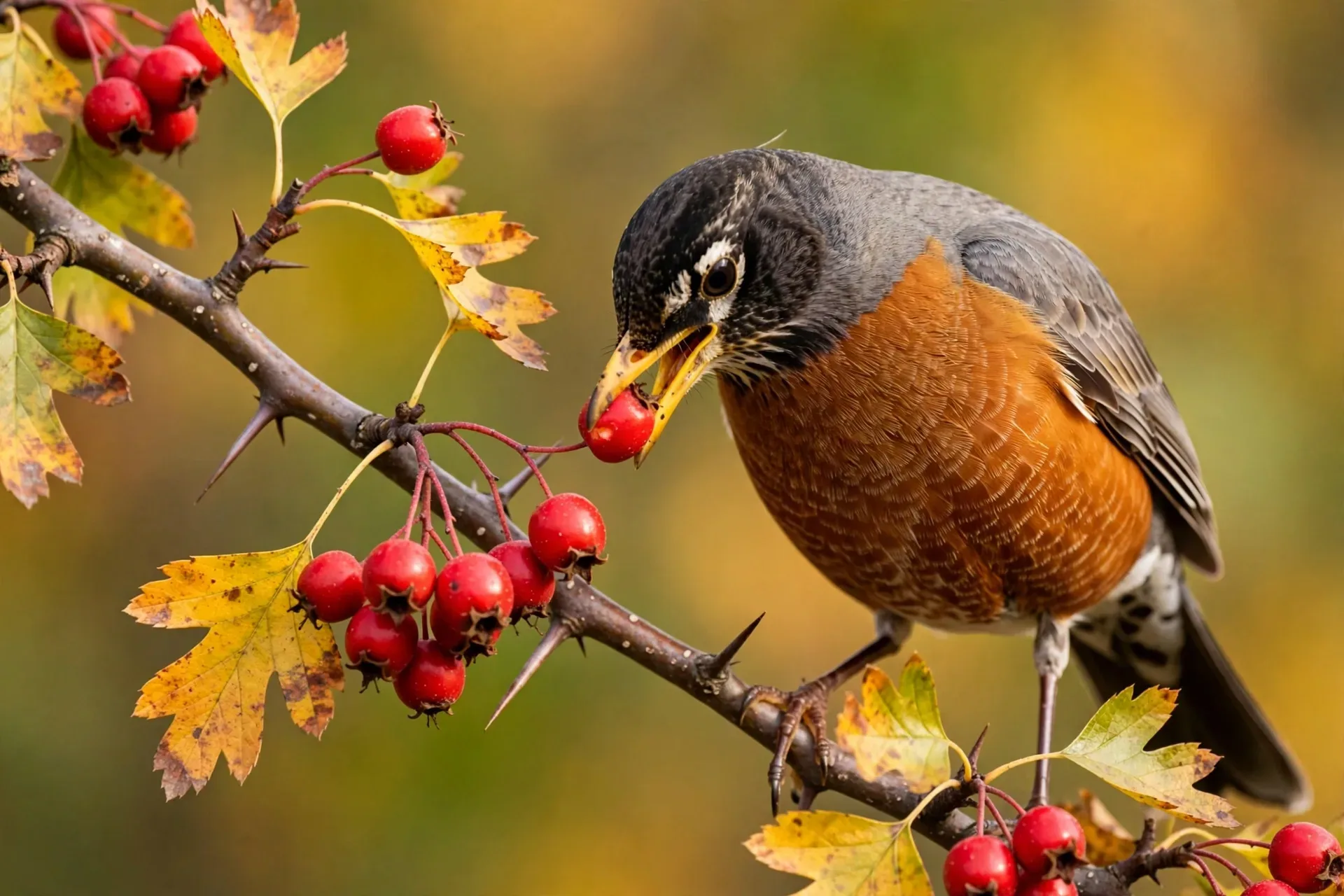
Here is the single biggest driver of the fall invasion: fruit. In spring and summer, robins feast on earthworms, insects, and other invertebrates pulled from lawns. But as insects dwindle and the ground cools, robins pivot hard toward berries and other fruits.
The Audubon field guide notes that fruit accounts for perhaps 60 percent of the American robin’s diet year-round, and in fall and winter that share climbs even higher.
They target chokecherries, hawthorn, dogwood, sumac, and juniper berries, along with crabapples, holly, and wild grapes. Unlike earthworms, which are spread fairly evenly across lawns, berries grow in concentrated, patchy crops.
One tree ripens at a time, and the flock that finds it first feasts while latecomers miss out. That patchiness is exactly what makes flocking worthwhile. More eyes find ripe fruit faster, and a discovered tree can feed many birds at once.
This food chase also explains why the crowd appears suddenly and vanishes just as fast. Fall robins are famously nomadic. They wander across regions following ripening fruit crops, arriving in waves as one food source peaks and another ripens elsewhere.
Your yard did not get discovered by a resident population. It got swept through by a moving front of hungry fruit seekers. Cornell Lab researchers note that during winter many robins move into moist woods where berry-producing trees and shrubs are common, which is why a yard near good cover suddenly fills up.
A Day in the Life of a Fall Robin Flock
If you watch the crowd for a full day, you will notice the flock runs on a schedule. Fall robins live by a rhythm of breakup, foraging, gathering, and roosting that repeats daily for months. Here is how a typical day unfolds.
- Dawn breakup: At first light, the night roost empties in waves. Small groups peel off and scatter to known feeding areas, calling with soft, low notes as they go.
- Morning foraging: The flock works the ground and the berry trees in loose, shifting groups. Birds land, feed intensely for a few minutes, then leapfrog to the next patch. You will see the classic run and pause of lawn feeding mixed with bursts of activity in shrubs.
- Midday rest: Feeding slows around midday. Many birds perch quietly in dense cover to preen and digest, which is why the yard can look oddly empty at noon even on a day it was packed at nine.
- Afternoon second wave: Feeding picks back up in late afternoon as birds top up their energy for the cold night ahead.
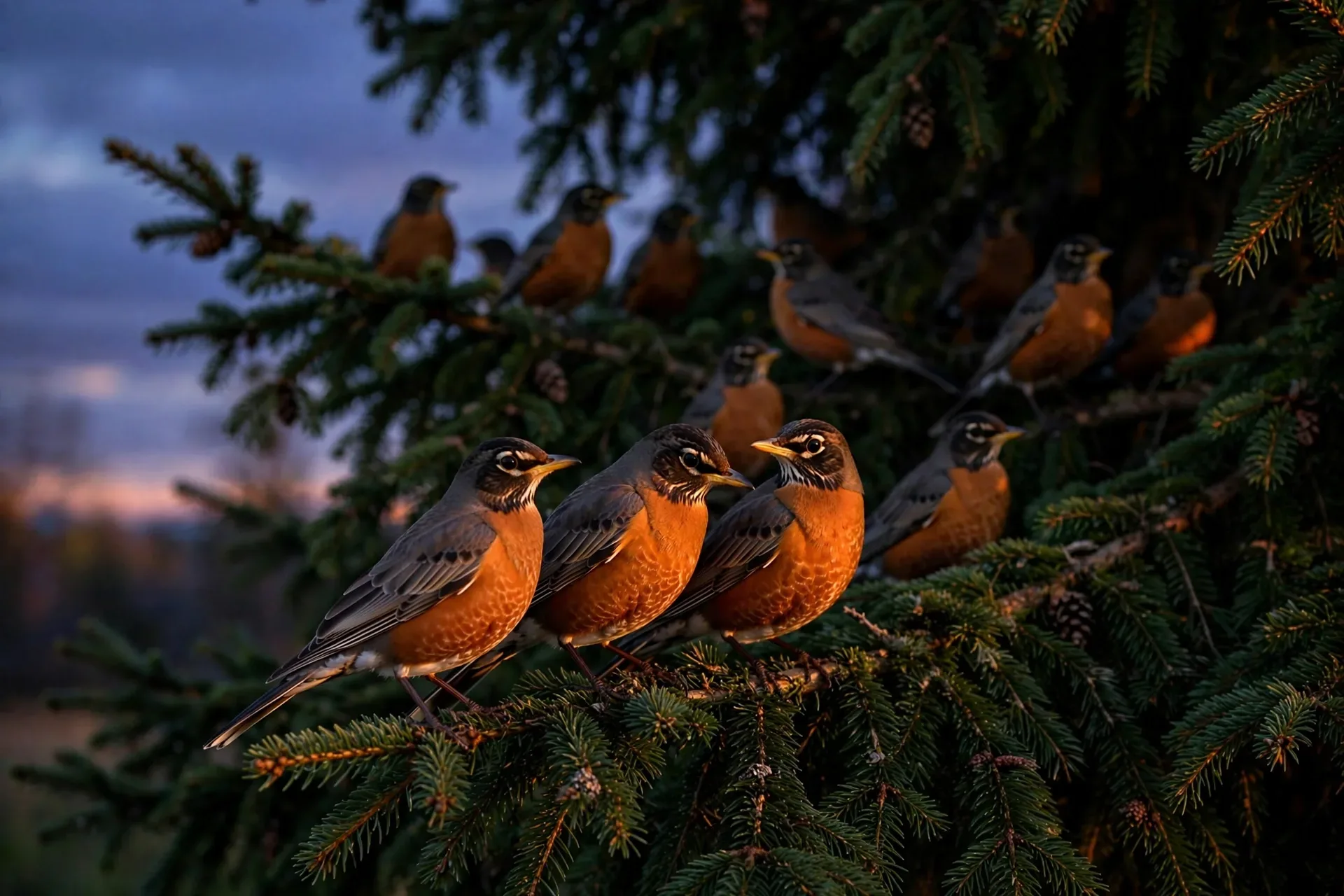
- Dusk gathering: This is the show. As light fades, robins converge from all directions, calling constantly, swirling in loose streams toward a communal roost tree. The noise and motion build for twenty minutes or more before the flock settles.
That dusk flight is one of the great free spectacles of autumn birding. Find where your yard’s flock heads at sunset and you have found their roost, the same tree or thicket they will return to night after night. If your yard sits along the flight line, you may get the stream of arrivals passing right over the fence.
How Big Can a Robin Roost Get?
Roost size varies enormously, and the numbers can surprise people. A neighborhood roost might hold a few hundred birds. Larger roosts in good habitat can hold thousands.
In exceptional cases, researchers and birders have reported roosts in the tens of thousands, though those giant gatherings are the exception rather than the rule.
Why pack together at all? The reasons stack up neatly, and they mirror why birds flock together in fall across many species. A crowded roost is warmer than a lonely perch on a frosty night. Dozens of watchful eyes spot an owl or a cat far sooner than one pair of eyes could.
And birds that fed together all day can, in theory, follow successful foragers back to food the next morning, though scientists still debate how much information actually passes at a roost.
Robins favor dense evergreens, thickets, and stands of small trees for roosts because tight cover breaks the wind and hides them from predators.
Before settling, the flock often stages in a nearby open tree, chattering and shifting for many minutes in what looks like chaos but functions as a final safety check. Only when the light is nearly gone do they drop into the roost itself.
The Flock Has Company: Waxwings and Fellow Travelers
Look closely at that berry tree and you may spot smaller companions mixed in with the robins. Cedar waxwings are the most common co-travelers. These sleek, crested birds are sociable in every season, and Audubon notes that their migratory flocks of 30 to 100 begin forming in August. Like robins, waxwings move irregularly following food supplies, and they chase the same berries: juniper, dogwood, and wild cherries.
Robins and waxwings feeding side by side in one tree is a classic autumn scene. The waxwings arrive with thin, high calls that sound like tiny bells, flutter among the branches plucking berries, and sometimes pass fruit from bill to bill along a branch. Eastern bluebirds, northern mockingbirds, and gray catbirds may join the fruit feast too, depending on your region.
These mixed gatherings are not accidents. Fruit crops attract every fruit eater in the area, and different species tolerate each other when food is abundant. The tree becomes a temporary cafeteria. When the berries run out, the whole mixed crowd moves on together, which is another reason your yard can empty overnight.

Fall Flocks vs. Spring Territories: A Behavior Comparison
The contrast between the two robin lifestyles is so sharp that a spring birdwatcher and a fall birdwatcher might think they were watching different species. The table below lays out the shift.
| Behavior | Spring (Territorial) | Fall (Flocking) |
|---|---|---|
| Main food | Earthworms and insects from lawns | Berries and fruit from trees and shrubs |
| Social structure | Pairs defend territories aggressively | Loose flocks of dozens to hundreds |
| Where they spend time | Open lawns and nesting shrubs | Treetops, berry thickets, roost trees |
| Vocalizations | Loud, musical territorial song at dawn | Soft contact calls, chattering, flight notes |
| Movement | Settled on a breeding territory | Nomadic, following ripening fruit crops |
| Night | Pairs roost quietly near the nest area | Large communal roosts in dense cover |
Notice what drives nearly every row: food. The robin is not becoming a different bird. It is running a different feeding strategy on a different fuel, and the social behavior follows from the fuel. Patchy fruit rewards groups. Evenly spread worms reward defenders.
Will the Flock Stay All Winter?
Maybe, and maybe not. The American robin is a partial migrant, which means some individuals migrate south while others stay put, and the pattern changes with latitude, weather, and food.
Many people assume robins disappear in winter, but in much of the United States they simply move out of sight: off the open lawns and up into treetops and berry thickets, where Cornell Lab notes they are easy to miss.
A yard full of fall robins may thin out as the deepest cold arrives, or a fresh wave may arrive from farther north to replace it.
Severe cold snaps and ice storms push flocks south in a hurry because frozen berries and snow-covered ground cut off food. Mild winters let flocks linger for months. If you want the full picture of where robins go in winter, the short version is that there is no single answer: your fall flock is one moving piece in a continent-wide reshuffling that lasts all season.
October is peak movement time for many species, not just robins. If the sky seems busy lately, you are also seeing other birds migrating through in October, from warblers to hawks, all riding the same seasonal currents south.
Six Smart Things to Do With a Robin Crowd in Your Yard
A hundred robins sounds like a problem to solve, but it is really an opportunity to enjoy. The flock is temporary, harmless, and a sign your yard offers something birds need. Here is how to make the most of it.
- Leave the berries alone. Resist pruning berry-heavy shrubs and trees until the flock has moved through. Those fruits are the whole reason the birds came, and late-season berries also feed waxwings, bluebirds, and overwintering thrushes.
- Plant for next fall. If you want a repeat visit, add native fruit producers like dogwood, serviceberry, winterberry holly, or juniper. Fall flocks remember productive patches and return to them in later years.
- Keep water open. A shallow birdbath matters as much as food in fall. Robins bathe and drink constantly, and a reliable water source can anchor a flock to your yard for weeks.
- Skip the pesticides. Robins still supplement berries with invertebrates, and pesticide-treated lawns poison the birds directly. The Cornell Lab flags pesticide exposure as a real vulnerability for this lawn-foraging species.
- Leave the leaves. Fallen leaves shelter the insects and invertebrates robins glean between berry meals, and the leaf litter feeds the whole food web. Rake lightly or not at all under shrubs.
- Count them for science. Large, visible flocks are perfect for community science. Log your robin numbers in eBird or join a winter count like Project FeederWatch. Your hundred-bird morning becomes real data.
Frequently Asked Questions
Why are there 100 robins in my yard all at once?
You are seeing a fall foraging flock, not a population explosion. Robins gather in large groups in autumn to exploit patchy berry crops efficiently, then disperse or move on when the fruit runs out. A count of 100 is completely normal for a productive tree or a roost staging area, and the same birds may cover several neighborhoods in a single day.
Do big fall robin flocks mean a harsh winter is coming?
No. This is a persistent myth with no scientific backing. Flock size reflects local food abundance and the timing of fruit ripening, not a forecast. Robins cannot predict winter severity, and neither can their flocking behavior. A huge October flock says your berry crop was excellent, nothing more.
How long will the flock stay?
It depends on the food. A flock can strip a single crabapple tree in days and move on, or linger for weeks if your yard holds staggered crops that ripen one after another. Cold snaps accelerate departures. In mild years with good fruit, some robins settle into winter roosts nearby and visit the same yards all season.
Will so many robins damage my lawn or garden?
Very little. Fall robins do far less lawn damage than spring robins because they spend most of their time in trees eating fruit. Droppings under a favorite roost tree can stain patios and cars, which is the most common complaint, but the birds themselves do not harm plants. If droppings bother you, cover the car or patio furniture for the few weeks the flock is around rather than trying to drive the birds away.
Enjoy the Crowd While It Lasts
So why are there so many robins in my yard? Because autumn turned your neighborhood into a berry buffet, and robins are built to find it together. The flock on your lawn is running an ancient seasonal program: follow the fruit, feed in numbers, gather at dusk, and roost in safety.
Every behavior that looks strange, from the dawn scatter to the noisy dusk convergence, is a piece of that program working exactly as it should. The crowd will thin as the berries fade and winter sorts the migrants from the stayers.
Until then, keep the birdbath full, leave the fruit on the branches, and watch the dusk flight. A yard that can hold a hundred robins is a yard that is doing something right.