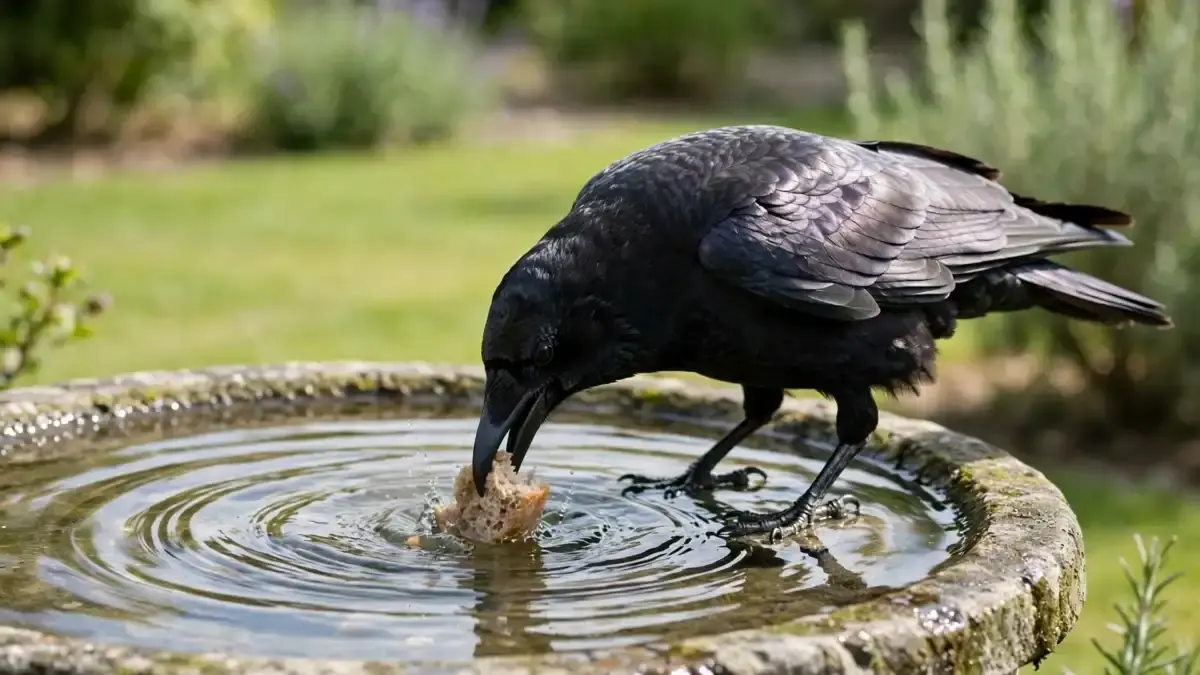
Crows dip food in water mainly to soften it and make it easier to swallow, and parent crows also dip food to moisten it for their nestlings. A crow picks up a piece of dry bread, a biscuit, or a hard pellet, carries it to a birdbath or puddle, pushes it under the surface for a few seconds, then lifts out a softer, wetter morsel and eats it. The habit looks strange at first glance, almost like washing, but it is practical. Water turns food a crow cannot swallow comfortably into food it can eat safely, and it turns food a chick cannot manage into food a chick can swallow. This article explains each reason in detail, separates the facts from the raccoon myth, and shows what the habit means for anyone who feeds crows.
What the Behavior Actually Looks Like
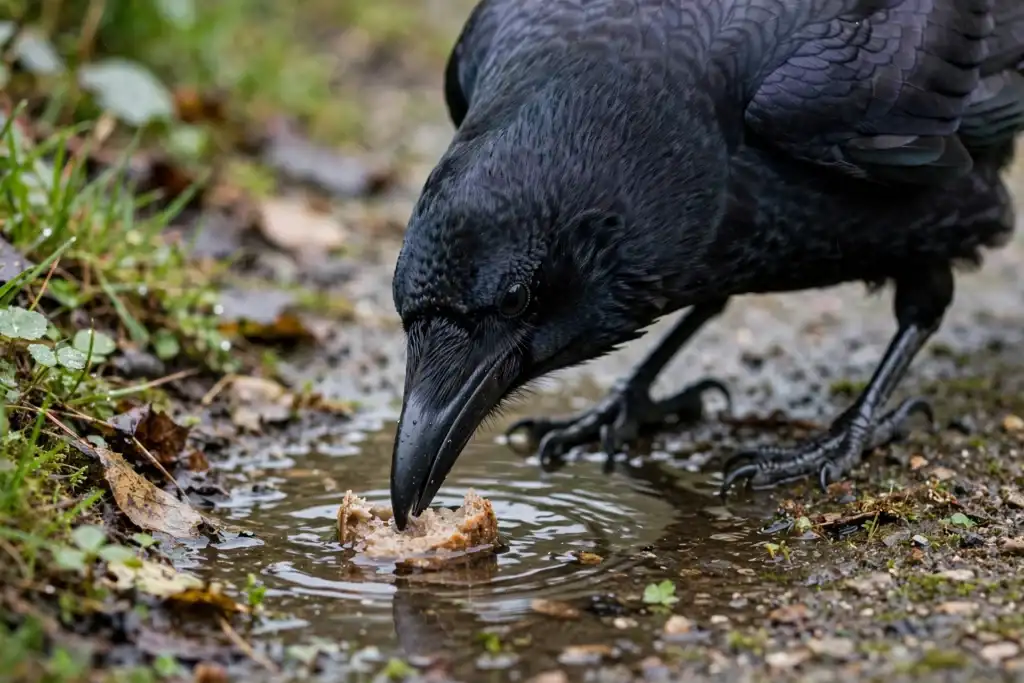
The sequence is easy to recognize once you know it. A crow lands near food, picks up a dry item in its bill, and walks or flies to the nearest water. The water may be a birdbath, a puddle, a pond edge, a dog bowl, or even a dripping tap. The crow lowers the food into the water and holds it there, sometimes moving it from side to side. After a few seconds it lifts the food out, shakes off the excess water, and swallows it or flies away with it.
Some crows dip briefly and eat at once. Others leave the food soaking for a minute or longer while they watch for rivals. A few return to the same piece several times, dipping, nibbling, and dipping again. The pattern is deliberate, not accidental. The crow chooses the water, carries the food to it, and waits for the food to change.
The behavior is not rare or limited to one species. Carrion crows and hooded crows in Europe do it, American crows and fish crows in North America do it, and rooks and grackles show the same trick. Wherever intelligent corvids meet dry food and shallow water, dipping appears.
The Main Reason: Softening Dry Food
Softening is the leading explanation, and it fits the evidence best. Crows eat a wide diet that includes grain, bread, biscuits, dry pet food, nuts, and seeds. Many of these foods are hard, dry, or stale when a crow finds them. A dry crust can be difficult to break apart and hard to swallow, especially in one piece. A few seconds in water changes the texture completely. The crust turns soft, the crumb swells, and the piece breaks apart with far less effort.
Think of the problem from the crow’s point of view. A crow has no hands and no teeth. Its bill is strong, but it cannot chew the way a mammal chews. It tears food into pieces and swallows them whole. A hard, dry lump resists tearing and can stick in the throat. Soaked food tears easily, slides down smoothly, and poses far less risk of choking. Water does the work that teeth would do.
Why Dry Food Is Hard for a Crow to Swallow
A crow’s throat is built for whole, moist items such as worms, grubs, fruit, and fresh meat. Dry food absorbs saliva slowly and can form a rough lump. Such a lump can scratch the throat or lodge briefly before going down. Crows avoid that discomfort by wetting the food first. The water acts as a lubricant, coating the surface and letting the piece glide down.
Stale bread is the classic example. Fresh bread is soft enough to eat dry, but bread left out for a day turns hard at the edges. Crows handle this by dipping the stale pieces and eating the fresh ones as they are. The same logic applies to dry pet kibble, breakfast cereal, and hard cheese rinds. Each of these foods becomes safer and easier to eat after a short soak.
What Foods Crows Dip Most Often
Watchers report a clear pattern in what gets dipped and what does not. The list below covers the most common items.
- Stale bread and crusts: the most dipped food of all, because dry bread softens fast and tears easily once wet.
- Dry pet food and kibble: hard pellets swell in water and become soft enough for chicks as well as adults.
- Biscuits and crackers: thin, dry, and quick to soak, so they are dipped briefly and eaten at once.
- Breakfast cereal and dry grains: small hard pieces that clump together when wet and are easier to carry.
- Hard cheese rinds and pastry: dry edges soften in water while the softer center stays intact.
Foods that are already soft or wet are almost never dipped. Fresh fruit, worms, eggs, and meat go down without help. That contrast strengthens the softening explanation. If crows dipped food to wash it, they would dip everything. Instead they dip exactly the foods that need softening, which is what a practical feeding trick looks like.
Moistening Food for the Nestlings
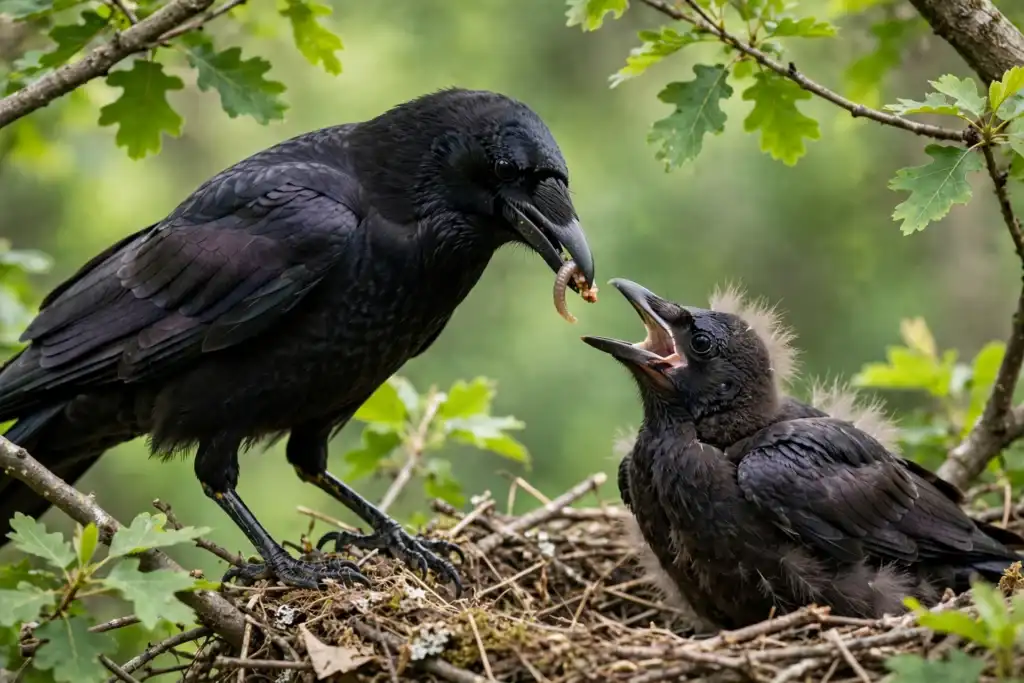
The second major reason involves the young. Parent crows feed their chicks for weeks after hatching, and chicks cannot handle dry food. A nestling’s throat is narrow, its swallowing is weak, and dry crumbs can choke it. Parent crows solve this by dipping food in water before carrying it back to the nest. The wet morsel slides down the chick’s throat safely and gives the chick water at the same time.
This behavior peaks during the breeding season. The British Trust for Ornithology records carrion crows laying 3 to 4 eggs per clutch, with incubation lasting 18 to 20 days and fledging taking around 28 to 30 days. That is a long period of feeding, and the parents make hundreds of trips. Many of those trips include a stop at water. The soaked food keeps the chicks fed and hydrated without the parents needing to carry water separately.
Chicks also need softer food because their bills are still growing. An adult crow can tear a hard crust apart, but a chick cannot. A soaked piece arrives pre-softened, almost like food that has already been chewed. The parent can place it directly into the chick’s open mouth, and the chick swallows it with little effort. Observers have seen parent crows dip the same piece twice, once for softness and once more just before delivery, to make sure it is wet enough.
The habit may also help fledglings learn. Young crows that have recently left the nest often dip food clumsily, dropping pieces and fishing them out again. They watch their parents and copy the steps. Over a few weeks the clumsy attempts turn into smooth, quick dips. That learning curve is another sign that dipping is a real skill, passed on by watching rather than pure instinct.
Easier Swallowing and Digestion
Softening helps the food go down, and wet food may also help it digest. A dry lump needs more stomach acid and more time to break apart inside the bird. A soaked piece is already partly broken down, so digestion starts faster. Researchers believe this gives the crow more energy from the same food, though no controlled study has measured the exact gain. The logic is sound, and it matches what happens in other animals that soak food before eating.
The Raccoon Comparison: Crows Do Not Wash Their Food
Many people compare crow dipping to raccoons washing food, but the comparison is misleading on both sides. Raccoons do not actually wash their food. The old idea that raccoons clean their meals in streams came from watching captive raccoons dunk food in water. Researchers later found that raccoons dunk food to feel it better. Their paws are highly sensitive, and water increases that sensitivity. The behavior is called dousing, and it is about touch, not cleaning.
Crows are different. A crow dips food to change the food itself, not to feel it. The crow holds the food in its bill, not in sensitive hands, so the touch explanation does not apply. The crow also eats the food after dipping it, which is the point. The water softens the food, and the softened food gets eaten. Nothing about the act is aimed at removing dirt.
The table below sets out the main explanations for crow dipping and what the evidence actually shows for each one.
| Possible reason | What the evidence shows |
|---|---|
| Softening dry food | Strong support. Crows dip hard, dry foods far more than soft foods, and soaked pieces tear and swallow easily. |
| Moistening food for chicks | Strong support. Dipping peaks in the breeding season, and parents carry wet food back to nestlings that cannot swallow dry pieces. |
| Washing off dirt | Weak support. Crows dip clean food from feeders as readily as food found on the ground, and they eat the water with the food. |
| Cooling food in hot weather | Little support. Dipping happens in cool weather too, and crows do not dip food that is already cool and soft. |
| Playing or experimenting | Possible in young birds. Fledglings dip clumsily and drop pieces, but adults dip with clear purpose and stop when food is soft. |
The washing idea also fails a simple test. If crows wanted clean food, they would dip dirty food and skip clean food. They do the opposite. They dip the driest food, whatever its source, and they leave wet food alone. The deciding factor is texture, not dirt. That is why researchers treat softening and feeding chicks as the real reasons and washing as a myth borrowed from the raccoon story.
What Researchers and the BTO Observe
No single controlled study has settled every question about crow dipping, and honest reporting should say so. What exists instead is a large body of field observations, gathered by ornithologists and garden watchers over many decades, and the pattern in those observations is consistent. Crows dip dry food, they dip more in the breeding season, and they stop dipping when food is already soft. The consistency across countries and crow species gives the softening explanation real weight.
The British Trust for Ornithology describes the carrion crow as a large, intelligent, inquisitive, and omnivorous bird that takes grains, invertebrates, eggs, chicks, carrion, and whatever else it can scavenge. That broad diet is exactly the kind of diet that includes hard, dry items needing softening. The BTO records a typical clutch of 3 to 4 eggs and a fledging period of around 28 to 30 days, which is a long window in which parents must deliver food their chicks can swallow. You can read the full species profile on the British Trust for Ornithology website.
Crow intelligence also helps explain why dipping is so widespread. Crows are among the smartest birds on earth, and their problem solving has been tested in laboratories as well as in the wild. Our guide to how smart crows are covers the tool use, memory, and social learning that set corvids apart. Dipping fits that picture. It is a learned technique that solves a real feeding problem, and it spreads through a population as young birds copy adults.
The Cornell Lab of Ornithology notes that American crows eat almost anything, from earthworms and insects to seeds, fruit, garbage, and carrion, and that they usually feed on the ground. Ground feeding brings crows into contact with dry, hard scraps, and their intelligence lets them work out that water fixes the problem. The Cornell profile of the American Crow gives a clear picture of this adaptable, all-black bird and its habits.
Other Birds That Dip Their Food
Crows are not the only birds that soak food. Rooks, close relatives of crows, dip bread and grain in the same way. Grackles in North America are famous for it, and birdwatchers often see them dunking dry food at birdbaths before feeding their young. Gulls soak bread and chips in puddles and ponds, and some herons and egrets wet food before swallowing it. Even some smaller garden birds, such as starlings and blackbirds, have been seen dipping dry food in water.
The habit appears in birds that share two traits: a broad diet that includes dry food, and enough intelligence or flexibility to try a new technique. Birds with narrow diets rarely need it. A goldfinch eating soft seeds has no reason to dip. A crow eating everything it finds has every reason. That pattern points to dipping as a practical solution that several smart, generalist species have reached on their own.
What Dipping Means for Your Birdbath and Feeding Station
If you feed crows, their dipping habit has practical consequences for your garden. The good news is that dipping is a sign your feeding setup works. Crows visit because they find food and water in the same place. The challenge is keeping that water clean, because dipped food leaves crumbs, starch, and grease in the bath. A birdbath that crows use for dipping needs cleaning more often than one used only for drinking and bathing.
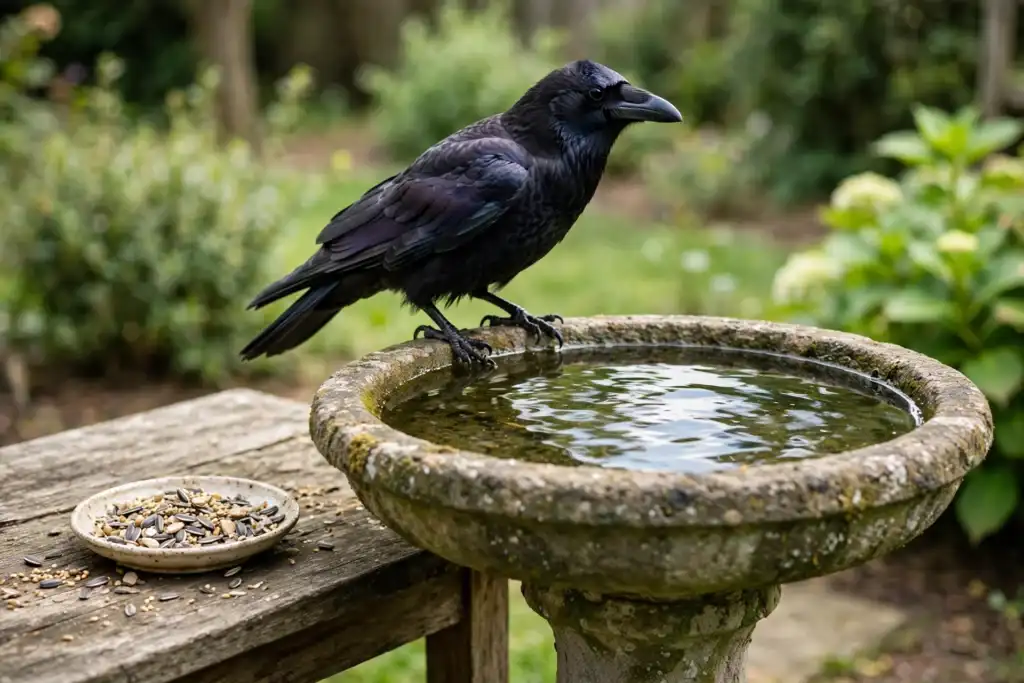
Place your birdbath close to your feeding area, but not directly under the feeder. Food dropped from above fouls the water fast. A gap of a metre or two lets crows carry food to the water without raining crumbs into it from above. A shallow bath works best, with water no deeper than about 5 centimetres at the edge, so crows can stand and dip without wading. A rough stone rim gives them a safe grip while they work.
Change the water daily in warm weather, and scrub the bath every few days to stop algae and bacteria building up. Stale, dirty water can spread disease among garden birds, and crows that dip food in it swallow that water with their meal. Fresh water protects them and keeps the bath attractive. Our guide to choosing and cleaning a birdbath covers depth, placement, and cleaning routines in full.
Think about what you offer as food, too. Crows dip dry food because they must, not because they prefer soaked scraps. Offering foods that need no dipping, such as unsalted peanuts, soft fruit, and cooked eggs, reduces the mess in your birdbath. If you do offer bread, keep the pieces small and offer it sparingly, since bread is low in nutrition for birds. Our guide to what crows eat lists the best foods to offer and the ones to avoid.
- Keep the birdbath shallow: water about 5 centimetres deep at the rim lets crows dip without wading.
- Change the water daily: fresh water stays safe for birds that swallow it with dipped food.
- Scrub the bath weekly: a stiff brush removes algae, crumbs, and the film that dipped food leaves behind.
- Place food and water apart: a gap of a metre or two stops crumbs raining into the bath from the feeder.
- Offer soft foods too: peanuts, fruit, and cooked eggs need no dipping and keep the water cleaner.
Frequently Asked Questions
Do crows dip food in water to wash it?
No, crows do not dip food to wash it. They dip dry food to soften it so it is easier to tear apart and swallow, and to moisten food for their nestlings. They dip clean food from feeders just as readily as food picked up from the ground, which shows dirt is not the trigger. The washing idea comes from the old raccoon myth, and it does not fit what crows actually do.
Why do crows dip food in birdbaths?
Crows use birdbaths because the water is shallow, close to the food, and easy to reach. A birdbath gives them a stable rim to stand on and a few centimetres of water to push food into. Puddles and pond edges work the same way. Any clean, shallow water near a food source will attract dipping crows.
Do crows dip food for their babies?
Yes, parent crows dip food before carrying it to the nest. Nestlings cannot swallow dry food safely, so the parents soak each piece and deliver it wet. Dipping rises sharply during the breeding season, when adults make hundreds of feeding trips. The soaked food also gives chicks extra water, which matters on hot days.
Is it safe for crows to eat food soaked in birdbath water?
Yes, as long as the water is fresh and the bath is cleaned regularly. Stagnant water can carry bacteria, so change the water daily and scrub the bath every few days. Avoid offering salty, mouldy, or processed foods, since soaking does not make unsafe food safe. Fresh water and sensible food choices keep dipping harmless.
Do all crows dip their food in water?
Not every individual crow dips, and not every crow species does it as often. The habit is widespread in carrion crows, American crows, rooks, and grackles, but individual birds vary. Some dip every dry morsel, while others dip only the hardest pieces. Young crows learn the trick by watching adults, so the habit spreads where water and dry food sit side by side.
Should I stop crows dipping food in my birdbath?
There is no need to stop them. Dipping is natural behavior, and a clean birdbath handles it well. If the water fouls quickly, change it more often, offer softer foods, and move the feeder a little further from the bath. A second shallow dish of water near the food can also spread the load and keep the main bath cleaner.
Conclusion
Crows dip food in water because dry food is hard to eat and wet food is easy. A short soak softens crusts and pellets, makes swallowing safer, and turns a meal a chick cannot manage into one it can swallow. The habit is practical, learned, and widespread, and it has nothing to do with washing. If you feed crows, keep their water fresh and their food sensible, and let them get on with it. The dipping you see at your birdbath is a clever bird solving a simple problem in the simplest way it can.